Showing posts with label chemical weapons. Show all posts

Tuesday, November 12, 2013

Israel’s gains from the death of Arafat cannot be ignored

It seems there are still plenty of parties who would prefer that the death of the long-time Palestinian leader Yasser Arafat continues to be treated as a mystery rather than as an assassination.

Yasser Arafat

It is hard, however, to avoid drawing the logical conclusion from the finding last week by Swiss scientists that the Palestinian leader’s body contained high levels of a radioactive isotope, polonium-210. An inconclusive and much more limited study by a Russian team published immediately after the Swiss announcement also suggests Arafat died from poisoning.

It is time to state the obvious: Arafat was killed. And suspicion falls squarely on Israel.

Israel alone had the means, track record, stated intention and motive. Without Israel’s fingerprints on the murder weapon, it may be impossible to secure a conviction in a court of law, but there should be evidence enough to convict Israel in the court of world opinion.

Israel had access to polonium from its nuclear reactor in Dimona, and has a long record of carrying out political assassinations, some ostentatious and others covert, often using hard-to-trace chemical agents. There is also plenty of evidence that Israel wanted Arafat “removed”. In January 2002, Shaul Mofaz, Israel’s military chief of staff, was caught on a microphone whispering to Israel’s then prime minister, Ariel Sharon, about Arafat: “We have to get rid of him.”

With the Palestinian leader holed up for more than two years in his battered compound in Ramallah, surrounded by Israeli tanks, the debate in the Israel government centred on whether he should be exiled or killed.

In September 2003, the cabinet even issued a warning that Israel would “remove this obstacle in a manner, and at a time, of its choosing”. The then-deputy prime minister, Ehud Olmert, clarified that killing Arafat was “one of the options”.

What stayed Israel’s hand – and fuelled its equivocal tone – was Washington’s adamant opposition. After these threats, Colin Powell, the US former secretary of state, warned that a move against Arafat would trigger “rage throughout the Arab world”.

By April 2004, however, Mr Sharon declared he was no longer obligated by his earlier commitment to George Bush not to “harm Arafat physically”. “I am released from that pledge,” he said. The White House too indicated a weakening of its stance: an unnamed spokesman responded feebly that the US “opposed any such action”.

So what about motive? How did Israel gain from “removing” Arafat? To understand Israel’s thinking, one needs to return to another debate raging at that time, among Palestinians.

The Palestinian leadership was split into two camps, centred on Arafat and Mahmoud Abbas, then Arafat’s heir apparent. The pair had starkly divergent strategies for dealing with Israel.

In Arafat’s view, Israel had reneged on commitments it made in the Oslo accords. He was therefore loath to invest exclusively in the peace process. He wanted a twin strategy: keeping open channels for talks while maintaining the option of armed resistance to pressure Israel. For this reason, he kept a tight personal grip on the Palestinian security forces.

Mr Abbas, on the other hand, believed that armed resistance was a gift to Israel, delegitimising the Palestinian struggle. He wanted to focus exclusively on negotiations and state-building, hoping to exert indirect pressure on Israel by proving to the international community that the Palestinians could be trusted with statehood. His priority was cooperating closely with the US and Israel in security matters. More


Thursday, November 7, 2013

Is the world failing Syrians?

The United Nations has warned that the humanitarian situation in Syria is deteriorating rapidly, and it estimates that more than nine million people - almost forty percent of the population - are now in need of help.

Delivery of aid has slowed and some reports suggest there has been little help for many people in need for almost a year.

The UN says the number of people displaced from their homes has risen to 6.5 million, and many are living without adequate food or access to electricity and medical supplies.

Officials of the Syrian Arab Red Crescent say their agency is able access most of the affected areas but the humanitarian aid has not been sufficient.

The figures are staggering, it’s catastrophic, the numbers continue to rise. Now when we have reached this very high figure, if we compare to the previous figures that went out in June when we were talking of about 4.2 million people displaced inside the country, it is not one event that has triggered this. It’s a continuation of conflict. It’s a continuation of the displacement that has now brought us to this horrific number.

Jens Laerke, a spokesman for the United Nations Office for the Coordination of Humanitarian Affairs

"It’s not difficult to get the aid in the country. The main challenge we are facing on the ground is the aid from outside, through our partners, is not enough for the need on the ground," Khaled Erksoussi, the head of operations for the Syrian Arab Red Crescent, told Al Jazeera.

"Now we are estimating the number is more than 6 million people internally displaced, yet we are still receiving aid only enough for 2.5 million people to be distributed each month."

Since the unrest began in March 2011, more than 100,000 people are estimated to have been killed. More than two million people have fled the country, seeking refuge in neighbouring Lebanon, Jordan and Turkey, as well as in Iraq and Egypt.

The 15-member UN Security Council approved a statement in October, calling for increased humanitarian assistance. But it was non-binding and, speaking in October, humanitarian chief Valerie Amos said it had had little impact on the ground.

"I expressed to the council my deep disappointment that the progress that we had hoped to see on the ground as a result of that statement has not happened, and as a result, what we are seeing is a deepening of the crisis, more and more people affected and, in particular, my worries [are] about the extremely brutal and violent nature of this conflict," she said.

Amos is calling on the Security Council to use its influence over those parties that can ensure the safe passage of medical personnel and supplies, the safe and unhindered delivery of humanitarian assistance, the protection of civilians, and those who can help expand critical, life-saving relief operations.

Bashar Jaafari, Syria's ambassador to the UN, said his country has done its part to help humanitarian aid workers on the ground - although he did admit that visas are limited, and not granted to all groups that request access.

"We are issuing too many visas to too many people. We are a sovereign nation like any other nation and we have our own reasons to deny visa to this individual or that individual. This is an integral part of our sovereignty - of any state in the United Nations," he said.

While all this was going on, the World Health Organization confirmed Syria's first outbreak of polio since 1999. At least 10 children have tested positive for polio in the eastern province of Deir az-Zor, with another 12 suffering from paralysis. More


Friday, September 20, 2013

Israeli forces manhandle EU diplomats, seize West Bank aid

KHIRBET AL-MAKHUL, West Bank (Reuters) - Israeli soldiers manhandled European diplomats on Friday and seized a truck full of tents and emergency aid they had been trying to deliver to Palestinians whose homes were demolished this week.

French diplomat Marion Castaing

A Reuters reporter saw soldiers throw sound grenades at a group of diplomats, aid workers and locals in the occupied West Bank, and yank a French diplomat out of the truck before driving away with its contents.

"They dragged me out of the truck and forced me to the ground with no regard for my diplomatic immunity," French diplomat Marion Castaing said.

"This is how international law is being respected here," she said, covered with dust.

The Israeli army and police declined to comment.

Locals said Khirbet Al-Makhul was home to about 120 people. The army demolished their ramshackle houses, stables and a kindergarten on Monday after Israel's high court ruled that they did not have proper building permits.

Despite losing their property, the inhabitants have refused to leave the land, where, they say, their families have lived for generations along with their flocks of sheep.

Israeli soldiers stopped the International Committee of the Red Cross (ICRC) delivering emergency aid on Tuesday and on Wednesday IRCS staff managed to put up some tents but the army forced them to take the shelters down.

Diplomats from France, Britain, Spain, Ireland, Australia and the European Union's political office, turned up on Friday with more supplies. As soon as they arrived, about a dozen Israeli army jeeps converged on them, and soldiers told them not to unload their truck.

"It's shocking and outrageous. We will report these actions to our governments," said one EU diplomat, who declined to be named because he did not have authorization to talk to the media.

"(Our presence here) is a clear matter of international humanitarian law. By the Geneva Convention, an occupying power needs to see to the needs of people under occupation. These people aren't being protected," he said.

In scuffles between soldiers and locals, several villagers were detained and an elderly Palestinian man fainted and was taken for medical treatment to a nearby ambulance.

The U.N. Office for the Coordination of Humanitarian Affairs (OCHA) said in a statement that Makhul was the third Bedouin community to be demolished by the Israelis in the West Bank and adjacent Jerusalem municipality since August.

Palestinians have accused the Israeli authorities of progressively taking their historical grazing lands, either earmarking it for military use or handing it over to the Israelis whose settlements dot the West Bank.

Israelis and Palestinians resumed direct peace talks last month after a three-year hiatus. Palestinian officials have expressed serious doubts about the prospects of a breakthrough.

"What the Israelis are doing is not helpful to the negotiations. Under any circumstances, talks or not, they're obligated to respect international law," the unnamed EU diplomat said. More


Sunday, September 15, 2013

Resolving the Syrian Chemical Weapons Crisis: Sunlight and Shadows By Richard Falk

The Putin Moment: Not only did Vladimir Putin exhibit a new constructive role for Russia in 21st statecraft, spare Syria and the Middle East from another cycleof escalating violence, but he articulated this Kremlin initiative in the form of a direct appeal to the American people.

There were reasons to be particularly surprised by this display of Russian diplomacy: not since Nikita Khrushchev helped save the world from experiencing the catastrophe of nuclear war in the Cuban missile crisis of 1962 by backing down and agreeing to a face-saving formula for both superpowers, had Moscow distinguished itself in any positive way with respect to the conduct of international relations; for Putin to be so forthcoming, without being belligerent, was particularly impressive in view of Obama’s rather ill-considered cancellation only a few weeks ago of a bilateral meeting with the Russian leader because of Washington’s supposed anger at the refusal of the Russian government to turn the NSA whistleblower, Edward Snowden, over to the United States for criminal prosecution under American espionage laws; and finally, considering that Putin has much blood on his hands given past policies pursued in relation to Chechnya and in the autocratic treatment of domestic political opposition, it was hard to expect anything benevolent during his watch. And so Putin is emerging as a virtual ‘geopolitical black swan,’ making unanticipated moves of such a major character as to have the potential to transform the character of conflict management and resolution in the 21st century. It should be understood that Putin could have stayed on the sidelines, and benefitted from seeing Obama sink deeper and deeper into the Syrian quagmire, and instead he stepped in with a momentous move that seems to have served the regional and global interest.

Putin has explained in a coherent manner in his opinion piece that was published in the NY Times on September 11th attacks) that his approach to Russian foreign policy relies on two instruments: soft power and economic diplomacy. He acknowledged American leadership, but only if exercised within a framework of respect for international law and the UN Charter. And he appropriately took issue with Obama’s sentiments expressed a night earlier to the effect that America in its leadership role had a unique entitlement to use force to overcome injustice in situations other than self-defense and even without authorization by the UN Security Council. It was Putin, perhaps disingenuously, who claimed (quite correctly) that such a prerogative was “extremely dangerous.” He rejected Obama’s pretension that a unilateral discretion with respect to the use of force could be inferred from American exceptionalism. Whether disingenuous or not, the requirement of a Security Council authorization for non-defensive uses of force, while sometimes preventing a peacekeeping response by the UN to certain tragic situations of civil strife and humanitarian crisis overall contributed to finding diplomatically agreed upon solutions for conflict and enabled the UN (unlike the League of Nations) to persist despite severe tensions among its dominant members. Let hope that this Putin vituoso exhibition of creative diplomacy prompts his counterpart in the White House to explore more diligently soft power opportunities that will better protect American national interests, while simultaneously serving the global interest in war prevention and the rejection of militarism, and might also have the added benefit of reversing the steady decline of American credibility as a benevolent global leader ever since the end of the Cold War.(without invoking the symbolism of the twelfth anniversary of the 9/11

Constitutional Balance: Perhaps what might be of even greater importance than averting an ill-considered punitive attack on Syria, is the grounding of recourse to war on the major republican premise of Congressional authorization. There is little doubt that here the efficient cause and anti-hero was David Cameron, who turned to Parliament to support his wish to join with Obama in the attack coalition despite the anti-war mood in British public opinion. Cameron was politically spared by the vote of the House of Commons to withhold authorization. It is hard to believe that Obama’s decision to seek authorization from the U.S. Congress was not a belated realization that if Britain deferred to its Parliament as an expression of constitutional democracy, it would be unseemly for the United States to go to war without the formal backing of Congress. Of course, the Putin initiative saved Obama from the near certain embarrassment of being turned down by Congress, which would mean that either he would follow in Cameron’s and face savage criticism from his hawkish boosters or insist upon his authority as Commander in Chief to act on his own, a prerogative that seems constitutional dubious to support a bill of impeachment. Beyond this, theWar Powers Act that would seem to require some emergency justification for the presidential bypassing of Congress in the context of a proposed military action. Hopefully, we are witnessing, without an accompanying acknowledgement, the downfall of the ‘imperial presidency’ that got its start during the Vietnam War. The governmental pendulum in the United States may have started to swing back toward the separation of powers and checks and balances, and thus be more in keeping with the original republican hopes of limited executive authority, especially in relation to war making. This renewal of republican constitutionalism, combined with growing populist skepticism about military adventures abroad, might make this Syrian crisis of decision a welcome tipping point, reversing the unhealthy subordination of Congress in war/peace situations during the last half century and anti-democratic disregard of the views of the citizenry. More

Sunday, September 1, 2013

Syria: Obama’s Surprising (and Confusing) Latest Moves by Richard Falk

President Obama’s August 31st remarks from the White House Rose Garden will long be remembered for their strangeness, but the final interpretation of their significance will have to await months if not years.

Richard Falk

There are three dimensions, at least, that are worth pondering: (1) seeking Congressional authorization for a punitive military attack against Syria in support of the treaty prohibition on recourse to chemical weapons in an armed conflict; (2) reconciling any endorsement of an attack by Congress with United States obligations under international law and with respect to the United Nations and its Charter; (3) assessing the degree to which American war making prerogatives continue to operate within an unacceptable domain of American exceptionalism.

In framing the issues at stake Obama set forth the fundamental policy choices in a rather incoherent manner:

  • First of all, he asserted that on the basis of evidence available to the United States Government, that the Assad regime was without doubt responsible for the massive chemical weapons attack of August 21st directed at the Ghouta residential neighborhood on the outskirts of Damascus, and causing over 1,000 civilian deaths, including several hundred children. The Russian president, Vladimir Putin, clearly articulated the grounds for skepticism about this American construction of the Ghouta atrocity. He put forward a strongly worded request that the allegations be confirmed by the release of convincing evidence. This is a reasonable demand. Many around the world have questioned why Assad would launch such a provocative attack to coincide with the arrival of UN inspectors, and when the battlefield balance was tipping in favor of the Damascus regime. All along such important figures in the Obama administration, especially John Kerry and Joe Biden, have arrogantly dismissed the relevance of any information provided by the UN inspection team. In light of the gigantic deception relating to Saddam Hussein’s supposed weapons of mass destruction (WMD) arsenal, which was more politely described long after the event as an ‘intelligence failure,’ it would have been appropriate for Washington to admit that it has a credibility problem in winning governmental and popular support for an attack on Syria. Its refusal to acknowledge such an issue merely deepens suspicions.
  • Secondly, Obama informed listeners that “..after careful deliberation, I have decided that the United States should take military action against Syrian regime targets.” He added that he made this decision “as Commander-in-Chief on what I am convinced are our national security interests.” This conclusion was explained to rest on the importance of punishing such a crime against humanity and deterring future recourse to chemical weapons and other weapons of mass destruction by Syria, as well as sending a message to Iran and North Korea about America’s readiness to use force to uphold such norms of international law.
  • Thirdly, there was no effort in Obama’s remarks to show why, absent a UN mandate, the United States in coalition with a few other countries, had the legal authority to attack a sovereign state in a circumstance other than self-defense.
  • Fourthly, although the decision against involvement by the British Parliament was noted, there was no consideration as to whether such an outcome should bear on American policy. Nor was the German or Italian unwillingness to join in the attack noted, nor that of the Arab League. But the French support was duly appreciated, including a dig at the United Kingdom, by reminding his listeners around the world that it was France that was America’s “oldest ally.” (It is worth noting that the roles of these two European friends were directly reversed in the context of the Iraq War; then, it was the French more conservative led government that opposed participation, while now a socialist leader in Paris supports an attack against Syria).
  • Fifthly, and in the most dramatic passage in the speech, Obama announces that because the United States is a proud democracy he has made “a second decision: I will seek the authorization for the use of force from the American people’s representatives in Congress” by calling for a debate and vote. No mention is made of a time frame, nor how he would react in the event that authorization was not forthcoming. Such an eventuality would set up a potential tension between his duties to uphold national security and an obligation of deference to a decision by Congress on the vital matter of authority to wage war. Obama touched all the bases by saying, “Yet, while I believe I have the authority to carry out this military action without specific congressional authorization, I know that the country will be stronger if we take this course, and our actions will be even more effective.” In effect, there is no constitutional legal requirement to obtain Congressional authorization, but doing so will create a more effective response. But what if authorization is withheld? Or Congress is split with approval by the Senate, and disapproval by the House?
  • Sixthly, there is an implicit endorsement of American exceptionalism. After saying that the case for an attack will be made internationally, as well as domestically, Obama reaffirms a national prerogative of illegal unilateralism. He uses this phrase: “But we are the United States of America, and we cannot and must not turn a blind eye to what happened in Damascus.” That is no matter that others disagree, the United States alone has the duty to act as it sees fit. It is correctly presumed that such discretion is not vested in other sovereign states. Otherwise the world would be in flames. In effect, Syria, Iran, North Korea are bound by international law, as interpreted by the United States, while the United States and its closest allies are guided by assessments of their national security interests.

It is this double standard that is at the core of American exceptionalism, and also underpins the debate as to whether it is more instructive to view the United States as ‘global leader’ or ‘imperial power,’ or possibly some blend;

There is something rather sinister about announcing an intention to strike a vulnerable country with which the United States is not at war, coupled with the announcement that the needed military capabilities are in place, but will not be used until convenient; in effect, a lethal strike against Syria can take place at any point from now on until a time weeks or months from now, depending only on the workings of the internal American political process and the disposition of its Commander-in-Chief. If this is deemed to be in the interest of the Syrian people, I would like to know how.

Even if the controversy as to the facts is ignored, and theproblems associated with double standards as to the relevance ofinternational law to the use of force, there are some other reasonsfor concern about the approach adopted by PresidentObama:

  • It denies constitutional status to the request for Congressionalauthorization, making it a discretionary presidential judgment callthat is not necessitated by the Constitution, but is an expressionof Obama’s belief in democratic procedures. To not rest thisrequest on the Constitution itself is a missed opportunity, andthus amounts to yet another reassertion of excessive authority bythe Executive Branch of government;
  • Itmakes no effort to assess what would be of benefit to the people ofSyria, and rather makes the case for a narrow strike as acombination of punishing (without intending to displace) the Assadregime and abstract American national security interests in itsself-appointed role as preventing the use and spread ofWMD;
  • Itfails to advocate in a serious manner a diplomatic approach toending the violence of the conflict by calling for a second Genevaconference with the full participation of Iran that would deal withregional peace and security issues, as well as the war inSyria;
  • Itundermines the authority of the UN and international law by vestingin the U.S. Government the final word on when it is appropriate touse international force in non-defensive modes and fails to makewar a matter of ‘last resort’;
  • It draws an overly sharp a distinction between this incidentinvolving chemical weapons and other massacres that have occurredduring the course of two years of strife in Syria; regardless ofthe weaponry deployed both forms of violence are crimes againsthumanity that deserve a serious and effective response, ifavailable.

*******************************************************************

It is as yet possible that Congress will rescue Obama from havingto respect a red line he ill-advisedly proclaimed a year ago. Itwould be ironic if this one time the anti-Obama Republicans savedhim from the worse foreign policy excess of hispresidency!

It is possible that Obama will be pushed by pro-interventionists tooverride a Congressional failure to give authorization. It is alsopossible that Congress will authorize, and public opinion stronglyoppose. And we are left to wonder whether Congress canconstitutionally authorize a use of force that violatesinternational treaty law. Of course, we would be unlikely to findout given the passivity of the U.S. Supreme Court when it comes tochallenges directed at legally dubious foreign policy and nationalsecurity matters.

All of the above suggests that the revitalization of Americanrepublicanism requires, as a matter of urgency, a constitutionalconvention with an explicit mandate to restore the separation ofpowers and checks and balances in relations to war/peace issues.The U.S. Government has longed strayed from this vital pillar ofrepublican democracy.

Nothing would do more to restore confidence in the United States asa global leader! Such a momentous event will not happen withoutmassive grassroots pressure; it will never be decreed from onhigh.

A final word of blurred appreciation: CNN talking heads are veryfond of referring to Obama as epitomizing ‘the reluctant warrior.’And reluctant he is, but also warrior he has been, and continues tobe, casting a rather dark shadow over the Nobel Peace Prizedecision process. The reluctance is articulated over and over againin his words and sometimes reflected in his policies, and certainlyseems sincere. And such reluctance may be credited, at leastsubconsciously, with this welcome move to broaden the domesticauthorization process with respect to this non-defensive use ofinternational force. Obama would deserve less ambiguous praise ifhe had recognized the role of Congress prior to the decision of theBritish Parliament. And prior the many demands from Congress for agreater role gathering political momentum.More

___________________________

Editorial

I question how the international community can discipline a States Party to the United Nations for acting unilaterally? States that carry out drone strikes, committing extra-judicial killings, allegedly as part of their war on terror, a 'war' that the said state may be at least partially responsible for causing.

There has to be accountability, or as Richard Falk points out; Obama reaffirms a national prerogative of illegal unilateralism. He uses this phrase: “But we are the United States of America, and we cannot and must not turn a blind eye to what happened in Damascus.” That is no matter that others disagree, the United States alone has the duty to act as it sees fit.

The international community must uphold the Rule of Law, the United National and all International Organizations have an obligation to uphold the Rule of Law. The mandate of the Geneva Conventions must be upheld. I argue that it is a human right for all states to be held accountable and for there to consequences for illegal actions. Editor

Saturday, August 24, 2013

MSF-backed hospitals treated Syria 'chemical victims

Medecins Sans Frontieres says hospitals it supports in Syria treated about 3,600 patients with "neurotoxic symptoms", of whom 355 have died.

It said the patients had arrived in three hospitals in the Damascus governorate on 21 August - when opposition activists say chemical attacks were launched against rebels.

But MSF says it cannot "scientifically confirm" the use of chemical weapons.

Both sides in the conflict accuse each other of using chemical weapons.

MSF says staff at the hospitals described a large number of patients arriving in the space of less than three hours with symptoms including convulsions, extreme salivation, contracted pupils and sight and respiratory problems.

The charity said many were treated with atropine, a drug administered to those with "neurotoxic symptoms".

"MSF can neither scientifically confirm the cause of these symptoms nor establish who is responsible for the attack," said MSF Director of Operations Bart Janssens.

"However, the reported symptoms of the patients, in addition to the epidemiological pattern of the events, characterised by the massive influx of patients in a short period of time, the origin of the patients, and the contamination of medical and first aid workers, strongly indicate mass exposure to a neurotoxic agent.

"This would constitute a violation of international humanitarian law, which absolutely prohibits the use of chemical and biological weapons."

MSF's disclosure came hours after the UN disarmament chief Angela Kane arrived in Damascus to press the Syrian government to allow access to the site of the alleged chemical weapons attack.

France has joined the UK in accusing Bashar al-Assad's forces of carrying out the attack in the capital's eastern suburbs on Wednesday.

US President Obama has said he is weighing his options and described it as a "big event of grave concern". More


Wednesday, August 21, 2013

Hundreds of Syrians killed by alleged chemical weapons attacks


Over 1100 killed in the chemical weapon attack this morning in Damascus suburbs

SAMS (Syrian American Medical Society)


Over 1100 killed in the chemical weapon attack this morning in Damascus suburbs
One of the worst attacks in the recent history
50% of victims are children and women
Numbers of victims are increasing
Field hospitals exhausted all available oxygen and needed medications
Whole families suffocated and died at their homes

Saturday, May 11, 2013

Rethinking ‘Red Lines’ by Richard Falk

The Wrong ‘Red Line’ (expanded and revised Al-Jazeera opinion piece)

Richard Falk

There are widespread reports circulating in the media that President Obama had not fully appreciated the political consequences of responding to a question at an August press conference that asked about the consequences of a possible future use of chemical weapons by the Assad regime. Obama replied that such a use, should it occur, would be to cross ‘a red line.’ Such an assertion was widely understood to be a threat by Obama either to launch air strikes or to provide rebel forces with major direct military assistance, including weaponry. There have been sketchy reports that Syria did make some use chemical weapons, as well as allegations that the reported use was ‘a false flag’ operation, designed to call Obama’s bluff. As the New York Times notes in a frontpage story on May 7th, Obama “finds himself in a geopolitical box, his credibility at stake with frustratingly few good options.” Such a policy dilemma raised tactical issues for the U.S. Government about how to intervene in the Syrian civil war without risking a costly and uncertain involvement in yet another Middle Eastern war. Not responding also raises delicate questions of presidential leadership in a highly polarized domestic political atmosphere, already shamelessly exploited by belligerent Republican lawmakers backed by a feverish media that always seem to be pushing Obama to pursue a more muscular foreign policy in support of alleged America’s global interests, as if hard power geopolitics still is the key to global security.

UN HQ - New York

What is missing from the debate on Syria, and generally from the challenge to American foreign policy, is a more fundamental red line that the United States at another time and place took the lead in formulating—namely, the unconditional prohibition of the use of international force by states other than in cases of self-defense against a prior armed attack. This prohibition was the core idea embodied in the United Nations Charter, embedded in contemporary international law, and it was also a natural sequel to the prosecution and punishment of surviving German and Japanese leaders afterWorld War II for their commission of Crimes against Peace, which was the international crime associated with engaging in aggressive warfare. The only lawful exception to this prohibition was a use of force consistent with the terms of a prior authorization given by theUN Security Council. The key hope for world peace was this consensus among the winners in World War II that in the future aggressive war and any acquisition of territory by force, even acquired in the exercise of self-defense, must be outlawed without exceptions. Such authorizations by the Security Council were obtained by the West in the Gulf War of 1991 and again in the NATO Libya War of 2011, but in each instance the actual undertaking became controversial as a result of the scope and intensity of the military operations far exceeding the UN mandate. As a consequence, there was a loss of trust on the part of China and Russia in endorsing limited uses of force under UN auspices, which became evident in the course of the gridlocked debate about what to do in response to the regionally dangerous violence in Syria that combined internal strife with external proxy involvements threatening the expansion of the war zone in a variety of menacing ways.

UN Logo

Actually the Charter red line has been surprisingly well respected over the period since 1945, at least in clear instances of border-crossing sustained violence. The UN authorized the defense of South Korea in response to an armed attack by North Korea in 1950. The UN, with surprising U.S. support, even exerted effective pressure in 1956 on the United Kingdom, France, and Israel to withdraw from territory seized after their attack on Egypt, which was the sole prominent example of law prevailing over geopolitics. In 1991 the UN successfully authorized force that followed sanctions, and succeeded in restoring the sovereignty of Kuwait after Iraq’s aggressive occupation and annexation of the country in the previous year. The UN red line held up reasonably well until the end of the last century, although all along its interpretation was subject to geopolitical manipulations by reference to a variety of loopholes and evasions associated with claims of humanitarian intervention, as well as a variety of strategically motivated covert interventions (e.g. Iran 1953, Guatemala 1954). This pattern of evasion was a prominent feature of the Cold War as both sides intervened in foreign states or in their respective spheres of influence (e.g. South Vietnam, Eastern Europe, Afghanistan) to uphold by force of arms an ideological alignment with one or the other superpower. Such uses of international force by rival superpowers without engaging the UN framework definitely eroded the authority of the anti-aggression red line and its stature in international law, but it did not lead political actors to call for its abandonment in view of the behavior of leading states. It is true that some anti-legalist international law specialists who subscribed to a realist worldview felt that patterns of state practice overrode the claims of international law and the UN Charter, and that, in effect, the red line had been erased, at least for the top tier of sovereign states. Although not made explicit, the American position was increasingly exhibiting the psychological characteristics of geopolitical bipolarity: no red line for American foreign policy, while maintaining a bright red line for others, especially for adversary states.

What weakened this red line even more decisively was undoubtedly the American led ‘coalition of the willing’ attack on Iraq in 2003 after an American plea for UN permission to use force had been rebuffed by the Security Council despite a concerted effort to convince its members that Iraq’s supposed possession of weapons of mass destruction was such a great menace to world peace as to justify what amounted to a ‘preventive war’. This undisguised defiance of this most fundamental red line of international law by the United States also defied world public opinion that had expressed itself in the most massive anti-war demonstrations in all of history held in some 80 countries on February 15, 2003, a little more than a month before the ‘shock and awe’ start of the Iraq War. Richard Perle, often touted as the most astute of the neocon intellectuals who fashioned American strategic policy during the Bush years, was exultant about this seemingly definitive breach of the red line, celebrating American aggression against Iraq in a Guardian article aptly headlined, “Thank God for the Death of the UN.” [March 20, 2003] Although the authority of the UN was definitely flouted by the invasion and occupation of Iraq, the UN is far from dead as an Organization in its manifold efforts to address the concerns of the world, and even its red line, although covered with dust, has not yet been erased. Maybe we should really thank God that the collective global consciousness is so forgetful!

What is baffling about the Obama approach is that it purports to be very mindful of the importance of exhibiting respect for international law. Just last September in a speech to the General Assembly Obama said, “We know from painful experience that the path to security prosperity does not lie outside the boundaries of international law..” In his Second Inaugural Obama repeated the sentiment: “We will defend our people and uphold values through strength of arms and rule of law.” And in arguing on behalf of taking collective action against states that violate international law told the Nobel Peace Prize audience in Stockholm, “[t]hose that claim respect for international law cannot avert their eyes when those laws are flouted.”
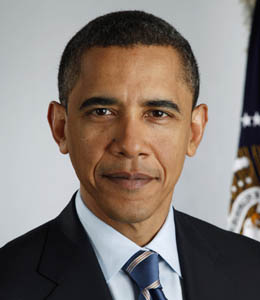
Barak Obama

And yet, when reflecting on intervening in Syria or resort to a military option in relation to Iran’s nuclear program, Obama is silent about the relevance of international law, although neither instance of contemplated uses of force can be remotely claimed to be justified as either individual or collective self-defense. And for obvious reasons, there is also no mention of circumventing the red line by failing to seek authorization for a contemplated used of force from the Security Council. Presumably since approval would not be forthcoming due to the anticipated opposition of Russia and China it was not even worth considering as a public tactic. It is true that the Clinton presidency in participating via NATO in the Kosovo War proceeded also to embark on a non-defensive war without seeking prior authorization for somewhat similar reasons as any resolution on Kosovo proposing use of force was sure to be vetoed by Russia and China. The Kosovo precedent generated worries about non-defensive military undertakings lacking a legal foundation. These were offset in the belief that a humanitarian catastrophe had been averted. The Kosovo undertaking was convincingly justified at the time on credible moral grounds of imminent genocide, on political grounds as enjoying support from almost all of Kosovo’s European neighbors, and on practical grounds as a military intervention that was feasible. In effect, the legitimacy of the was allowed to offset its illegality. As it turned out the military undertaking and political follow up was more difficult than anticipated, but still achieved at a reasonable cost, within a relatively short period, and productive of zero casualties among the intervening forces.

The question raised is whether from an overall perspective, the red line of international law at stake in Syria is more like Iraq or Kosovo/Libya. It is unlike Iraq in the sense that there is an ongoing unresolved civil war in Syria that is actively destabilizing the region and already spilling over national borders to cause unrest in neighboring countries. Syria is also the scene of severe Crimes Against Humanity that are being mainly committed by the regime. Finally, at present, there is no end of the violence is in sight give the relative strength of the two sides. It is, however, unlike Kosovo/Libya as there are proxy states acting as participants on both sides, the Damascus regime despite its behavior maintains considerable internal support while the opposition is widely viewed with deep suspicion and fear as to its democratic credentials, its lack of inclusiveness, and its uncertain respect for non-Sunni minorities. In a sense it is essential that each conflict be assessed within its own distinctive context, which should raise for discussion whether the red lines of international law and UN authority should be crossed in this instance on behalf of the blue lines of legitimacy (saving a vulnerable people from a humanitarian catastrophe) and white lines of feasibility (likelihood of success with minimum loss of life and high probability of positive net effects).

What is strange in all this is that Obama talks the talk, but seems unwilling to walk the walk. Such a disjunction invites cynicism about law and morality, and induces despair on the part of those of us who believe the world we inhabit badly needs red lines, but the right red lines.

Finally, it has been argued that the changing nature of conflict has made the red line embedded in the UN Charter obsolete or at least in need of a drastically modified interpretation. The rationale for rethinking the Charter approach to the use of force is associated with the global security situation that has resulted from terrorist attacks since 9/11 leading to the global war on terror being waged on a battlefield without national limits and increasingly doing the killing via reliance on robotic warfare on the one side and very primitive forms of disruptive violence by political extremists on the other side. Traditional ideas of deterrence, containment, and territorial defense seem almost irrelevant in relation to global security regimes when the perceived assailants are individuals who cannot be deterred, and are operating in non-territorial networks and exhibiting a readiness to die to complete their mission. As matters are proceeding the policy about force is being formulated without bothering with the red lines of international law and the UN, regressively producing once again a world of unregulated sovereign states and extremist non-states essentially deciding on their own when war is permissible. The recent Israeli air strikes on Syrian targets is illustrative: unprovoked and non-defensive, yet eliciting scant criticism in the media or even commentary about the dangers of unilateralism with respect to uses of international force. Such normative chaos in a world where already nine countries possess nuclear weapons seems like a prescription for eventual species suicide, an impression reinforced by the failure to take precautionary steps with respect to the menace of global warming. Never has the world more needed red lines that are drawn by major states, and upheld by them out of the realization that the national interest has also merged with the global interest. Arguably the red lines of the Charter need to be modified in light of the rise of non-state actors and the advent of non-territorial warfare, but such an undertaking is no where on the agenda of major states, and so the world drifts back to the pre-World War I era of unrestricted warfare, at least on the level of geopolitics. More