Showing posts with label torture. Show all posts

Monday, December 22, 2014

Prosecute Torturers and Their Bosses

Since the day President Obama took office, he has failed to bring to justice anyone responsible for the torture of terrorism suspects — an official government program conceived and carried out in the years after the attacks of Sept. 11, 2001.

He did allow his Justice Department to investigate the C.I.A.’s destruction of videotapes of torture sessions and those who may have gone beyond the torture techniques authorized by President George W. Bush. But the investigation did not lead to any charges being filed, or even any accounting of why they were not filed.

Mr. Obama has said multiple times that “we need to look forward as opposed to looking backwards,” as though the two were incompatible. They are not. The nation cannot move forward in any meaningful way without coming to terms, legally and morally, with the abhorrent acts that were authorized, given a false patina of legality, and committed by American men and women from the highest levels of government on down.

Americans have known about many of these acts for years, but the 524-page executive summary of the Senate Intelligence Committee’s report erases any lingering doubt about their depravity and illegality: In addition to new revelations of sadistic tactics like “rectal feeding,” scores of detainees were waterboarded, hung by their wrists, confined in coffins, sleep-deprived, threatened with death or brutally beaten. In November 2002, one detainee who was chained to a concrete floor died of “suspected hypothermia.”

These are, simply, crimes. They are prohibited by federal law, which defines torture as the intentional infliction of “severe physical or mental pain or suffering.” They are also banned by the Convention Against Torture, the international treaty that the United States ratified in 1994 and that requires prosecution of any acts of torture.

So it is no wonder that today’s blinkered apologists are desperate to call these acts anything but torture, which they clearly were. As the report reveals, these claims fail for a simple reason: C.I.A. officials admitted at the time that what they intended to do was illegal.

In July 2002, C.I.A. lawyers told the Justice Department that the agency needed to use “more aggressive methods” of interrogation that would “otherwise be prohibited by the torture statute.” They asked the department to promise not to prosecute those who used these methods. When the department refused, they shopped around for the answer they wanted. They got it from the ideologically driven lawyers in the Office of Legal Counsel, who wrote memos fabricating a legal foundation for the methods. Government officials now rely on the memos as proof that they sought and received legal clearance for their actions. But the report changes the game: We now know that this reliance was not made in good faith.

No amount of legal pretzel logic can justify the behavior detailed in the report. Indeed, it is impossible to read it and conclude that no one can be held accountable. At the very least, Mr. Obama needs to authorize a full and independent criminal investigation.

The American Civil Liberties Union and Human Rights Watch are to give Attorney General Eric Holder Jr. a letter Monday calling for appointment of a special prosecutor to investigate what appears increasingly to be “a vast criminal conspiracy, under color of law, to commit torture and other serious crimes.”

The question everyone will want answered, of course, is: Who should be held accountable? That will depend on what an investigation finds, and as hard as it is to imagine Mr. Obama having the political courage to order a new investigation, it is harder to imagine a criminal probe of the actions of a former president.

But any credible investigation should include former Vice President Dick Cheney; Mr. Cheney’s chief of staff, David Addington; the former C.I.A. director George Tenet; and John Yoo and Jay Bybee, the Office of Legal Counsel lawyers who drafted what became known as the torture memos. There are many more names that could be considered, including Jose Rodriguez Jr., the C.I.A. official who ordered the destruction of the videotapes; the psychologists who devised the torture regimen; and the C.I.A. employees who carried out that regimen.

One would expect Republicans who have gone hoarse braying about Mr. Obama’s executive overreach to be the first to demand accountability, but with one notable exception, Senator John McCain, they have either fallen silent or actively defended the indefensible. They cannot even point to any results: Contrary to repeated claims by the C.I.A., the report concluded that “at no time” did any of these techniques yield intelligence that averted a terror attack. And at least 26 detainees were later determined to have been “wrongfully held.” More


Sunday, August 3, 2014

Britain 'attempts to censor' US report on torture sites

The government stands accused of seeking to conceal Britain’s role in extraordinary rendition, ahead of the release of a declassified intelligence report that exposes the use of torture at US secret prisons around the world.

Diego Garcia

The Senate report on the CIA’s interrogation programme, due to be released in days, will confirm that the US tortured terrorist suspects after 9/11. In advance of the release, Barack Obama admitted on Friday: “We tortured some folks. We did some things that were contrary to our values.”

Now, in a letter to the human rights group Reprieve, former foreign secretary William Hague has confirmed that the UK government has held discussions with the US about what it intends to reveal in the report which, according to al-Jazeera, acknowledges that the British territory of Diego Garcia was used for extraordinary rendition.

“We have made representations to seek assurances that ordinary procedures for clearance of UK material will be followed in the event that UK material provide[d] to the Senate committee were to be disclosed,” Hague wrote.

Cori Crider, a director at Reprieve, accused the UK government of seeking to redact embarrassing information: “This shows that the UK government is attempting to censor the US Senate’s torture report. In plain English, it is a request to the US to keep Britain’s role in rendition out of the public domain.”

Lawyers representing a number of terrorist suspects held at Guantánamo Bay believe their clients were rendered via Diego Garcia. Papers found in Libya indicated that the US planned to transport Abdul-Hakim Belhaj, an opponent of Muammar Gaddafi, and his wife via the territory, an atoll in the Indian Ocean leased by Britain to the US. The government has denied Belhaj was rendered via Diego Garcia, but there are suspicions that others were held on the atoll.

Crider said the UK’s attempts to lobby the US into redacting parts of the report “turns the government’s defence in the Libyan renditions case of Abdul-Hakim Belhaj and his wife entirely on its head”.

The government has consistently sought to block Belhaj from bringing a case against it.

“The government protested America would be angered if this kidnap case ever went to trial – and now we learn the British government is leaning on the Americans not to air Britain’s dirty laundry. It exposes their litigation stance as mere posturing,” she added.

Confirmation that a British territory was involved in extraordinary rendition could leave the government vulnerable to legal action. Last month the European court of human rights ruled that the Polish government actively assisted the CIA’s European “black site” programme, which saw detainees interrogated in secret prisons across the continent.

The court concluded it was “established beyond reasonable doubt” that Abu Zubaydah, a Guantánamo detainee the US mistakenly believed to be a senior member of al-Qaida, was flown from a secret site in Thailand to another CIA prison in Stare Kiejkuty in northern Poland.

The judges concluded that not only was Poland “informed of and involved in the preparation and execution of the [High Value Detainee] Programme on its territory”, but also “for all practical purposes, facilitated the whole process, created the conditions for it to happen and made no attempt to prevent it”, prompting lawyers to ask what else it has been used for since. More


Monday, April 28, 2014

Karen Greenberg, Abu Ghraib Never Left Us

In mid-April, Abu Ghraib was closed down. It was a grim end for the Iraqi prison where the Bush administration gave autocrat Saddam Hussein a run for his money.

The Iraqi government feared it might be overrun by an al-Qaeda offshoot that calls itself the Islamic State of Iraq and the Levant. By then, the city of Fallujah for which American troops had fought two bitter, pitched battles back in 2004 had been in the hands of those black-flag-flying insurgents for months. Needless to say, the American project in Iraq, begun so gloriously -- remember Iraqi exiles assuring Vice President Cheney that the invaders would be greeted with “sweets and flowers” -- was truly in ruins. By then, hundreds of thousands had died in the aftermath of the 2003 invasion, the insurgencies that followed, and the grimmest of sectarian civil wars. And the temperature was rising anew in that divided land, where only the Kurdish north was relatively peaceful. Iraq was once again threatening to fracture, with suicide bombers and car bombs daily occurrences, especially in Shiite areas of the country, and the body count rising rapidly.

The legacy of America’s Iraq is essentially an oil-producing wreck of a state withanother autocrat in power, a Shiite government allied to Iran in Baghdad, and a Sunni population in revolt. That, in short, is the upshot of Washington’s multi-trillion-dollar war. It might be worth a painting by George W. Bush. Or maybe the former president should reserve his next round of oils not for the world leaders he met (and Googled), but for those iconic photos from the prison that might have closed in Iraq, but will never close in the American mind. From the torture troves of Abu Ghraib, there are so many scenes that the former president could focus on in his days of tranquil retirement.

Those photos from hell were, at the time, so run-of-the-mill for the new American Iraq (“as common as cornflakes”) that they were used as screen-savers by U.S. military guards at that prison. The images then returned to the United States as computer "wallpaper" before making it onto "60 Minutes II" and into our collective brains. They revealed to this country for the first time that, post-9/11, Washington had taken a cue from the Marquis de Sade and any other set of sadists you cared to invoke. Of course, the photos and the systematic torture and abuse that went with them at Abu Ghraib were quickly blamed on the usual “few bad apples” and “some hillbilly kids out of control.”

As it happened, those photos that first entered public consciousness 10 years ago this week exposed a genuine American nightmare that led right to the top in Washington and has never ended. Included in the debacle were Justice Department lawyers who, at the bidding of the highest officials in the land, redefined torture in remarkable ways. They made it clear, for instance, that the only person who could affirm whether torture had actually taken place was the torturer himself. (If he didn’t think he had tortured, he hadn’t, or so the reasoning then went.)

No one has followed this endlessly grim tale more assiduously than TomDispatch regular Karen Greenberg, the chronicler of the creation of the prison at Guantanamo Bay and the editor of The Torture Papers: The Road to Abu Ghraib. Today, she explores the shameful tale of why, a decade later, the Abu Ghraib affair remains without an end. Tom

The Road From Abu Ghraib
A Torture Story Without a Hero or an Ending

It’s mind-boggling. Torture is still up for grabs in America. No one questions anymore whether the CIA waterboarded one individual 83 times or another 186 times. The basic facts are no longer in dispute either by those who champion torture or those who, like myself, despise the very idea of it. No one questions whether some individuals died being tortured in American custody. (They did.) No one questions that it was a national policy devised by those at the very highest levels of government. (It was.) But many, it seems, still believe that the torture policy, politely renamed in its heyday “the enhanced interrogation program,” was a good thing for the country.

Now, the nation awaits the newest chapter in the torture debate without having any idea whether it will close the book on American torture or open a path of pain and shame into the distant future. No one yet knows whether we will be allowed to awake from the nightmarish and unacceptable world of illegality and obfuscation into which torture and the network of offshore prisons, or “black sites,” plunged us all.

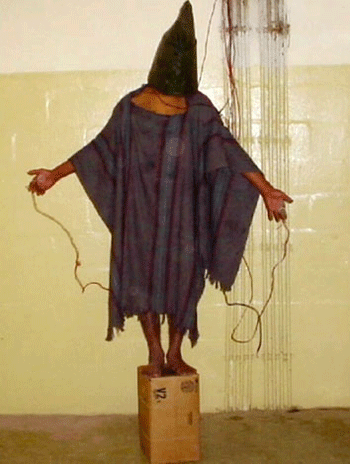
April 28th marks the tenth anniversary of the moment that the horrors of Abu Ghraib were made public in this country. On that day a decade ago, the TV news magazine "60 Minutes II" broadcast the first photographs from that American-run prison in “liberated” Iraq. They showed U.S. military personnel humiliating, hurting, and abusing Iraqi prisoners in a myriad of perverse ways. While American servicemen and women smiled and gave a thumbs up, naked men were threatened by dogs, or were hooded, forced into sexual positions, placed standing with wires attached to their bodies, or left bleeding on prison floors.

Thus began America’s public odyssey with torture, a story in many chapters and still missing an ending. As the Abu Ghraib anniversary nears and the White House, the CIA, and various senators still battleover the release of a summary of a 6,300-page report by the Senate Intelligence Committee on Bush-era torture policies, it’s worth considering the strange journey we’ve taken and wondering just where we as a nation mired in the legacy of torture might be headed.

Chapter One: Revelations

The odyssey started with the shock of those "60 Minutes II" photos, followed two days later by the reporting of veteran New Yorker writerSeymour Hersh. Having seen even more grim photographs and interviewed many in the chain of command stretching from Abu Ghraib to the Joint Chiefs of Staff and the Pentagon, Hersh painted a picture of a deliberate policy of abuse. He traced Abu Ghraib’s crimes to pressure from “military-intelligence teams, which included CIA officers and linguists and interrogation specialists from private defense contractors,” urging the production -- and fast -- of crucial information from U.S. captives in Iraq. Towards this end, the guards at Abu Ghraib were encouraged to “soften up” the detainees for interrogation.

That summer and fall of 2004, the Washington Post, the New York Times, the ACLU, and others got their hands on several Bush administration memos justifying and legalizing torture. These had largely been written by John Yoo and Jay Bybee, lawyers in the Office of Legal Counsel at the Department of Justice, and they proved grim reading indeed. The documents provided uniquely tortured definitions of torture that made almost any act in which the infliction of pain didn’t rise to the level of “organ failure, impairment of bodily function, or even death” acceptable. As if that weren’t enough, they developed no less tortured theories of executive power in which the president as commander-in-chief retained the right to authorize torture for national security reasons, despite its illegality under domestic, military, and international law.

With this anything-goes green light switched on, the memos proceeded to expressly approve individual methods of abuse (previously defined as torture) for American interrogators. Used in combination and repeatedly, these were known to destroy the human psyche and bring severe pain to the body as well. Specifically, they put the Bush administration’s stamp of approval on graphically described “techniques,” including sleep deprivation, slapping, the dangling of trussed prisoners from beams, and especially waterboarding, a process in which individuals essentially experience drowning, only to be saved at the last moment.

The trail of evidence went right to the top. The office of Defense Secretary Donald Rumsfeld told the interrogators of “the American Taliban,” John Walker Lindh, to “take the gloves off.” Vice President Dick Cheney, who famously said it was time to “work the dark side,” hasrepeatedly defended the policy of harsh interrogation techniques, including waterboarding, as effective and essential in keeping the nation safe. Top officials reportedly had various “enhanced interrogation techniques” demonstrated in the White House. The 2002 torture memos were addressed to White House Counsel and later Attorney General Alberto Gonzales. More


Saturday, April 12, 2014

China tortured Tibetan prisoner with pain-inducing injections

The Dharamshala, India based Tibetan rights group says the Chinese police and prison authorities brutally tortured a Tibetan political prisoner in detention, using pain-inducing injections.

Goshul Lobsang

"Goshul Lobsang, who recently died of torture injuries, might have received injections designed to cause and exacerbate his pain while he was being tortured in detention. The use of torture methods to increase pain is consistent with other Chinese torture tactics. For example, the Chinese adopted Soviet torture techniques to inflict pain faster," said Tsering Tsomo, director of the Tibetan Centre for Human Rights and Democracy (TCHRD).

"Goshul Lobsang was arrested on 29 June 2010[ii] by Machu County Public Security Bureau (PSB) officers. For about 5 months he was subjected to severe torture including pain-inducing injections, and deprived of sleep and food by the interrogation officers in Machu County," the report said, citing with a source who hails from the same village as Goshul Lobsang.

"Chinese officers used sharp-pointed objects such as toothpicks to repeatedly pierce and penetrate into the tops of his finger nails and cuticles of Goshul Lobsang. This stabbing, applied with force and consistency, resulted in severe bleeding, swelling and pain making Goshul Lobsang unable to temporarily use his hands," another source told group.

Normally, the use of techniques to make torture more painful does not result in any further violations of international law. This is because the fundamental question under international law is whether a person was tortured, not how much the victim was tortured. However, in 1974 the UN General Assembly passed a resolution on Principles of Medical Ethics. While not legally binding on its own, the resolution recognized and emphasized a pre-existing rule of international law—that nobody is allowed to participate in torture. The resolution emphasized that medical professionals should not use their unique knowledge or position to facilitate torture.

The use of pain-inducing injections on Golshul Lobsang to facilitate and expedite his torture was not only a violation of international law but also an extreme violation of medical ethics. The widespread and systematic torture in Chinese prisons cannot exist without the active and implied consent of medical professionals. The medical professionals working in Chinese prisons should use Golshul Lobsang's death and the participation of medical professionals in his death as an opportunity to support medical ethics and oppose torture.

The group said they has also obtained a copy of a note written by Goshul Lobsang while he was imprisoned at Ding Xi (??) city in Gansu Province. Goshul Lobsang shared the note which he had written on 28 September 2012 with a select group of friends on 1 March 2014, just weeks before his death. In the note titled "Prisoner of Clear Conscience", Goshul Lobsang clearly challenges the official Chinese propaganda that Tibetan activists are criminals deserving to be imprisoned. Instead he asserts that his conscience is clear and that he has no regrets for defying authoritarian, oppressive policies. Below is a translation of the note:

Prisoner of Clear Conscience

"I have a family. I have siblings. I have a wife and children. For them, I have sincere love and affection, and for the sake of this love and affection, I am determined to sacrifice my life. But for the sake of our own people, even if I lose this love and affection, I will have no regrets. I am an ordinary nomad who loves his people, so I am willing to do anything for my people. I might lose this bony and haggard body that has suffered brutal pain and torture inflicted out of sheer hatred, I still will not have any regrets. I have the desire to follow in the footsteps of martyrs who expressed everything through flaming fire, but I lack courage [to do such a thing].

However, I don't have the desire to bow my head in surrender to an environment, which denies freedom to speak out against lies and to struggle for equality. [Therefore], I fell into such a situation [of torture and suffering], for which I, an ordinary nomad, have no regrets. What I desire is a free world wherein people can enjoy a life of harmony – I don't want an atmosphere of darkness, a society wherein life is subjected to oppression.

I have no regrets, although all of a sudden, I may be compelled to separate from the path of life that [I have been treading along] with my beloved mother, siblings, wife and children. I may have to depart with [feelings] of cold, heavy sadness, but I have no sense of guilt in my heart.

My clear conscience is my only asset in this world. I don't possess anything other than this, and I don't need anything other than this.

[But] my only regret that weighs heavily on my heart is the lack of profound sense of solidarity among our people, because of which we are unable to achieve a strong unified stand.

Fellow countrymen, we must have a far-sighted [political] vision and strong unity. We must have a strong sense of faith in our culture and tradition, and a sense of gratitude to those who have contributed so much to our nation.

Fellow countrymen of the Land of Snows, we must all uphold unity. May this unity be sustained for tens of thousands of years!"

Goshul Lobsang,28 September 2012,Dingxi, Gansu

According to sources in the region, Goshul Lobsang led a difficult life, harassed by the local authorities since his return from India in mid-1990s. He went to India in 1992 to study in a Tibetan school. He was first detained in late 1990s when many leaflets apparently calling for freedom appeared in Machu area. He never accepted the accusations and the Machu County PSB officers had to release him for lack of evidence. However, he continued to be under police surveillance making it difficult for him to lead a normal life. Thereafter, for some time, he left for Lhasa and other areas but later returned to teach English to fellow nomads and neighbourhood children.

During the 2008 uprising, Goshul Lobsang took part in the protests that rocked Machu area for three consecutive days beginning 17 March. He even hoisted a Tibetan flag outside his nomad tent in defiance of the Chinese authorities.

In January 2009, when leaflets calling on Tibetans not to celebrate ostentatious Losar (Tibetan New Year) and the local authorities to stop colluding with human traffickers appeared in Machu, Goshul Lobsang and others shared these incidents on the popular Chinese instant messaging site known as QQ. The authorities had one more reason for target Goshul Lobsang after this incident.

On 10 April 2009, fed up with the authorities' constant harassment of local Tibetans since the 2008 protests in Machu, Goshul Lobsang and some other Tibetans confronted the local officials in an attempt to clarify the matter. Instead of engaging in civil talks, the police officers started beating Goshul Lobsang and another Tibetan, Dakpa. The severe beatings prompted around 400 local Tibetans to directly confront the police, with some locals raising protest slogans and throwing stones. As the matter escalated, the police had no choice but to temporarily let go of Goshul Lobsang and Dakpa.

But the local authorities were firm in their resolve to arrest Goshul Lobsang as soon as possible but they did not want to antagonise the whole community. Therefore, on 12 April 2009, local authorities called a meeting of major village leaders in Bhelpan Township and served them an ultimatum to surrender the five ringleaders of the 2008 protests including Goshul Lobsang. It was around this time that Goshul Lobsang took to the mountains to escape arrest. He spent about a year in wilderness without any access to basic necessities including food and medication.

On 29 June 2010, Goshul Lobsang was arrested by the Machu County PSB who held him for about five months in Machu County. On 26 November 2010, he was sentenced to 10 years in prison by the Kanlho (Ch: Gannan) Intermediate People's Court and imprisoned at Ding Xi, about 100 km from Lanzhou.

He remained in prison for about three years in extreme health condition. By November 2013, the state of his health alarmed the prison officials who decided that Goshul Lobsang should not die in prison. Shortly after, Goshul Lobsang's family members were called to fetch him but on the condition that they signed a letter stating that Goshul Lobsang's medical condition was caused by natural causes. The family had no choice but to sign the letter because they knew Goshul Lobsang wouldn't survive long and they wanted him to spend his last moments at his home. He was released on 29 November 2013.

On 19 March 2014, at around 1 am, Goshul Lobsang died surrounded by his family members. He was cremeted on 26 March 2014. He is survived by his mother Tardon, 73, wife Tarpey, 39, son Sherab, 18, daughter Dolma, 14, and unidentified siblings. More


Sunday, June 30, 2013

Bradley Manning should win the Nobel Peace Prize

Peace is more than simply the absence of war; it is the active creation of something better.

Bradley Manning

Alfred Nobel recognized this when he created alongside those for chemistry, literature, medicine and physics, an annual prize for outstanding contributions in peace. Nobel's foresight is a reminder to us all that peace must be created, maintained, and advanced, and it is indeed possible for one individual to have an extraordinary impact. For this year's prize, I have chosen to nominate US Army Pfc Bradley Manning, for I can think of no one more deserving. His incredible disclosure of secret documents to Wikileaks helped end the Iraq War, and may have helped prevent further conflicts elsewhere.

I recently visited Syria, where I met a few of the millions of refugees and internally displaced people whose lives have been torn apart by the ongoing conflict in that country. I learned from those I spoke to, both within the government and in opposition groups, that while there is a legitimate and long-overdue movement for peace and non-violent reform in Syria, the worst acts of violence are being perpetrated by outside groups. Extremist groups from around the world have converged upon Syria, bent on turning this conflict into one of ideological hatred.

In recent years this would have spelled an undeniable formula for United States intervention. However, the world has changed in the years since Manning's whistleblowing – the Middle East especially. In Bahrain, Tunisia, Egypt, and now Turkey, advocates of democracy have joined together to fight against their own governments' control of information, and used the free-flowing data of social media to help build enormously successful non-violent movements. Some activists of what has come to be known as the Arab Spring have even directly credited Bradley Manning, and the information he disclosed, as an inspiration for their struggles.

In a Middle East newly dedicated to democratic flow of information, those who would commit human rights violations can more easily be held accountable. If not for whistleblower Bradley Manning, the world still might not know of how US forces committed covert crimes in the name of spreading democracy in Iraq, killing innocent civilians in incidents such as the one depicted in the "Collateral Murder" video, and supporting Iraqi prisoner torture. Now, those who would support foreign intervention in the Middle East know that every action would be scrutinized under international human rights law. Clearly, this is for the best. International peacekeepers, as well as experts and civilians inside Syria, are nearly unanimous in their view that United States involvement would only worsen this conflict.

Around the world, Manning is hailed as a peacemaker and a hero. His nomination for the Nobel Peace Prize is a reflection of this. Yet at his home in America, Manning stands trial for charges of espionage and "aiding the enemy". This should not be considered a refutation of his candidacy – rather, he is in good company. Burmese politician Aung San Suu Kyi and Chinese writer Liu Xiaobo were each awarded the prize in recent years while imprisoned by their home countries.

Last week at Manning's trial, the public learned that at the time Manning released his information, WikiLeaks stated they wanted to publish "the concealed documents or recordings most sought after by a country's journalists, activists, historians, lawyers, police or human rights investigators". Manning's disclosures to Wikileaks only "aided the enemy," as his prosecutors charge, if the enemy is international cooperation and peace itself.

Manning is the only one on trial, yet what of those who committed the atrocities he revealed? The United States, the most militarized country on earth, should stand for something better than war. Its government must be open to "debates, discussions and reforms" concerning its foreign policy, to use Manning's own words. By heeding Pfc Bradley Manning's message on the importance of transparency, America's government can once again rebuild its image in the eyes of the world, and spread democracy not through foreign invasions, but through setting a strong example. More

Do you want your government to be accountable? How else should you do so? They certainly cannot be trusted to police themselves as the NSA fiasco shows. Do you want more American enemies to be created every day? Ask your self what type of government you want. Editor


Tuesday, April 30, 2013

6 Horrifying Facts Every American Should Know About Guantanamo Bay and the Ongoing Hunger Strike

As the hunger strike grows, the U.S. is sending more medical personnel to help force-feed the prisoners. Here are some of the facts you should know about the protest and the prison camp.

The hunger strike at Guantanamo Bay continues to grow. The U.S. recently forced many prisoners into solitary confinement. The military now admits that 100 prisoners at the camp are refusing to eat. But lawyers for Guantanamo detainees say that more than 130 detainees are on hunger strike.

While the claims and counter-claims bounce back and forth, the situation continues to deteriorate. Here’s 6 facts you should know about Guantanamo Bay and the ongoing act of protest most of the prisoners are participating in.

1. U.S. Medical Reinforcements Have Arrived to Force-Feed Prisoners

One of the latest news items is that “medical reinforcements” from the U.S. Navy have arrived at Guantanamo Bay to cope with the growing hunger strike. The Naval nurses and specialists are there to help facilitate the process of force-feeding the detainees.

“We will not allow a detainee to starve themselves to death, and we will continue to treat each person humanely,” Guantanamo prison spokesman Samuel House told the New York Times. But the practice of force-feeding has been criticized by human rights groups.

When detainees are force-fed, they are shackled to a “restraint chair.” Then, U.S. military officials force a tube into their nose to pump nutrients into their body. The American Medical Association has come out strongly against the practice. “Every competent patient has the right to refuse medical intervention, including life-sustaining interventions,” AMA President Jeremy Lazarus wrote in a letter to Secretary of Defense Chuck Hagel, the Miami Herald reports.

In a harrowing New York Times Op-Ed, Guantanamo prisoner Samir Naji al Hasan Moqbel described the process of force-feeding. “I will never forget the first time they passed the feeding tube up my nose. I can’t describe how painful it is to be force-fed this way. As it was thrust in, it made me feel like throwing up,” he wrote. “I wanted to vomit, but I couldn’t. There was agony in my chest, throat and stomach. I had never experienced such pain before. I would not wish this cruel punishment upon anyone.”

2. Hunger Strike Sparked By Raids, Fueled By Indefinite Detention

Detainees began the hunger strike in early February after they said personnel at the camp raided cells, confiscated personal items and treated the Qu’ran disrespectfully. The military disputes this narrative. But what is clear is that, as the New York Times reported, the strike is being driven by “a growing sense among many prisoners, some of whom have been held without trial for more than 11 years, that they will never go home.”

“The men are not starving themselves so they can become martyrs...They’re doing this because they’re desperate. They’re desperate to be free from Guantanamo. They don’t see any alternative to leaving in a coffin. That’s the bottom line,” Wells Dixon, an attorney for five Guantamano detainees, told AlterNet earlier this month.

3. 86 Detainees Have Been Cleared for Release--But They’re Still There

There are currently 166 detainees at Guantanamo. And over half of them--86--have been cleared for release out of the hellish prison camp. But they’re still there, a fact that is helping to drive the hunger strike. More


Monday, April 1, 2013

Camp Nama: British personnel reveal horrors of secret US base in Baghdad

Detainees captured by SAS and SBS squads subjected to human-rights abuses at detention centre, say British witnesses.

Camp Nama at Baghdad Airport

British soldiers and airmen who helped to operate a secretive US detention facility in Baghdad that was at the centre of some of the most serious human rights abuses to occur in Iraq after the invasion have, for the first time, spoken about abuses they witnessed there.

Personnel from two RAF squadrons and one Army Air Corps squadron were given guard and transport duties at the secret prison, the Guardian has established.

And many of the detainees were brought to the facility by snatch squads formed from Special Air Service and Special Boat Service squadrons.

Codenamed Task Force 121, the joint US-UK special forces unit was at first deployed to detain individuals thought to have information about Saddam Hussein's weapons of mass destruction. Once it was realised that Saddam's regime had long since abandoned its WMD programme, TF 121 was re-tasked with tracking down people who might know where the deposed dictator and his loyalists might be, and then with catching al-Qaida leaders who sprang up in the country after the regime collapsed.

Suspects were brought to the secret prison at Baghdad International airport, known as Camp Nama, for questioning by US military and civilian interrogators. But the methods used were so brutal that they drew condemnation not only from a US human rights body but from a special investigator reporting to the Pentagon.

A British serviceman who served at Nama recalled: "I saw one man having his prosthetic leg being pulled off him, and being beaten about the head with it before he was thrown on to the truck."

On the 10th anniversary of the invasion of Iraq, a number of former members of TF 121 and its successor unit TF6-26 have come forward to describe the abuses they witnessed, and to state that they complained about the mistreatment of detainees.

The abuses they say they saw include:

• Iraqi prisoners being held for prolonged periods in cells the size of large dog kennels.

• Prisoners being subjected to electric shocks.

• Prisoners being routinely hooded.

• Inmates being taken into a sound-proofed shipping container for interrogation, and emerging in a state of physical distress.

It is unclear how many of their complaints were registered or passed up the chain of command. A Ministry of Defence spokesperson said a search of its records did not turn up "anything specific" about complaints from British personnel at Camp Nama, or anything that substantiated such complaints.

Nevertheless, the emergence of evidence of British involvement in the running of such a notorious detention facility appears to raise fresh questions about ministerial approval of operations that resulted in serious human rights abuses.

Geoff Hoon, defence secretary at the time, insisted he had no knowledge of Camp Nama. When it was pointed out to him that the British military had provided transport services and a guard force, and had helped to detain Nama's inmates, he replied: "I've never heard of the place."

The MoD, on the other hand, repeatedly failed to address questions about ministerial approval of British operations at Camp Nama. Nor would the department say whether ministers had been made aware of concerns about human rights abuses there. More


Monday, February 25, 2013

How Israel legitimises torturing Palestinians to death

Six days after Arafat Jaradat was arrested by the Israeli army and the Shin Bet, he was dead. Between the date of his arrest - February 18 - and the day of his death - February 23 - his lawyer Kamil Sabbagh met with Arafat only once: in front of a military judge at the Shin Bet's Kishon interrogation facility.

Sabbagh reported that when he saw Jaradat, the man was terrified. Arafat told his lawyer that he was in acute pain from being beaten and forced to sit in stress positions with his hands bound behind his back.

When it announced his death, Israeli Prison Service claimed Arafat - who leaves a pregnant widow and two children - died from cardiac arrest. However, the subsequent autopsy found no blood clot in his heart. In fact, the autopsy concluded that Arafat, who turned 30 this year, was in fine cardiovascular health.

What the final autopsy did find, however, was that Jaradat had been pummelled by repeated blows to his chest and body and had sustained a total of six broken bones in his spine, arms and legs; his lips lacerated; his face badly bruised.

The ordeal that Arafat suffered before he died at the hands of Israel's Shin Bet is common to many Palestinians that pass through Israel's prisons. According to the prisoners' rights organisation Addameer, since 1967, a total of 72 Palestinians have been killed as a result of torture and 53 due to medical neglect. Less than a month before Jaradat was killed, Ashraf Abu Dhra died while in Israeli custody in a case that Addameer argues was a direct result of medical neglect.

The legal impunity of the Shin Bet, commonly referred to as the GSS, and its torture techniques has been well established. Between 2001 and 2011, 700 Palestinianslodged complaints with the State Attorney's Office but not a single one has been criminally investigated.

Writing in Adalah's 2012 publication, On Torture [PDF], Bana Shoughry-Badarne, an attorney and the Legal Director of the Public Committee Against Torture in Israel, wrote, "The GSS's impunity is absolute."

Israel's High Court has been extravagantly helpful in securing the Shin Bet with its imperviousness to accountability to international law, and thus enabling widespread and lethal torture.

In August of 2012, Israel's High Court rejected petitions submitted by Israeli human rights organisations Adalah, the Association for Civil Rights in Israel and PCATI to demand that Israeli attorney general, Yehuda Weinstein, carry out criminal investigations into each allegation of torture by the Shin Bet.

And in the first week of February, two weeks before Arafat was killed, the High Court of Justice threw out Adalah's petition that demanded the GSS videotape and audio record all of its interrogations in order to comply with requirements of the United Nations Convention Against Torture (CAT) to which Israel is a signatory.

In May 2009, UNCAT condemned [PDF] Israel for exempting the Shin Bet's interrogations from audio and video recording, noting that such oversight is an essential preventative measure to curtail torture. Yet despite this admonition, in 2012 the Knesset extended the exemption for another three years.

Rationalising its failure to comply with this most basic requirement of recording interrogations, the State maintains that it is in the interests of "national security" that its interrogation techniques not be made public. More


Thursday, February 14, 2013

Stop Torturing Lab Animals

Lab chimps successfully treated with anti-depressants

The chimps, like Tomas, were all disturbed

A study has shown that anti-depressants can be used to help former lab chimps combat depression and trauma.

Researchers say that the treatment should be considered for hundreds of other chimps that have been used in scientific research.

The finding comes as a US funding body thinks about retiring the more than 300 chimps it uses for medical research.

The study was presented in Boston at the at the American Association for the Advancement of Science (AAAS) meeting.

Dr Godelieve Kranendonk, a behavioural biologist leading the study at AAP, a rescue centre for animals in the Netherlands, told BBC News that the results had been astonishing.

"Suddenly, [the chimps] woke up. It was as if they were zombies in their enclosures and now they are happy, playing with each other. They are chimps again - that was really nice to see," she told me.

AAP is a rescue centre for Dutch chimps and other mammals that have been used in scientific research.

Many animals emerge from their time in laboratories depressed and traumatised. Having been confined for 15 to 20 years as lab animals, they have lost their ability to play or relate to other chimps. Instead, they spend their time in brooding isolation and sometimes eat their own vomit.

The chimps often repeatedly rock back and forth, pace back and forth and pull their own hair.

Playfulness restored

Staff at the AAP sanctuary care for the animals until they die. They try to rehabilitate them so that they can live out their remaining years happily.

The chimps are fed a good diet of vegetables, have toys and plenty of space in which to play. But Dr Kranendonk found that the abnormal behaviour actually increased. It was as if the animals did not know how to cope with their new found freedom.

Dr Kranendonk decided to consult Martin Bruene, a professor of human psychiatric disorders at the University of Bochum, Germany. He prescribed a course of anti-depressants for five of the chimps.

All the animals had been used in medical experiments and were infected with Hepatitis C. "Willy" showed the least abnormal behaviour. "Tomas" and "Zorro", on the other hand, would spend a third of their waking hours eating their own vomit.

"Iris" had lost so much weight from vomiting when she first came to the sanctuary that the staff thought she would die.

The most troubled though was "Kenny", a small chimp who was constantly anxious that the others would attack him and spent much of his time screaming in terror.

The chimps were given SSRI (Selective Serotonin Reuptake Inhibitors), which is a class of anti-depressant similar to Prozac and is used to treat human patients for depression, anxiety disorder and obsessive compulsive disorder.

After six to eight weeks, the animals behaviour started improving. The abnormal behaviour declined and the chimps began to play together. After seven months, there was a vast difference.

Kenny responded best of all to the treatment. He is now the clown of the group, entertaining the others and initiating play.

Long-term prognosis

Prof Bruene said that the results were "quite amazing". More


Saturday, October 27, 2012

How Britain tortured Nazi PoWs

The horrifying interrogation methods that belie our proud boast that we fought a clean war

Getty Images

The German SS officer was fighting to save himself from the gallows for a terrible war crime and might say anything to escape the noose. But Fritz Knöchlein was not lying in 1946 when he claimed that, in captivity in London, he had been tortured by British soldiers to force a confession out of him.

Tortured by British soldiers? In captivity? In London? The idea seems incredible.

Britain has a reputation as a nation that prides itself on its love of fair play and respect for the rule of law. We claim the moral high ground when it comes to human rights. We were among the first to sign the 1929 Geneva Convention on the humane treatment of prisoners of war.


Surely, you would think, the British avoid torture? But you would be wrong, as my research into what has gone on behind closed doors for decades shows.

It was in 2005 during my work as an investigative reporter that I came across a veiled mention of a World War II detention centre known as the London Cage. It took a number of Freedom Of Information requests to the Foreign Office before government files were reluctantly handed over.

From these, a sinister world unfolded — of a torture centre that the British military operated throughout the Forties, in complete secrecy, in the heart of one of the most exclusive neighbourhoods in the capital.


Thousands of Germans passed through the unit that became known as the London Cage, where they were beaten, deprived of sleep and forced to assume stress positions for days at a time.

Some were told they were to be murdered and their bodies quietly buried. Others were threatened with unnecessary surgery carried out by people with no medical qualifications. Guards boasted that they were ‘the English Gestapo’.

The London Cage was part of a network of nine ‘cages’ around Britain run by the Prisoner of War Interrogation Section (PWIS), which came under the jurisdiction of the Directorate of Military Intelligence. More


Saturday, August 11, 2012

Israeli high court decision enables widespread torture of Palestinian detainees

When human rights workers, lawyers and doctors get a chance to speak with Palestinian detainees about their treatment in Israeli prisons, the standard response is‘ādi, meaning “as usual.” After a little prodding, sometimes they will get the details of what exactly is “usual.” (See Bana Shoughry-Badarne’s “Torture in Israel – A Question of Getting Away With It.”)

One man tells of being violently beaten for 80 hours while being told his mother was dying.

Another man was allowed to sleep for two hours every three days for a total of 40 days, while interrogators shouted directly into his ears. (Examples from Shoughry-Badarne’s article.)

When the brutal “interrogation” is exhausted, officers may send the prisoners to a foul-smelling cell, where mold lines the walls and there is a hole in the floor to use as a toilet.

Usually — that is 70-90 percent of the time — the detained men, women and children are not allowed to speak to anyone, including a lawyer, until they have “confessed.”

And once the Shin Bet (also known as the General Security Services, GSS, or Shabak) have a confession — no matter what induced it — there is no chance for a lawyer to help the prisoner regain his freedom.

Torture, or “moderate physical pressure” was supposed to be made illegal by a 1999 Israeli high court decision. However, in the decision, the court made the exception to the rule for those Palestinians deemed to be a “ticking bomb;” in other words, they withheld information that could help save lives.

Shin Bet impunity “absolute”

But since 2000, 700 complaints of torture at the hands of the Shin Bet have been submitted to the state prosecutors’ office and not a single case has been criminally charged, prosecuted or convicted. When turning back each unresolved complaint, the state prosecutor’s office either denies the factuality of the allegations of physical abuse or invokes the “necessity defense” — that is, the detainee fell under the “ticking bomb” scenario. More