Tuesday, July 19, 2011

Rising Seas, Corporate Greed, and the Plight of an Alaskan Village

Book Excerpt
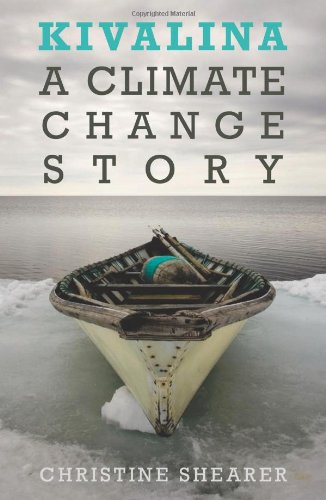
For the Inupiat people of Kivalina in the Arctic of Alaska, the price of further climate change denial could be the complete devastation of their lives and culture. Their crumbling village must be relocated to survive. But neither the government, nor the fossil fuel giants who have helped speed up the destruction of their village seem to willing to take responsibility.

In February 2008, a tiny Alaska Native village named Kivalina filed suit against twenty-four fossil fuel companies for contributing to the village’s erosion through large greenhouse gas emissions, and for creating a false debate around climate change. The lawsuit was filed in conjunction with environmental justice and indigenous rights organizations as one of several steps in a broader push for climate justice, aiming to help Kivalina residents draw attention to their situation and call for action from government and corporate officials that had so far largely ignored them.

The media gave the lawsuit brief attention that quickly faded, and the judge’s ruling was issued with little discussion or notice outside of certain legal circles. Meanwhile, the people of Kivalina are still in danger from the effects of climate change, in a situation that is going to become more common throughout the world.

For roughly the past ten thousand years we have enjoyed a relatively stable climate that has allowed for the development of agriculture and civilization. Such stability is the exception, not the norm, when it comes to the earth’s 4.54 billion-year history. The Earth has oscillated between long periods of cooling (glaciations) and shorter periods of warming (interglacials), sometimes undergoing radical climate variations within the span of a century or even a decade. Evidence suggests that later glaciations correspond with periodic shifts in the earth’s orbit, tilt, and precession (movement of the axis), which can reduce the amount of energy received at the poles. This small temperature perturbation, in turn, can kickstart a glaciation through feedbacks: as ice builds, greenhouse concentrations within the oceans are sequestered and reduced in the atmosphere, and the ice reflects a greater amount of sunlight back to space (the “albedo effect”). These processes maintain the cooling, and can create the conditions for layer upon layer of cumulative ice sheets. 

Gaza ‘flotilla’ blocked by Israeli navy


The Israeli navy on Tuesday boarded a boat carrying a small group of pro-Palestinian activists, thwarting the latest attempt to break Israel’s maritime blockade of the Gaza Strip.
There was no resistance by the 10 passengers and three crew members, the Israeli military said. Passengers and crew would be taken to the Israeli port of Ashdod and handed over to the border authority, it added.
The French-flagged ship, known as the Dignite-Karama, sailed from the Greek island of Kastellorizo on Saturday. It was originally scheduled to make the journey as part of a flotilla heading for Gaza, but all the other ships were either damaged – raising accusations of sabotage – or were blocked from leaving port by the Greek authorities.
Platform Palestine, the French group that co-organised the voyage, said Israel’s move “clearly shows the military logic of Israeli politics, which only speaks the language of force”. More >>>

Monday, July 18, 2011

Yemen’s Dangerous Hunger Crisis

The embattled nation is struggling to find food and water while the world focuses on ending President Ali Abdullah Saleh’s violent campaign to keep power.


In one of the cities at the center of Yemen’s revolution, tanks and soldiers of President Ali Abdullah Saleh’s loyalist forces occupy the main hospital, turning away the civilian sick and wounded, and using the hospital as a vantage point to shell residential neighborhoods at night.

Prices of water as well as food have soared amid Yemen’s political crisis, so that ever more poor families are resorting to drinking water from rain and other contaminated sources, and new reports of cholera outbreaks are reaching the capital, Sana’a. Yemeni cities are emptying of day laborers and other poor, aid officials and residents told me, as men return with their families to their villages in hopes of escaping hunger.

Months of violent political crisis are depleting the savings and stockpiles of more and more Yemenis, so that not only beggars, but neighbors, come round to quietly ask for food.

“There’s no work, no water, no electricity, no security. When we sleep, my family and I are not sure if we will live until morning, because of the shelling on the houses, and the bullets all night,” says Ali Qassim Abdullah, a 44-year-old father of three young children. Abdullah spoke in Yemen’s southern city of Taiz, where loyalist units commanded by the son of Yemen’s president are accused of nightly—and sometimes random—artillery fire.
“The whole world is watching this happen to us in Taiz. And no one speaks or objects,” Abdullah told a Yemeni reporter in Taiz who helped me talk to civilians. More >>>

Location: Cayman Islands

Israel Rules Out Non-Violence

Nazareth: It was an Arab legislator who made the most telling comment to the Israeli parliament last week as it passed the boycott law, which outlaws calls to boycott Israel or its settlements in the occupied territories.


Ahmed Tibi asked: “What is a peace activist or Palestinian allowed to do to oppose the occupation? Is there anything you agree to?”

The boycott law is the latest in a series of ever-more draconian laws being introduced by the far-right. The legislation's goal is to intimidate those Israeli citizens, Jews and Palestinians, who have yet to bow down before the majority-rule mob.

Look out in the coming days and weeks for a bill to block the work of Israeli human rights organisations trying to protect Palestinians in the occupied territories from abuses by the Israeli army and settlers; and a draft law investing a parliamentary committee, headed by the far-right, with the power to veto appointments to the supreme court. The court is the only, and already enfeebled, bulwark against the right's absolute ascendancy.

The boycott law, backed by Benjamin Netanyahu's government, marks a watershed in this legislative assault in two respects. More >>>

Human Rights Report: Doctors targeted in Bahrain

Bahraini security forces attacked doctors and nurses, lay siege to hospitals and clinics, detained protesters who sought treatment, and arrested and prosecuted dozens of medical personnel after unrest hit the island kingdom in February, a prominent human rights organisation has alleged.


Since mid-March, when the government stifled the uprising, the government has arrested more than 70 medical professionals, including several dozen doctors, and has put 48 on trial in a special military court, Human Rights Watch alleged in a 24-page report released on Monday.

The organisation called on Bahrain to stop harrassing medical personnel, withdraw all security forces from health centres and release all those facing minor charges, while providing due process to those accused of more serious crimes.

The report also called on the United Nations to conduct an independent investigation into the government crackdown.

"The Bahraini government's violent campaign of intimidation against the medical community and its interference in the provision of vital medical assistance to injured protesters is one of the most egregious aspects of its brutal repression of the pro-democracy protest movement," the report stated. More >>>

Location: Cayman Islands

Sunday, July 17, 2011

Arrest of ex-CIA lawyer sought over drone use

Human rights lawyers in the UK and Pakistan are seeking the arrest of the Central Intelligence Agency's (CIA) former legal director for approving drone strikes that killed hundreds of people.


John Rizzo, who served as the acting general counsel for the agency, has admitted approving drone attacks inside Pakistan, beginning in 2004.
In February, Rizzo, who left the CIA more than a year ago, told Newsweek magazine he agreed to a list of people to be targeted by drone strikes, which started under the Bush administration.

"It's basically a hit list," Rizzo said. "The Predator is the weapon of choice, but it could also be someone putting a bullet in your head." A study by the New America Foundation, a Washington-based think tank, said 42 drone attacks were approved in four years.

The report said that the amount of strikes has quadrupled under the administration of US President Barack Obama and estimates about 2,500 people were killed in attacks on targets in Pakistan since 2004.

Arrest warrant

"There has clearly been a crime committed here," Clive Stafford Smith, a British human rights lawyer who is leading the effort to seek a warrant for Rizzo, told Al Jazeera.

"The issue here is whether the United States is willing to flaunt international law. More >>>

Location: Islamabad

Monday, July 11, 2011

Aguan Biogas Project linked to serious Human Rights

Violations in Honduras One of the CDM projects currently seeking registration is the “Aguan biogas recovery from Palm Oil Mill Effluent ponds and biogas utilisation” (Project 3197).


The company behind the project, Grupo Dinant subsidiary Exportadora del Atlantico, is implicated in assassinations and other serious human rights abuses in Honduras and there are grave concerns that additional funding through the CDM, could be used to to pay for more armed paramilitaries.

A second CDM application by the same project participants – Exportadora del At-lantico and EDF Trading, authorised by the UK government – is awaiting validation by TUV SUED, which also wrote the validation report for the Aguan project. That project is called “Lean Biogas recovery from Palm Oil Mill Effluent (POME) ponds and biogas / biomass utilisation”. The Aguan and Lean projects would, if approved, generate around 23,000 and 25,500 CERs annually, generating about €276,000 and €306,000 respectively.

Following the registration request, a review related to concerns about additionality was requested by Board members. Indeed, additionality concerns seem valid: the validation report accepts assertions made in the PDD according to which the com-pany had only obtained a private bank loan, not loans or grants from international development banks. Yet in 2009, Exportadora del Atlantico obtained a $30 million loan from the World Bank‘s International Finance Corporation and a $7million loan from the Inter-American Investment Corporation. Both loans were partly granted for biogas production from palm oil residues but are not mentioned in the PDD. However, a letter to the CDM Executive Board by Biofuelwatch, Salva la Selva/Rettet den Re-genwald and CDM Watch outlines additional concerns that should also be addressed when reviewing the project. More [PDF] >>>

Location: Cayman Islands