Showing posts with label Arctic. Show all posts

Friday, March 28, 2014

This is Climate Change: This is Reality

IPlil Plait has been saying for a long time that to communicate science effectively, we need to connect with people. Scientists have a habit of just relaying facts to each other, since that’s how nature itself works. But people don’t work that way at all, and just reciting facts doesn’t work.

If we want to connect with people, especially over the sound and fury of the anti-science noise machine, we need to be passionate. We need to be emotional. And we need to tell the human story.

That’s exactly what it looks like Showtime is doing with its new big-budget eight-part series Years of Living Dangerously, which will show the impact of climate change on our planet. It looks phenomenal, gorgeously shot, and features journalists and celebrities who travel the world to investigate what we’re doing to our planet. Among the people in it are Jessica Alba, Harrison Ford, Arnold Schwarzenegger, Lesley Stahl, and Thomas L. Friedman.

This isn’t a fluff piece, from what I can tell: Their science adviser team includes scientists Michael Mann, Katharine Hayhoe, James Hansen, and Joe Romm, among other top-flight climatologists.*

They’ve also set up a really nice website with more information, including links to the stories they cover and the science of climate change. The trailer looks great, and there’s also a version of it on YouTube: More


Tuesday, July 19, 2011

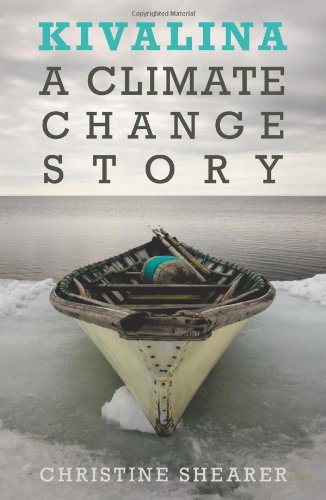
Rising Seas, Corporate Greed, and the Plight of an Alaskan Village

Book Excerpt
For the Inupiat people of Kivalina in the Arctic of Alaska, the price of further climate change denial could be the complete devastation of their lives and culture. Their crumbling village must be relocated to survive. But neither the government, nor the fossil fuel giants who have helped speed up the destruction of their village seem to willing to take responsibility.

In February 2008, a tiny Alaska Native village named Kivalina filed suit against twenty-four fossil fuel companies for contributing to the village’s erosion through large greenhouse gas emissions, and for creating a false debate around climate change. The lawsuit was filed in conjunction with environmental justice and indigenous rights organizations as one of several steps in a broader push for climate justice, aiming to help Kivalina residents draw attention to their situation and call for action from government and corporate officials that had so far largely ignored them.

The media gave the lawsuit brief attention that quickly faded, and the judge’s ruling was issued with little discussion or notice outside of certain legal circles. Meanwhile, the people of Kivalina are still in danger from the effects of climate change, in a situation that is going to become more common throughout the world.

For roughly the past ten thousand years we have enjoyed a relatively stable climate that has allowed for the development of agriculture and civilization. Such stability is the exception, not the norm, when it comes to the earth’s 4.54 billion-year history. The Earth has oscillated between long periods of cooling (glaciations) and shorter periods of warming (interglacials), sometimes undergoing radical climate variations within the span of a century or even a decade. Evidence suggests that later glaciations correspond with periodic shifts in the earth’s orbit, tilt, and precession (movement of the axis), which can reduce the amount of energy received at the poles. This small temperature perturbation, in turn, can kickstart a glaciation through feedbacks: as ice builds, greenhouse concentrations within the oceans are sequestered and reduced in the atmosphere, and the ice reflects a greater amount of sunlight back to space (the “albedo effect”). These processes maintain the cooling, and can create the conditions for layer upon layer of cumulative ice sheets.