Archbishop Desmond Tutu on Climate Change
Showing posts with label climate. Show all posts
Showing posts with label climate. Show all posts
Wednesday, September 24, 2014
 © 2014
Friday, March 28, 2014
This is Climate Change: This is Reality
IPlil Plait has been saying for a long time that to communicate science effectively, we need to connect with people. Scientists have a habit of just relaying facts to each other, since that’s how nature itself works. But people don’t work that way at all, and just reciting facts doesn’t work.
If we want to connect with people, especially over the sound and fury of the anti-science noise machine, we need to be passionate. We need to be emotional. And we need to tell the human story.
That’s exactly what it looks like Showtime is doing with its new big-budget eight-part series Years of Living Dangerously, which will show the impact of climate change on our planet. It looks phenomenal, gorgeously shot, and features journalists and celebrities who travel the world to investigate what we’re doing to our planet. Among the people in it are Jessica Alba, Harrison Ford, Arnold Schwarzenegger, Lesley Stahl, and Thomas L. Friedman.
This isn’t a fluff piece, from what I can tell: Their science adviser team includes scientists Michael Mann, Katharine Hayhoe, James Hansen, and Joe Romm, among other top-flight climatologists.*
They’ve also set up a really nice website with more information, including links to the stories they cover and the science of climate change. The trailer looks great, and there’s also a version of it on YouTube: More

Thursday, September 12, 2013
Angola: Head of State appoints Ecocide Convention Work Team
The Angolan head of State José Eduardo dos Santos Wednesday in Luanda ordered the setting up of a Work Team to study and draft proposals for incorporation in the country’s legal system of the Ecocide Convention, Angop learned from an official source.
 |
| Angolan head of State José Eduardo dos Santos |
Ecocide is defined as the destruction or degradation of various ecosystems in a certain territory, through human action or others, putting at stake the full development of the resources by the population.
The United Nations has decided to discuss, approve and promote among the member states an International Convention against the Ecocide, aiming to protect the earth and its living species against the evil and hold legally accountable the institutions, organisms, organisations and their leaders found responsible for the phenomenon.
Internally, the Executive is required to set up national mechanisms of combat against the ecocide, promotion of the enforcement of the law and regulation of the cooperation with the international organisms and organisations involved in the protection of the environment, its technical assistance and exchange of information.
The just appointed Work Team is coordinated by the minister of Environment and includes representatives of the ministries of Energy and Water, Interior, Oil and National Defence.
According to the source, The Work Team is expected to conduct a deep study on the Ecocide Convention draft, by analysing the impact the phenomenon might have on the country’s legal system.
It is also the Work Team’s duty to create a legal framework for the country’s economic development, promote and facilitate international cooperation and provide technical assistance to prevent the ecocide, the source said.
The body is also tasked with arranging and promoting inter-sectoral programmes of information, publicity and social awareness, through environmental education campaigns and identifying and protecting the communities based in threatened areas. More
Tuesday, July 30, 2013
[Human Rights] in the CDM
After this weekend’s CDM reform workshop, ECO has new hope for the CDM’s ability to address human rights.
For the first time in the history of the CDM, Parties had an open dialogue about the impacts of CDM on human rights. It is important to recall that Parties agreed to “fully respect human rights in all climate change related actions.” The review of the CDM Modalities and Procedures provides a critical opportunity for the CDM to make this a reality.
 |
| CAN's Leadership Development Program |
A case in point…The Barro Blanco project is a hydroelectric dam that is currently under construction on the Tabasará River in western Panama. Once completed, the dam is projected to flood homes, schools, and religious, historical and cultural sites in Ngäbe indigenous territories, threatening the Ngäbe’s cultural heritage. In addition, the dam will transform the Tabasará River – critical to the Ngäbe’s physical, cultural, and economic survival – from a flowing river to a stagnant lake ecosystem. This will severely affect the Ngäbe’s lands and means of subsistence, and result in the forced relocation of many families.
CDM rules require investors to consult with local stakeholders and to take their comments into account during the registration process. However, the company did not consult the Ngäbe communities regarding the Barro Blanco project and its impacts. In February 2011, the Ngäbe, in collaboration with civil society groups, submitted comments to the CDM Executive Board. The comments documented the Ngäbe’s concerns, in particular the fact that the Ngäbe were not given notice of the consultation process and were never consulted. Despite concrete evidence that the Barro Blanco project violated CDM rules on stakeholder consultation, in 2011, the CDM Executive Board registered the Barro Blanco as a CDM project.
Now that Barro Blanco has been registered, there is no process that allows the Ngäbe to raise their concerns regarding the project’s social and environmental impacts. Over the past two years, the SBI has been negotiating an appeals procedure that would allow stakeholders to challenge registration decisions under the CDM. However, ECO is dismayed that, as discussions currently stand, this procedure would not provide a means of recourse for affected communities once a project is under construction or operational.
More than 6,500 projects are registered under the CDM, and these projects will be operational for many years to come. ECO calls on Parties to revise the CDM Modalities and Procedures to: establish international safeguards to protect human rights; strengthen requirements on how to conduct local stakeholder consultations; establish a grievance process that allows affected peoples and communities to raise concerns about harms associated with CDM projects; and develop a process to deregister projects where there are violations of CDM rules.
To learn more, join us at a side event on CDM and human rights TODAY at 6:30 pm in Room Solar. You will meet on Monday at 6:30 pm, wWeni Bakama, a Ngäbe activist, and other panelists who will discuss how we can integrate human rights protections in the CDM. More
Today, we are writing to ask you to sign an ACTION ALERT in support of the Barro Blanco campaign and our broader CDM advocacy efforts. We launched this petition two weeks ago, asking James Anaya, UN Special Rapporteur on the Rights of Indigenous Peoples, to recommend reforms to protect communities that are adversely affected by CDM projects, such as Barro Blanco. In astatement released at the end of his recent visit to Panama, Special Rapporteur Anaya described his visit to the Ngäbe communities and highlighted the Barro Blanco project as an example of the many large-scale development projects that threaten the rights of indigenous peoples in Panama. In the coming months, Mr. Anaya will be preparing his final report, which provides an opportunity for the Special Rapporteur to document the ways in which the existing CDM rules are inadequate to protect the rights of indigenous peoples.
PLEASE TAKE ACTION by signing this alert to urge Special Rapporteur Anaya to make recommendations to the CDM and the Panamanian government, calling for both to respect human rights for development projects that generate social and environmental impacts, with particular attention to indigenous rights. Also, please share with your lists and promote via Facebook/Twitter. Our goal is to reach 1000 signatories by the end of the week.
| July 19, 2013
| ||||
We need your help. Will you add your name and support to a letter asking James Anaya, UN Special Rapporteur on the Rights of Indigenous Peoples, to recommend reforms to protect indigenous communities in Panama? Yesterday, Mr. Anaya began his ten-day visit to Panama. At the request of CIEL and adozen other organizations, Mr. Anaya will meet with community representatives in the Ngäbe-Buglé territory in Panama who are directly affected by the Barro Blanco hydroelectric dam. He will hear firsthand about how the Panamanian state has violated the rights of affected indigenous communities to free, prior and informed consent on a project which threatens to violate their right to traditional land and territories. When completed, the dam would flood historic and religious Ngäbe-Buglé sites and compromise the ecosystem upon which their traditional diet depends. The Barro Blanco dam is registered under the Clean Development Mechanism (CDM), a carbon-market mechanism of the UN convention on climate change. The CDM allows developed countries to claim emission reductions by paying for mitigation efforts – in this case a hydroelectric dam – in developing countries. Unfortunately, the CDM has no standards for human or indigenous rights, nor does it have a way for communities that are negatively affected by CDM projects to even register complaints. Following Mr. Anaya’s Panama trip, he will present a report on his findings of concerns related to indigenous peoples in Panama, including the human rights violations against the indigenous people affected by Barro Blanco. As Special Rapporteur and as part of his mandate, Mr. Anaya is in a unique position to give advice and recommendations to the CDM as well as other UN-related mechanisms that affect the rights of indigenous peoples.His recommendations could help to halt and prevent human rights violations | |||||


Tuesday, July 9, 2013
Peaceful Protest Now Illegal In Israel
Israel puts Palestinian female activists on trial
RAMALLAH, West Bank, July 9 (Reuters) - Two Palestinian activists went on trial in an Israeli military court on Tuesday over their involvement in weekly demonstrations against a Jewish settlement in the occupied West Bank.
 |
| Nariman Tamim |
Rights groups and activists say the prosecution of Nariman Tamimi and Rana Hamadeh comes amid an uptick of Israeli arrests in recent weeks of Palestinian protest organisers.
The decision to put the two women on trial was unusual since charges against them focus on their entry to a "closed military zone" during a protest in Nabi Saleh village on June 28, an offence that rarely leads to prosecution in court.
"They have been denied the basic human right to peacefully protest over land illegally seized by Israeli settlers, and the Israeli judiciary has used spurious legal tools to punish them," Amnesty International said in a statement.
Villagers began organising protests every Friday after Israelis from the Halamish settlement took control of a spring between the two communities in 2009, which they say deprived them of a source of irrigation.
The protests typically involve flag-waving and rock-throwing by the Palestinian side, which is met by tear gas, rubber bullets and even live ammunition by the Israeli army.
Two Palestinians have been shot dead by soldiers since the protests began, including Nariman's brother Rushdi in November.
During the confrontations, the Israeli army restricts access to the village and declares it a "closed military zone."
The Israeli military did not immediately comment.
Sarit Michaeli of Israeli human rights group B'Tselem said the pair's trial is expected to last months and is part of Israeli policies which "makes it virtually impossible for Palestinians to legally demonstrate".
The court on Tuesday released Tamimi on bail but mandated that she stay inside her house each Friday and barred Hamadeh from entering Nabi Saleh on Fridays while the trial continues.
In the last week, Israel arrested two other prominent activists in the West Bank villages of Bil'in and Beit Ummar, who organise protests as part of a strategy dubbed "popular resistance" blessed by Palestinian President Mahmoud Abbas.
Israel has occupied the West Bank and sown it widely with Jewish settlements since capturing it in the 1967 Middle East war along with East Jerusalem and Gaza - land Palestinians want for a future state.
Most countries consider the settlements illegal. Israel, which disputes this, cites historical and Biblical links to the West Bank and Jerusalem. (Reporting By Noah Browning, Editing by Jeffrey Heller and Ralph Boulton) More
Saturday, May 18, 2013
Drastic Reductions In CO2 Output Critical For Survival
Heat-Trapping Gas Passes Milestone, Raising Fears
 |
| Research facility at Mauna Loa |
The level of the most important heat-trapping gas in the atmosphere, carbon dioxide, has passed a long-feared milestone, scientists reported Friday, reaching a concentration not seen on the earth for millions of years.
Scientific instruments showed that the gas had reached an average daily level above 400 parts per million — just an odometer moment in one sense, but also a sobering reminder that decades of efforts to bring human-produced emissions under control are faltering.
The best available evidence suggests the amount of the gas in the air has not been this high for at least three million years, before humans evolved, and scientists believe the rise portends large changes in the climate and the level of the sea.
“It feels like the inevitable march toward disaster,” said Maureen E. Raymo, a scientist at the Lamont-Doherty Earth Observatory, a unit of Columbia University.
“It symbolizes that so far we have failed miserably in tackling this problem,” said Pieter P. Tans, who runs the monitoring program at the National Oceanic and Atmospheric Administration that reported the new reading.
Ralph Keeling, who runs another monitoring program at the Scripps Institution of Oceanography in San Diego, said a continuing rise could be catastrophic. “It means we are quickly losing the possibility of keeping the climate below what people thought were possibly tolerable thresholds,” he said.
Virtually every automobile ride, every plane trip and, in most places, every flip of a light switch adds carbon dioxide to the air, and relatively little money is being spent to find and deploy alternative technologies.
China is now the largest emitter, but Americans have been consuming fossil fuels extensively for far longer, and experts say the United States is more responsible than any other nation for the high level.
The new measurement came from analyzers atop Mauna Loa, the volcano on the big island of Hawaii that has long been ground zero for monitoring the worldwide trend on carbon dioxide, or CO2. Devices there sample clean, crisp air that has blown thousands of miles across the Pacific Ocean, producing a record of rising carbon dioxide levels that has been closely tracked for half a century.
Carbon dioxide above 400 parts per million was first seen in the Arctic last year, and had also spiked above that level in hourly readings at Mauna Loa.
But the average reading for an entire day surpassed that level at Mauna Loa for the first time in the 24 hours that ended at 8 p.m. Eastern Daylight Time on Thursday. The two monitoring programs use slightly different protocols; NOAA reported an average for the period of 400.03 parts per million, while Scripps reported 400.08.
Carbon dioxide rises and falls on a seasonal cycle, and the level will dip below 400 this summer as leaf growth in the Northern Hemisphere pulls about 10 billion tons of carbon out of the air. But experts say that will be a brief reprieve — the moment is approaching when no measurement of the ambient air anywhere on earth, in any season, will produce a reading below 400.
“It feels like the inevitable march toward disaster,” said Maureen E. Raymo, a scientist at the Lamont-Doherty Earth Observatory, a unit of Columbia University.
From studying air bubbles trapped in Antarctic ice, scientists know that going back 800,000 years, the carbon dioxide level oscillated in a tight band, from about 180 parts per million in the depths of ice ages to about 280 during the warm periods between. The evidence shows that global temperatures and CO2 levels are tightly linked.
For the entire period of human civilization, roughly 8,000 years, the carbon dioxide level was relatively stable near that upper bound. But the burning of fossil fuels has caused a 41 percent increase in the heat-trapping gas since the Industrial Revolution, a mere geological instant, and scientists say the climate is beginning to react, though they expect far larger changes in the future.
Indirect measurements suggest that the last time the carbon dioxide level was this high was at least three million years ago, during an epoch called the Pliocene. Geological research shows that the climate then was far warmer than today, the world’s ice caps were smaller, and the sea level might have been as much as 60 or 80 feet higher.
Experts fear that humanity may be precipitating a return to such conditions — except this time, billions of people are in harm’s way.
“It takes a long time to melt ice, but we’re doing it,” Dr. Keeling said. “It’s scary.”
Dr. Keeling’s father, Charles David Keeling, began carbon dioxide measurements on Mauna Loa and at other locations in the late 1950s. The elder Dr. Keeling found a level in the air then of about 315 parts per million — meaning that if a person had filled a million quart jars with air, about 315 quart jars of carbon dioxide would have been mixed in.
His analysis revealed a relentless, long-term increase superimposed on the seasonal cycle, a trend that was dubbed the Keeling Curve.
Countries have adopted an official target to limit the damage from global warming, with 450 parts per million seen as the maximum level compatible with that goal. “Unless things slow down, we’ll probably get there in well under 25 years,” Ralph Keeling said. More
Editorial
If we want to continue life in some semblance to what we have become accustomed there needs to be a drastic global reduction in carbon output into the atmosphere. If we care about the lives of our children and grand children we need to speak out now. Our governments spend an obscene amount of money on the military driven by the lobbying of the defence industry which needs to be spent on reducing greenhouse gas output.
You the people must speak out. Demand action from your governments. Demonstrate. Take to the streets.
Summarizing some key details from the Stockholm International Peace Research Institute (SIPRI)’s recent trends summary:
- World military expenditure in 2010 is estimated to have reached $1.63 trillion at 2010 prices;
- This represents a 1.3 per cent increase in real terms over 2008 and a 50 per cent increase since 2001;
- This corresponds to 2.6 per cent of world gross domestic product (GDP), or approximately $236 for each person in the world;
The USA with its massive spending budget, is the principal determinant of the current world trend, and its military expenditure now accounts for just under half of the world total, at 41% of the world total;

Of all the enemies to public liberty war is, perhaps, the most to be dreaded because it comprises and develops the germ of every other. War is the parent of armies; from these proceed debts and taxes … known instruments for bringing the many under the domination of the few.… No nation could preserve its freedom in the midst of continual warfare.
— James Madison, Political Observations, 1795
Saturday, March 9, 2013
Researcher uncovers hidden facts of Israeli-Palestinian water politics
The Israeli government has been forcing the Palestinian Authority into approving water infrastructure for illegal West Bank settlements for the past 15 years, according to research by a University of Sussex academic.

The research by Senior Lecturer in International Relations Dr Jan Selby is published today (5 February 2013) in the journal Water Alternatives.1
It presents the first known evidence of the Palestinian Authority lending its official consent to parts of Israel’s settlement expansion programme.
Settlements and related infrastructure are illegal under international law, and are recognised as one of the major obstacles to a two-state solution to the Israeli-Palestinian conflict.
The research is based on minutes of the Joint Water Committee – an Israeli-Palestinian body often upheld as an example of good Israeli-Palestinian relations – and interviews with participants. Dr Selby concludes that:
- Israel has repeatedly made its approval of improvements to Palestinian water supplies conditional upon Palestinian Authority approval of new water facilities for Israeli settlements;
- the Palestinians, who face serious water shortage issues and an underdeveloped supply system, have given this approval in almost every case;
- the arrangement was known about by former Palestinian leader Yasser Arafat and current President Abu Mazen;
- international donors have known that Israel’s approval of donor-funded projects for Palestinians is conditional on Palestinian approval of Israeli settlement infrastructures, but have preferred to remain silent on the issue;
- the Palestinian water crisis in the West Bank has significantly worsened since the creation of the Joint Water Committee.
Dr Selby says: “None of the parties emerge very well from these findings. Israel has been exploiting Palestinian desperation for improved water supplies. The Palestinian Authority has been pressured into consenting to its own colonisation and has not contested Israel’s cynical tactics as forcefully as it might have done.
“And international donors have variously stood by or been complicit in activity which is contrary to international law, and contrary to their own policies on the peace process, and which has helped to undermine the possibility of a two state solution.” More
Wednesday, November 14, 2012
Dutch government may face legal action over climate change
The Dutch government is facing the threat of legal action if it fails to take swift action on climate change.
 The move, which is thought to be the first time that European human rights legislation has been used to take a government to court over climate change failures, is intended to put the spotlight on what campaigners say is a lack of action and force them to prioritise cuts in greenhouse gas emissions.
Urgenda, the pressure group behind the move, sent a letter to ministers calling on them to announce new initiatives on cutting emissions. Without that, the group said it would proceed to the courts.
The government of the Netherlands has not yet responded.
The Dutch campaigners believe similar laws could be used in other countries to force the hand of governments. Marjan Minnesma, of Urgenda, and one of the leaders of the action, said: "We definitely want to give a strong example to other countries. We believe we can take this to the courts and we would like organisations in other countries to look at what we are doing and consider it for themselves."
Their campaign is supported by the Nasa climate scientist Prof James Hansen. "In the climate and energy debate we need more pressure and involvement from the public, willing to defend our rights and those of our children and grandchildren using all the means of our laws to achieve justice," he said.
Wednesday's move came as governments prepared to meet for the next round of United Nations negotiations on climate change, to start at the end of this month in Doha, Qatar. This year marks the end of the first commitment period of the Kyoto protocol, and some governments – including the EU and Australia, but not the US, Japan or Canada – are expected to sign up to a continuation to 2020, with fresh commitments to cut emissions. More
Urgenda, the pressure group behind the move, sent a letter to ministers calling on them to announce new initiatives on cutting emissions. Without that, the group said it would proceed to the courts.
The government of the Netherlands has not yet responded.
The Dutch campaigners believe similar laws could be used in other countries to force the hand of governments. Marjan Minnesma, of Urgenda, and one of the leaders of the action, said: "We definitely want to give a strong example to other countries. We believe we can take this to the courts and we would like organisations in other countries to look at what we are doing and consider it for themselves."
Their campaign is supported by the Nasa climate scientist Prof James Hansen. "In the climate and energy debate we need more pressure and involvement from the public, willing to defend our rights and those of our children and grandchildren using all the means of our laws to achieve justice," he said.
Wednesday's move came as governments prepared to meet for the next round of United Nations negotiations on climate change, to start at the end of this month in Doha, Qatar. This year marks the end of the first commitment period of the Kyoto protocol, and some governments – including the EU and Australia, but not the US, Japan or Canada – are expected to sign up to a continuation to 2020, with fresh commitments to cut emissions. More
Wednesday, October 31, 2012
Watching Sandy, Ignoring Climate Change
A couple of weeks ago, Munich Re, one of the world’s largest reinsurance firms, issued a study titled “Severe Weather in North America.”

According to the press release that accompanied the report, “Nowhere in the world is the rising number of natural catastrophes more evident than in North America.” The number of what Munich Re refers to as “weather-related loss events,” and what the rest of us would probably call weather-related disasters, has quintupled over the last three decades. While many factors have contributed to this trend, including an increase in the number of people living in flood-prone areas, the report identified global warming as one of the major culprits: “Climate change particularly affects formation of heat-waves, droughts, intense precipitation events, and in the long run most probably also tropical cyclone intensity.”
Munich Re’s report was aimed at the firm’s clients—other insurance companies—and does not make compelling reading for a general audience. But its appearance just two weeks ahead of Hurricane Sandy seems to lend it a peculiarly grisly relevance. Sandy has been called a “superstorm,” a “Frankenstorm,” a “freakish and unprecedented monster,” and possibly “unique in the annals of American weather history.” It has already killed sixty-five people in the Caribbean, and, although it’s too early to tell what its full impact will be as it churns up the East Coast, loss estimates are topping six billion dollars.
As with any particular “weather-related loss event,” it’s impossible to attribute Sandy to climate change. However, it is possible to say that the storm fits the general pattern in North America, and indeed around the world, toward more extreme weather, a pattern that, increasingly, can be attributed to climate change. Just a few weeks before the Munich Re report appeared, scientists at NASA’s Goddard Institute for Space Studies, in New York, published a study in the Proceedings of the National Academy of Sciences on the apparent increase in extreme heat waves. Extreme summertime heat, which just a few decades ago affected much less than one per cent of the earth’s surface, “now typically covers about 10% of the land area,” the paper observed. “It follows that we can state, with a high degree of confidence, that extreme anomalies”—i.e., heat waves—“such as those in Texas and Oklahoma in 2011 and Moscow in 2010 were a consequence of global warming because their likelihood in the absence of global warming was exceedingly small.” It is worth noting that one of several forces fuelling Sandy is much-higher-than-average sea-surface temperatures along the East Coast.
Coming as it is just a week before Election Day, Sandy makes the fact that climate change has been entirely ignored during this campaign seem all the more grotesque. In a year of record-breaking temperatures across the U.S., record drought conditions in the country’s corn belt, and now a record storm affecting the nation’s most populous cities, neither candidate found the issue to be worthy of discussion. Pressed about this finally the other day on MTV, President Obama called climate change a “critical issue” that he was “surprised” hadn’t come up during any of the debates, a response that was at once completely accurate and totally disingenuous. (As one commentator pointed out, he might have brought up this “critical” issue on his own since “he is the friggin’ POTUS.”) More
Tuesday, October 30, 2012
Bill McKibben on Hurricane Sandy and Climate Change: "If There Was Ever a Wake-up Call, This Is It"
We welcome you both to Democracy Now! Let’s start with Bill McKibben. Bill, you’ve just made it back to Vermont, to your home. Can you talk about the significance of what the East Coast is facing right now?
 BILL McKIBBEN: Well, I think, Amy, that the first thing is this is a storm of really historic proportion. It’s really like something we haven’t seen before. It’s half, again, the size of Texas. It’s coming across water that’s near record warmth as it makes its way up the East Coast. Apparently we’re seeing lower pressures north of Cape Hatteras than have been ever recorded before. The storm surge, which is going to be the very worst part of this storm, is being driven by that huge size and expanse of the storm, but of course it comes in on water that’s already somewhat higher than it would have been in the past because of sea level rise. It’s—it’s a monster. It’s—Frankenstorm, frankly, is not only a catchy name; in many ways, it’s the right name for it. This thing is stitched together from elements natural and unnatural, and it seems poised to cause real havoc. The governor of Connecticut said yesterday, "The last time we saw anything like this was never." And I think that’s about right.
AMY GOODMAN: There certainly was a lack of discussion, to put it mildly, in the presidential debates around the issue of climate change.
BILL McKIBBEN: Yeah.
AMY GOODMAN: I don’t think it was raised at all in the three debates.
BILL McKIBBEN: How do you think Mitt Romney is feeling this morning for having the one mention he’s made the whole time? His big laugh line at the Republican convention was how silly it was for Obama to be talking about slowing the rise of the oceans. I’d say that’s—wins pretty much every prize for ironic right now.
There has been a pervading climate silence. We’re doing our best to break that. Yesterday afternoon, there was a demonstration in Times Square, a sort of giant dot to connect the dots with all the other climate trouble around the world. Overnight, continuing in Boston, there’s a week-long vigil outside Government Center to try and get the Senate candidates there to address the issue of climate change.
It’s incredibly important that we not only—I mean, first priority is obviously people’s safety and assisting relief efforts in every possible way, but it’s also really important that everybody, even those who aren’t in the kind of path of this storm, reflect about what it means that in the warmest year in U.S. history, when we’ve seen the warmest month, July, of any month in a year in U.S. history, in a year when we saw, essentially, summer sea ice in the Arctic just vanish before our eyes, what it means that we’re now seeing storms of this unprecedented magnitude. If there was ever a wake-up call, this is it. More
I suggest that it is an abuse of human rights for states not to undertake all possible adaptation and mitigation measures against climate change. Editor

AMY GOODMAN: There certainly was a lack of discussion, to put it mildly, in the presidential debates around the issue of climate change.
BILL McKIBBEN: Yeah.
AMY GOODMAN: I don’t think it was raised at all in the three debates.
BILL McKIBBEN: How do you think Mitt Romney is feeling this morning for having the one mention he’s made the whole time? His big laugh line at the Republican convention was how silly it was for Obama to be talking about slowing the rise of the oceans. I’d say that’s—wins pretty much every prize for ironic right now.
There has been a pervading climate silence. We’re doing our best to break that. Yesterday afternoon, there was a demonstration in Times Square, a sort of giant dot to connect the dots with all the other climate trouble around the world. Overnight, continuing in Boston, there’s a week-long vigil outside Government Center to try and get the Senate candidates there to address the issue of climate change.
It’s incredibly important that we not only—I mean, first priority is obviously people’s safety and assisting relief efforts in every possible way, but it’s also really important that everybody, even those who aren’t in the kind of path of this storm, reflect about what it means that in the warmest year in U.S. history, when we’ve seen the warmest month, July, of any month in a year in U.S. history, in a year when we saw, essentially, summer sea ice in the Arctic just vanish before our eyes, what it means that we’re now seeing storms of this unprecedented magnitude. If there was ever a wake-up call, this is it. More
I suggest that it is an abuse of human rights for states not to undertake all possible adaptation and mitigation measures against climate change. Editor
Saturday, August 25, 2012
Building Resilience In A Changing Climate - Richard Heinberg
Climate shocks are on the way. We’ve already spewed so much carbon into the atmosphere that a cascade of worsening crop failures, droughts, floods, and freak storms is virtually guaranteed. You, your family, and your community will feel the effects.
 Ironically, however, avoiding climate change also has its costs. It makes sense from a climate-protection standpoint to dramatically and rapidly reduce our use of fossil fuels, which drive global warming. But these fuels largely, well, fueled the spectacular economic growth of the past 200 years, and weaning ourselves from them quickly now—while most industrial economies are over-indebted and starved for growth—could risk financial upheaval.
Oil, the most economically pivotal of the fossil fuels, is getting more expensive anyway. Cheap, onshore, conventional crude is depleting; its replacements—deepwater oil, tar sands, and tight oil—cost more to produce, in both dollar and environmental terms. Though high oil prices discourage driving (good for the climate), they also precipitate recessions (bad for the economy). While renewable energy sources are our hope for the future and we should be doing everything we can to develop them, it will be decades before they can supply all our energy needs.
In the face of impending environmental and economic shocks, our best strategy is to build resilience throughout society. Resilience is the subject of decades of research by ecologists and social scientists who define it as “the capacity of a system to tolerate disturbance without collapsing into a qualitatively different state that is controlled by a different set of processes.” In other words, resilience is the capacity to absorb shocks, reorganize, and continue functioning.
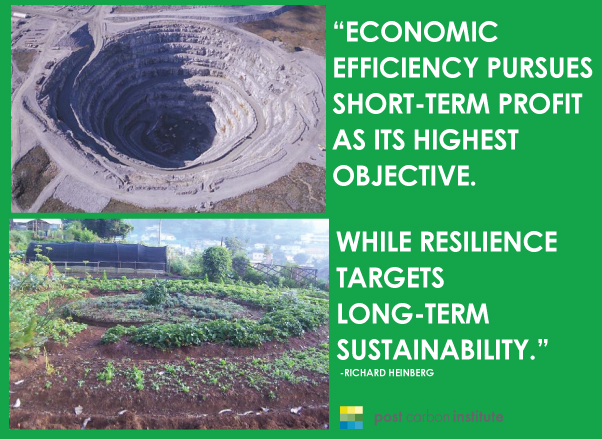
In many respects a resilient society defies the imperative of economic efficiency. Resilience needs dispersed inventories and redundancy, while economic efficiency—in its ruthless pursuit of competitive advantage—eliminates inventories and redundancies everywhere it can. Economic efficiency leads toward globalization, resilience toward localization. Economic efficiency pursues short-term profit as its highest objective, while resilience targets long-term sustainability. It would appear that industrial society circa 2012 has gone about as far in the direction of economic efficiency as it is possible to go, and that a correction is necessary and inevitable. Climate change simply underscores the need for that course correction.
Building resilience means helping society to work more like an ecosystem—and that has major implications for how we use energy. Ecosystems conserve energy by closing nutrient loops: plants capture and chemically store solar energy, which is then circulated as food throughout the food web. Nothing is wasted. We humans—having developed the ability to draw upon ancient, concentrated, cheap, and abundant (though ultimately finite) fossil fuels—have simultaneously adopted the habit of wasting energy on a colossal scale. Our food, transport, manufacturing, and dwelling systems burn through thirty billion barrels of oil and eight billion tons of coal per year; globally, humans use over four hundred quadrillion BTUs of energy in total. Even where energy is not technically going to waste, demand for it could be substantially reduced by redesigning our basic systems. More
Oil, the most economically pivotal of the fossil fuels, is getting more expensive anyway. Cheap, onshore, conventional crude is depleting; its replacements—deepwater oil, tar sands, and tight oil—cost more to produce, in both dollar and environmental terms. Though high oil prices discourage driving (good for the climate), they also precipitate recessions (bad for the economy). While renewable energy sources are our hope for the future and we should be doing everything we can to develop them, it will be decades before they can supply all our energy needs.
In the face of impending environmental and economic shocks, our best strategy is to build resilience throughout society. Resilience is the subject of decades of research by ecologists and social scientists who define it as “the capacity of a system to tolerate disturbance without collapsing into a qualitatively different state that is controlled by a different set of processes.” In other words, resilience is the capacity to absorb shocks, reorganize, and continue functioning.
In many respects a resilient society defies the imperative of economic efficiency. Resilience needs dispersed inventories and redundancy, while economic efficiency—in its ruthless pursuit of competitive advantage—eliminates inventories and redundancies everywhere it can. Economic efficiency leads toward globalization, resilience toward localization. Economic efficiency pursues short-term profit as its highest objective, while resilience targets long-term sustainability. It would appear that industrial society circa 2012 has gone about as far in the direction of economic efficiency as it is possible to go, and that a correction is necessary and inevitable. Climate change simply underscores the need for that course correction.
Building resilience means helping society to work more like an ecosystem—and that has major implications for how we use energy. Ecosystems conserve energy by closing nutrient loops: plants capture and chemically store solar energy, which is then circulated as food throughout the food web. Nothing is wasted. We humans—having developed the ability to draw upon ancient, concentrated, cheap, and abundant (though ultimately finite) fossil fuels—have simultaneously adopted the habit of wasting energy on a colossal scale. Our food, transport, manufacturing, and dwelling systems burn through thirty billion barrels of oil and eight billion tons of coal per year; globally, humans use over four hundred quadrillion BTUs of energy in total. Even where energy is not technically going to waste, demand for it could be substantially reduced by redesigning our basic systems. More
Friday, April 6, 2012
NASA Climate Scientist Compares Climate Change to Slavery
This week, NASA climate scientist James Hansen described climate change as a “great moral issue” similar to the movement to end slavery. He linked the climate change debate with the 19th century struggle to abolish slavery from the United States with his claim that both have enormous consequences and are behind the “injustice of one generation to others.” He made the comments in the lead-up to an award he will receive next week for his contribution to science.

Hansen argued that the lack of action on reversing climate change is handing future generations a world spiraling out of control with vast damage to ecosystems, flooded coastal regions and extreme weather. He will expand upon these comments on Tuesday, when he will receive the Edinburgh Medal. His acceptance speech will focus on his advocacy of a global tax on all carbon emissions.
Hansen first made climate change a topic of everyday discussion when he testified about the issue in front of Congress in the late 1980s. He developed one of the first global warming scientific models and is a prolific writer and researcher. Hansen’s work is frequently cited by climate change activists, including Al Gore. His climate activism has also led to several arrests for his protests against the coal industry and the Keystone pipeline.
Describing climate change as an inter-generational issue, Hansen believes that older generations did not realize their energy usage was causing problems for future generations. Now however, he said, the future will be one of climate-related disasters and species extinction because currently Americans “only pretend we don’t know” about climate science. To slow the effects of climate change, Hansen urges a flat-rate carbon tax to force cuts in fossil fuel consumption. Instead of the tax going into governments’ treasuries, however, the funds would be distributed equally among the public. The tax would then simulate the development of low-carbon energy while forcing the most wasteful energy users to curtail their consumption. Hansen’s heightened rhetoric in recent years, however, has earned him sharp criticism from former allies. More
Saturday, December 24, 2011
UN expert concerned at poor living conditions of Canada's indigenous
20 December 2011 –
An independent United Nations human rights expert has asked Canada to clarify what it is doing to address the “dire” socio-economic conditions of the Attawapiskat aboriginal community, noting that many of its members live in unheated shacks or trailers, with no running water. James Anaya, the Special Rapporteur on the rights of indigenous peoples, said in a news release that he has been in touch with the Canadian Government to voice his deep concern about the conditions of the Attawapiskat First Nation, which he said exemplifies the conditions of many aboriginal communities in the country.

The Attawapiskat First Nation is a remote community in northern Ontario comprised of about 1,800 members. Mr. Anaya noted that the poor living conditions are particularly serious as winter approaches the area, which faces winter temperatures as low as minus 28 degrees Celsius. “The social and economic situation of the Attawapiskat seems to represent the condition of many First Nation communities living on reserves throughout Canada, which is allegedly akin to Third World conditions,” he stated.
“Yet, this situation is not representative of non-aboriginal communities in Canada, a country with overall human rights indicators scoring among the top of all countries of the world.
“Aboriginal communities face vastly higher poverty rights, and poorer health, education, employment rates as compared to non-aboriginal people,” said the expert. More
Wednesday, December 21, 2011
Failure at Durban - Is There a Crime of Ecocide
There is increasing evidence of dangerous, possibly catastrophic, climate change approaching. The latest science leads to the conclusion that limiting climate change to a 2⁰C increase in average global temperature is now not possible.
 The talk will now turn to ‘transition periods’, to ‘preparatory phases’, ‘voluntary targets’, ‘coordinated action’, and ‘bottom-up approaches’. Our national leaders will spin positively into 2012. The ‘realistic expectation’ will focus on the possibility of global agreement by, or after, 2020.
There always was, after all, only a 50% chance. Now it has become a question of which year the threshold will be breached, how high the temperature will rise, over what time period, and what the consequences will be for the planet. Twenty years after Rio – after the legislative framework for effective global coordination to combat climate change was set in place – we arrive at deadlock. The capacity of the global community to solve the over-riding global challenge has proven to be inadequate. The global interest has been torn to shreds by the mindlessly competitive pursuit of excessive national interests.

Subscribe to:
Posts (Atom)