Showing posts with label food. Show all posts

Friday, October 4, 2013

A Fierce Green Fire - Trailer

Spanning 50 years of grassroots and global activism, this Sundance documentary brings to light the vital stories of the environmental movement where people fought -- and succeeded -- against enormous odds. From halting dams in the Grand Canyon to fighting toxic waste at Love Canal; from Greenpeace to Chico Mendes; from climate change to the promise of transforming our civilization, A Fierce Green Fire is "nothing less than the history of environmentalism itself." (Los Angeles Times)

From the Academy Award-nominated director of "Berkeley in the Sixties", and narrated by Robert Redford, Meryl Streep, Ashley Judd, Van Jones and Isabel Allende.

Wednesday, February 27, 2013

Giant Food Corporations Work Hand-In-Glove With Corrupt Government Agencies To Dish Up Cheap, Unhealthy Food

Big Food Is Making Us Sick

The Independent reports that small farmers are being challenged by food companies are becoming insanely concentrated:

Increasingly, a handful of multinationals are tightening their grip on the commodity markets, with potentially dramatic effects for consumers and food producers alike.

***

Three companies now account for more than 40 per cent of global coffee sales, eight companies control the supply of cocoa and chocolate, seven control 85 per cent of tea production, five account for 75 per cent of the world banana trade, and the largest six sugar traders account for about two-thirds of world trade, according to the new publication from the Fairtrade Foundation.

***

This is the year “to put the politics of food on the public agenda and find better solutions to the insanity of our broken food system”.

More people may be shopping ethically – sales of Fairtrade cocoa grew by more than 20 per cent last year to £153m – but, according to the report, the world’s food system is “dangerously out of control”.

How is that effecting the safety of our food supply? Reuters notes:

Multinational food, drink and alcohol companies are using strategies similar to those employed by the tobacco industry to undermine public health policies, health experts said on Tuesday.

In an international analysis of involvement by so-called “unhealthy commodity” companies in health policy-making, researchers from Australia, Britain, Brazil and elsewhere said … that through the aggressive marketing of ultra-processed food and drink, multinational companies were now major drivers of the world’s growing epidemic of chronic diseases such as heart disease, cancer and diabetes.

Writing in The Lancet medical journal, the researchers cited industry documents they said revealed how companies seek to shape health legislation and avoid regulation.

This is done by “building financial and institutional relations” with health professionals, non-governmental organizations and health agencies, distorting research findings, and lobbying politicians to oppose health reforms, they said.

They cited analysis of published research which found systematic bias from industry funding: articles sponsored exclusively by food and drinks companies were between four and eight times more likely to have conclusions that favored the companies than those not sponsored by them.

How are giant food manufacturers trying to influence legislation?

As Waking Times reports, they’re trying to gag all reporting:

States are adopting laws meant to keep consumers in the dark about where their food comes from.

Do you have a right to know where that steak on your plate came from?

Should it be legal to photograph chicken farms and dairy cows?

Big Agriculture says you don’t and it shouldn’t. Armies of Big Ag lobbyists are pushing for new state-level laws across the country to keep us all in the dark. Less restrictive versions have been law in some states since the 1980s, but the meat industry has ratcheted up a radical new campaign.

This wave of “ag-gag” bills would criminalize whistleblowers, investigators, and journalists who expose animal welfare abuses at factory farms and slaughterhouses. Ten states considered “ag-gag” bills last year, and Iowa, Missouri, and Utah approved them. Even more are soon to follow.

Had these laws been in force, the Humane Society might have been prosecuted for documenting repeated animal welfare and food safety violations at Hallmark/Westland, formerly the second-largest supplier of beef to the National School Lunch Program. Cows too sick to walk were being slaughtered and that meat was shipped to our schools, endangering our kids. The investigation led to the largest meat recall in U.S. history.

***

Big Ag wants to silence whistleblowers rather than clean up its act. Ag-gag bills are now pending in Pennsylvania, Arkansas, Indiana, Nebraska, and New Hampshire. Similar legislation may crop up in North Carolina and Minnesota.

The bills aren’t identical, but they share common language — sometimes even word-for-word. Some criminalize anyone who even “records an image or sound” from a factory farm. Others mandate that witnesses report abuses within a few hours, which would make it impossible for whistleblowers to secure advice and protection, or for them to document a pattern of abuses.

Indiana’s version of this cookie-cutter legislation ominously begins with the statement that farmers have the right to “engage in agricultural operations free from the threat of terrorism and interference from unauthorized third persons.” [The Feds are treating people who expose abuse in factory farms as potential terrorists … and the states want the same power.]

Yet these bills aren’t about violence or terrorism. They’re about truth-telling that’s bad for branding. For these corporations, a “terrorist” is anyone who threatens their profits by exposing inhumane practices that jeopardize consumer health.

***

Ag-gag bills aren’t about silencing journalists and whistleblowers. They’re about curbing consumer access to information at a time when more and more Americans want to know where our food comes from and how it’s produced. More


Monday, February 18, 2013

Oil spill firm to pay $400 million to fix Gulf coast

The Deepwater Horizon spill has just provided a $400-million windfall for Louisiana's environment. Transocean, which worked with BP on the stricken Macondo well, pleaded guilty last week to a violation of the US Clean Water Act, and admitted that it was negligent in the 2010 spill.

The resultingmultimillion-dollar fine will be used to pay for a host of environmental projectsaround the Gulf of Mexico.

It is the second largest fine for environmental damage in history, after the $4.5-billion fine BP had to pay out for the same spill. Transocean has two years to pay up in full.

The National Academy of Sciences (NAS) will get $150 million, and another $150 million will go to the National Fish and Wildlife Foundation (NFWF), a non-profit based in Washington DC. The NAS will use its portion to research oil-spill prevention and better ways to respond to spills. The NFWF's Timothy DiCintio says it will distribute its award between the affected Gulf Coast states, for ongoing remediation efforts such as marsh and wetland clean-up.

The remainder of the money will go directly to Louisiana's $50-billion Coastal Master Plan, which aims to restore the state's degraded coastline. The money will fund a host of projects, including restoring barrier island reefs and creating diversions on the Mississippi to repair eroded coasts.

"The way Louisiana looks at it, their coastal problems are so pervasive that the degradation from the spill was a final indignity," says DiCintio. The modifications should not only allow the state to rebuild after the lingering effects of the spill and hurricane Katrina, but also help the coast cope with future disasters. More


Sunday, October 28, 2012

Abuses colour Cambodia's fight for land

Phnom Penh, Cambodia - Nearly three years ago, a few hundred small-scale cassava farmers migrated from a district on Cambodia's eastern border to Kratie, a neighbouring province, where they heard there was farmland available in a village called Broma.

The move was not unusual in this predominantly rural country, where land tenure is shaky and poor farmers often uproot themselves for a chance at acquiring land.

"Villagers went there expecting to make their living from farming. They just wanted to survive," explained Bun Sothea, 22, one of the migrants.

But what supposedly happened next was extraordinary. According to the Cambodian government, the villagers allegedly banded together into a separatist movement and decided to "secede" from the Southeast Asian nation.

This so-called secession culminated in a violent battle between villagers and security forces, in which soldiers shot and killed a 14-year-old girl who had been hiding underneath her house.

After the Khmer Rouge abolished private property and instituted forced communal farming, the country - which never had a strong tradition of land ownership in the first place - was left in economic shambles.

Six months later, a total of 14 people have now been prosecuted and convicted for spearheading the so-called Broma separatist movement, including Mam Sonando, an elderly French-Cambodian who owns one of the few independent radio stations here. He was sentenced earlier this month to 20 years in prison.

But rights groups, internationals observers, and the villagers themselves say that the "secessionist plot" is a convenient fiction manufactured by the Cambodian government to justify the death of the girl, Heng Chantha, during a forced eviction.

'No evidence'

The farmland where the villagers had settled was on the edge of a 15,000-hectare plantation that the government had granted to an agroindustrial firm.

The company allegedly attempted to evict them starting in late 2011 so that it could plant rubber saplings. When villagers resisted, hundreds of police and soldiers sealed off the village and called in a helicopter for backup before storming in-and shooting Chantha in the process.

Both rights workers and villagers insist that arrested radio presenter Sonando did not even have a connection to the events in Broma, other than broadcasting stories about them on his radio station.

"This entire court case was just for hiding the death of the girl during the combat against villagers," says Am Sam Ath, the technical supervisor for Licadho, a human rights group that campaigns against land grabs and forced evictions. "There is no actual evidence proving that there was an insurrection."

Sam Ath, who was blocked from approaching the village on the day of the battle but was able to observe from a distance, said that 1,000 soldiers, police and military police officers had surrounded Broma in all directions. "They tied red cloths to their heads like they were about to go to war."

Land tenure

Although most outsiders still associate this Southeast Asian country with land mines, civil war, and the depredations of the Khmer Rouge regime, the biggest issue facing many Cambodians is one that gets little traction in the international media: land tenure.

After the Khmer Rouge abolished private property and instituted forced communal farming, the country - which never had a strong tradition of land ownership in the first place - was left in an economic shambles.

Although the ultra-Maoist regime was ousted in 1979, an additional decade of Vietnamese-backed Communist rule meant that private property rights were not re-established until the early 1990s.

Since then, despite a few high-profile land titling drives and the creation of the Land Law in 2001, many Cambodians still do not have titles to their homes or farmland, even if they have lived there for decades. More


Wednesday, October 24, 2012

Israel’s formula for a starvation diet

How 400 trucks to feed Gaza became just 67

Jonathan Cook
Six and a half years go, shortly after Hamas won the Palestinian national elections and took charge of Gaza, a senior Israeli official described Israel’s planned response. “The idea,” he said, “is to put the Palestinians on a diet, but not to make them die of hunger.”

Although Dov Weisglass was adviser to Ehud Olmert, the prime minister of the day, few observers treated his comment as more than hyperbole, a supposedly droll characterisation of the blockade Israel was about to impose on the tiny enclave.

Last week, however, the evidence finally emerged to prove that this did indeed become Israeli policy. After a three-year legal battle by an Israeli human rights group, Israel was forced to disclose its so-called “Red Lines” document. Drafted in early 2008, as the blockade was tightened still further, the defence ministry paper set forth proposals on how to treat Hamas-ruled Gaza.

Health officials provided calculations of the minimum number of calories needed by Gaza’s 1.5 million inhabitants to avoid malnutrition. Those figures were then translated into truckloads of food Israel was supposed to allow in each day.

The Israeli media have tried to present these chilling discussions, held in secret, in the best light possible. Even the liberal Haaretz newspaper euphemistically described this extreme form of calorie-counting as designed to “make sure Gaza didn’t starve”.

But a rather different picture emerges as one reads the small print. While the health ministry determined that Gazans needed daily an average of 2,279 calories each to avoid malnutrition – requiring 170 trucks a day – military officials then found a host of pretexts to whittle down the trucks to a fraction of the original figure.

The reality was that, in this period, an average of only 67 trucks – much less than half of the minimum requirement – entered Gaza daily. This compared to more than 400 trucks before the blockade began.

To achieve this large reduction, officials deducted trucks based both on an over-generous assessment of how much food could be grown locally and on differences in the ”culture and experience” of food consumption in Gaza, a rationale never explained.

Gisha, the organisation that fought for the document’s publication, observes that Israeli officials ignored the fact that the blockade had severely impaired Gaza’s farming industry, with a shortage of seeds and chickens that had led to a dramatic drop in food output.

UN staff too have noted that Israel failed to factor in the large quantity of food from each day’s supply of 67 trucks that never actually reached Gaza. That was because Israeli restrictions at the crossings created long delays as food was unloaded, checked and then put on to new trucks. Many items spoiled as they lay in the sun.

And on top of this, Israel further adjusted the formula so that the number of trucks carrying nutrient-poor sugar were doubled while the trucks carrying milk, fruit and vegetables were greatly reduced, sometimes by as much as a half.

Robert Turner, director of the UN refugee agency’s operations in the Gaza Strip, has observed: “The facts on the ground in Gaza demonstrate that food imports consistently fell below the red lines.”

It does not need an expert to conclude that the imposition of this Weisglass-style “diet” would entail widespread malnutrition, especially among children. And that is precisely what happened, as a leaked report from the International Committee of the Red Cross found at the time. “Chronic malnutrition is on a steadily rising trend and micro-nutrient deficiencies are of great concern,” it reported in early 2008. More


Saturday, August 25, 2012

Building Resilience In A Changing Climate - Richard Heinberg

Climate shocks are on the way. We’ve already spewed so much carbon into the atmosphere that a cascade of worsening crop failures, droughts, floods, and freak storms is virtually guaranteed. You, your family, and your community will feel the effects.

Ironically, however, avoiding climate change also has its costs. It makes sense from a climate-protection standpoint to dramatically and rapidly reduce our use of fossil fuels, which drive global warming. But these fuels largely, well, fueled the spectacular economic growth of the past 200 years, and weaning ourselves from them quickly now—while most industrial economies are over-indebted and starved for growth—could risk financial upheaval.

Oil, the most economically pivotal of the fossil fuels, is getting more expensive anyway. Cheap, onshore, conventional crude is depleting; its replacements—deepwater oil, tar sands, and tight oil—cost more to produce, in both dollar and environmental terms. Though high oil prices discourage driving (good for the climate), they also precipitate recessions (bad for the economy). While renewable energy sources are our hope for the future and we should be doing everything we can to develop them, it will be decades before they can supply all our energy needs.

In the face of impending environmental and economic shocks, our best strategy is to build resilience throughout society. Resilience is the subject of decades of research by ecologists and social scientists who define it as “the capacity of a system to tolerate disturbance without collapsing into a qualitatively different state that is controlled by a different set of processes.” In other words, resilience is the capacity to absorb shocks, reorganize, and continue functioning.

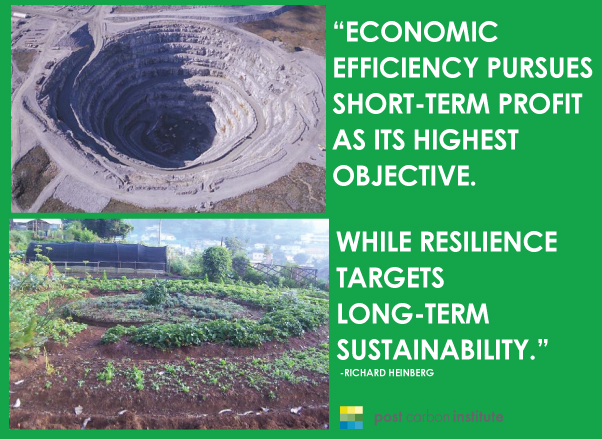
In many respects a resilient society defies the imperative of economic efficiency. Resilience needs dispersed inventories and redundancy, while economic efficiency—in its ruthless pursuit of competitive advantage—eliminates inventories and redundancies everywhere it can. Economic efficiency leads toward globalization, resilience toward localization. Economic efficiency pursues short-term profit as its highest objective, while resilience targets long-term sustainability. It would appear that industrial society circa 2012 has gone about as far in the direction of economic efficiency as it is possible to go, and that a correction is necessary and inevitable. Climate change simply underscores the need for that course correction.

Building resilience means helping society to work more like an ecosystem—and that has major implications for how we use energy. Ecosystems conserve energy by closing nutrient loops: plants capture and chemically store solar energy, which is then circulated as food throughout the food web. Nothing is wasted. We humans—having developed the ability to draw upon ancient, concentrated, cheap, and abundant (though ultimately finite) fossil fuels—have simultaneously adopted the habit of wasting energy on a colossal scale. Our food, transport, manufacturing, and dwelling systems burn through thirty billion barrels of oil and eight billion tons of coal per year; globally, humans use over four hundred quadrillion BTUs of energy in total. Even where energy is not technically going to waste, demand for it could be substantially reduced by redesigning our basic systems. More


Thursday, August 23, 2012

We'll make a killing out of food crisis, Glencore trading boss Chris Mahoney boasts

Drought is good for business, says world's largest commodities trading company

23 August 2012 - The United Nations, aid agencies and the British Government have lined up to attack the world's largest commodities trading company, Glencore, after it described the current global food crisis and soaring world prices as a "good" business opportunity.

With the US experiencing a rerun of the drought "Dust Bowl" days of the 1930s and Russia suffering a similar food crisis that could see Vladimir Putin's government banning grain exports, the senior economist of the UN's Food and Agriculture Organisation, Concepcion Calpe, told The Independent: "Private companies like Glencore are playing a game that will make them enormous profits."

Ms Calpe said leading international politicians and banks expecting Glencore to back away from trading in potential starvation and hunger in developing nations for "ethical reasons" would be disappointed.

"This won't happen," she said. "So now is the time to change the rules and regulations about how Glencore and other multinationals such as ADM and Monsanto operate. They know this and have been lobbying heavily around the world to water down and halt any reform."

Glencore's director of agriculture trading, Chris Mahoney, sparked the controversy when he said: "The environment is a good one. High prices, lots of volatility, a lot of dislocation, tightness, a lot of arbitrage opportunities.

"We will be able to provide the world with solutions... and that should also be good for Glencore."

Glencore announced pre-tax global profits of £1.4bn. The G20 is considering holding an emergency summit on the world food crisis.

Oxfam was scathing about Glencore's exploitation of volatile world food prices. Jodie Thorpe, from the aid agency's Grow Campaign, said: "Glencore's comment that 'high prices and lots of volatility and dislocation' was 'good' gives us a rare glimpse into the little-known world of companies that dominate the global food system." More


Wednesday, April 25, 2012

South Africa’s Smallholders Lose Battle for Seed Security

CAPE TOWN, South Africa, Apr 23, 2012 (IPS) - In an almost ceremonial manner, Selinah Mncwango opens her big plastic bag and pulls out several smaller packets, each filled with different types of seeds: sorghum, bean, pumpkin, and maize. They are her pride, her wealth, the "pillar of my family," says the farmer from a village in South Africa’s KwaZulu-Natal province.

Sixty-five-year-old Mncwango comes from a family of smallholder farmers in the village of Ingwawuma in the east coast province. The crops she grows today are from seeds that have been handed down from generation to generation, over decades, she says. Other seeds come from exchanges with neighbouring farmers. "My seeds are very important to me. I hope the day will never come when I have to buy seeds from a shop," says the farmer, whose five children and eight grandchildren largely depend on her harvest. She is keenly aware of the fact that seed saving, storing and exchanging promotes crop diversity, saves money and provides smallholder farmers with a safety net in case of harvest failures.

But the traditional farming methods of smallholder farmers – which, researchers say, also help to fight soil depletion, reduce irrigation needs and adapt to climate change – may soon disappear. They are being wiped out by governments focused on promoting commercial monocultures that they hope will bring fast, high yields in order to boost national agricultural sales on global markets.

"The sector is dominated by commercial seed companies and industrial agricultural production," explains Rachel Wynberg, policy analyst at the Environmental Evaluation Unit of the University of Cape Town in South Africa. Small-scale farmers have been systematically pushed out of the system by those who put profits before food security and biodiversity, she says.

"There is a poor understanding of small farmers’ rights. Traditional agricultural practices have thus been eroded over decades," she adds.

In South Africa, and in most other countries on the continent, the rights of small-scale farmers are regularly violated by governments and commercial entities that push genetically modified (GM) and hybrid seeds – which have been cross-pollinated in controlled environments – on them. More