Human rights are freedoms established by custom or international agreement that impose standards of conduct on all nations. Human rights are distinct from civil liberties, which are freedoms established by the law of a particular state and applied by that state in its own jurisdiction.
Saturday, August 25, 2012
Building Resilience In A Changing Climate - Richard Heinberg
Ironically, however, avoiding climate change also has its costs. It makes sense from a climate-protection standpoint to dramatically and rapidly reduce our use of fossil fuels, which drive global warming. But these fuels largely, well, fueled the spectacular economic growth of the past 200 years, and weaning ourselves from them quickly now—while most industrial economies are over-indebted and starved for growth—could risk financial upheaval.
Oil, the most economically pivotal of the fossil fuels, is getting more expensive anyway. Cheap, onshore, conventional crude is depleting; its replacements—deepwater oil, tar sands, and tight oil—cost more to produce, in both dollar and environmental terms. Though high oil prices discourage driving (good for the climate), they also precipitate recessions (bad for the economy). While renewable energy sources are our hope for the future and we should be doing everything we can to develop them, it will be decades before they can supply all our energy needs.
In the face of impending environmental and economic shocks, our best strategy is to build resilience throughout society. Resilience is the subject of decades of research by ecologists and social scientists who define it as “the capacity of a system to tolerate disturbance without collapsing into a qualitatively different state that is controlled by a different set of processes.” In other words, resilience is the capacity to absorb shocks, reorganize, and continue functioning.
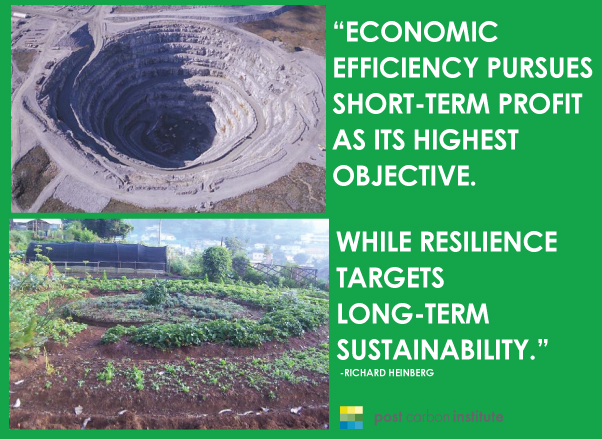
In many respects a resilient society defies the imperative of economic efficiency. Resilience needs dispersed inventories and redundancy, while economic efficiency—in its ruthless pursuit of competitive advantage—eliminates inventories and redundancies everywhere it can. Economic efficiency leads toward globalization, resilience toward localization. Economic efficiency pursues short-term profit as its highest objective, while resilience targets long-term sustainability. It would appear that industrial society circa 2012 has gone about as far in the direction of economic efficiency as it is possible to go, and that a correction is necessary and inevitable. Climate change simply underscores the need for that course correction.
Building resilience means helping society to work more like an ecosystem—and that has major implications for how we use energy. Ecosystems conserve energy by closing nutrient loops: plants capture and chemically store solar energy, which is then circulated as food throughout the food web. Nothing is wasted. We humans—having developed the ability to draw upon ancient, concentrated, cheap, and abundant (though ultimately finite) fossil fuels—have simultaneously adopted the habit of wasting energy on a colossal scale. Our food, transport, manufacturing, and dwelling systems burn through thirty billion barrels of oil and eight billion tons of coal per year; globally, humans use over four hundred quadrillion BTUs of energy in total. Even where energy is not technically going to waste, demand for it could be substantially reduced by redesigning our basic systems. More
Friday, April 6, 2012
NASA Climate Scientist Compares Climate Change to Slavery
This week, NASA climate scientist James Hansen described climate change as a “great moral issue” similar to the movement to end slavery. He linked the climate change debate with the 19th century struggle to abolish slavery from the United States with his claim that both have enormous consequences and are behind the “injustice of one generation to others.” He made the comments in the lead-up to an award he will receive next week for his contribution to science.
Hansen argued that the lack of action on reversing climate change is handing future generations a world spiraling out of control with vast damage to ecosystems, flooded coastal regions and extreme weather. He will expand upon these comments on Tuesday, when he will receive the Edinburgh Medal. His acceptance speech will focus on his advocacy of a global tax on all carbon emissions.
Hansen first made climate change a topic of everyday discussion when he testified about the issue in front of Congress in the late 1980s. He developed one of the first global warming scientific models and is a prolific writer and researcher. Hansen’s work is frequently cited by climate change activists, including Al Gore. His climate activism has also led to several arrests for his protests against the coal industry and the Keystone pipeline.
Describing climate change as an inter-generational issue, Hansen believes that older generations did not realize their energy usage was causing problems for future generations. Now however, he said, the future will be one of climate-related disasters and species extinction because currently Americans “only pretend we don’t know” about climate science. To slow the effects of climate change, Hansen urges a flat-rate carbon tax to force cuts in fossil fuel consumption. Instead of the tax going into governments’ treasuries, however, the funds would be distributed equally among the public. The tax would then simulate the development of low-carbon energy while forcing the most wasteful energy users to curtail their consumption. Hansen’s heightened rhetoric in recent years, however, has earned him sharp criticism from former allies. More
Saturday, December 24, 2011
UN expert concerned at poor living conditions of Canada's indigenous
The Attawapiskat First Nation is a remote community in northern Ontario comprised of about 1,800 members. Mr. Anaya noted that the poor living conditions are particularly serious as winter approaches the area, which faces winter temperatures as low as minus 28 degrees Celsius. “The social and economic situation of the Attawapiskat seems to represent the condition of many First Nation communities living on reserves throughout Canada, which is allegedly akin to Third World conditions,” he stated.
Wednesday, December 21, 2011
Failure at Durban - Is There a Crime of Ecocide
The realistic prescription, from the UN and research institutes, is that global emissions need to peak between 2015 and ’17.
Historians, assuming sufficient social stability for dispassionate analysis a half-century from now, will search for reasons for our collective failure during the critical twenty-year period, 1992 – 2012. They will conclude that human technology outpaced human institutional capacity for rational decision-making. National leaders responded, as constitutionally and politically obliged, to national interest. More