Showing posts with label agriculture. Show all posts

Friday, May 16, 2014

Never stop being outraged by injustice


Dear friends,


Although I became an Elder last year, this is my first time writing to all of you, so to introduce myself: I am a lawyer and human rights defender. My background is in the women’s rights movement in Pakistan, where I still live and work.


As a human rights lawyer, I look at every issue through a human rights lens. This is particularly important for climate change, which cannot be understood as a purely scientific, environmental issue. Above all, climate change affects people – and the most vulnerable among us are affected most of all.


Jimmy Carter, Mary Robinson and I discussed this very topic with young activists, students and entrepreneurs in Paris last month. These young people are rightly outraged by the injustice of climate change. They are frustrated with political leaders who, by failing to act, are condemning their generation and future generations to a world of conflict, hardship and inequity. My message to these and all young people is: never stop being outraged. Never allow yourselves to become apathetic and pessimistic.


In turn, we Elders were inspired by what we saw and heard during that debate. A room full of young people determined to put their energy into mobilising their fellow citizens, challenging leaders and corporations, changing their own lifestyles, and working together across borders to find solutions to climate change.


It was a privilege to be asked to join The Elders, a group with with no vested interests apart from our common humanity, who are unafraid to speak truth to power. And I have been glad to see that even with our combined experience and influence, we do not underestimate the importance of listening to our ‘Youngers’. I look forward to many more such productive and inspiring discussions.


Best wishes,


Hina Jilani


Friday, October 4, 2013

A Fierce Green Fire - Trailer

Spanning 50 years of grassroots and global activism, this Sundance documentary brings to light the vital stories of the environmental movement where people fought -- and succeeded -- against enormous odds. From halting dams in the Grand Canyon to fighting toxic waste at Love Canal; from Greenpeace to Chico Mendes; from climate change to the promise of transforming our civilization, A Fierce Green Fire is "nothing less than the history of environmentalism itself." (Los Angeles Times)

From the Academy Award-nominated director of "Berkeley in the Sixties", and narrated by Robert Redford, Meryl Streep, Ashley Judd, Van Jones and Isabel Allende.

Wednesday, May 22, 2013

The Goodman Affair: Monsanto Targets the Heart of Science

Richard Smith, former editor of the British Medical Journal, has jested that instead of scientific peer review, its rival The Lancet had a system of throwing a pile of papers down the stairs and publishing those that reached the bottom. On another occasion, Smith was challenged to publish an issue of theBMJ exclusively comprising papers that had failed peer review and see if anybody noticed. He replied, “How do you know I haven’t already done it?”

Richard E Goodman

As Smith’s stories show, journal editors have a lot of power in science – power that provides opportunities for abuse. The life science industry knows this, and has increasingly moved to influence and control science publishing.

The strategy, often with the willing cooperation of publishers, is effective and sometimes blatant. In 2009, the scientific publishing giant Elsevier was found to have invented an entire medical journal, complete with editorial board, in order to publish papers promoting the products of the pharmaceutical manufacturer Merck. Merck provided the papers, Elsevier published them, and doctors read them, unaware that the Australasian Journal of Bone and Joint Medicine was simply a stuffed dummy.

Fast forward to September 2012, when the scientific journal Food and Chemical Toxicology (FCT) published a study that caused an international storm (Séralini, et al. 2012). The study, led by Prof Gilles-Eric Séralini of the University of Caen, France, suggested a Monsanto genetically modified (GM) maize, and the Roundup herbicide it is grown with, pose serious health risks. The two-year feeding study found that rats fed both suffered severe organ damage and increased rates of tumors and premature death. Both the herbicide (Roundup) and the GM maize are Monsanto products. Corinne Lepage, France’s former environment minister, called the study “a bomb”.

Subsequently, an orchestrated campaign was launched to discredit the study in the media and persuade the journal to retract it. Many of those who wrote letters to FCT (which is published by Elsevier) had conflicts of interest with the GM industry and its lobby groups, though these were not publicly disclosed.

The journal did not retract the study. But just a few months later, in early 2013 the FCT editorial board acquired a new “Associate Editor for biotechnology”, Richard E. Goodman. This was a new position, seemingly established especially for Goodman in the wake of the “Séralini affair”.

Richard E. Goodman is professor at the Food Allergy Research and Resource Program, University of Nebraska. But he is also a former Monsanto employee, who worked for the company between 1997 and 2004. While at Monsanto he assessed the allergenicity of the company’s GM crops and published papers on its behalf on allergenicity and safety issues relating to GM food (Goodman and Leach 2004).

Goodman had no documented connection to the journal until February 2013. His fast-tracked appointment, directly onto the upper editorial board raises urgent questions. Does Monsanto now effectively decide which papers on biotechnology are published in FCT? And is this part of an attempt by Monsanto and the life science industry to seize control of science?

To equate one journal with “science” may seem like an exaggeration. But peer-reviewed publication, in the minds of most scientists, is science. Once a paper is published in an academic journal it enters the canon and stands with the discovery of plate tectonics or the structure of DNA. All other research, no matter how groundbreaking or true, is irrelevant. As a scientist once scathingly said of the “commercially confidential” industry safety data that underpin approvals of chemicals and GM foods, “If it isn’t published, it doesn’t exist.”

Goodman’s ILSI links

The industry affiliations of FCT’s new gatekeeper for biotechnology are not restricted to having worked directly for Monsanto. Goodman has an active and ongoing involvement with the International Life Sciences Institute (ILSI). ILSI is funded by the multinational GM and agrochemical companies, including Monsanto. It develops industry-friendly risk assessment methods for GM foods and chemical food contaminants and inserts them into government regulations.

ILSI describes itself as a public interest non-profit but its infiltration of regulatory agencies and influence on risk assessment policy has become highly controversial in North America and Europe. In 2005 US-based non-profits and trade unions wrote to the World Health Organization (WHO) protesting against ILSI’s influence on international health standards protecting food and water supplies. As a result, the WHO barred ILSI from taking part in WHO activities setting safety standards, because of its funding sources. And in Europe in 2012, Diana Banati, then head of the management board at the European Food Safety Authority (EFSA), had to resign over her undisclosed long-standing involvement with ILSI (Robinson et al. 2013).

Goodman’s appointment to FCT is surprising also for the fact that the journal already has expertise in GM food safety. Of the four senior editors, José L. Domingo is a professor of toxicology and environmental health and author of two comprehensive reviews of GM food safety studies (Domingo 2007; Domingo and Bordonaba 2011). Both reviews expressed skepticism of the thesis that GMOs are safe. Consequently, it is far from clear why FCT needs an “associate editor for biotechnology”, but it is clear why Monsanto would have an interest in ensuring that the “Séralini affair” is never repeated.

Editing the scientific record: The case of Paul Christou

FCT is not the only academic journal that appears to have been captured by commercial interests. After the initial campaign failed to get FCT to retract the Séralini study, the journal Transgenic Researchpublished a heavy-handed critique of the study and of the researchers themselves (Arjo et al., 2013). The lead author of that critique was Paul Christou.

Christou and co-authors castigated the editor of FCT for publishing the study, calling it “a clear and egregious breach of the standards of scientific publishing”. They insisted that the journal editor retract the study “based on its clearly flawed data, its breaches of ethical standards, and the strong evidence for scientific misconduct and abuse of the peer-review process”. “Even a full retraction of the Séralini article” wrote Christou, “will not cleanse the Internet of the inflammatory images of tumorous rats.”

The same writers further implied that the Séralini study was “fraudulent”, that the researchers failed to analyse the data objectively, and that the treatment of the experimental animals was inhumane.

This is not the first time Christou has attacked scientific findings that have raised doubts about GM crops. In 2001 Ignacio Chapela and David Quist of the University of California, Berkeley, reported in the journal Nature that indigenous Mexican maize varieties had become contaminated with GM genes (Quist and Chapela, 2001). This issue was, and remains, highly controversial since Mexico is the genetic centre of origin for maize. In an exact parallel with the Séralini study, an internet campaign was waged against Chapela and Quist demanding that the journal retract the study. Then Christou, just as he was later to do with the Séralini study, attacked Chapela and Quist’s paper in an article in Transgenic Research. The title said it all: “No credible scientific evidence is presented to support claims that transgenic DNA was introgressed into traditional maize landraces in Oaxaca, Mexico” (Christou, 2002).

Responding to the campaign, Nature editor Philip Campbell asked Chapela and Quist for more data, which they provided, and arranged another round of peer review. Only one reviewer in the final group of three supported retraction, and no one had presented any data or analysis that contradicted Chapela and Quist’s main finding. Nevertheless, Nature asserted, “The evidence available is not sufficient to justify the publication of the original paper”. Some subsequent investigations, testing different samples, reported finding GM genes in native landraces of Mexican corn (Pineyro-Nelson et al. 2009), while others did not (Ortiz-Garcia et al. 2005).

Paul Christou, in contrast, probably did not have much trouble getting either of his critiques published inTransgenic Research. He is the journal’s editor-in-chief. And, like Goodman, Christou is connected to Monsanto. Monsanto bought the GM seed company Agracetus (Christou’s former employer) and Monsanto now holds patents for the production of GM crops on which Christou is named as the inventor. It is normal practice to declare inventor status on patents as a competing interest in scientific articles, but Christou did not disclose either conflict of interest – his editorship of the journal or his patent inventor status – in his critique of the Séralini study.

The Ermakova affair: Preemptive editing of the scientific record

Not only can journal editors prevent the publication of research showing problems with GM crops in their own journals – they can effectively prevent publication elsewhere. In 2007, the leading academic journal Nature Biotechnology featured an extraordinary attack on the work of Russian scientist, Irina Ermakova (Marshall, 2007). Her laboratory research had found decreased weight gain, increased mortality, and decreased fertility in rats fed GM Roundup-tolerant soy over several generations (Ermakova, 2006; Ermakova, 2009). More


Saturday, April 13, 2013

Seeds of suicide

“Monsanto is an agricultural company.

We apply innovation and technology to help farmers around the world produce more while conserving more.”

“Producing more, Conserving more, Improving farmers lives.”

Mar 27, 2013 - Control over seed is the first link in the food chain because seed is the source of life. When a corporation controls seed, it controls life, especially the life of farmers.

Monsanto’s concentrated control over the seed sector in India as well as across the world is very worrying. This is what connects farmers’ suicides in India to Monsanto vs Percy Schmeiser in Canada, to Monsanto vs Bowman in the US, and to farmers in Brazil suing Monsanto for $2.2 billion for unfair collection of royalty.

These are the promises Monsanto India’s website makes, alongside pictures of smiling, prosperous farmers from the state of Maharashtra. This is a desperate attempt by Monsanto and its PR machinery to delink the epidemic of farmers’ suicides in India from the company’s growing control over cotton seed supply — 95 per cent of India’s cotton seed is now controlled by Monsanto.

Monsanto’s talk of ‘technology’ tries to hide its real objectives of control over seed where genetic engineering is a means to control seed

Through patents on seed, Monsanto has become the “Life Lord” of our planet, collecting rents for life’s renewal from farmers, the original breeders.

Patents on seed are illegitimate because putting a toxic gene into a plant cell is not “creating” or “inventing” a plant. These are seeds of deception — the deception that Monsanto is the creator of seeds and life; the deception that while Monsanto sues farmers and traps them in debt, it pretends to be working for farmers’ welfare, and the deception that GMOs feed the world. GMOs are failing to control pests and weeds, and have instead led to the emergence of superpests and superweeds.

The entry of Monsanto in the Indian seed sector was made possible with a 1988 Seed Policy imposed by the World Bank, requiring the Government of India to deregulate the seed sector. Five things changed with Monsanto’s entry: First, Indian companies were locked into joint-ventures and licensing arrangements, and concentration over the seed sector increased. Second, seed which had been the farmers’ common resource became the “intellectual property” of Monsanto, for which it started collecting royalties, thus raising the costs of seed. Third, open pollinated cotton seeds were displaced by hybrids, including GMO hybrids. A renewable resource became a non-renewable, patented commodity. Fourth, cotton which had earlier been grown as a mixture with food crops now had to be grown as a monoculture, with higher vulnerability to pests, disease, drought and crop failure. Fifth, Monsanto started to subvert India’s regulatory processes and, in fact, started to use public resources to push its non-renewable hybrids and GMOs through so-called public-private partnerships (PPP).

In 1995, Monsanto introduced its Bt technology in India through a joint-venture with the Indian company Mahyco. In 1997-98, Monsanto started open field trials of its GMO Bt cotton illegally and announced that it would be selling the seeds commercially the following year. India has rules for regulating GMOs since 1989, under the Environment Protection Act. It is mandatory to get approval from the Genetic Engineering Approval Committee under the ministry of environment for GMO trials. The Research Foundation for Science, Technology and Ecology sued Monsanto in the Supreme Court of India and Monsanto could not start the commercial sales of its Bt cotton seeds until 2002.

And, after the damning report of India’s parliamentary committee on Bt crops in August 2012, the panel of technical experts appointed by the Supreme Court recommended a 10-year moratorium on field trials of all GM food and termination of all ongoing trials of transgenic crops.

But it had changed Indian agriculture already.

Monsanto’s seed monopolies, the destruction of alternatives, the collection of superprofits in the form of royalties, and the increasing vulnerability of monocultures has created a context for debt, suicides and agrarian distress which is driving the farmers’ suicide epidemic in India. This systemic control has been intensified with Bt cotton. That is why most suicides are in the cotton belt.

An internal advisory by the agricultural ministry of India in January 2012 had this to say to the cotton-growing states in India — “Cotton farmers are in a deep crisis since shifting to Bt cotton. The spate of farmer suicides in 2011-12 has been particularly severe among Bt cotton farmers.”

The highest acreage of Bt cotton is in Maharashtra and this is also where the highest farmer suicides are. Suicides increased after Bt cotton was introduced — Monsanto’s royalty extraction, and the high costs of seed and chemicals have created a debt trap. According to Government of India data, nearly 75 per cent rural debt is due to purchase inputs. As Monsanto’s profits grow, farmers’ debt grows. It is in this systemic sense that Monsanto’s seeds are seeds of suicide.

The ultimate seeds of suicide is Monsanto’s patented technology to create sterile seeds. (Called “Terminator technology” by the media, sterile seed technology is a type of Gene Use Restriction Technology, GRUT, in which seed produced by a crop will not grow — crops will not produce viable offspring seeds or will produce viable seeds with specific genes switched off.) The Convention on Biological Diversity has banned its use, otherwise Monsanto would be collecting even higher profits from seed.

Monsanto’s talk of “technology” tries to hide its real objectives of ownership and control over seed where genetic engineering is just a means to control seed and the food system through patents and intellectual property rights.

A Monsanto representative admitted that they were “the patient’s diagnostician, and physician all in one” in writing the patents on life-forms, from micro-organisms to plants, in the TRIPS’ agreement of WTO. Stopping farmers from saving seeds and exercising their seed sovereignty was the main objective. Monsanto is now extending its patents to conventionally bred seed, as in the case of broccoli and capsicum, or the low gluten wheat it had pirated from India which we challenged as a biopiracy case in the European Patent office.

That is why we have started Fibres of Freedom in the heart of Monsanto’s Bt cotton/suicide belt in Vidharba. We have created community seed banks with indigenous seeds and helped farmers go organic. No GMO seeds, no debt, no suicides.

The writer is the executive director of the Navdanya Trust More


Seeds of suicide

“Monsanto is an agricultural company.

We apply innovation and technology to help farmers around the world produce more while conserving more.”

“Producing more, Conserving more, Improving farmers lives.”

Mar 27, 2013 - Control over seed is the first link in the food chain because seed is the source of life. When a corporation controls seed, it controls life, especially the life of farmers.

Monsanto’s concentrated control over the seed sector in India as well as across the world is very worrying. This is what connects farmers’ suicides in India to Monsanto vs Percy Schmeiser in Canada, to Monsanto vs Bowman in the US, and to farmers in Brazil suing Monsanto for $2.2 billion for unfair collection of royalty.

These are the promises Monsanto India’s website makes, alongside pictures of smiling, prosperous farmers from the state of Maharashtra. This is a desperate attempt by Monsanto and its PR machinery to delink the epidemic of farmers’ suicides in India from the company’s growing control over cotton seed supply — 95 per cent of India’s cotton seed is now controlled by Monsanto.

Monsanto’s talk of ‘technology’ tries to hide its real objectives of control over seed where genetic engineering is a means to control seed

Through patents on seed, Monsanto has become the “Life Lord” of our planet, collecting rents for life’s renewal from farmers, the original breeders.

Patents on seed are illegitimate because putting a toxic gene into a plant cell is not “creating” or “inventing” a plant. These are seeds of deception — the deception that Monsanto is the creator of seeds and life; the deception that while Monsanto sues farmers and traps them in debt, it pretends to be working for farmers’ welfare, and the deception that GMOs feed the world. GMOs are failing to control pests and weeds, and have instead led to the emergence of superpests and superweeds.

The entry of Monsanto in the Indian seed sector was made possible with a 1988 Seed Policy imposed by the World Bank, requiring the Government of India to deregulate the seed sector. Five things changed with Monsanto’s entry: First, Indian companies were locked into joint-ventures and licensing arrangements, and concentration over the seed sector increased. Second, seed which had been the farmers’ common resource became the “intellectual property” of Monsanto, for which it started collecting royalties, thus raising the costs of seed. Third, open pollinated cotton seeds were displaced by hybrids, including GMO hybrids. A renewable resource became a non-renewable, patented commodity. Fourth, cotton which had earlier been grown as a mixture with food crops now had to be grown as a monoculture, with higher vulnerability to pests, disease, drought and crop failure. Fifth, Monsanto started to subvert India’s regulatory processes and, in fact, started to use public resources to push its non-renewable hybrids and GMOs through so-called public-private partnerships (PPP).

In 1995, Monsanto introduced its Bt technology in India through a joint-venture with the Indian company Mahyco. In 1997-98, Monsanto started open field trials of its GMO Bt cotton illegally and announced that it would be selling the seeds commercially the following year. India has rules for regulating GMOs since 1989, under the Environment Protection Act. It is mandatory to get approval from the Genetic Engineering Approval Committee under the ministry of environment for GMO trials. The Research Foundation for Science, Technology and Ecology sued Monsanto in the Supreme Court of India and Monsanto could not start the commercial sales of its Bt cotton seeds until 2002.

And, after the damning report of India’s parliamentary committee on Bt crops in August 2012, the panel of technical experts appointed by the Supreme Court recommended a 10-year moratorium on field trials of all GM food and termination of all ongoing trials of transgenic crops.

But it had changed Indian agriculture already.

Monsanto’s seed monopolies, the destruction of alternatives, the collection of superprofits in the form of royalties, and the increasing vulnerability of monocultures has created a context for debt, suicides and agrarian distress which is driving the farmers’ suicide epidemic in India. This systemic control has been intensified with Bt cotton. That is why most suicides are in the cotton belt.

An internal advisory by the agricultural ministry of India in January 2012 had this to say to the cotton-growing states in India — “Cotton farmers are in a deep crisis since shifting to Bt cotton. The spate of farmer suicides in 2011-12 has been particularly severe among Bt cotton farmers.”

The highest acreage of Bt cotton is in Maharashtra and this is also where the highest farmer suicides are. Suicides increased after Bt cotton was introduced — Monsanto’s royalty extraction, and the high costs of seed and chemicals have created a debt trap. According to Government of India data, nearly 75 per cent rural debt is due to purchase inputs. As Monsanto’s profits grow, farmers’ debt grows. It is in this systemic sense that Monsanto’s seeds are seeds of suicide.

The ultimate seeds of suicide is Monsanto’s patented technology to create sterile seeds. (Called “Terminator technology” by the media, sterile seed technology is a type of Gene Use Restriction Technology, GRUT, in which seed produced by a crop will not grow — crops will not produce viable offspring seeds or will produce viable seeds with specific genes switched off.) The Convention on Biological Diversity has banned its use, otherwise Monsanto would be collecting even higher profits from seed.

Monsanto’s talk of “technology” tries to hide its real objectives of ownership and control over seed where genetic engineering is just a means to control seed and the food system through patents and intellectual property rights.

A Monsanto representative admitted that they were “the patient’s diagnostician, and physician all in one” in writing the patents on life-forms, from micro-organisms to plants, in the TRIPS’ agreement of WTO. Stopping farmers from saving seeds and exercising their seed sovereignty was the main objective. Monsanto is now extending its patents to conventionally bred seed, as in the case of broccoli and capsicum, or the low gluten wheat it had pirated from India which we challenged as a biopiracy case in the European Patent office.

That is why we have started Fibres of Freedom in the heart of Monsanto’s Bt cotton/suicide belt in Vidharba. We have created community seed banks with indigenous seeds and helped farmers go organic. No GMO seeds, no debt, no suicides.

The writer is the executive director of the Navdanya Trust More


Wednesday, April 3, 2013

The "Massive Con" Causing a Suicide Every 30 Minutes

According to the authors of the NYU report:

"While striking on their own, these figures considerably underestimate the actual number of farmer suicides taking place. Women, for example, are often excluded from farmer suicide statistics because most do not have title to land—a common prerequisite for being recognized as a farmer in official statistics and programs."

The general trend over time is increasing suicides, despite the generally decreasing numbers of Indians performing farming each year, which makes the statistics even starker: It's estimated that more than 250,000 Indian farmers have committed suicide so far. But this problem is not limited to India, as the suicide rate for farmers is higher worldwide than for the non-farming population.

In the Midwestern U.S., suicide rates among male farmers are twice that of the overall population. In Britain, one farmer commits suicide every week.v

For every Indian farmer who takes his own life, a family is hounded by the debt he leaves behind, typically resulting in children dropping out of school to become farmhands, and surviving family members themselves frequently committing suicide out of hopelessness and despair. The Indian government's response to the crisis—largely in the form of limited debt relief and compensation programs—has failed to address the magnitude and scope of the problem or its underlying causes.

More

Monday, March 25, 2013

Israel appropriates 82% of Palestinian water

A Palestinian water expert has criticised the 1993 Oslo Peace Agreement signed between the Palestinians and the Israelis for giving Israel the right to control Palestinian water.

The Director of the Association of Palestinian Hydrologists, Abur-Rahman Al-Tamimi, said: "The Oslo Agreements gave control over basic water resources to the Israelis. The role of the Palestinian side was limited to serving it."

During a discussion panel in Ramallah, Al-Tamimi said: "The problem emerged when the Palestinians agreed to postpone the issue of water to final status negotiations. They did not even discuss the issue of irrigation water." He said the Israelis steal about 82 per cent of Palestinian water.

Al-Tamimi severely criticised the "Palestinian negotiators who ignored the rights of the Palestinians regarding water."

At the same time, he said: "The agreements laid down the right of the Israelis to the water of the River Jordan. It also laid down their rights to veto against any future talks regarding it."

The Palestinian expert also added: "The agreements included the rights of the Israeli to control all Palestinian water wells."

Regarding the future of Palestinian water, Al-Tamimi said: "As the Israelis completely control Palestinian water resources, future conflict in the region will be over water resources." More


Saturday, March 9, 2013

Researcher uncovers hidden facts of Israeli-Palestinian water politics

The Israeli government has been forcing the Palestinian Authority into approving water infrastructure for illegal West Bank settlements for the past 15 years, according to research by a University of Sussex academic.

The research by Senior Lecturer in International Relations Dr Jan Selby is published today (5 February 2013) in the journal Water Alternatives.1

It presents the first known evidence of the Palestinian Authority lending its official consent to parts of Israel’s settlement expansion programme.

Settlements and related infrastructure are illegal under international law, and are recognised as one of the major obstacles to a two-state solution to the Israeli-Palestinian conflict.

The research is based on minutes of the Joint Water Committee – an Israeli-Palestinian body often upheld as an example of good Israeli-Palestinian relations – and interviews with participants. Dr Selby concludes that:

  • Israel has repeatedly made its approval of improvements to Palestinian water supplies conditional upon Palestinian Authority approval of new water facilities for Israeli settlements;
  • the Palestinians, who face serious water shortage issues and an underdeveloped supply system, have given this approval in almost every case;
  • the arrangement was known about by former Palestinian leader Yasser Arafat and current President Abu Mazen;
  • international donors have known that Israel’s approval of donor-funded projects for Palestinians is conditional on Palestinian approval of Israeli settlement infrastructures, but have preferred to remain silent on the issue;
  • the Palestinian water crisis in the West Bank has significantly worsened since the creation of the Joint Water Committee.


Dr Selby says: “None of the parties emerge very well from these findings. Israel has been exploiting Palestinian desperation for improved water supplies. The Palestinian Authority has been pressured into consenting to its own colonisation and has not contested Israel’s cynical tactics as forcefully as it might have done.

“And international donors have variously stood by or been complicit in activity which is contrary to international law, and contrary to their own policies on the peace process, and which has helped to undermine the possibility of a two state solution.” More


Sunday, October 28, 2012

Abuses colour Cambodia's fight for land

Phnom Penh, Cambodia - Nearly three years ago, a few hundred small-scale cassava farmers migrated from a district on Cambodia's eastern border to Kratie, a neighbouring province, where they heard there was farmland available in a village called Broma.

The move was not unusual in this predominantly rural country, where land tenure is shaky and poor farmers often uproot themselves for a chance at acquiring land.

"Villagers went there expecting to make their living from farming. They just wanted to survive," explained Bun Sothea, 22, one of the migrants.

But what supposedly happened next was extraordinary. According to the Cambodian government, the villagers allegedly banded together into a separatist movement and decided to "secede" from the Southeast Asian nation.

This so-called secession culminated in a violent battle between villagers and security forces, in which soldiers shot and killed a 14-year-old girl who had been hiding underneath her house.

After the Khmer Rouge abolished private property and instituted forced communal farming, the country - which never had a strong tradition of land ownership in the first place - was left in economic shambles.

Six months later, a total of 14 people have now been prosecuted and convicted for spearheading the so-called Broma separatist movement, including Mam Sonando, an elderly French-Cambodian who owns one of the few independent radio stations here. He was sentenced earlier this month to 20 years in prison.

But rights groups, internationals observers, and the villagers themselves say that the "secessionist plot" is a convenient fiction manufactured by the Cambodian government to justify the death of the girl, Heng Chantha, during a forced eviction.

'No evidence'

The farmland where the villagers had settled was on the edge of a 15,000-hectare plantation that the government had granted to an agroindustrial firm.

The company allegedly attempted to evict them starting in late 2011 so that it could plant rubber saplings. When villagers resisted, hundreds of police and soldiers sealed off the village and called in a helicopter for backup before storming in-and shooting Chantha in the process.

Both rights workers and villagers insist that arrested radio presenter Sonando did not even have a connection to the events in Broma, other than broadcasting stories about them on his radio station.

"This entire court case was just for hiding the death of the girl during the combat against villagers," says Am Sam Ath, the technical supervisor for Licadho, a human rights group that campaigns against land grabs and forced evictions. "There is no actual evidence proving that there was an insurrection."

Sam Ath, who was blocked from approaching the village on the day of the battle but was able to observe from a distance, said that 1,000 soldiers, police and military police officers had surrounded Broma in all directions. "They tied red cloths to their heads like they were about to go to war."

Land tenure

Although most outsiders still associate this Southeast Asian country with land mines, civil war, and the depredations of the Khmer Rouge regime, the biggest issue facing many Cambodians is one that gets little traction in the international media: land tenure.

After the Khmer Rouge abolished private property and instituted forced communal farming, the country - which never had a strong tradition of land ownership in the first place - was left in an economic shambles.

Although the ultra-Maoist regime was ousted in 1979, an additional decade of Vietnamese-backed Communist rule meant that private property rights were not re-established until the early 1990s.

Since then, despite a few high-profile land titling drives and the creation of the Land Law in 2001, many Cambodians still do not have titles to their homes or farmland, even if they have lived there for decades. More


Thursday, October 4, 2012

The new expropriation regime in the West Bank

Week 2362 of Occupation

Israel’s takeover of West Bank lands for settlement construction has proceeded without interruption since 1967. But the legal strategies for carrying out land acquisition and legitimating it in the eyes of the Israeli public and the international community have evolved over the 45 years. There are now signs that the regime of expropriation is once again changing its shape, this time making even fewer concessions to international law and opinion.

Since the beginning of Israel’s occupation of the West Bank, Israeli courts have allowed the army to expropriate private Palestinian-owned land. International law allows for the occupier’s use of land in cases of “military necessity,” and Israel’s High Court of Justice gave “military necessity” an extremely liberal interpretation, in effect allowing seizure of land whenever the military authorities claimed that it would benefit the security of the state.
Thus many of the early settlements were established on private land seized by the army and legitimated by the court. That was until 1979, when the High Court of Justice, in the face of a flagrant mockery of the spirit of international law, ruled that the military could not confiscate land for the sole purpose, with no security rationale, of establishing a permanent settlement. The extreme religious settlement of Elon Moreh was forced to relocate, and the era of military pretexts for the theft of private land for settlements was brought to a close.
But of course the Elon Moreh decision did not slow the acquisition of Palestinian land for the illegal settlement enterprise. It led to two new techniques. The first involved the spurious legal distinction between private Palestinian lands, and “state lands” to which no one held legal title. The court declared that private land could not be used for settlements (although military requisition was still approved), but state lands were fair game. Thus the courts created a legal avenue for the theft of lands, some of which had been cultivated for many generations, and all of which constitute the only territory left for the future Palestinian state.
The other consequence of the landmark Elon Moreh decision was the practice of seizing hilltops and claiming unauthorized but unofficially-sanctioned outposts. The networks of religious settler activists, and well placed bureaucrats in the ministries of defense and housing continued to spread across the central spine of the West Bank, oblivious to whom the land’s legal owners might be. The Elon Moreh ruling was bypassed as settlers grabbed hilltops, while government agencies quickly connected them to the electric grid, water services, and road network.
Now this thirty-year-old regime of land acquisition, with its dual offensives of legal procedure for so-called “state lands,” and after-the-fact normalization of illegal “outposts,” might be undergoing another transformation. Recent years have placed some obstacles in the path of the settler movements, from the work of Peace Now, to Dalia Sasson’s government-sponsored expose of the deeply rooted corruption that enables the illegal settlements. And most recently, in July of this year, a government-appointed commission headed by retired jurist Edmond Levy called for an end to the two-faced policy of unofficially promoting outposts while officially placing them outside the law. The Levy commission called for the immediate legalization of the outposts, even preserving those built on private Palestinian land, perhaps compensating the owners. More


Sunday, September 23, 2012

Two pipes for two peoples: The politics of water in the West Bank

The 's Civil Administration is preventing the Palestinian Authority from laying a water pipe that would alleviate the acute water shortage for more than 600,000 Palestinians in the West Bank.

The reason given for preventing the pipe's construction is that a section of less than two kilometers of it, laid on the margins of Route 50, would disrupt passenger traffic on the road.

The annual water amount provided to the district is about 20 million cubic meters - some 90 liters per capita per day. A considerable part of the water is lost on the way due to leaks and faulty connections.

The district needs an additional 13 million cubic meters a year for domestic use, apart from farming. From May to October the water to the Palestinians in the area is severely rationed. Some neighborhoods have water for a few hours once a week, others twice a month or less.

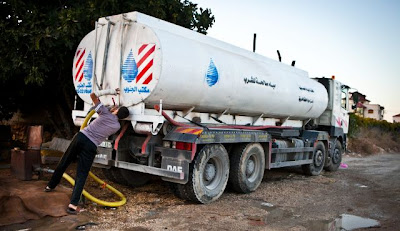
Banal functions such as house cleaning and laundry all depend on the water supply. Every day some 400 tankers transfer water from central depots to hospitals, factories, schools and other public facilities in the region.

About half the water amount to the district comes from springs and wells. The PA buys the other half from the Israeli water company . Some 10,000 cubic meters a day - more than a third of the amount bought from - are funneled from the Dir Sha'ar (Etzion junction ) pumping depot in an 11 kilometer pipe.

About half the water is lost on the way, Mekorot's monthly invoices show. The Palestinians pay the amount registered at the depot, minus the water the pipe provides the Carmei Zur settlement (about 100 cubic meters a day ). The water meters in the Palestinian neighborhoods show that the amount actually supplied to the Palestinians is much smaller.

The PA has been planning to replace the pipe since 2008, with the financing of the United states Agency for International Development.

The pipe, built by in 1972, loses 45-50 percent of the water flowing in it due to deterioration, illegal connections, bad construction and faulty installation, the American construction company MWH wrote in its project description.

Much of the water flowing in the pipe, which passes under residential and farming areas, is stolen, especially for farming. The water quality is unsafe, the company wrote.

The Palestinian water authority and MWH planned a new route alongside the road, to prevent hooking up to the pipe illegally. A new, wider pipe would reduce leaks and ensure the water's quality, they said. Mekorot agreed to increase the water amount to the Hebron district by 5,000 cubic meters a day.

Palestinian water tanks destroyed by settlers in Hebron
The project was approved by the joint Israeli-Palestinian water committee in August 2010, as required by the Oslo agreement.

The Civil Administration had to approve the route, located in Area C. Finally it was agreed to lay nine kilometers of the pipe alongside an existing farm route, leaving 1.9 kilometers of pipe along Route 60. "This is necessary to avoid destroying two houses and fatally damaging vineyards," an engineer said.

But the Civil Administration refused "because the construction would disrupt the Jewish drivers' traffic," the Palestinian engineer said.

"When they do maintenance work on other roads in the West Bank, don't they disrupt the traffic?" he asked.

Like all Hebron neighborhoods, Jabar, located in Area H2 (in Israeli jurisdiction ) has water only once every few weeks. Some of the residents' front doors and windows have been sealed and the alleys in the neighborhood are blocked. Only Israeli vehicles to and from the Jewish homes in ancient Hebron and the Cave of the Patriarchs are allowed to travel there. Water tankers to the Palestinian houses are not allowed and the residents use water holes. More


Saturday, August 25, 2012

Building Resilience In A Changing Climate - Richard Heinberg

Climate shocks are on the way. We’ve already spewed so much carbon into the atmosphere that a cascade of worsening crop failures, droughts, floods, and freak storms is virtually guaranteed. You, your family, and your community will feel the effects.

Ironically, however, avoiding climate change also has its costs. It makes sense from a climate-protection standpoint to dramatically and rapidly reduce our use of fossil fuels, which drive global warming. But these fuels largely, well, fueled the spectacular economic growth of the past 200 years, and weaning ourselves from them quickly now—while most industrial economies are over-indebted and starved for growth—could risk financial upheaval.

Oil, the most economically pivotal of the fossil fuels, is getting more expensive anyway. Cheap, onshore, conventional crude is depleting; its replacements—deepwater oil, tar sands, and tight oil—cost more to produce, in both dollar and environmental terms. Though high oil prices discourage driving (good for the climate), they also precipitate recessions (bad for the economy). While renewable energy sources are our hope for the future and we should be doing everything we can to develop them, it will be decades before they can supply all our energy needs.

In the face of impending environmental and economic shocks, our best strategy is to build resilience throughout society. Resilience is the subject of decades of research by ecologists and social scientists who define it as “the capacity of a system to tolerate disturbance without collapsing into a qualitatively different state that is controlled by a different set of processes.” In other words, resilience is the capacity to absorb shocks, reorganize, and continue functioning.

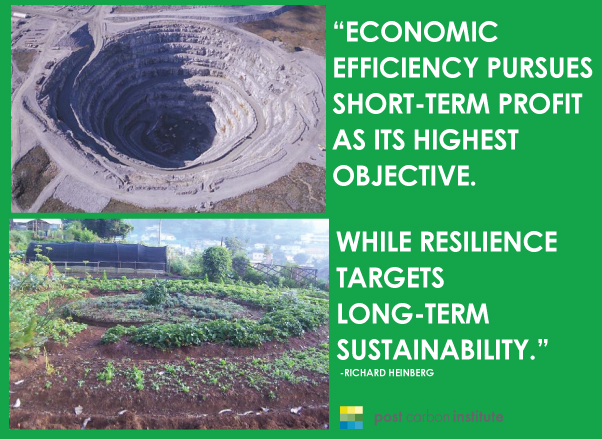
In many respects a resilient society defies the imperative of economic efficiency. Resilience needs dispersed inventories and redundancy, while economic efficiency—in its ruthless pursuit of competitive advantage—eliminates inventories and redundancies everywhere it can. Economic efficiency leads toward globalization, resilience toward localization. Economic efficiency pursues short-term profit as its highest objective, while resilience targets long-term sustainability. It would appear that industrial society circa 2012 has gone about as far in the direction of economic efficiency as it is possible to go, and that a correction is necessary and inevitable. Climate change simply underscores the need for that course correction.

Building resilience means helping society to work more like an ecosystem—and that has major implications for how we use energy. Ecosystems conserve energy by closing nutrient loops: plants capture and chemically store solar energy, which is then circulated as food throughout the food web. Nothing is wasted. We humans—having developed the ability to draw upon ancient, concentrated, cheap, and abundant (though ultimately finite) fossil fuels—have simultaneously adopted the habit of wasting energy on a colossal scale. Our food, transport, manufacturing, and dwelling systems burn through thirty billion barrels of oil and eight billion tons of coal per year; globally, humans use over four hundred quadrillion BTUs of energy in total. Even where energy is not technically going to waste, demand for it could be substantially reduced by redesigning our basic systems. More


Thursday, August 23, 2012

We'll make a killing out of food crisis, Glencore trading boss Chris Mahoney boasts

Drought is good for business, says world's largest commodities trading company

23 August 2012 - The United Nations, aid agencies and the British Government have lined up to attack the world's largest commodities trading company, Glencore, after it described the current global food crisis and soaring world prices as a "good" business opportunity.

With the US experiencing a rerun of the drought "Dust Bowl" days of the 1930s and Russia suffering a similar food crisis that could see Vladimir Putin's government banning grain exports, the senior economist of the UN's Food and Agriculture Organisation, Concepcion Calpe, told The Independent: "Private companies like Glencore are playing a game that will make them enormous profits."

Ms Calpe said leading international politicians and banks expecting Glencore to back away from trading in potential starvation and hunger in developing nations for "ethical reasons" would be disappointed.

"This won't happen," she said. "So now is the time to change the rules and regulations about how Glencore and other multinationals such as ADM and Monsanto operate. They know this and have been lobbying heavily around the world to water down and halt any reform."

Glencore's director of agriculture trading, Chris Mahoney, sparked the controversy when he said: "The environment is a good one. High prices, lots of volatility, a lot of dislocation, tightness, a lot of arbitrage opportunities.

"We will be able to provide the world with solutions... and that should also be good for Glencore."

Glencore announced pre-tax global profits of £1.4bn. The G20 is considering holding an emergency summit on the world food crisis.

Oxfam was scathing about Glencore's exploitation of volatile world food prices. Jodie Thorpe, from the aid agency's Grow Campaign, said: "Glencore's comment that 'high prices and lots of volatility and dislocation' was 'good' gives us a rare glimpse into the little-known world of companies that dominate the global food system." More


Tuesday, August 7, 2012

Palestinian villages struggle as Israeli settlement waste contaminates the environment

"The bad odor is constant here and nowadays it has become normal to find rodents and insects in this area" Ahmed, a resident of Burin, tells staring at the smelly polluted water flowing less than 10 meters from the houses of his village located between Salfit and Nablus, in the northern part of the West Bank – "It's not only about the smell.

In the village a lot of people suffer from skin diseases, asthmas, and other illnesses." The waste water stemming from Ariel settlement has played a major role in the contamination of water and in the pollution of the environment in the Salfit area. Due to the concentration of pollutant elements in this zone, many agricultural fields have been destroyed and many animals and plants have been killed. Moreover, many infectious waterborne diseases, like diarrhea, have broken out especially among children.

Betar Illit from Nahalin MartaFortunato
Betar Illit from Nahalin (Photo: Marta Fortunato)
The inhabitants of Wadi Fukin and Nahalin, south-west of Bethlehem, face the same problems. Surrounded by the Israeli settlement of Beitar Illit, these two villages, known for the quality of the agricultural products, are constantly threatened by the flow of waste water coming from the nearby settlement. "Inside Beitar Illit there is a waste water treatment facility but it can't handle the amount of waste water it receives and as a consequence it overflows reversing untreated waste water onto the agricultural fields" explains Dib Najajrah, a resident of Wadi Fukin. "Moreover, in the last years the settlers have started attacking our crops by deliberately pumping the waste water coming out of the settlement into the cultivated land of Nahalin."

Water pollution and contamination of ground water are the main environmental threats that the Palestinians living in the West Bank have to deal with. As an occupying power, according to the article 56 of the Fourth Geneva Convention, Israel has the duty of "ensuring and maintaining, with the cooperation of national and local authorities... public health and hygiene in the occupied territory" in order to prevent the spread of diseases and epidemics. However, since 1967 Israel has consistently failed to provide Palestinians with efficient sewage and waste water facilities and at the same time the Israeli settlements have started discharging untreated domestic and industrial sewage onto the aquifer, causing the contamination of ground water and the destruction of Palestinian agricultural fields. More


Wednesday, July 18, 2012

Israel Issues Demolition Order on Two Water Cisterns in Palestine

On Tuesday, the Israeli army raided Al Qanoub area in Sa'ir, eastern Hebron and issued a demolition order on two cisterns used to irrigate land for the benefit of twenty people, of whom more than half are children.

One cistern owned by Basem and Omar al-Shalaldais is used to irrigate farmland of more than 10 dunums containing 210 seedlings.

The other cistern owned by the family of Shaher al Shalalda's is used to water 5 dunums of land planted with 185 fruit tree seedlings.

The two cisterns were built with the aid of the Improving Livelihood in the Occupied Palestinian Territories Program funded by the Netherlands Representative Office.

Palestinians are rarely issued with planning permission to build on their own land in the occupied territories, while illegal Israeli settlements are free to expand without restriction. More