Showing posts with label indigenous. Show all posts

Tuesday, June 26, 2018

5 Ways Indigenous Groups Are Fighting Back Against Land Seizures


Governments, corporations and local elites are eager to acquire land to extract natural resources; grow food, fibers and biofuels; or simply hold it for speculative purposes. Most communities hold land under customary tenure systems and lack formal titles for it. While national laws in many countries recognize customary rights, the legal protections are often weak and poorly enforced, making community land especially vulnerable to being taken by more powerful actors.

Communities, however, are not standing by idly. They're increasingly taking action to protect their lands.

Here are five ways communities are defending their land rights: Read More

Saturday, April 28, 2018

Paris to decide fate of 'mega' gold mine in forests of French Guiana


Environmentalists and indigenous chiefs have vehemently opposed the “mega-mine”, warning of serious risks of pollution in the basin of the Mana river which flows through indigenous land, and damage to the area’s biodiversity.

Opponents have particularly expressed concerns over the 57,000 tonnes of explosives, 46,500 tonnes of cyanides and 142m litres of fuel WWF estimated the company will use over the mine’s 12-year lifespan. Montagne d’Or has contested the figures.

Christophe Pierre, a 24-year-old indigenous activist from the village of Terre Rouge about 100km away from the proposed mine is unyielding.

“The project is intolerable and not negotiable,” he said. “It impedes on our living space. There is hunting land nearby and pre-Colombian sites were found next to the proposed mine.

“We never gave up our sovereignty on this land. The French state does not recognise our presence prior to its arrival but this has been our land for thousands for years.” Read More

Saturday, April 7, 2018

Dreaming Beyond Capitalism: a Culture Without Fear


First Nation tribes from North America coined a term to describe the ‘disease of the white man’ – wetiko. In their understanding, wetiko consists of two essential characteristics: chronic inability for empathy and an egoistic fixation on ones own personal benefit and profit. The First Peoples used this word specifically because they could not fathom any other explanation for the behavior of the European colonialists. While often declared as unchangeable psychological features of humanity, greed, selfishness and violent impulses may in fact not be our “human nature” as many claim, but rather the outcome of our alienation under capitalist conditions. Marx said, “Social being determines consciousness.”[ii] According to epigenetic research, our genetic programming contains many different possibilities of existence. Whether wetiko takes holds of our psyche or we become compassionate strongly depends on the social structures we live in. We only consider egoism, hatred and brutality to be “normal” because over the past few thousand years our civilization has been conditioned in this way – basing its economy on war, its social organization on domination and conformity, its religion on punishment, damnation and sin, its education on coercion, its security on the elimination of the supposed enemy, its very image of love on fear of loss. Read More

Monday, May 5, 2014

The Woman Who Breaks Mega-Dams

Ruth Buendía Mestoquiari has built her career, and staked the fate of her people, on the law.

Ruth Buendía Mestoquiari

But she doesn't have a law degree. In fact, she didn't even start elementary school until she was a teenager and didn't finish high school until age 25. While her peers went to class, she spent her childhood in the 1980s and 90s shuttling between her native village of Cutivireni, the town of Satipo, and the city of Lima, as Peru's two-decade civil war devastated her community and claimed her father, who was killed in the violence when Buendía was only 12.

What Buendía does have is five children, all 18 and younger, and a "wonderful husband." She has the distinction of being the first female president of CARE, an organization representing roughly 10,000 indigenous Asháninka who live along the banks of the Ene River in the Peruvian Amazon. And she has a knack for blocking massive hydroelectric dams, having thwarted not one but two planned projects that she believed would displace the Asháninka and destroy the ancestral lands they depend on for their livelihoods. It's a threat she characterizes as "economic terrorism," in an allusion to the armed terrorism she experienced during the civil war.

Through it all, she's managed to redeem what we've come to consider something of a dark art: the lawsuit.

The 37-year-old, who received a Goldman Environmental Prize this week for her efforts, has employed several tactics in her duels with the dams, which were first proposed as part of an energy agreement between Peru and Brazil in 2010. She's marshaled technology, using a laptop and computer simulation to show constituents how the dams would flood the Ene River Valley. She's courted media attention, established international partnerships, and mobilized her people in regional assemblies.

But above all, she's insisted, again and again, that she has the law on her side—specifically an International Labor Organization treaty that Peru ratified in 1994 andnational legislation that the country passed in 2011. Both require the government to consult with indigenous communities before launching development projects—be they infrastructure initiatives or mining concessions—that will affect them. The concept is known as "prior consultation."

Buendía's primary argument isn't that the dams are illegal per se, but rather that Peruvian authorities must first secure her people's consent about how the projects should proceed—if, that is, there are grounds to proceed in the first place. By filing lawsuits in Peruvian courts with the help of legal advisors and making her case to bodies like the D.C.-based Inter-American Commission on Human Rights, Buendía has pressured Peruvian officials and Brazilian companies to halt the construction of the Pakitzapango and Tambo-40 dams—at least for now.

In prioritizing legal strategies over others, Buendía's key insight is to fight fire with fire. After all, the proposed dams are a product of a compact between governments—a 50-year energy agreement that Peru and Brazil struck in 2010. The plan was for Brazilian corporations to dam rivers in the Amazon rainforest in Peru and produce up to 7,200 megawatts of hydropower.

Peru's leaders trumpeted the numerous benefits the dams would bring: Brazilian companies would be investing heavily in one of the country's few energy sources—its rivers—and leveraging a renewable energy source at that. The projects would create thousands of jobs for Peruvians and bring affordable energy to rural areas. But under the deal, most of the power generated would have been exported to Brazil. And the Asháninka, along with several studies by conservation groups, have warned of the grave environmental and social impacts of the plants. The dams, for instance, could flood the surrounding jungle, submerging arable land, threatening water quality, endangering the forest's biodiversity and the rivers' fish populations, and forcing Asháninka to migrate.

"They think we're going to break windows and protest like in Conga, but we aren't,” Buendía told The New York Times in 2012, in reference to fierce demonstrations in northern Peru against a gold-mine project. "Just as they do to us with legal documents we are going to do to them."

International treaties and national laws have granted the Asháninka rights, she reasons. Now it's up to the Asháninka to apply the law. More


Tuesday, July 30, 2013

[Human Rights] in the CDM

After this weekend’s CDM reform workshop, ECO has new hope for the CDM’s ability to address human rights.

For the first time in the history of the CDM, Parties had an open dialogue about the impacts of CDM on human rights. It is important to recall that Parties agreed to “fully respect human rights in all climate change related actions.” The review of the CDM Modalities and Procedures provides a critical opportunity for the CDM to make this a reality.

CAN's Leadership Development Program

A case in point…The Barro Blanco project is a hydroelectric dam that is currently under construction on the Tabasará River in western Panama. Once completed, the dam is projected to flood homes, schools, and religious, historical and cultural sites in Ngäbe indigenous territories, threatening the Ngäbe’s cultural heritage. In addition, the dam will transform the Tabasará River – critical to the Ngäbe’s physical, cultural, and economic survival – from a flowing river to a stagnant lake ecosystem. This will severely affect the Ngäbe’s lands and means of subsistence, and result in the forced relocation of many families.

CDM rules require investors to consult with local stakeholders and to take their comments into account during the registration process. However, the company did not consult the Ngäbe communities regarding the Barro Blanco project and its impacts. In February 2011, the Ngäbe, in collaboration with civil society groups, submitted comments to the CDM Executive Board. The comments documented the Ngäbe’s concerns, in particular the fact that the Ngäbe were not given notice of the consultation process and were never consulted. Despite concrete evidence that the Barro Blanco project violated CDM rules on stakeholder consultation, in 2011, the CDM Executive Board registered the Barro Blanco as a CDM project.

Now that Barro Blanco has been registered, there is no process that allows the Ngäbe to raise their concerns regarding the project’s social and environmental impacts. Over the past two years, the SBI has been negotiating an appeals procedure that would allow stakeholders to challenge registration decisions under the CDM. However, ECO is dismayed that, as discussions currently stand, this procedure would not provide a means of recourse for affected communities once a project is under construction or operational.

More than 6,500 projects are registered under the CDM, and these projects will be operational for many years to come. ECO calls on Parties to revise the CDM Modalities and Procedures to: establish international safeguards to protect human rights; strengthen requirements on how to conduct local stakeholder consultations; establish a grievance process that allows affected peoples and communities to raise concerns about harms associated with CDM projects; and develop a process to deregister projects where there are violations of CDM rules.

To learn more, join us at a side event on CDM and human rights TODAY at 6:30 pm in Room Solar. You will meet on Monday at 6:30 pm, wWeni Bakama, a Ngäbe activist, and other panelists who will discuss how we can integrate human rights protections in the CDM. More


Today, we are writing to ask you to sign an ACTION ALERT in support of the Barro Blanco campaign and our broader CDM advocacy efforts. We launched this petition two weeks ago, asking James Anaya, UN Special Rapporteur on the Rights of Indigenous Peoples, to recommend reforms to protect communities that are adversely affected by CDM projects, such as Barro Blanco. In astatement released at the end of his recent visit to Panama, Special Rapporteur Anaya described his visit to the Ngäbe communities and highlighted the Barro Blanco project as an example of the many large-scale development projects that threaten the rights of indigenous peoples in Panama. In the coming months, Mr. Anaya will be preparing his final report, which provides an opportunity for the Special Rapporteur to document the ways in which the existing CDM rules are inadequate to protect the rights of indigenous peoples.

PLEASE TAKE ACTION
by signing this alert to urge Special Rapporteur Anaya to make recommendations to the CDM and the Panamanian government, calling for both to respect human rights for development projects that generate social and environmental impacts, with particular attention to indigenous rights. Also, please share with your lists and promote via Facebook/Twitter. Our goal is to reach 1000 signatories by the end of the week.

CIEL Newsletter

July 19, 2013


Donate

CIEL on FacebookCIEL on Twitter
CIEL's RSS FeedCIEL's Blog

We need your help. Will you add your name and support to a letter asking James Anaya, UN Special Rapporteur on the Rights of Indigenous Peoples, to recommend reforms to protect indigenous communities in Panama?

Yesterday, Mr. Anaya began his ten-day visit to Panama. At the request of CIEL and adozen other organizations, Mr. Anaya will meet with community representatives in the Ngäbe-Buglé territory in Panama who are directly affected by the Barro Blanco hydroelectric dam. He will hear firsthand about how the Panamanian state has violated the rights of affected indigenous communities to free, prior and informed consent on a project which threatens to violate their right to traditional land and territories. When completed, the dam would flood historic and religious Ngäbe-Buglé sites and compromise the ecosystem upon which their traditional diet depends.

The Barro Blanco dam is registered under the Clean Development Mechanism (CDM), a carbon-market mechanism of the UN convention on climate change. The CDM allows developed countries to claim emission reductions by paying for mitigation efforts – in this case a hydroelectric dam – in developing countries. Unfortunately, the CDM has no standards for human or indigenous rights, nor does it have a way for communities that are negatively affected by CDM projects to even register complaints.

Following Mr. Anaya’s Panama trip, he will present a report on his findings of concerns related to indigenous peoples in Panama, including the human rights violations against the indigenous people affected by Barro Blanco. As Special Rapporteur and as part of his mandate, Mr. Anaya is in a unique position to give advice and recommendations to the CDM as well as other UN-related mechanisms that affect the rights of indigenous peoples.His recommendations could help to halt and prevent human rights violations

Thursday, May 30, 2013

We will die. We will not leave without being heard


Amazon Watch

Português | Español | Deutsch | More

URGENT:
"We will die. We will not leave without being heard."


URGENT: 'We will die. We will not leave without being heard.'

Only three days after the reoccupation of the Belo Monte Dam began, the fate of 170 indigenous people is at stake. On Tuesday, the Federal Court in Altamira ordered them to leave by 4 pm yesterday or they would be removed by Federal Police. They responded by tearing up the order and refused to leave by the deadline. Instead, they are standing strong and are demanding that President Dilma’s Chief of Staff, Gilberto Carvalho, come meet with them. Their letter to the Brazilian government is here.

Read, Share and Take Urgent Action Right Now! »

DONATE

We need your support!

For over fifteen years, Amazon Watch has been an effective force in supporting indigenous environmental movements on the front lines of halting destructive development.

JOIN US IN PROTECTING THE AMAZON RAINFOREST TO

Monday, April 8, 2013

Chiquita Sues to Block Release of Files on Colombia Terrorist Payments

Washington, D.C., April 8, 2013 – Chiquita Brands International last week filed a "reverse" Freedom of Information lawsuit to block the release of records to the National Security Archive on the company's illegal payments to Colombian terrorist groups, according to the complaint filed in U.S. District Court.

At issue are thousands of documents the company turned over to the Securities and Exchange Commission (SEC) from 1998-2004 as part of an investigation of the company's illegal transactions with leftist insurgents and right-wing paramilitaries from the United Self-Defense Forces of Colombia (AUC).

Two years ago, the Archive published "The Chiquita Papers," a declassified collection of more than 5,000 pages of internal Chiquita documents turned over to the Department of Justice and the Federal Bureau of Investigation as part of a criminal investigation of more than $1.7 million in payments to the AUC over six years, and for nearly three years after the group was formally designated as a terrorist organization. That case resulted in a 2007 sentencing agreement in which Chiquita admitted to more than ten years of payments to a variety of Colombian guerrilla and paramilitary groups.

The Chiquita Papers included evidence that Chiquita and its Colombian subsidiary had received tangible benefits from those transactions, undermining one of the key aspects of the company's defense: that it had never received "any actual security services or actual security equipment in exchange for the payments." Chiquita's "reverse" FOIA complaint now claims that the news headlines based on the documents were part of "a media campaign to publicize biased mischaracterizations of the documents."

"We strongly reject Chiquita's assertion that we mischaracterized information found in their own corporate records," said Michael Evans, director of the Archive's Colombia Documentation Project. "Chiquita admitted to more than a decade of regular payments to death squads and narcotraffickers," he added. "Now, Chiquita wants to cover up the documents that would let us judge for ourselves whether those payments were extortion or security for banana operations, or both."

Among the evidence that Chiquita did, in fact, benefit from its "sensitive payments" is a 1994 legal memo indicating that Colombian insurgents provided security at some of Chiquita's plantations in Colombia. The memo says that the general manager of Chiquita operations in Turbó told company attorneys that "Guerrilla Groups" were "used to supply security personnel at the various farms." A subsequent draft of the same memo includes annotations asking, "Why is this relevant?" and, "Why is this being written?"

Another document published by the Archive in April 2011 shows that Chiquita also paid right-wing paramilitary forces for security services-including intelligence on guerrilla operations-after the AUC wrested control of the region from insurgents in the mid-1990s. The March 2000 memo, written by Chiquita Senior Counsel Robert Thomas and based on a conversation with managers from Chiquita's wholly-owned subsidiary, Banadex, indicates that paramilitaries formed a front company to disguise "the real purpose of providing security." The unidentified Banadex official said Chiquita "should continue making the payments," because the company "can't get the same level of support from the military." More

_________________

Could the payments made to '1992 May 8 – Chiquita legal memo on whether support for Colombian military counterinsurgency operations through a "trade association of banana exporters" known as Fundiban is a violation of the Foreign Corrupt Practices Act (FCPA)' be payments to military officers trained at the 'School of the Americas' the United States Army notorius counter-insurgency training establishment which Since 1946, the SOA has trained over 64,000 Latin American soldiers in counterinsurgency techniques, sniper training, commando and psychological warfare, military intelligence and interrogation tactics. These graduates have consistently used their skills to wage a war against their own people. Among those targeted by SOA graduates are educators, union organizers, religious workers, student leaders, and others who work for the rights of the poor. Hundreds of thousands of Latin Americans have been tortured, raped, assassinated, “disappeared,” massacred, and forced into refugee by those trained at the School of Assassins. Editor


Monday, March 18, 2013

Privatization Leads To Catastrophic Loss Of Cambodia’sTropical Flooded Grasslands

Around half of Cambodia's tropical flooded grasslands have been lost in just 10 years according to new research from the University of East Anglia.

Tonle Sap, Cambodia

The seasonally flooded grasslands around the Tonle Sap, Southeast Asia's largest freshwater lake, are of great importance for biodiversity. It is a refuge for 11 globally-threatened bird species. They are also a vital fishing, grazing, and traditional rice farming resource for around 1.1 million people.

Research published today in the journal Conservation Biology quantifies for the first time the area's catastrophic loss of tropical flooded grassland.

The grassland area spanned 3349 km² in 1995, but by 2005 it had been reduced to just 1817 km² -- a loss of 46 percent.

Despite conservation efforts in some areas, it has continued to shrink rapidly since, with a further 19 percent lost in four years (2005-2009) from the key remaining grassland area in the southeast of the Tonle Sap floodplain.

Factors include intensive commercial rice farming with construction of irrigation channels, which is often illegal. Some areas have also been lost to scrubland where traditional, low-intensity agricultural activity has been abandoned.

The research has been led by Dr Charlotte Packman from UEA's school of Environmental Sciences, in collaboration with the Wildlife Conservation Society Cambodia Program and BirdLife International. It was funded by the Critical Ecosystem Partnership Fund.

Dr Packman said: "Tropical and flooded grasslands are among the most threatened ecosystems globally. The area around the Tonle Sap lake is the largest remaining tropical flooded grassland in Southeast Asia. It is hugely important to both biodiversity and the livelihoods of some of the world's poorest communities. Our research shows that these grasslands are disappearing at an alarming rate.

"These unique grasslands are home to many threatened birds including by far the largest remaining population of the critically endangered Bengal florican -- the world's rarest bustard. This bird has experienced a dramatic population decline of 44 percent in seven years due to the destruction of its grassland habitat. Other birds under threat in this area include sarus cranes, storks, ibises and eagles.

"Rural communities have been left vulnerable to land-grabbing and privatization of communal grasslands. Traditional, low-intensity use of the grasslands by these communities, such as burning and cattle-grazing, help to maintain the grasslands and prevent scrubland from invading.

"Intensive commercial rice production by private companies, involving the construction of huge channels and reservoirs for irrigation, is denying local communities access to the grasslands on which their livelihoods depend and destroying a very important habitat for threatened wildlife. More


Friday, February 22, 2013

India opens the floodgates for extinguishment of Indigenous Rights

India's central government has walked away from its position on the need to obtain consent from Indigenous peoples and forest dwellers before handing their lands over to industry.

On February 15, the central government announced that major "linear projects" such as roads, railways, transmission lines, canal systems and pipelines do not need to obtain consent from affected forest populations before clearing their lands. The announcement, which stands in sharp contrast to provisions in the Forest Rights Act, could now make way for hundreds of new industrial projects that would have never otherwise seen the light of day.

"This is serious breach of trust and a huge step back in ensuring the dignity and survival of traditional forest-dwelling people across the country", said Dr. Swati Shresth, from the Ashoka Trust for Research in Ecology and the Environment. "Forests are going to be cleared to make way for a particular kind of economic development; it will adversely impact communities and the environment."

Just four years ago, the Union Ministry of Environment and Forests (MoEF) made the matter of consent of affected communities mandatory for all projects that would destroy forests. The landmark decision came in direct response to the attempt by UK-based mining company Vedanta Resources Inc. to clear the Dongria Kondh's lands. Last week's announcement effectly revokes that mandatory rule.

On the same day of the announcement, the MoEF took another troubling step away from Indigenous Rights, while reiterating the inviolable nature of those rights.

In an affidavit that was filed in the Supreme Court in the ongoing case with Vedanta, the MoEF reiterated that mining in Niyamgiri hills cannot be permitted, stating that:

"The diversion of forest land on the proposed mining site of the Lanjigarh bauxite mining lease is violative of the fundamental rights of the Dongria Kondh tribals as well as the spirit of Forest Rights Act especially for the vulnerable tribal groups such as the Dongria Kondh and thus cannot be allowed for this reason alone.

"More than 7 sq. km. of the sacred undisturbed forests on top of the mountain, where the proposed mining lease area of the Lanjigarh bauxite mining lease is located has been protected for centuries by the Dongria Kondh, a primitive tribal group [now termed as particularly vulnerable tribe] as sacred to their deity. Diversion of these sacred areas for mining will undermine the customary rights of the Dongria Kondhs to protect their sacred places of worship and thereby amount to a violation of their fundamental right to manage their own affairs in the matter of religion and fundamental right to conserve the culture of their own. It was also in direct violation further of the specific provisions of the Forest Rights Act."

This is, of course, great news for the Dongia Kondh who continue to stand in steadfast opposition to Vedanta's mining interests on their sacred land. http://www.thehindu.com/todays-paper/tp-national/forest-land-cannot-be-diverted-for-vedanta-project-says-centre/article4420821.ece?textsize=large&test=1

Speaking on the broader issue of consent, the MoEF went on to say that "No eviction of eligible forest dwellers can take place till the process of recognition and vesting of individual and community forest right under the Scheduled Tribes and Other Traditional Forest Dwellers (Recognition of Forest Rights) Act is complete."

However, the MoEF then did an about face. As reported by Down to Earth, the Ministry stated that such consent is only required in cases where "displacement of large number of people" is involved and which "affect the quality of life of the people".

In cases where the diversion of such forest land is "unavoidable" where rights of the forest dwellers are recognized, their rights may be "circumscribed or extinguished using the eminent domain of the state". More


Friday, August 31, 2012

Resource Wars Connect Yanomami Massacre and Shell’s Arctic Drilling

It has been a painful day for me. Two pieces of news came in this morning: one about the massacre of an Yanomami settlement in the Amazon, and the other about Obama green lighting Shell’s drilling in the Arctic Ocean. Both are about resource wars that lead to killing—humans and/or animals, fast or slow, one to get gold, and the other to get oil.

“A massacre of up to 80 Yanomami Indians has taken place in the Venezuelan state of Amazonas,” The Guardian reported. “According to local testimonies an armed group [illegal gold miners] flew over in a helicopter, opening fire with guns and launching explosives into Irotatheri settlement in the High Ocamo area.”

Survival International, a London–based NGO that works with indigenous communities around the world (over the years I contributed my Arctic photographs for their campaigns) stated in a news release, “Witnesses of the aftermath described finding ‘burnt bodies and bones’ when they visited the community of Irotatheri in the country’s Momoi region, close to the border with Brazil.…The attack is believed to have happened in July, but news is only just emerging.”

Today about 20,000 Yanomami people live in small communities in the Amazon rainforest bordering Brazil and Venezuela. I first came to know about the Yanomami from the remarkable photographs of artist–activist Claudia Andujar. In the 1970s Andujar gave up her career as a photojournalist and embarked on an in–depth photo–essay about the Yanomami people. During this time she was witness to, “one of the most significant cultural dislocations to occur in Yanomami history, when the government began construction of a transcontinental highway in Northern Brazil. Villages were razed to pave roads, and the Yanomami suffered a devastating measles epidemic.” Then, during the 1980s, a new kind of devastation came into the Yanomami homeland, when thousands of garimpeiros, illegal, small–scale gold diggers came to the Amazon to make their fortunes. Twenty percent of the Yanomami died in the 1980’s as a consequence of the gold mining intrusion. Also the mining led to environmental destruction. Following a 15–year campaign, in which Andujar’s work played a crucial role, in 1992, with the help of Brazilian anthropologists and Survival International, the Brazilian government established the Yanomami Park “for protection and use by Yanomami people.”

The July massacre wiped out an entire indigenous settlement. Not the first time. One of the worst Indian massacres had taken place in the predawn hours of April 30, 1871, that came to be known as the Camp Grant Massacre, in which nearly 150 Apaches, including children, elders and women from a single settlement in the Aravaipa canyon in Arizona had been brutally killed. Historian Karl Jacoby writes about that incident in his powerful book “Shadows at Dawn: A Borderlands Massacre and the Violence of History.” From the companion website for the book you’ll learn about what Jacoby calls “the most familiar and yet the most overlooked subject in American history—violence against Indians.” More


Sunday, May 6, 2012

A Battle With The Brewers By NICHOLAS D. KRISTOF

AFTER seeing Anheuser-Busch’s devastating exploitation of American Indians, I’m done with its beer.

The human toll is evident here in Whiteclay: men and women staggering on the street, or passed out, whispers of girls traded for alcohol. The town has a population of about 10 people, but it sells more than four million cans of beer and malt liquor annually — because it is the main channel through which alcohol illegally enters the Pine Ridge Indian Reservation a few steps away.

Pine Ridge, one of America’s largest Indian reservations, bans alcohol. The Oglala Sioux who live there struggle to keep alcohol out, going so far as to arrest people for possession of a can of beer. But the tribe has no jurisdiction over Whiteclay because it is just outside the reservation boundary.

So Anheuser-Busch and other brewers pour hundreds of thousands of gallons of alcohol into the liquor stores of Whiteclay, knowing that it ends up consumed illicitly by Pine Ridge residents and fuels alcoholism, crime and misery there. In short, a giant corporation’s business model here is based on violating tribal rules and destroying the Indians’ way of living.

It’s as if Mexico legally sold methamphetamine and crack cocaine to Americans in Tijuana and Ciudad Juárez.

Pine Ridge encompasses one of the poorest counties in the entire United States — Shannon County, S.D. — and life expectancy is about the same as in Afghanistan. As many as two-thirds of adults there may be alcoholics, and one-quarter of children are born suffering from fetal alcohol spectrum disorders.

In short, this isn’t just about consenting adults. Children are born with neurological damage and never get a chance.

“Every person on this reservation has personally seen the negative effects of alcohol, with loved ones or themselves,” said John Yellow Bird Steele, the tribe president. More

First we steal their land and then we hide them on reservations, don't allow their children to learn their language and culture, and finally turn them into alcoholics. That does get rid of a problem, doesn't it. I really dislike colonialism. It has much to answer for. Editor


Saturday, May 5, 2012

India: Barefoot lawyers bring food security to tribes

KHAMMAM, India — It was a deal struck almost 40 years ago by a poor, illiterate Indian farmer, driven by desperation after a drought wiped out his crops and left his family close to starvation.

The agreement: Four hectares of land, the size of four soccer fieldss, for a mere 10 kg of sorghum.

“My father-in-law pawned the land for food,” said Kowasalya Thati, lifting the hem of her grey sari and stepping into the muddy field of rice paddy in Kottasuraream village in the southern region of Andhra Pradesh.

“When he returned the grain later, the land owners refused to give it back. They claimed it and we had no document to prove otherwise. For 28 years, we had to work on the land we once owned. Without land, we had nothing ... not even enough food. It’s a miracle we got it back.”

Kowasalya’s family is one of hundreds of thousands who belong to India’s 700 listed tribes who are at last gaining legal titles to the land they have lived on for generations, thanks to a legal aid scheme run by the Andhra Pradesh government with international advocacy group Landesa.

In the scheme, which is likely to be rolled out nationally, young people often armed with only a secondary-level education are drawn from mud-and-brick villages and trained as paralegals, then sent out to help people to understand their rights and secure title, or “patta”, to their land.

For most tribal and landless families, that simple piece of paper means an end to a constant fear of hunger.

“Land is the most important factor of production,” said Pramod Joshi, South Asia director of the International Food Policy Research Institute. “It helps ensure food security for the poorest of the poor. It has been shown in many regions that if the poor have land, they are in a better position to feed themselves.” More


U.S. must heal native peoples' wounds, return lands: U.N. | Reuters

UNITED NATIONS (Reuters) - The United States must do more to heal the wounds of indigenous peoples caused by more than a century of oppression, including restoring control over lands Native Americans consider to be sacred, a U.N. human rights investigator said on Friday.

James Anaya, the U.N. special rapporteur on the rights of indigenous peoples, just completed a 12-day visit to the United States where he met with representatives of indigenous peoples in the District of Columbia, Arizona, Alaska, Oregon, Washington State, South Dakota, and Oklahoma. He also met with U.S. government officials.

“I have heard stories that make evident the profound hurt that indigenous peoples continue to feel because of the history of oppression they have faced,” Anaya said in a statement issued by the U.N. human rights office in Geneva.

That oppression, he said, has included the seizure of lands and resources, the removal of children from their families and communities, the loss of languages, violation of treaties, and brutality, all grounded in racial discrimination.

Anaya welcomed the U.S. decision to endorse the U.N. Declaration on the Rights of Indigenous Peoples in 2010 and other steps the government has taken, but said more was needed. His findings will be included in a final report submitted to the U.N. Human Rights Council. While not binding, the recommendations carry moral weight that can influence governments. More


Sunday, April 8, 2012

Capitalism: A Ghost Story and a Land Grab

Is it a house or a home? A temple to the new India, or a warehouse for its ghosts? Ever since Antilla arrived on Altamont Road in Mumbai, exuding mystery and quiet menace, things have not been the same. “Here we are,” the friend who took me there said, “Pay your respects to our new Ruler.”

Antilla belongs to India’s richest man, Mukesh Ambani. I had read about this most expensive dwelling ever built, the twenty-seven floors, three helipads, nine lifts, hanging gardens, ballrooms, weather rooms, gymnasiums, six floors of parking, and the six hundred servants. Nothing had prepared me for the vertical lawn—a soaring, 27-storey-high wall of grass attached to a vast metal grid. The grass was dry in patches; bits had fallen off in neat rectangles. Clearly, Trickledown hadn’t worked.

But Gush-Up certainly has. That’s why in a nation of 1.2 billion, India’s 100 richest people own assets equivalent to one-fourth of the GDP.

The word on the street (and in the New York Times) is, or at least was, that after all that effort and gardening, the Ambanis don’t live in Antilla. No one knows for sure. People still whisper about ghosts and bad luck, Vaastu and Feng Shui. Maybe it’s all Karl Marx’s fault. (All that cussing.) Capitalism, he said, “has conjured up such gigantic means of production and of exchange, that it is like the sorcerer who is no longer able to control the powers of the nether world whom he has called up by his spells”.

In India, the 300 million of us who belong to the new, post-IMF “reforms” middle class—the market—live side by side with spirits of the nether world, the poltergeists of dead rivers, dry wells, bald mountains and denuded forests; the ghosts of 2,50,000 debt-ridden farmers who have killed themselves, and of the 800 million who have been impoverished and dispossessed to make way for us. And who survive on less than twenty rupees a day.

Mukesh Ambani is personally worth $20 billion. He holds a majority controlling share in Reliance Industries Limited (RIL), a company with a market capitalisation of $47 billion and global business interests that include petrochemicals, oil, natural gas, polyester fibre, Special Economic Zones, fresh food retail, high schools, life sciences research and stem cell storage services. RIL recently bought 95 per cent shares in Infotel, a TV consortium that controls 27 TV news and entertainment channels, including CNN-IBN, IBN Live, CNBC, IBN Lokmat, and ETV in almost every regional language. Infotel owns the only nationwide licence for 4G Broadband, a high-speed “information pipeline” which, if the technology works, could be the future of information exchange. Mr Ambani also owns a cricket team.

RIL is one of a handful of corporations that run India. Some of the others are the Tatas, Jindals, Vedanta, Mittals, Infosys, Essar and the other Reliance (ADAG), owned by Mukesh’s brother Anil. Their race for growth has spilled across Europe, Central Asia, Africa and Latin America. Their nets are cast wide; they are visible and invisible, over-ground as well as underground. The Tatas, for example, run more than 100 companies in 80 countries. They are one of India’s oldest and largest private sector power companies. They own mines, gas fields, steel plants, telephone, cable TV and broadband networks, and run whole townships. They manufacture cars and trucks, own the Taj Hotel chain, Jaguar, Land Rover, Daewoo, Tetley Tea, a publishing company, a chain of bookstores, a major brand of iodised salt and the cosmetics giant Lakme. Their advertising tagline could easily be: You Can’t Live Without Us.

According to the rules of the Gush-Up Gospel, the more you have, the more you can have.

The era of the Privatisation of Everything has made the Indian economy one of the fastest growing in the world. However, like any good old-fashioned colony, one of its main exports is its minerals. India’s new mega-corporations—Tatas, Jindals, Essar, Reliance, Sterlite—are those who have managed to muscle their way to the head of the spigot that is spewing money extracted from deep inside the earth. It’s a dream come true for businessmen—to be able to sell what they don’t have to buy.

The other major source of corporate wealth comes from their land-banks. All over the world, weak, corrupt local governments have helped Wall Street brokers, agro-business corporations and Chinese billionaires to amass huge tracts of land. (Of course, this entails commandeering water too.) In India, the land of millions of people is being acquired and made over to private corporations for “public interest”—for Special Economic Zones, infrastructure projects, dams, highways, car manufacture, chemical hubs and Formula One racing. (The sanctity of private property never applies to the poor.) As always, local people are promised that their displacement from their land and the expropriation of everything they ever had is actually part of employment generation. But by now we know that the connection between GDP growth and jobs is a myth. After 20 years of “growth”, 60 per cent of India’s workforce is self-employed, 90 per cent of India’s labour force works in the unorganised sector. More


Saturday, April 7, 2012

In Defense of Gunter Glass

“Throughout history, it has been the inaction of those who could have acted, the indifference of those who should have known better, the silence of the voice of justice when it mattered most, that has made it possible for evil to triumph”- Haile Selassie

“Have our Jewish sisters and brothers forgotten their humiliation? Have they forgotten the collective punishment, the home demolitions, in their own history so soon? Have they turned their backs on their profound and noble religious traditions? Have they forgotten that God cares deeply about the downtrodden” - Bishop Desmond Tutu

These two cautionary admonitions capture the thrust of Guenter Grass' electrifying poem, “What Must Be Said,” that has brought an avalanche of invective – some scurrilous, some vituperative, some even personal vilification – against the man who warns the people of the world as well as the Jewish people of the dangers inherent in the actions of the Zionist controlled government of the State of Israel. Such condemnations avoid direct rebuttal of Grass' pointed cries of despair as he contemplates continued indifference to the slow yet calculated genocide that exists in Israel 's occupation of Palestine reverting instead to derogatory innuendo, ignorance of conditions prevalent in the occupied territories, ignorance of those determined to destroy Israel , and personal guilt as a German. There is no reflection on the worst sin human kind can inflict on their fellow human beings, the silence of indifference to the plight of the Palestinians or to the potential danger facing the people of the mid-east should Israel preemptively strike Iran .

The title of his poem, “What Must Be Said,” echoes the prophets of old, cries of those weeping in the wilderness to heed the obvious, to hear the hypocrisy that masks the reality of a nation that cries for peace as it stealthily steals more land, that demands dismantling of Iran's nuclear plants as it declares its right to Demona and untold weapons of mass destruction, that denounces with all brazen duplicity, indeed silences those who criticize the state of Israel while they are free to attack them as anti-Semitic.

“Why silence so long,” Grass asks of himself and answers, as must we all, that we are “slaves to an oppressive lie,” what cannot be said without condemnation because Israel has the “right” to demand and defend what it will. Is it wrong to criticize the obvious? Is it wrong to bare truth when silence once before begot a holocaust? Is it wrong for the German people to mark what they have learned through decades of reflection and reparation and not reveal what they have lived and learned? Is it wrong to speak when devastation threatens, when arrogance buries truth, when the weak have no voice, when the unknown consequence of brutal, raw, preemptive poweris imminent?

I would have Guenter Grass speak for me, my children and grandchildren, and all others who could suffer yet another World War, by noting the obvious that has been silenced so long: More


Tuesday, April 3, 2012

‘Prawer Plan’ to uproot Bedouins shows folly of the phrase ‘democratic Israel’

Peter Beinart’s pro-settlement boycott article in the New York Times has rightly been critiqued from the left for ignoring the fact that “Israel is only a ‘genuine democracy’ for its Jewish citizens,” as Adam Horowitz put it. A close look at the Israeli government’s Prawer Plan, which calls for the forced relocation of tens of thousands of citizens of Israel, further shows why the notion of a “democratic Israel” is a farce.

Beinart’s NYT Op-Ed constantly mentions “democratic Israel,” or variations on the phrase, to distinguish between the Israeli occupation of the West Bank and “Israel proper.” But how do the Bedouin citizens of Israel targeted for forced relocation fit into this “democratic Israel”? The answer is they don’t.

The Prawer Plan, recently okayed by Israeli Prime Minister Benjamin Netanyahu’s office, calls for the uprooting of 30,000 Bedouin citizens living in the Negev. The Israeli government wants to move these citizens to “recognized” communities set up by the state. Part of the plan is to build new, Jewish-only settlements on the formerly Bedouin land, where generations of Bedouins have been living, longer than the State of Israel has existed. The Bedouin communities are not happy with the plan, but the Israeli government is offering them money and support for infrastructure to convince them to move.

It sounds like a typical story in the occupied West Bank (minus the incentives to move), but this is happening on the Israeli side of the ever-fading Green Line. And the people Israel wants to uproot are citizens. More


Thursday, March 15, 2012

Palestinians prepare to lose the solar panels that provide a lifeline

Israel is planning to demolish 'illegal' solar panels that are the only source of electricity for Palestinians in West Bank villages.

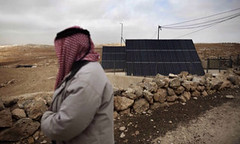
Two large solar panels jut out of the barren landscape near Imneizil in the Hebron hills. The hi-tech structures sit incongruously alongside the tents and rough stone buildings of the Palestinian village, but they are fundamental to life here: they provide electricity.

Imneizil is not connected to the national electricity grid. Nor are the vast majority of Palestinian communities in Area C, the 62% of the West Bank controlled by Israel. The solar energy has replaced expensive and clunky oil-powered generators.

According to the Israeli authorities, these solar panels – along with six others in nearby villages – are illegal and have been slated for demolition.

Nihad Moor, 25, has three small children. The family live in a two-room tent kitted out with a fridge, TV and very old computer. She also has a small electric butter churn, which she uses to supplement her husband's small income from sheep farming. "The kids get sick all the time. At the moment, because of a change in the weather, they all have colds. Without electricity I wouldn't even be able to see to help them when they need to use the [outdoor] toilet at night," Moor says. "I don't want to imagine what life would be like here if [the panels] were demolished."

Imneizil's solar system was built in 2009 by the Spanish NGO Seba at a cost of €30,000 to the Spanish government. According to the Israeli authorities, it was built without a permit.

Guy Inbar, a spokesperson for the Israeli authorities in the West Bank, explains: "International aid is an important component in improving and promoting the quality of life of the Palestinian population but this does not grant immunity for illegal or unco-ordinated activity." The problem for Palestinian communities here is that permission to build any infrastructure is very hard to come by. According to figures from the civil administration quoted by the pressure group Peace Now, 91 permits were issued for Palestinian construction in Area C between 2001 and 2007. In the same period, more than 10,000 Israeli settlement units were built and1,663 Palestinian structures demolished.

The Jewish settlements in Area C are connected to the national water and electricity grids. But most Palestinian villages are cut off from basic infrastructure, including water and sewage services. Imneizil, which borders the ultra-religious settlement of Beit Yatir, currently has nine demolition orders on various structures, including a toilet block and water cistern for the school. More


Sunday, February 26, 2012

Palestinian woman on 11th day of hunger strike, as parents join her to protest no-charge detention by Israel

As Palestinian “administrative detainee” Hana Al-Shalabi, 29, entered her eleventh day on hunger strike, her parents continued their own hunger strike in solidarity, against their daughter’s imprisonment without charge or trial by Israel.

Hana was arrested from her home in Burqin village near Jenin on 17 February in the Israeli-occupied West Bank. She had previously spent two and a half years in administrative detention – with no charge or trial – from 14 September 2009, until she was released last October as part of a prisoner exchange deal between Israel and Hamas, according to updates posted by Addameer via itsTwitter and Facebook pages.

Parents on hunger strike

Meanwhile, al-Shalabi’s parents have been on hunger strike for three days, in a solidarity tent near next to their home in Burqin, and have called for international intervention to free their daughter and end the policy of administrative detention.

Call for Action

Samidoun, the Palestinian Prisoner Solidarity Network, has issued an action alert calling for people to take action to bring attention to Hana Al-Shalabi’s case.

Renewed attention to Israel’s widespread use of detention without charge came as a result of the 66-day hunger strike of Khader Adnan. Amnesty International called the deal which ended Adnan’s hunger strike “insufficient” and reiterated its demand that Israel end the use of detention without charge or trial.

Currently more than 300 Palestinians are in Israeli administrative detention, including 21 elected members of the Palestinian Legislative Council. More