Showing posts with label united nations. Show all posts

Friday, June 22, 2018

Nikki Haley: ‘It is patently ridiculous for the United Nations to examine poverty in America’


All Hail The Land of the Fee & Home of the Slave

A United Nations report condemning entrenched poverty in the United States is a “misleading and politically motivated” document about “the wealthiest and freest country in the world,” according to the Trump administration's ambassador to the world body.

U.N. Ambassador Nikki Haley criticized the report for critiquing the United States' treatment of its poor, arguing that the United Nations should instead focus on poverty in developing countries such as Burundi and Congo. The U.N. report also faulted the Trump administration for pursuing policies it said would exacerbate U.S. poverty.

“It is patently ridiculous for the United Nations to examine poverty in America,” Haley wrote in a letter to Sen. Bernie Sanders (I-Vt.) on Thursday. “In our country, the President, Members of Congress, Governors, Mayors, and City Council members actively engage on poverty issues every day. Compare that to the many countries around the world, whose governments knowingly abuse human rights and cause pain and suffering.”

The rebuke comes two days after Haley announced the United States' resignation from the U.N. Human Rights Council over that body's perceived bias against Israel and toleration of human rights abusers. Read More

Tuesday, March 15, 2016

Climate Change Impacts Human Rights, Says UN Special Rapporteur

4 March 2016: A global temperature increase of one or two degrees Celsius would adversely affect human rights, including the rights to life, development, food, water, health and housing, the UN Special Rapporteur on human rights and the environment, John Knox, told the Human Rights Council (HRC).

Knox stressed that human rights obligations with respect to climate change include decisions about how much climate protection to pursue, as well as the mitigation and adaptation measures through which protection is achieved.

In its resolution 29/15, the HRC requested the UN High Commissioner for Human Rights to prepare a detailed 'Analytical study of the Office of the High Commissioner for Human Rights (OHCHR) on the relationship between climate change and the human right of everyone to the enjoyment of the highest attainable standard of physical and mental health (A/HRC/31/36).' The High Commissioner has asked for additional time and research, and will submit its report to the HRC at its 32nd session.


The Special Rapporteur shared an informal summary of inputs received on the 'Relationship between climate change and the human right of everyone to the enjoyment of the highest attainable standard of physical and mental health (A/HRC/31/CRP.4),' which is expected to inform OHCHR's final report. The informal summary notes, inter alia, that climate change: threatens to undermine the last half century of gains in development and global health; impacts physical and mental health in several ways; and disproportionately impacts the poor and other disadvantaged, marginalized and vulnerable groups.


According to the informal summary, respondents called for further integration of human rights in climate action at all levels of governance, as well as further analysis and study of the impacts of climate change on the right to health, among other recommendations.


During discussion, several delegations expressed support for protecting human rights in relation to climate adaptation and mitigation, including the European Union (EU) and Costa Rica. South Africa, on behalf of the African Group, supported enhanced, quick action to adapt to climate change to ensure the full realization of human rights, stressing that climate change threatens sustainable development. The Philippines called for reducing greenhouse gas (GHG) emissions to keep temperature rise below 1.5 degrees Celsius above pre-industrial levels and scaling up additional and predictable means of implementation. Brazil recognized the impacts of climate change on human rights, including economic, social and cultural rights. The EU asked how to better plan and manage urban areas to address synergies among climate change, sustainable development and urbanization.


The world does not need to wait until 2018 to start strengthening its efforts to address climate change and begin implementing the Paris Agreement on climate change, the Special Rapporteur reminded participants in his response, pointing to the use of renewable energy by Iceland, Morocco and Uruguay.


Knox presented on two aspects of his mandate, clarifying the human rights obligations relating to climate change, and on methods of implementing those obligations relating to the enjoyment of a safe, clean, healthy and sustainable environment, in Geneva, Switzerland, on 3 March 2016. [UNOG Press Release] [OHCHR Press Release] [A/HRC/31/36] [Special Rapporteur Website]


read more: http://larc.iisd.org/news/climate-change-impacts-human-rights-says-un-special-rapporteur/


Saturday, February 6, 2016

Lies about UN body imperil not just Assange

6 FEBRUARY 201 - Something extremely dangerous is happening before our eyes as we watch British officials and the corporate media respond to today’s ruling of the UN Working Group on Arbitrary Detention, which found that Julian Assange is being arbitrarily detained in the UK.

A major international institution upholding the rights of political dissidents around the world as they face illegal detention, abuse and torture is being turned into a laughing stock with the enthusiastic connivance of supposedly liberal media outlets like the Guardian and the BBC.

Reporters, columnists and comedians are pouring scorn on the UN group, legal experts who until yesterday were widely respected in the west and seen as a final bulwark against the most oppressive regimes on earth.

In desperate moments, confined and isolated, dissidents like Aung Sang Suu Kyi in Burma and opposition leader Anwar Ibrahim in Malaysia could take solace from the knowledge that a respected UN group stood shoulder to shoulder with them. In some cases, faced the weight of its opinion, regimes preferred to release such dissidents.

Now the UN Working Group’s status and the significance of its decisions are being irreparably undermined. In their desperation to keep Assange reviled, British officials and their collaborators in the media are destroying the last vestiges of protection for political dissidents around the world.

The most glaring example of this process, as pointed out by the former UK diplomat Craig Murray, is an outright lie being peddled by the British Foreign Secretary, Phillip Hammond. He says the UN panel is “made up of lay people and not lawyers”.

In reality, the panel consists of distinguished legal experts in the field of international law. You can see their CVs here.

Unlike Hammond, who is doubtless looking over his shoulder to the other side of the Atlantic, these are truly independent figures – that is, they are not beholden to the governments of the countries they are from. And if Mats Andenas, the Norwegian chair of the Working Group for much of its investigation, is to be believed, they are brave too. He says the panel has come under intense pressure from the US and UK to arrive at a decision contrary to the one they actually reached.

We know why the US wanted the panel’s decision to go against Assange – after all, he is in the Ecuadorean embassy precisely because he fears extradition to the US, where a secret grand jury is awaiting him.

But one has to wonder why the UK was so keen to overturn the Working Group’s ruling. Doesn’t the UK claim it is simply a “bobby on the beat”, trying to uphold the letter of the law as it spends millions on policing Assange’s detention? If the UN group says Assange should go free, that’s a nice little saving for the British taxpayer, isn’t it?

Hammond’s lie has not been challenged in the British media, even though a quick Google search would prove it is a falsehood. And now Murray informs us, the Foreign Office’s official spokesman has said the government department stands by the lie. In short, Hammond’s lie is no longer simply one politician’s foolish spin, but the official view of the diplomatic service.

The readiness of all sections of the British media to spread this lie and even expand on it is illustrated by a truly despicable piece of journalism from the Guardian’s columnist Marina Hyde. She is not some freelance blogger; she’s one of the most senior staff writers at the newspaper. Her voice can be considered to reflect the prevailing view of the paper’s editors.

Hyde not only echoes Hammond but uses her well-known cutting wit to deride the UN panel. Apparently, these leading experts on international law are really know-nothings:

I don’t want to go out on too much of a limb here, but my sense is that the finest legal minds are not drawn to UN panels as a career path. … Perhaps UN panellists are like UN goodwill ambassadors, and even Geri Halliwell could be one. …

As for their almost-amusing diagnosis of “house arrest”, the only possible rejoinder, if you’ll forgive the legalese, is: Do. Me. A. Favour. Assange’s bail conditions – I’m sorry if the term is confusing to the panel – saw him placed with an electronic tag in a stately home from which he was free to come and go all day long.

And so on.

Similar ridicule has already been heaped on the UN decision by a popular BBC comedy show, slowly settling in the British public’s mind that Assange is a rapist refusing to face the music (even though he has not yet been charged); that the UN’s legal experts are buffoons who cannot hold a candle to our own resolutely independent judges; and that Britain is a disinterested party simply honouring the letter of the law. More


Friday, March 13, 2015

Different Angles on Iran

Dear Colleague,


As the deadline for finalizing the outline of a nuclear deal with Iran approaches, I want to draw your attention to recent commentary and analysis by Carnegie’s scholars.

Critics of the agreement, including Israeli Prime Minister Benjamin Netanyahu and U.S. Republican senators, are voicing their complaints. But as I explain in a Q&A, there is no better alternative to the current approach, and critics’ arguments depend on dubious assumptions that Iran is not deterrable.

In an article on China’s role in the negotiations, Tong Zhao analyzes how Beijing’s strategic interests align with those of Washington, providing China a chance to contribute to an important precedent for nonproliferation.

In an article on EU-Iran relations, Cornelius Adebahr, Marc Otte, and Nathalie Tocci look at conditions for a more effective EU policy toward Tehran.

In an op-ed published in Arms Control Today, Ariel Levite outlines a Plan B to avoid undue escalation if the goal of securing a credible deal proves elusive.

Finally, in an op-ed published in National Interest, Alexei Arbatov discusses ways for U.S. policymakers to move on in case of a failure to reach a final deal.

I very much hope that you’ll take a look.

Sincerely,

George Perkovich
Vice President for Studies
Nuclear Policy Program


Monday, December 22, 2014

Prosecute Torturers and Their Bosses

Since the day President Obama took office, he has failed to bring to justice anyone responsible for the torture of terrorism suspects — an official government program conceived and carried out in the years after the attacks of Sept. 11, 2001.

He did allow his Justice Department to investigate the C.I.A.’s destruction of videotapes of torture sessions and those who may have gone beyond the torture techniques authorized by President George W. Bush. But the investigation did not lead to any charges being filed, or even any accounting of why they were not filed.

Mr. Obama has said multiple times that “we need to look forward as opposed to looking backwards,” as though the two were incompatible. They are not. The nation cannot move forward in any meaningful way without coming to terms, legally and morally, with the abhorrent acts that were authorized, given a false patina of legality, and committed by American men and women from the highest levels of government on down.

Americans have known about many of these acts for years, but the 524-page executive summary of the Senate Intelligence Committee’s report erases any lingering doubt about their depravity and illegality: In addition to new revelations of sadistic tactics like “rectal feeding,” scores of detainees were waterboarded, hung by their wrists, confined in coffins, sleep-deprived, threatened with death or brutally beaten. In November 2002, one detainee who was chained to a concrete floor died of “suspected hypothermia.”

These are, simply, crimes. They are prohibited by federal law, which defines torture as the intentional infliction of “severe physical or mental pain or suffering.” They are also banned by the Convention Against Torture, the international treaty that the United States ratified in 1994 and that requires prosecution of any acts of torture.

So it is no wonder that today’s blinkered apologists are desperate to call these acts anything but torture, which they clearly were. As the report reveals, these claims fail for a simple reason: C.I.A. officials admitted at the time that what they intended to do was illegal.

In July 2002, C.I.A. lawyers told the Justice Department that the agency needed to use “more aggressive methods” of interrogation that would “otherwise be prohibited by the torture statute.” They asked the department to promise not to prosecute those who used these methods. When the department refused, they shopped around for the answer they wanted. They got it from the ideologically driven lawyers in the Office of Legal Counsel, who wrote memos fabricating a legal foundation for the methods. Government officials now rely on the memos as proof that they sought and received legal clearance for their actions. But the report changes the game: We now know that this reliance was not made in good faith.

No amount of legal pretzel logic can justify the behavior detailed in the report. Indeed, it is impossible to read it and conclude that no one can be held accountable. At the very least, Mr. Obama needs to authorize a full and independent criminal investigation.

The American Civil Liberties Union and Human Rights Watch are to give Attorney General Eric Holder Jr. a letter Monday calling for appointment of a special prosecutor to investigate what appears increasingly to be “a vast criminal conspiracy, under color of law, to commit torture and other serious crimes.”

The question everyone will want answered, of course, is: Who should be held accountable? That will depend on what an investigation finds, and as hard as it is to imagine Mr. Obama having the political courage to order a new investigation, it is harder to imagine a criminal probe of the actions of a former president.

But any credible investigation should include former Vice President Dick Cheney; Mr. Cheney’s chief of staff, David Addington; the former C.I.A. director George Tenet; and John Yoo and Jay Bybee, the Office of Legal Counsel lawyers who drafted what became known as the torture memos. There are many more names that could be considered, including Jose Rodriguez Jr., the C.I.A. official who ordered the destruction of the videotapes; the psychologists who devised the torture regimen; and the C.I.A. employees who carried out that regimen.

One would expect Republicans who have gone hoarse braying about Mr. Obama’s executive overreach to be the first to demand accountability, but with one notable exception, Senator John McCain, they have either fallen silent or actively defended the indefensible. They cannot even point to any results: Contrary to repeated claims by the C.I.A., the report concluded that “at no time” did any of these techniques yield intelligence that averted a terror attack. And at least 26 detainees were later determined to have been “wrongfully held.” More


Thursday, November 27, 2014

Israel, U.S. attempting to prevent Geneva Convention summit on Palestinians

Israel and the United States are trying to dissuade the nearly 200 states that are party to the Fourth Geneva Convention from convening a special session in mid-December to address conditions in the West Bank, Gaza Strip and East Jerusalem, Israeli and Western diplomats told Haaretz Wednesday.

Government officials believe that convention sponsor Switzerland has come under strong pressure from the Palestinians and Arab states, and is expected to issue invitations to the conference within days.

In early April, following Israel’s refusal to free the last scheduled group of Palestinian prisoners, and its announcement that it would build 700 homes in East Jerusalem, Palestinian Authority President Mahmoud Abbas decided to sign, in the Palestinian state’s name, on 15 international conventions and ask to join them. One of them was the Fourth Geneva Convention, which deals with protecting the civilian population in fighting areas or occupied territories.

This move brought to a head the crisis that led to the collapse of U.S. efforts to extend the talks between Israel and the Palestinians. A few weeks later the Palestinians and Arab League asked Switzerland officially to call a conference of the convention signatories to discuss the Israeli occupation in the West Bank and East Jerusalem, as well as the damage Israel caused civilians in Gaza.

So far four attempts have been made to convene the Fourth Geneva Convention – all of them in regard to the Israeli-Palestinian conflict. The last attempt was made in 2009 after Operation Cast Lead in the Gaza Strip.

However, after consultations of the Swiss Foreign Ministry at the time, it was decided there wasn’t sufficiently broad international support for holding the conference. In 2001, on the other hand, after the outbreak of the second intifada, such a conference was held. Israel and the United States boycotted it.

Recently Swiss diplomats said their country, as the convention’s sponsor, couldn’t decide by itself on calling the conference again. So Switzerland began consultations with the other signatory states to see if enough of them were interested in holding the conference.

Switzerland distributed to all the signatories a proposal to hold the conference in Geneva in mid-December. The Swiss made it clear they wanted the event to focus on the upholding of international humanitarian law.

The Swiss proposal is for a three-hour conference at an ambassadorial level, with few speeches and no media coverage except for a statement to the press to be released at the end.

“We made it clear we didn’t want a political event or debate club, or a conference that would blame or criticize one of the sides,” a Swiss diplomat said.

Israel objected to the move strongly despite the low profile Switzerland suggested. Senior Israeli diplomats went to Bern and Geneva a few times in a bid to persuade the Swiss Foreign Ministry not to hold the conference, saying Israel would boycott it if it were held.

“They told us that holding the conference would help a one-sided Palestinian move intended to make Israel look bad and attack it in an international forum,” the Swiss diplomat said.

Updated draft refers to settlements

The conference cannot make binding decisions, but could increase international criticism of Israel’s policy in the territories, especially regarding the settlements.

The Israeli fear over the conference increased after Jerusalem received an updated draft of its proposed contents. Unlike previous versions, the updated draft was phrased in a very political way, mentioning Israel by name and referring in detail to issues like the West Bank settlements.

Israeli and Swiss diplomats said the United States, Canada and Australia were helping Israel and exerting pressure on Switzerland and other states to thwart the conference. Israeli diplomats said that despite the fact that the Americans have yet to make a formal decision on the matter, U.S. officials have told Switzerland they would boycott the conference if it is held. Canada has conveyed a similar message to Switzerland.

Speaking with Haaretz on Wednesday, Edgar Vasquez, a spokesman for the U.S. State Department, affirmed the American disapproval. "We strongly oppose the convening of the High Contracting Parties to the Geneva Conventions and have made our opposition unmistakably clear," he said.

Foreign Minister Avigdor Lieberman held telephone conversations in the last few days with colleagues worldwide, asking them to object to the conference and declare they would boycott it if it is held. Also, Israeli ambassadors in several key Western states have been instructed to try to obtain a commitment from those states to boycott the conference.

The Palestinians, meanwhile, along with the group of Arab nations, are pushing for the summit to be held.

But the Israeli efforts look bound to fail. Israeli and Swiss diplomats estimate that the Swiss government will in the coming days announce the holding of the summit.

Western diplomats knowledgeable of the proceedings described the Swiss as determined to move forward despite the significant resistance by nations such as the U.S., Canada, Australia and others.

The Fourth Geneva Convention is one of the four treaties of the Geneva Conventions, adopted in 1949, which deals with the protection of civilian populations residing in areas of armed conflict and in areas under military occupation. The treaty forbids harming any agents uninvolved in the fighting – which includes, in addition to civilians, captured and wounded soldiers.

In regarding to a state of protracted military occupation - such as exists in the West Bank – the treaty decrees that the occupying power must uphold the human rights of the occupied civilian population, and ensure its conditions of living. The treaty also forbids any and all movement of civilian population from within the borders of the occupying power into the areas under military rule – such as the Israeli settlements in the West Bank.

Israel is a party to the convention, but the Knesset has never legislated the treaty into Israeli law. Israel claims the treaty is not applicable to the West Bank or East Jerusalem, for it considers these areas to be "disputed," and not as under occupation. Thus, Israel does not regard the settlements as violations to the treaty.


Wednesday, November 19, 2014

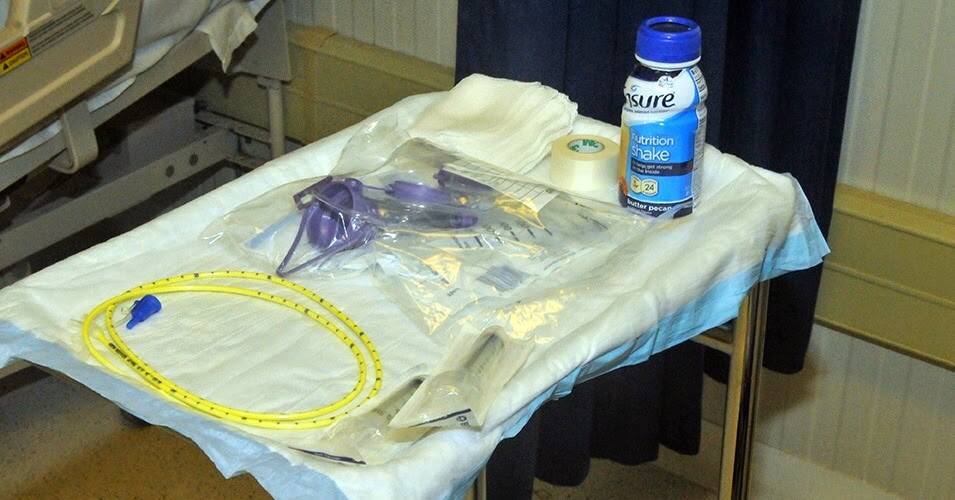
Duty to Refuse': Top Medical Groups Back Nurse Who Said 'No' to Force-Feeding Guantanamo Hunger Strikers

Force-feeding a competent person is not the practice of medicine; it is aggravated assault.'

Leading medical groups are speaking out in support of a U.S. Navy nurse who refused on ethical grounds to force-feed hunger strikers held captive at Guantanamo Bay.

The American Nurses Association announced Wednesday that they have penned letters to U.S. government and military officials strongly urging against any punishment or retaliation for the act of refusal, which occurred in July. The military is planning to try the unidentified nurse, who is an officer, before a Board of Inquiry, which could result in a dishonorable discharge that strips him of his veterans benefits.

"The ANA Code of Ethics for Nurses clearly supports the ethical right of a professional nurse to make an independent judgment about whether he or she should participate in this or any other such activity," reads an October 17 letter (pdf) to Secretary of Defense Chuck Hagel from Pamela Cipriano, ANA president. "The military setting does not change the nurse’s ethical commitments or standards."

Doctor Vincent Iacopino, senior medical adviser for Physicians for Human Rights, told Common Dreams that his organization strongly supports the nurse's refusal to take part in the force-feeding of competent adults, which is banned by the World Medical Association and the American Medical Association and has been condemned by the office of the United Nations high commissioner for human rights as torture and a violation of international law.

"Force feedings are being done without informed consent, against people's wishes," said Iacopino. "We have codes of conduct that prohibit us from conducting therapeutic interventions or diagnostic procedures that people do not consent to."

"The government is claiming it is doing this to save people's lives," Iacopino continued. "The reality is that people are on hunger strike, protesting something: indefinite detention, often without charges. Any health professional under those circumstances has a duty to refuse. This is ill treatment with no respect for autonomy."

This is not the first time medical professionals have called for non-participation in the Guantanamo Bay force-feedings.

In op-ed published in the New England Journal of Medicine in July, a time of doctors writes, "Force-feeding a competent person is not the practice of medicine; it is aggravated assault. Using a physician to assault prisoners no more changes the nature of the act than using physicians to 'monitor' torture makes torture a medical procedure. Military physicians are no more entitled to betray medical ethics than military lawyers are to betray the Constitution or military chaplains are to betray their religion."

Furthermore, the American Medical Association also penned a letter to Hagel in April declaring, "Every competent patient has the right to refuse medical intervention, including life-sustaining interventions."

The nurse's act of refusal was originally revealed by Abu Wa'el Dhiab, a Syrian man and father of four who currently held in Guantanamo Bay despite being cleared for release since 2009. Dhiab told his lawyers at Reprieve that he heard the nurse, described as an approximately 40 year-old Latino man, state, "I have come to the decision that I refuse to participate in this criminal act."

"Before we came here, we were told a different story," the nurse reportedly added. "The story we were told was completely the opposite of what I saw."

The U.S. military has been broadly criticized for its treatment of hunger strikers. In response, the U.S. has imposed secrecy on its procedures and practices, including a media blackout on the number of people participating in the protest.

One hundred forty eight men remain incarcerated at Guantanamo Bay without charges or fair trial. More

This work is licensed under a Creative Commons Attribution-Share Alike 3.0 License

If this brave and honourable nurse is going to be tried, then so should President Obama and the Joint Chief of Staff. Editor


Thursday, November 13, 2014

Why is a Colorado firm selling apartments in Israel’s illegal settlements?

The Colorado-based real estate firm RE/MAX is profiting from Israel’s relentless theft of Palestinian land.

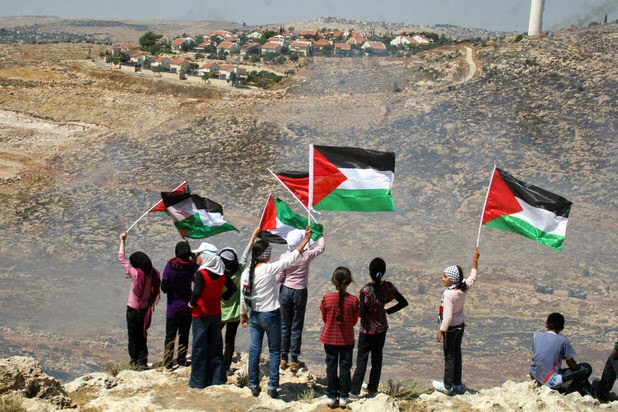
Palestinians protesting Illegal settlements

Active in the Israeli market since 1995, RE/MAX sells and rents houses and apartments in colonies reserved exclusively for Jews in the occupied West Bank, including East Jerusalem. Much of that work is coordinated in an office that the Israeli subsidiary of RE/MAX runs in Maale Adumim, a major settlement in the West Bank.

A United Nations report published last year suggested that the firm’s parent company in the US could be “held accountable” for assisting Israel’s crimes. RE/MAX International, which is headquartered in Denver, “has constant interaction and influence” over its franchises around the world. The company also provides “brand name affiliation,” training and other services, according to Richard Falk, the report’s author, who was then the UN special rapporteur for the West Bank and Gaza.

“Closet space” for settlers

On its website, RE/MAX offers properties in a number of settlement colonies in East Jerusalem, which has been under Israeli occupation since 1967. A four-room apartment with “lots of closet space” can be rented for 4,400 shekels ($1,100) per month. Among the apartment’s attractions listed by RE/MAX are proximity to the light rail system which links Israeli settlements in East Jerusalem to the city center.

Screen grab from RE/MAX Israel’s website

Such settlements violate the Fourth Geneva Convention, which forbids an occupying power from transfering its civilian population into a territory that it occupies.

Proespective settlers with a larger budget were recently offered what RE/MAX describes as “a beautiful old Arab house” in the Abu Tor neighborhood for 7 million shekels ($1.8 million).

Posing as a prospective buyer, an Electronic Intifada reporter phoned Orly Raz, a RE/MAX agent for East Jerusalem. Raz said that “we have just sold everything” that the firm was handling in Abu Tor.

Claiming that he would be moving to Jerusalem in early 2015, the reporter enquired if there would be any legal difficulties in buying a house or an apartment that previously belonged to Palestinians. “You don’t have to worry about these things,” Raz replied. “All our properties legally belong to Jewish owners. They didn’t take them from anyone.”

“Of course, if you are worried about the ‘67 border line, this is not a good area to buy property,” she added.

“Check very carefully”

Raz then asked: “Are you Jewish?” When the reporter responded that he was not, she said: “You have to check the properties — if their owners say they can sell an apartment to non-Jewish people.” She added, however, that such conditions are not mentioned on the firm’s website.

When the reporter feigned surprise that a real estate firm might discriminate based on religion or ethnicity, Raz said: “I’m just saying this is an issue to check very carefully.”

Ateret Cohanim, a Zionist organization, has been known to buy Palestinian homes in Abu Tor, so that they can be passed on to Israeli settlers.

Abu Tor has also witnessed considerable brutality by Israeli forces against its Palestinian residents lately. In late October, Israeli police officers broke into a house of a Palestinian living in Abu Tor, shooting him dead.

And in the first week of November, two Palestinian buildings were demolished in Abu Tor at the instruction of the Israeli authorities.

RE/MAX has enjoyed fawning coverage in the Israeli press. In 2004, the newspaper Haaretz published a profile of Bernard Raskin, the chief executive of RE/MAX Israel. Zimbabwean-born Raskin claimed that his firm had become a leading player in the Israeli property market because its competitors had “no professionalism.”

During a 2013 real estate conference in South Africa, Raskin noted that the Israeli economy has not suffered as severely as many others during the recession of recent years. One problem he identified was that “there is generally a shortage of stock.”

He added, however, that “more and more building is taking place outside of Tel Aviv, where property is expensive.”

Money from crime

The Israeli authorities have ensured that RE/MAX will have new business, thanks to the ongoing expansion of Jewish-only settlements in East Jerusalem and the wider West Bank. Earlier this month, the Israeli-controlled Jerusalem municipality announced that it had rubber-stamped the construction of new housing units in Ramot, a settlement in East Jerusalem. RE/MAX is already active in Ramot.

Although the US government says it is opposed to the construction of Israeli settlements, it has refused to impose sanctions on Israel. Because of that refusal, RE/MAX can continue turning violations of international law into a money-making opportunity.

The Colorado headquarters of RE/MAX International did not respond to requests for comment.

While the company’s Israeli operations may have some autonomy, RE/MAX International cannot claim that these matters have nothing to do with it. As the UN made clear in its aforementioned 2013 report, RE/MAX wields considerable influence over its franchises around the world.

The Palestinian-led boycott, divestment and sanctions movement has succeeded in putting the spotlight on how corporations like Veolia and G4S aid the Israeli occupation. Given that RE/MAX is so directly involved in the settlements that are central to that occupation, there is a strong case for putting the firm under the same kind of pressure. More


Saturday, September 6, 2014

Israel's Video Justifying Destruction of a Hospital Was From 2009

The video clip showing apparent firing from an annex to the hospital was actually shot during Israel's 2008-09 "Operation Cast Lead," and the audio clip accompanying it was from an incident unrelated to Al Wafa. (Screengrab: The Times of Israel)

A video distributed by the Israeli military in July suggesting that Palestinian fighters had fired from the Al Wafa Rehabilitation and Geriatric Hospital in Gaza City was not shot during the recent Israeli attack on Gaza, and both audio and video clips were manipulated to cover up the fact that they were from entirely different incidents, a Truthout investigation has revealed.

The video, released by the Israel Defense Forces (IDF) on July 23, the same day Israeli airstrikes destroyed Al Wafa, was widely reported by pro-Israeli publications and websites as proving that the hospital was destroyed because Hamas had turned the hospital into a military facility. But the video clip showing apparent firing from an annex to the hospital was actually shot during Israel's 2008-09 "Operation Cast Lead," and the audio clip accompanying it was from an incident unrelated to Al Wafa.

The misleading video was only the last in a series of IDF dissimulations about Al Wafa hospital that included false claims that Hamas rockets had been launched from the hospital grounds, or very near it, and that the hospital had been damaged by an attack on the launching site.

The IDF began to prepare the ground for the destruction of Al Wafa hospital well before Israeli ground troops entered Gaza on July 17. On July 11, the IDF fired four warning rockets on the fourth floor of Al Wafa, making a large hole in the ceiling - the standard IDF signal that a building was going to be destroyed by an airstrike.

On July 17, the hospital was hit by a total of 15 rockets, according to Dr. Basman Alashi, Al Wafa's director. After the first few rockets, a phone call from the IDF "asked how much time do you need to evacuate?" he told Truthout. After the second and third floors were largely destroyed, the patients' rooms were filled with smoke and the hospital lost electricity, he gave the order to evacuate the hospital.

An IDF spokesman told Allison Deger of Mondoweiss that Hamas rocket launches had come "from exactly near the hospital, 100 meters near." A slide show released by the IDF August 19 includes an aerial view of Al Wafa Hospital with two alleged rocket launching sites marked that are clearly much farther from the hospital than the 100 meters.

Even if that IDF claim of 100 meters were accurate, however, it was more than sufficient to allow the IDF to hit the launch site with precision-guided munitions without damaging the hospital. Israeli air to ground missiles, especially those fired from drones, are known to be able to hit small targets without causing collateral damage to nearby buildings. An IDF video posted on August 9, for example, shows a missile destroying what is said to be a hidden rocket launch site without harming a mosque only a few meters away from the explosion.

IDF spokesman Captain Eytan Buchman nevertheless blandly suggested that it was collateral damage from striking the launch site. He said the IDF was "left with no choice" but to "target the launcher with the most precise munitions capable of ensuring its destruction."

On July 21, the IDF Spokesman's Office pushed its propaganda line linking Al Wafa and rocket launching sites even further, claiming in a tweet and on its blog, "Hamas fires rockets from Wafa hospital in the Gaza neighborhood of Shujaiya." Under that headline was an aerial photo enhanced to highlight what was said to be Al Wafa Hospital, along with a red dot representing an M-75 rocket launch site that was not on the hospital grounds, but appeared to be a few meters away.

But the building shown in the aerial photo was not Al Wafa hospital, as Dr. Alashi quickly pointed out. A Google map of Al Wafa hospital shows none of the buildings resemble the one the IDF identified as Al Wafa. The building in the IDF image belongs to the Right to Life Society.

After that prevarication had been revealed, the IDF added a new claim that "the hospital grounds" had been used by Hamas and the Palestinian Islamic Jihad as "a post enabling terrorists to open fire at soldiers."

The IDF said that Hamas had "fired at Israel and at IDF forces from the hospital" despite warnings from the IDF, and the IDF had been forced to attack targets on the hospital site.

The statement was accompanied by a video purporting to document the firing at Israeli troops. Based on the camera angle and altitude, the video was taken by an Israeli drone, according to a former US intelligence officer, with experience in interpreting military-related images, who analyzed the video for Truthout.

The first segment of the video is a grainy, black-and-white aerial shot of a building that starts with the legend, "Terrorists Threaten IDF from inside Wafa Hospital." The building shown is not Al Wafa hospital, however, but an annex to the hospital that had been empty, both Dr. Alashi and Charlie Andeasson, a Swedish activist who was in the hospital when it was attacked on July 16, told Truthout.

The eight-second video shows what could be two brief bursts of fire from one of the windows on the third floor and then a third flash in a fourth story window. The former US intelligence officer confirmed that the footage of the building was selected from two different times of day. After the first three seconds of the video, the camera angle and the amount of light both change perceptibly. Nevertheless an exchange between the two voices on the audiotape accompanying the video continues as though the scene were continuous during the entire eight seconds.

The first voice heard on the audio recording says, in Hebrew, "Do you see this firing? Have spotted fires from within the house." The English subtitles accompanying the audio add "hospital" in parentheses after the word "house," but Seattle-based blogger on Israeli affairs Richard Silverstein, who speaks Hebrew, confirmed to Truthout after listening to the audio clip that the speaker uses the word "bayit," which can only mean "house."

A second voice then says, according to the subtitles, "Positive, fire from within the house." But the speaker actually uses the term "small house" ("bayit ha katan hazeh"), according to Silverstein.

Those references to firing from a small house indicate that the audio clip was taken from an entirely different incident at another location. That device was obviously used because there was no audio of an incident involving firing from the hospital.

Dr. Alashi said he believes the eight-second video clip portrays firing from the annex that occurred in the 2008-09 Israeli attack on Gaza. "People confirmed to me that there was firing from the building then," he told Truthout. That building was, in fact, attacked on January 16, 2009, by Israeli tanks only 70 meters away from the hospital, damaging the third and fourth floors of the building - the very floors from which the flashes are shown in the video - as the UN Fact-Finding Mission noted in its September 2009 report.

The last segment of the video showing the bombing of the Al Wafa hospital, bears the legend "secondary explosion" - meaning explosions of weapons - as each building is shown being destroyed, in line with the Israeli argument throughout the operation that Hamas stored rockets and other weapons in hospitals, schools and mosques.

The video fist shows the hospital itself being blown up, followed by heavy billowing smoke covering the entire hospital and then another flash of fire. But the former intelligence official who viewed the video said that flash indicated another Israeli missile strike on the target rather than a secondary explosion.

The clip then cuts to the destruction of the annex, again with the "secondary explosion" legend. The billowing smoke from the initial bomb explosion covers the building, and then two or three small puffs of darker smoke appear. Those puffs of smoke would suggest a secondary explosion, according to the former US intelligence officer. But he also observed that a hospital would have flammable materials other than hidden weapons that could cause the darker smoke to appear.

Given the existence of Hamas' complex network of tunnels, which provided plenty of storage space for its rockets and other weaponry, it would have made no sense for Hamas to store rockets in a hospital that it knew had already been targeted by the IDF.

In its final seconds, the video focuses in to show a square which the legend describes as a “tunnel opening near Al Wafa.” But Dr. Alashi told Truthout that it is actually a water well.

The IDF real reason for the destruction of Al Wafa hospital appears to be related to the determination to raise the cost to the civilian population of Gaza for Palestinian resistance, in line with the approach represented by its "Dahiya doctrine," named after the Beirut suburb dominated by Hezbollah, much of which the Israeli Air Force reduced to rubble in the 2006 war.

That strategy, recognized as a violation of the international laws of war, was pursued most obviously in the complete destruction of every house in several square blocks in three separate areas of the Shujaiya district of Gaza City July 19-20. But it was also evident in IDF attacks on Al Wafa and in the series of mortar and artillery attacks on six different UN shelters from July 21 though August 3. Those attacks killed a total of 47 civilians and wounded 341, according to a survey of the incidents by The Guardian.

In none of the six cases where UN shelters were hit by IDF mortar shells was the military able to offer a plausible explanation, and in three cases, it offered no explanation whatever. More

Gareth Porter (@GarethPorter) is an independent investigative journalist and historian writing about US national security policy, and the recipient of the Gellhorn Prize for Journalism in 2012. His investigation of the US entry into war in Vietnam, Perils of Dominance: Imbalance of Power and the Road to War in Vietnam, was published by University of California Press in 2005.


Wednesday, July 16, 2014

Edward Snowden should not face trial, says UN human rights commissioner

The United Nations's top human rights official has suggested that the United States should abandon its efforts to prosecute Edward Snowden, saying his revelations of massive state surveillance had been in the public interest.

Navi Pillay

The UN high commissioner for human rights, Navi Pillay, credited Snowden, a former US National Security Agency contractor, with opening a global debate that has led to calls for the curtailing of state powers to snoop on citizens online and store their data.

"Those who disclose human rights violations should be protected: we need them," Pillay told a news conference.

"I see some of it here in the case of Snowden, because his revelations go to the core of what we are saying about the need for transparency, the need for consultation," she said. "We owe a great deal to him for revealing this kind of information."

The United States has filed espionage charges against Snowden, charging him with theft of government property, unauthorised communication of national defence information and wilful communication of classified communications intelligence to an unauthorised person.

Pillay declined to be drawn on whether President Barack Obama should pardon Snowden, saying he had not yet been convicted. "As a former judge I know that if he is facing judicial proceedings we should wait for that outcome," she said. But she added that Snowden should be seen as a "human rights defender".

"I am raising right here some very important arguments that could be raised on his behalf so that these criminal proceedings are averted," she said.

Pillay was speaking after issuing a report on government surveillance, The Right to Privacy in the Digital Age (pdf), which says governments must accept stronger checks on their data surveillance powers and companies must do more to stand up to the state's demands for data.

Revelations of mass US surveillance based on documents leaked by Snowden sparked outrage among American allies including Germany, Brazil and Mexico. He has sought asylum in Russia.

The leaked documents revealed massive programmes run by the NSA that gathered information on emails, phone calls and internet use by hundreds of millions of Americans.

Mona Rishmawi, head of the rule of law branch of Pillay's office, said: "In this particular case, the way we see the situation of Snowden is he really revealed information which is very, very important for human rights. We would like this to be taken into account in assessing his situation."

All branches of government must be involved in the oversight of surveillance programmes, and completely independent civilian institutions must also monitor surveillance, Pillay says in her report. Checks on government must also be clearly understandable by the public.

The report, which will be debated at the UN general assembly later this year, says any collection of communications data or metadata is potentially a breach of privacy.

Governments often force internet and telecoms firms to store metadata about their customers, which was neither necessary nor proportionate, Pillay said, adding that companies should always be ready to challenge government requests.

"This can mean interpreting government demands as narrowly as possible or seeking clarification from a government with regard to the scope and legal foundation for the demand; requiring a court order before meeting government requests for data; and communicating transparently with users about risks and compliance with government demands," she told reporters.

She added: "I would say there are serious questions over the extent to which consumers are truly aware of what data they are sharing, how, and with whom, and to what use they will be put.

"And for how long is this data going to be out there? I would say that the same rights that people have offline must be protected online."

An emergency data collection law being rushed through the British parliament may not address concerns raised by the European Court of Justice and is difficult to justify, Pillay said. More


Palestinian factions reportedly set 10 conditions for 10-year truce with Israel

Reports in Israeli and Palestinian media say that the two Palestinian resistance groups Hamas and Islamic Jihad have set forth ten conditions for a ceasefire and ten-year truce with Israel.

Israel’s Maariv said that an unnamed "senior Palestinian official" passed it a copy of the demands, which have been transmitted by the factions to Egypt.

They include an end to all armed hostilities, the end of the siege of Gaza, and the construction of internationally supervised air and seaports.

Palestinians sleep in UN school

While Hamas has not as yet officially stated these demands, they are in line with the group’s long-standing policy of offering Israel a multi-year truce.

The reported conditions come after nine days of Israeli bombardment of the Gaza Strip that has killed more than 200 people, injured close to 1,400, and destroyed the homes of 8,200 others. Almost 80 percent of the dead, who include more than thirty children, are civilians, according to the UN.

Yesterday, Hamas refused to respond to a unilateral "ceasefire" declared by Israel that would have left the situation of siege on the Gaza Strip unchanged.

Airport, seaport and an end to violence

The ten conditions were translated by The Electronic Intifada from an Arabic version published by Ma’an News Agency:

  • Mutual cessation of the war and withdrawal of tanks to previous locations and the return of farmers to work their land in the agricultural border areas.
  • Release of all the Palestinians detained since 23 June 2014 and improvement of the conditions of Palestinian prisoners, especially the prisoners from Jerusalem, Gaza and Palestinians of the interior [present-day Israel].
  • Total lifting of the siege of Gaza and opening the border crossings to goods and people and allowing in all food and industrial supplies and construction of a power plant sufficient to supply all of Gaza.
  • Construction of an international seaport and an international airport supervised by the UN and non-biased countries.
  • Expansion of the maritime fishing zone to 10 kms and supplying fishermen with larger fishing and cargo vessels.
  • Converting the Rafah crossing into an international crossing under supervision of the UN and Arab and friendly countries.
  • Signing a 10-year truce agreement and deployment of international monitors to the borders.
  • A commitment by the occupation government not to violate Palestinian airspace and easing of conditions for worshipers in Al-Aqsa Mosque.
  • The occupation will not interfere in the affairs of the Palestinian government and will not hinder national reconciliation.
  • Restoration of the border industrial areas and their protection and development.
"Should have been met years ago"

Dr. Ramy Abdu, chair of the independent group Euro-Mid Observer for Human Rights (euromid.org, told The Electronic Intifada from Gaza City this morning:

I believe that these requirements should have been met years ago. The core of these requirements are not political but purely humanitarian and legally binding. The international community has called many times for their implementation. Palestinians have the right to move in and out freely like others in the world. They have the right to import and export, to control their borders and airspace. Israel argues that it left Gaza, so it should stop controlling the lives of Palestinians.

Abdu noted that his organization recently published a detailed proposal to establish a maritime link from Gaza to the rest of the world with an international role that could "alleviate security concerns." More


Thursday, June 19, 2014

Israel elected to leadership of UN committee on “Decolonization”

Just when it appeared that the United Nations could not be more ineffective in protecting Palestinian rights and holding Israel accountable for violating them, here comes the news that Israel has been elected as vice-chair of the UN Special Commitee on Decolonization – which deals among other things with matters related to Palestinian refugees.

Palestinians examine the ruins of
buildings demolished by Israeli
occupation forces in eastern Jerusalem,

According to UN minutes, the representative of Israel, the world’s last settler-colonial power, received 74 votes for the post, despite strong opposition from the Arab Group of UN member states.

Qatar, speaking on behalf of the Arab states, described Israel as a “State that violated the United Nations Charter and international law. Because its track record was rife with murder and its occupation had lasted more than 66 years, Israel was not qualified to preside over questions pertaining to Palestinian refugees, peacekeeping and the investigation of its own illegal practices.”

The Arab states had demanded a recorded vote, an unusual step, prompting objections from the ambassador of the United Kingdom which is a member of the Group of Western European and Other States that nominated Israel.

The Balfour Declaration

Canada took the opportunity to express its “unflinching support for Israel” and the United States said it “unequivocally supported Israel’s election.”

Saudi Arabia – whose own membership of the UN Human Rights Council has drawn much criticism – said that Israel’s election was “the moral equivalent of placing the apartheid regime of South Africa in charge of a committee to end racism.”

Theater of the absurd

Israel thanked its supporters, but perhaps its actions spoke louder than words. While this theater of the absurd was playing out in New York, Israeli occupation forces stepped up demolitions of Palestinian homes to make way for colonial settlements.

Its election comes just weeks after Israel announced yet another massive expansion of illegal colonies in the occupied West Bank.

On Wednesday alone, Israeli demolitions left seven Palestinian families homelessin the West Bank.

And take a look at the photostory by Silvia Boarini documenting Israel’s ongoing ethnic cleansing of Palestinian Bedouins in the southern Naqab (“Negev”) region of present-day Israel.

These latest measures of ethnic cleansing come amid Israel’s assault on West Bank cities over the past week, allegedly in search of three missing colonial settlers. Israel has so far abducted more than 300 Palestinians, raided 750 homes as well as dozens of charities and the Birzeit University campus.

If there were a UN Committee on How to Occupy and Colonize, Israel would indeed be the best candidate to lead it. More

The British are at the root of the Palestinian's problems as they, via the illegal Balfour Declaration, allowed the Jews to settle in Palestine (there was no israel then). And they did so while running the southern part of the ex-Ottoman Empire under a Mandate from the League of Nations. A mandate to govern the State of Trans-Jordan and Iraq on behalf of the citizens thereof. Editor