Showing posts with label palestinian. Show all posts

Sunday, February 7, 2016

Barbarism by an educated and cultured people’ — Dawayima massacre was worse than Deir Yassin

After the massacre, a letter was sent to the editor of the leftist affiliated newspaper Al-Hamishmar, but never published.

Yair Auron

As Auron notes, there are still many archives of the time which are classified. Auron also states that there was an investigation that was never concluded and “died out” as a massive amnesty was provided to military personnel in February 1949.

This is a very exhaustive article, but I found it useful enough to translate this letter in full on its own. The letter, which first “disappeared,’ was provided to Auron by historian Benny Morris. Although these matters have been referred to in passing in historical summaries, the letter has never been published before in full.

The letter is brought forth by a member of the MAPAM leftist party, S. Kaplan, who got the letter of testimony from the soldier. It is written to Eliezer Peri, editor of Al Hamishmar, and dated 8th November 1948 (18 days after the massacre):

To comrade Eliezer Peri, good day,

Today I have read the editorial of “Al Hamishmar” where the question of our army’s conduct was aired, the army which conquers all but its own desires.

A testimony provided to me by an officer which was in [Al] Dawayima the day after its conquering: The soldier is one of ours, intellectual, reliable, in all 100%. He had confided in me out of a need to unload the heaviness of his soul from the horror of the recognition that such level of barbarism can be reached by our educated and cultured people. He confided in me because not many are the hearts today who are able to listen.

There was no battle and no resistance (and no Egyptians). The first conquerors killed from eighty to a hundred Arabs [including] women and children. The children were killed by smashing of their skulls with sticks. There was not a house without dead. The second wave of the [Israeli] army was a platoon that the soldier giving testimony belongs to.

In the town were left male and female Arabs, who were put into houses and were then locked in without receiving food or drink. Later explosive engineers came to blow up houses. One commander ordered an engineer to put two elderly women into the house that was to be blown up. The engineered refused and said he is willing to receive orders only from his [own] commander. So then [his] commander ordered the soldiers to put the women in and the evil deed was performed.

One soldier boasted that he raped an Arab woman and afterwards shot her. An Arab woman with a days-old infant was used for cleaning the back yard where the soldiers eat. She serviced them for a day or two, after which they shot her and the infant. The soldier tells that the commanders who are cultured and polite, considered good guys in society, have become vile murderers, and this occurs not in the storm of battle and heated response, but rather from a system of expulsion and destruction. The fewer Arabs remain – the better. This principle is the main political motive of [the] expulsions and acts of horror which no-one objects to, not in the field command nor amongst the highest military command. I myself was at the front for two weeks and heard boasting stories of soldiers and commanders, of how they excelled in the acts of hunting and “fucking” [sic]. To fuck an Arab, just like that, and in any circumstance, is considered an impressive mission and there is competition on winning this [trophy].

We find ourselves in a conundrum. To shout this out in the press will mean to assist the Arab League, which our representatives deny all complaints of. To not react would mean solidarity with moral corruption. The soldier told me that Deir Yassin [another massacre, by Irgun militants, April 1948] is not the peak of hooliganism. Is it possible to shout about Deir Yassin and be silent about something much worse?

It is necessary to initiate a scandal in the internal channels, to insist upon an internal investigation and punish the culprits. And first of all it is necessary to create in the military a special unit for the restraint of the army. I myself accuse first of all the government, which doesn’t seem to have any interest to fight the phenomena and perhaps even encourages them indirectly. The fact of not-acting is in itself encouragement. My commander told me that there is an unwritten order to not take prisoners of war, and the interpretation of “prisoner” is individually given by each soldier and commander. A prisoner can be an Arab man, woman or child. This was not only done at the exhibition windows [major Palestinian towns] such as Majdal and Nazareth.

I write this to you so that in the editorial and in the party the truth will be known and something effective would be done. At least let them not indulge in phony diplomacy which covers up for blood and murder, and to the extent possible, also the paper must not let this pass in silence.

Kaplan

More


Sunday, December 28, 2014

Israel's Gas Dream – The End Is Nigh

In the five years since the discovery of the Tamar and Leviathan natural gas fields off the coast of Israel, the Israeli energy discourse has focused on questions like what to do with the gas, how much of it to export and to whom, and what the fairest distribution of profits would be among the gas partners, headed by Noble Energy and Delek Energy, and the Israeli public.

Click to expand

But after years of delays and billions of dollars spent, a new and increasingly likely scenario should be considered – the premature – and tragic – death of the Israeli gas dream. I alluded to this option in an August 2013 article titled "Israel's Zero Gas Game" in which I warned that Israel has become so busy dividing the pie that its leaders forgot it must first be baked and that due to the failure of the government to present a clear vision for the country's energy sector, articulate the rights and responsibilities of foreign investors and most importantly set rules and stick to them, "the gas will be left in the ground and the startup nation will be more worthy of the title 'shutdown nation'." Perhaps that sounded crazy at the time. Today, with the decision of the Israeli Anti-Trust Authority to revoke an arrangement permitting Noble-Delek partners to develop Leviathan, declaring them a cartel - a move that will require the separation of Leviathan from Tamar and the sale of Leviathan to a new partnership, effectively postponing the development of Leviathan indefinitely - the scenario of "zero gas" - and perhaps even the withdrawal of Noble from Israel altogether - should be considered seriously.

In deciding to enter Israel Noble has taken a huge financial, regulatory and geopolitical risk. However, the size of the discoveries, the potential of finding oil under the gas layers and the doubling of the company's market capitalization made the move easy to justify to its shareholders. But the Texas company, the only international energy company that was willing to set foot in Israel, was welcomed with no red carpet. Instead it was ushered through a Via Dolorosa of bureaucratic torture which eliminated any chance for gas production before the end of 2018 – ten years from the beginning of exploration. A ten year lead time from discovery to production is a lot to ask of a publicly traded company which has to satisfy quarterly thinking and profit hungry shareholders. But in light of Noble's recent stock performance, dropping from $80 in the summer to $50 today, the decision of the Israeli government provides an impetus to the company's leadership, not to mention the new CEO David Stover, to reconsider the commitment to Israel and begin to seek greener pastures.

There are very few oil and gas companies who have both the experience of drilling in deep waters and the willingness to associate themselves with Israel, especially in light of Noble's experience.

The Israeli government's ruling has huge implications for the future of the region as it means that at best the supply of gas from Leviathan will be delayed into the 2020s. At worst it will not happen at all. The government's concern about a gas monopoly is a legitimate one, especially during an election campaign when issues of cost of living dominate the local political discourse. But its hopes that the hot potato called Leviathan can somehow be sold to new partners require a lot of faith. There are many people with money who may be tempted to buy into a partnership in a 22 trillion cubic feet (tcf) field, but owning a stake in a gas field without an operator at hand is like owning a gold mine on the moon. There are very few oil and gas companies who have both the experience of drilling in deep waters and the willingness to associate themselves with Israel, especially in light of Noble's experience. With falling energy prices worldwide, the chance of a Noble-like operator popping out of nowhere is slim. This means that in its desire to avoid the creation of a monopoly, Israel is taking the risk that Leviathan, the world's largest offshore gas discovery of the past decade, will not be developed for many years to come - if ever. The losers will first and foremost be the Israeli people who will lose not only billions of dollars in tax revenue and the main engine of growth of their economy but also the prospects of securing their energy supply for generations. The scenario is equally bad for Jordan, Egypt and the Palestinian Authority who are counting on Leviathan gas for their economic well-being and which have all signed letters of intent to buy Israeli gas despite local opposition from their respective Israel-hating Islamists. Europe will also be a casualty since a portion of Leviathan was aimed for two LNG terminals in Egypt from where it would have been shipped to European countries aspiring to become less dependent on Russia's gas.

Other than the handful of lawyers who will earn millions litigating the dispute between Noble and the Israeli government in international courts, the biggest winner will be Cyprus. In December 2011 Noble announced the discovery of 7 tcf in a field northwest of Leviathan called Aphrodite (block 12). Other blocks have been opened for bids since attracting interest from a handful of large oil and gas companies including Total of France, Kogas of South Korea, ENI of Italy and Petronas of Malaysia. But with all eyes on Leviathan, Cyprus became an uninteresting side show. This may soon change. Cyprus may not be a paragon of regulatory stability and certainly not an investors' haven and its tense relations with Turkey pose some geopolitical risk, but the fatigue from Israel's energy shenanigans could bring about a shift from Israel to Cyprus as the new center of gravity in the East Mediterranean energy play.

There is no polite way of saying this. Israel's latest decision is tantamount to nationalization of the kind seen in Argentina, Venezuela, Mexico and Russia. All of those governments sugarcoated their decision invoking the need to protect the public interest. The investment community and global oil industry got the message and wrote off those countries. With this miserable decision, Israel has just lodged itself into this notorious club. The price will be paid in spades – and sooner than most Israelis realize. More

-------------

As the map above shows the gas field in offshore Gaza who should be the benefliciaries. Under international law Israel has no legal claim and Gaza most certainly does. I would give Gaza an income to rebuild the infrastracture destroyed by Israel as well as giving them fossil fuel to generate electricity. Editor


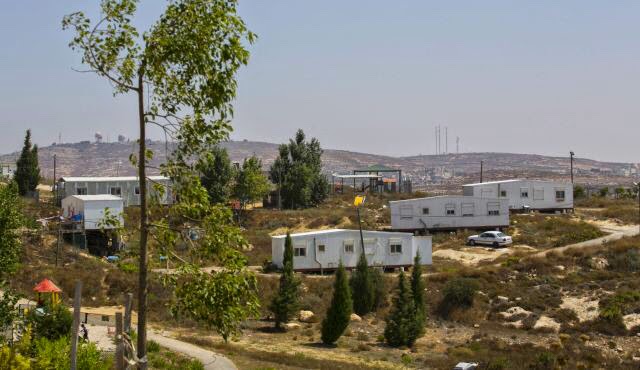
Palestinian landowners have waited too many years for Israeli wheels of justice to turn.

It is impossible to overstate the significance of the High Court of Justice ruling ordering the state to demolish within two years the Amona illegal outpost, which was built on private Palestinian land. After years of evasion, legal tricks, forged documents and unfulfilled pledges, even the High Court came to realize that the state cannot be trusted, not to mention the settlers, to voluntarily agree to return the land they plundered from their owners.

Amona was born in sin in 1997, when a group of settlers established residence in an area that had been earmarked for an archaeological site and a Mekorot Water Company reservoir. Cease and desist orders issued by Civil Administration inspectors in 2004 halted building for four years, but it resumed in force despite new stop-work orders.

In 2006, after the High Court ordered the demolition of Amona’s permanent structures, the settlers made clear that they were not bound by the court’s authority and they turned the “battle for Amona” into a national event in which they violently confronted the police. If there was no alternative to demolition, they would make Amona a “national trauma” that would threaten any future plans to evacuate outposts or settlements.

Even now, after the High Court ruling, the settler leaders are adamant: “We swear today to fight this with all our might,” Amona spokesman Avihai Boaron said. This is nothing but a continuation of the settlers’ common view that the state and its institutions are their servants, and when they do not fulfill their mission they must be fought. Particularly infuriating is the idea that “the left-wing government and the High Court are leading the country”; That is, in the struggle between land theft and the law, the High Court is not only a legal and ideological enemy but it also violates the political reality in which the right wing is in control. That perception is no less distorted and dangerous than the settlers’ position that the theft of Palestinian land is part of the Redemption.

The government of Israel cannot continue to avoid carrying out the High Court’s ruling, according to which “there is no possibility of authorizing the construction, even retroactively,” — a recognition of the tricks the cabinet could try. Two years is sufficient time to find alternative housing, and it would be best not to not wait until the last moment. The Palestinian landowners have waited too many years for the Israeli wheels of justice to turn. They have the right to have their property returned to them, with appropriate compensation. More


Sunday, December 14, 2014

Israelis rattled by search for truth about the Nakba

First ‘truth commission’ avoids issue of reconciliation as veteran Israeli fighters due to confess to 1948 war crimes

Middle East Eye – 9 December 2014

The first-ever “truth commission” in Israel, to be held on Wednesday, will feature confessions from veteran Israeli fighters of the 1948 war who are expected to admit to perpetrating war crimes as hundreds of thousands of Palestinians were expelled from their homes.

The commission is the culmination of more than decade of antagonistic confrontations between a small group of activists called Zochrot, the Hebrew word for Remembering, and the Israeli authorities as well as much of the Jewish public.

Founded in 2002, Zochrot is dedicated to educating Israeli Jews about what Palestinians call the Nakba, Arabic for catastrophe, referring to Israel’s creation on the ruins of their homeland more than six decades ago. The group also campaigns for the right of return for Palestinian refugees to Israel, probably the biggest taboo in Israeli society.

The commission, which has no official standing, could be the first of several such events around Israel, to investigate atrocities and war crimes committed in different localities, said Liat Rosenberg, Zochrot’s director.

“We have looked to other such commissions around the world as models, most obviously in South Africa,” she said. “But unlike the one there, ours does not include the element of reconciliation because the conflict here has yet to be resolved.

“We cannot talk about reconciliation when the Nakba is ongoing. We are still in a situation where there is apartheid, constant violations of human rights and 70 percent of the Palestinian community are refugees.”

The commission is likely to provoke outrage from the Israeli government, which passed the so-called Nakba Law in 2011 to try to make it harder to commemorate Palestinian suffering. The impact of the law is being widely felt. Just last month, the culture ministry vowed to block a government grant to a Tel Aviv cultural centre that hosted a Zochrot film festival on the Nakba.

Names kept secret

Rosenberg said Israeli veteran fighters and Palestinian witnesses participating in the truth commission had asked for their names to be kept secret until the hearings for fear that friends and family would put pressure on them to withdraw.

The commission is being held in the city of Beersheva, a once-Bedouin town that was ethnically cleansed in 1948 and is today the largest Jewish city in the Negev region in southern Israel.

Zochrot said it had chosen the city to host the first event event because forced expulsions of Bedouin from the Negev had taken place not only in 1948, but had continued on a large scale, out of view of observers, for many years afterwards.

The commission is the latest project by Zochrot that discredits a traditional Israeli narrative that some 750,000 Palestinians left under orders from Arab leaders and that Israel’s army acted only in self-defence. Such beliefs have fed into the common assumption from the Israeli public that Israel’s army is the “most moral in the world”.

“This is not just about researching the truth,” said Rosenberg. “The truth of the Nakba is to a large degree known, but the task is to expose the truth to the Israeli Jewish public – both so that it is forced to take responsibility for what happened and so there can be accountability.”

The commission is the direct result of a project launched by Zochrot two years ago to create an alternative archive of the Nakba, based on filmed testimonies from Palestinian refugees and Israeli veterans. Activists fear that, as the generation of refugees and fighters dies off, they will take their secrets to the grave.

Israeli military archives relating to the 1948 war began being opened to academics in the late 1980s. This led to a group of so-called “new historians” overturning the traditional accounts of that period and unearthing written evidence of massacres and ethnic cleansing operations for the first time.

Archives closed

However, historians have reported in recent years that the Israeli authorities have become more reluctant to open files and many of the more controversial episodes of the 1948 war are still unclear.

Rosenberg hopes the commission will begin to fill some of the gaps.

According to Rosenberg, three Israeli fighters and three Palestinian witnesses will testify before a panel of six commissioners. The commissioners will then question them further about events and make follow up recommendations.

The hearings are due to be streamed online.

One veteran of the fighting in the Negev, Amnon Neumann, has already gone on record in testimony that can be seen in Zochrot’s film archive.

He has said the Bedouin in the Negev – contrary to popular Israeli perception – put up almost no resistance to advancing Jewish forces because they lacked “a military capacity” and “had no weapons”. Nonetheless, he said, the Israeli army terrified the Bedouin villagers out of their homes by shooting either at them, or above their heads.

“We drove them out. Women and children went to Gaza. … By the morning there was nobody there. We burnt their houses,” Neumann said.

When villagers tried to sneak back to tend crops or vineyards under the cover of night, he recounted, the soldiers opened fire. “We would shoot and kill them. This was part of the horrible things we did.”

In other filmed testimony, Mordechai Bar-On, an officer in 1948 with the Givati Brigade, confirmed that orders were to shoot “infiltrators” – a reference to refugees who tried to return to their villages. “Even if there were women and children. I remember I told myself that we would do it. … There was an order to kill, not even catch them,” Bar-On said.

For the most part, the Israeli veterans are coming forward now out of a feeling of guilt.

“At that time I did not see anything wrong with what we were doing,” Neumann said. “If I was told to do things that I do not want to mention [here], I did them with no doubts at all. … Not now. It is already 50, 60 years that I am filled with regret.”

But challenges remain, and despite veterans coming forward, piecing together events can still be difficult.

Rosenberg said many of those giving filmed testimony, including Neumann, have been reluctant to go into details of the war crimes they participated in. It is now hoped that the questioning by the commissioners will encourage participants to be even more forthcoming.

Put on trucks to Gaza

The commission will also move beyond the 1948 period and examine expulsions in the semi-desert Negev region, comprising nearly two-thirds of Israel’s landmass, for the 12 years following the war.

Isolated from the rest of the new state of Israel, the Negev was largely unmonitored as the Israeli military carried out expulsions of Bedouin throughout the 1950s, said Raneen Jeries, a Zochrot organiser.

More than 2,000 Palestinian inhabitants of al-Majdal, which later became the Jewish city of Ashkelon, were put on trucks and shipped to Gaza nearly two years after the war ended, according to Nur Masalha, a Palestinian historian and expert on Israeli “transfer” policies.

Jeries said the legacy of the events of 1948 was being felt to this day, with policies of expulsion continuing in the Negev and the occupied territories.

Haaretz reporter Amira Hass revealed three months ago that the Israeli military was planning to forcibly relocate for a second time the Jahalin tribe. The tribe was driven out of the Negev in 1948 and fled to the safety of the West Bank, then under Jordanian control. However, Israel occupied the land after the 1967 war, and it seems that Israeli authorities now want to expel some 12,500 Jahalin tribes people, this time to a site near Jericho.

Zochrot had been successful in forcing Israelis to recognise the Nakba and a darker side to the 1948 war, said Neve Gordon, a politics professor at Ben Gurion University in Beersheva, where the truth commission is to be held.

“A decade ago, if I mentioned the Nakba in a class of 150 students, hardly any of them would have known what I meant. Now 80 or 90 per cent would know,” Gordon told MEE.

Gordon also attributed the change both to Zochrot’s activities and statements by Arab legislators representing Israel’s large Palestinian minority, comprising a fifth of the total population.

Law against commemoration

But as the issue of the Nakba has become more visible in Israel, sensitivity about it has only grown. Ahead of Nakba Day last May, Prime Minister Benjamin Netanyahu lashed out at the Palestinian Authority for commemorating the day, saying: “They are standing silent to mark the tragedy of the establishment of Israel, the state of the Jewish people.”

Palestinians were educating their children with “endless propaganda” calling for the disappearance of Israel, he said.

Economy Minister Naftali Bennett went further, saying: “We need not tolerate Israeli Arabs who promote Nakba Day.”

The government has backed up its rhetoric with legislation, passing a Nakba Law in 2011 that denies public funds to institutions and organisations that commemorate the Palestinians’ dispossession. The measure is partly seen as a reaction to Zochrot’s growing success.

The original legislation, which would have criminalised any commemoration of the Nakba – making many of Zochrot’s activities illegal – was water-downed after Israel came under strong international pressure.

In Zochrot’s early years, its main efforts were directed at escorting Israeli Jews and Palestinian refugees to some of the more than 500 Palestinian villages that Israel destroyed during and after the 1948 war. The villages were razed to prevent refugees from returning home.

The remnants of most of the villages are now barely traceable, hidden under forests planted by a charity called the Jewish National Fund or lost within gated communities in which only Jews can live.

Zochrot has continued such visits, placing signposts to remind the new Jewish inhabitants that their communities are built on the ruins of Palestinian homes, often belonging to neighbours living a short distance away. A large proportion of Israel’s Palestinian minority were internally displaced by the 1948 war and live close to their original homes but are barred from returning.

Backlash on campuses

Eitan Bronstein, who founded Zochrot, said the current challenge was how to change Israeli Jews’ perception of the Nakba.

“They now recognise the word but what does it mean to them? Many, it seems, think it is simply a negative label Palestinians have attached to Israel’s establishment. We have an Independence Day that they call their Nakba,” Bronstein said.

“We need to educate them about the events of the Nakba, what occurred and our responsibility for it. They have to stop thinking of it as just propaganda against Israel.”

The right wing, including the government of Benjamin Netanyahu, has grown increasingly rattled by Zochrot’s agenda-setting programme of events.

The popularity of a far-right youth movement, Im Tirtzu, has grown rapidly on Israeli university campuses over the past few years, in part as a backlash to commemorations of the Nakba by Zochrot and Palestinian students.

Last month, when Zochrot held its second Nakba and Right of Return Film Festival in Tel Aviv, the culture minister, Limor Livnat, immediately threatened to pull a government grant worth more than $450,000 from the cinema that hosted it.

“The state cannot bear the cost of funding of an entity that encourages debate over what the Palestinians call ‘the right of return’,” Livnat said in a statement. She was reported to have based her decision on her reading of the Nakba Law.

“The antagonism towards Zochrot and the idea of the Nakba is part of the educational process,” said Bronstein. “It is a necessary phase Israel needs to pass through if we are to get to a point of reconciliation.”

Unfazed by threats

Bronstein and others have faced angry opposition from the Israeli public and police as they have tried to stage Nakba commemorations – most notably in Tel Aviv in 2012, when they were surrounded by riot police for four hours. Three Zochrot activists were arrested.

Yet Zochrot’s organisers, whose members include both Jewish and Palestinian citizens, seem largely unfazed by the threats and hostility their group generates.

Last year Zochrot arranged a conference that for the first time examined not just the principle of the right of return but practical ways to implement it.

This year the group launched a phone app, called iNakba, in three languages, which provides users with detailed maps and information on the destroyed villages.

Jeries said it had had thousands of downloads, giving Israelis for the first time the chance to peel away the subsequent layers of construction and forestation to see what was destroyed, often on their doorstep. More

Tagged as: Bedouin, destroyed villages, Nakba


Friday, September 26, 2014

Israel’s very own history of eugenics

This hour-long documentary, the Ringworm Children, raises so many disturbing questions about Israel and its relationship with the US that one hardly knows where to begin.

http://www.jonathan-cook.net/blog/
2014-09-26/israels-very-own-history-of-eugenics/

In the 1950s, waves of new immigrants swept into Israel. To the dismay of the country’s Ashkenazi leaders (those originating from Europe and the US), the great majority were from Arab countries. Levi Eshkol, a later prime minister, expressed a common sentiment when he called them “human rubbish”. Israel, deprived of “good-quality” Jews, was being forced to bring to its shores Arab Jews, seen as just as primitive and dirty as the Palestinians whom Israel had recently succeeded in ethnically cleansing.

Into this deeply racist atmosphere stepped Dr Chaim Sheba, a eugenicist, who believed that the Arabs Jews were bringing along with them diseases that threatened the Ashkenazi Jews. His obsession was ringworm, an innocuous childhood disease that affects the scalp. He went to the US, collected old military X-ray equipment and zapped tens of thousands of these children’s heads with potentially lethal doses of radiation. The survivors tell of their horrifying experiences during and after the treatment, and of the brothers and sisters they lost at a young age.

But this isn’t just a history lesson exploring an unusual aspect of Israel’s racist underpinnings. The documentary exposes a massive cover-up by the state: many of the children’s medical files – long thought to have been lost – were actually held by one of the doctors involved. Even after this disclosure, the state has continued to refuse the victims access to the files, despite the fact that such access may be vital in helping them receive the correct life-saving treatment, as well as proper compensation.

The final shocking twist is the discovery that all these experiments cost the equivalent of hundreds of millions of dollars in today’s terms – in fact, more than Israel’s entire annual budget at the time. How could Israel have afforded it?

The documentary suggests persuasively that the US, with its own long fascination with eugenics, most likely sub-contracted these experiments to Israel as a way to bypass the increasing domestic legal impediments it faced. The US presumably footed the huge bill.

There are a couple of troubling omissions in the documentary itself. The first is that Dr Sheba did not carry out these experiments on Arab Jews only. He also exposed many Palestinian children in Israel to the same huge doses, for the same racist reasons.

The other is that Dr Sheba is still venerated to this day in Israel and has one of the country’s most famous hospitals, the Chaim Sheba Medical Center, named after him. As the documentary makes clear, there was plenty of evidence by the 1950s of the extremely dangerous effects of radiation on humans. What Dr Sheba did was a form of genocide. That he is still honoured in Israel is, to my mind, no different from Germany naming a hospital in Berlin the Josef Mengele Medical Center.

But keeping Dr Sheba’s reputation unblemished is, I suspect, important to those who wish to prevent other, even more unseemly skeletons being unearthed over this affair.

(UPDATE BELOW)

The documentary, from 2003, is in five 10-min parts: More

UPDATE:

I often talk about “hasbara” (what Israelis translate as “explanation” but really means “propaganda”) but rarely have I found an example of it quite as blatant as the entry on the Ringworm Affair on Wikipedia. By the look of it, this entry has been written by an Israeli government hasbara team. One can almost hear the indignation in the text dismissing the documentary’s claims. But interestingly there is no attempt to refute the two accusations at the heart of the film: that the medical files are still being withheld from the victims, and that the sum needed for the experiments was astronomical and way beyond Israel’s means. So who paid for them and why?


Monday, September 1, 2014

Israel remorseless after military campaign that killed more than 500 children, destroyed 20,000 buildings and displaced as many as half a million Palestinians

Despite hailing as a victory the seven weeks of fighting that killed more than 2,100 Palestinians and destroyed large swathes of Gaza’s infrastructure, Israel’s prime minister, Benjamin Netanyahu, appears to have emerged as the main political casualty of Operation Protective Edge.

Jonathan Cook

Among Israeli Jews, polls continue to show strong backing for the army, the most revered of Israel’s national institutions.

Last week, a survey by the Jerusalem Post and Maariv newspapers revealed that 61 per cent of respondents agreed with the statement that the Israeli military – but not Israel – had won in Gaza.

“Israel”, in this case, is clearly understood as a synonym for Netanyahu, whose fortunes have taken a sharp downturn in the aftermath of the military campaign.

In late July, as Israel launched its ground offensive, Netanyahu’s approval ratings stood at 82 per cent. Days before the current ceasefire took effect on 26 August, that figure had slumped to 55 per cent.

Last week, as the ceasefire began, Channel 2 TV found that his popularity had plummeted even further, to 32 per cent. Half the country were reported to be positively dissatisfied with his performance.

No signs of remorse

Israelis’ unhappiness with their prime minister does not indicate, as elsewhere in the world, a backlash against a military campaign that killed more than 500 children, destroyed 20,000 buildings and displaced as many as half a million Palestinians. In Israel there are scant signs of remorse, even from the country’s last remaining self-declared liberals.

Netanyahu and his allies in the cabinet, including defence minister Moshe Yaalon, have been trying to play up Israel’s successes, arguing that the army scored an “impressive victory”. Yaalon noted that Hamas had used up most of its rockets, while Israel had destroyed Hamas’ tunnels, killed key leaders and wrecked its supporting infrastructure.

That assessment has been challenged not only by Palestinians in the occupied territories but by leaders of the Palestinian minority in Israel. At the weekend several Palestinian members of the Israeli parliamentattended a victory rally for Hamas near Acre.

One of them, Haneen Zoabi, told Middle East Eye: “This was the longest Israeli attack faced by Palestinians in modern times. It was longer even than the war against Lebanon in 2006. And yet the will of the Palestinian resistance was not broken, and the people of Gaza stood strong. Israel did not achieve any of its political or military aims. When bombarded by one of the strongest armies in the world, that is an undoubted victory.”

Even Netanyahu sounded barely convinced of Israel’s success at a “post-war” press conference. Comparing Hamas to Islamic extremist groups, he observed defensively that even the United States had been unable to defeat al-Qaeda. That refrain was repeated in a rash of interviews with Israeli TV at the weekend.

Herculean task

Few found the comparison persuasive. Settler leader Amiel Ungar noted disparagingly that Hamas’ “Gaza emirate occupies 360 square kilometers and is surrounded on all sides. A week earlier we were told that if the order came down, the IDF could overrun Gaza in seven days. Now a week's work had suddenly mushroomed into a herculean task that would last years.”

Netanyahu’s problem appears to stem from the fact that he has failed to convince his natural constituency on the right that he acted decisively in Gaza. They expected Hamas “smashed”, a term used by many on the right throughout the fighting, or at the very least that Israel would insist on the faction’s “demilitarisation”.

Many Israelis appear particularly incensed by televised scenes of Hamas in Gaza celebrating last week, following the ceasefire announcement. Under its terms, Israel agreed to allow in aid and building materials to ease the humanitarian situation and to extend the fishing zone for Gaza’s fishermen.

Among Israeli Jews, the celebrations in Gaza are widely seen as crowing at the relatively large death toll of Israeli soldiers in the Gaza fighting. Yesterday, it was reported that another soldier had died from wounds sustained in earlier fighting, bringing the total to 66 soldiers and seven civilians.

The high price in blood – even if small in comparison to the suffering of Palestinians in Gaza – placed an added burden on Netanyahu to show he had secured major achievements against Hamas, said Shlomo Bron, a retired general and analyst for the Institute for National Security Studies at Tel Aviv University.

Sacrifice for nothing

“The public is prepared to accept heavy losses if war aims are achieved,” he told Middle East Eye. “But if the sacrifice is seen as for nothing – and that is the view of those who bought into the narrative that Hamas could be destroyed – then Netanyahu is likely to get the blame.”

In addition, the military campaign’s costs to the Israeli economy are already becoming apparent. Yesterday, it was revealed that $560 million cuts were needed immediately, slashing 2 per cent off the budgets of every government department apart from the defence ministry.

To many Israelis, it looks as though the ceasefire has simply restored the status quo, with forthcoming negotiations in Cairo that, it is feared, may win Hamas bigger concessions.

Such concerns were underscored yesterday when an Israeli military source suggested to the Haaretz newspaper that the army’s preferred new approach, designed to prevent renewed confrontation with Hamas, was an easing of the seven-year siege on Gaza. Hamas’ main demand has long been an end to the blockade.

“If we can assist by expanding fishing grounds and easing restrictions on border crossings of people and goods into and from Israel, this will help maintain the quiet,” an unnamed official said.

Rather than making concessions, the Israeli public believes Netanyahu should have pressed on against Hamas. Such sentiments have been voiced by the Israeli prime minister’s rivals in the cabinet, such as Avigdor Lieberman and Naftali Bennett. They have called for the army to “finish the job”.

The Jerusalem Post poll found 58 per cent of Israelis believed the truce was a mistake and that the army should have pushed deeper into Gaza to degrade Hamas military capabilities.

Reflecting that mood, Lieberman’s told Channel 1 TV at the weekend: "The fact that a 20,000-strong terror group has endured for 50 days against the strongest army in the Middle East and has stayed in power – it bothers me very much."

Confidence shaken

Yoav Bar, a leftwing activist and blogger from Haifa, noted that grand but misleading claims made early in the operation had undermined trust in the leadership’s competence. Early, on, he noted, “Israeli military commanders claimed that the resistance is running out of ammunition. By the end of the first week they declared that a third of the missiles were already used. After 51 days of war the only possible conclusion is that they didn’t have any idea how many rockets there were.”

Similar evasiveness over prior intelligence of Hamas’ extensive network of tunnels under Gaza, some of them leading into Israel, also shook Israelis’ confidence. How was it possible that the tunnels became the major justification for continuing the operation only after the ground invasion had begun?

David Horovitz, editor of the Times of Israel, said that, given the army’s near-sacred status in Israel, the blame was most likely to fall on Netanyahu.

The Israeli public, he pointed out, was “psychologically reliant on the assumption that its army can ultimately de-fang all threats, and that if the army fails to do so, that must be because it did not get the correct orders from the political leadership.”

Part of the disquiet, according to Moshe Arens, a former defence minister from Netanyahu’s Likud party, stems from a sense that Netanyahu lacks the political courage to deal with what is seen as a growing threat posed to Israel from Islamic extremism in the region.

That has not been helped by Netanyahu’s repeated efforts to equate Hamas with Islamic State, the jihadist group notorious for beheadings that has recently made major territorial gains across the region.

‘Al-Qaeda on the border’

At the weekend, Netanyahu told Channel 2 he had decided “not to invest all my resources” in Gaza at a time when “the Islamic State is galloping toward us, al-Qaeda is on the Golan borders.”

Arens wrote in the Haaretz newspaper yesterday that Israel’s operation in Gaza “could have been the beginning of a successful campaign against the fanatical Islamic terror spreading its tentacles through the Middle East, threatening not only Israel, but also many Arab countries.”

He and others have noted that the alignment of regional forces in Israel’s favour provided the best strategic environment Netanyahu could have hoped for. “Egypt, Jordan, Saudi Arabia and the Palestinian Authority were eager to see Israel defeat Hamas.”

Netanyahu’s approach to Gaza over the past two months has also risked exposing his own lack of a positive political vision. He appears afraid to destroy Hamas, but equally loath to make any concessions to bolster the position of Mahmoud Abbas.

Isaac Herzog, leader of the opposition Labour party, who had largely supported the operation, argued last week that the military offensive “could have been avoided” if Netanyahu had embraced diplomatic negotiations with Abbas.

Troubling inconsistency

That view may not be a majority one, but, as Horovitz notes, many Israeli Jews sense a troubling ambiguity in their prime minister’s attitude towards Abbas. Netanyahu has implied that Israel’s problems in Gaza could be solved by bringing in Abbas while at the same time also suggesting that the Palestinian leader is not a credible partner in the West Bank.

Bron said he had detected two trends among the Israeli public in the wake of Operation Protective Edge. The first group, Netanyahu’s natural constituency on the right, demanded Israel get even tougher with Hamas and the Palestinians.

The second trend – associated with those in the political centre and the left – believed the main lesson from Gaza was that there is no military solution to Israel’s conflict with the Palestinians and that Netanyahu must revive a diplomatic process.

Netanyahu has increasingly come to be identified with this latter view. At a cabinet meeting just before the ceasefire was agreed, Yaalon, his defence minister, observed: “There are no magic solutions.”

“This situation is full of political difficulties for Netanyahu. If there is no military solution, then he must engage in a diplomatic process. But if he does so, he will be seen as betraying his support base and this group will search for an alternative on the right who they feel better represents them.” More


Tuesday, August 19, 2014

Gaza reminds us of Zionism’s original sin

The morning after Lailat al-Qadr, the death toll in Gaza was approaching its first thousand.

Palestinians recover belongings from the
Khuzaa neighborhood of Khan Younis

Al-Qadr — the night before the last Friday in the holy month of Ramadan — is believed to be the night when the Quran was revealed to the prophet Muhammad. I spent this special night with friends in the occupied West Bank city of Ramallah after participating in the “48K March” for Gaza.

The march began in Ramallah and went to Qalandiya checkpoint. What began as a peaceful event with families bringing their children and even babies in strollers, ended with young Palestinians with gunshot wounds being rushed in ambulances to the local hospital.

Qalandiya crossing was fortified and air-tight, and the Israeli soldiers stationed on top were shooting live ammunition at the crowd.

As the ambulances were speeding through the crowd, I couldn’t help but wonder why there is no hospital between Qalandiya and Ramallah, a good distance which includes the municipalities of Jerusalem, al-Bireh and Ramallah.

The following night I was scheduled to leave Palestine to return to the United States. But Israeli forces sealed all the roads from Ramallah to Jerusalem for the night, and they were likely to be sealed the following day as well.

At the crack of dawn, when things had quietened down, my friend Samer drove me to a checkpoint that he suspected would be open. It was open, albeit for Israelis only, and from there I made my way back to Jerusalem.

That evening, as I was preparing to leave for Ben Gurion airport near Tel Aviv, people around me were trying to calm me down. “Don’t aggravate them, cooperate and they will be nice,” they said. “Why go through all this unnecessary inconvenience?”

They were talking about the “Smiling Gestapo,” Israeli security officers at Tel Aviv airport that go by the squeaky clean name of the Airport Security Division.

Non-cooperation and resistance

Listening to this, I was reminded of Jewish communities under the Nazi regime who believed that if they cooperated and showed they were good citizens then all would be well. But the road from cooperation to the concentration camps and then the gas chambers was a direct one.

The policies of racist discrimination and humiliation at Ben Gurion airport, and the policies of ethnic cleansing and murder of Palestinians in Gaza, emanate from the same Zionist ideology.

As we have seen over the past seven decades, cooperation and laying low do not make things ok.

Cooperation with the Israeli authorities might lead to short-term relief but it also validates Israel’s “right” to terrorize and humiliate Palestinians with our consent, “we” being all people of conscience. Whether we are Palestinian or not, the call of the hour is non-cooperation and resistance against injustice.

Today, Israel and its supporters lay the blame for the violence in Gaza on Hamas. But Israel did not start its assaults on the Gaza Strip when Hamas was established in the late 1980s. Israel began attacking Gaza when the Strip was populated with the first generation refugees in the early 1950s.

Palestinians, particularly in Gaza, are not faced with an option to resist and be killed or live in peace. They are presented with the options of being killed standing up and fighting or being killed sleeping in their beds.

“Sea of hatred”

Gaza is being punished because Gaza is a constant reminder to Israel and the world of the original sin of the ethnic cleansing of Palestine and the creation of a so-called Jewish state. Even though Palestinian resistance has never presented a military threat to Israel, it has always been portrayed as an existential threat to the state.

Moshe Dayan, the famed Israeli general with the eyepatch, described this in a speech in April 1956. He spoke in Kibbutz Nahal Oz, an Israeli settlement on the boundary of the Gaza Strip where Israeli tanks park each time there is a ground invasion of Gaza.

“Beyond the furrow of this border, there surges a sea of hatred and revenge,” Dayansaid then. Ironically, when six months later Israel had occupied Gaza and my father was appointed its military governor, he said that he saw “no hatred or desire for vengeance but a people eager to live and work together for a better future.”

Still, today, Israeli commanders and politicians say pretty much the same: Israel is destined to live by the sword and must strike Gaza whenever possible. Never mind the fact that Palestinians have never posed a military challenge, much less a threat to Israel.

After all, Palestinians have never possessed as much as a tank, a warship or a fighter jet, not to say a regular army.

So why the fear? Why the constant, six-decade-long campaign against Gaza? Because Palestinians in Gaza, more so than anywhere else, pose a threat to Israel’s legitimacy.

Israel is an illegitimate creation brought about by a union between racism and colonialism. The refugees who make up the majority of the population in the Gaza Strip are a constant reminder of this.

They are a reminder of the crime of ethnic cleansing upon which Israel was established. The poverty, lack of resources and lack of freedom stand in stark contrast to the abundance, freedom and power that exist in Israel and that rightfully belongs to Palestinians.

Generous offer

Back at Ben Gurion airport that night, I was told that if I cooperate and plead with the shift supervisor it would make the security screening go faster. When I declined this generous offer, I was told they “did not like my attitude.”

They proceeded to paste a sticker with the same bar code on my luggage and give me the same treatment Palestinians receive.

As I write these words, the number of Palestinians murdered by Israel in Gaza has exceeded two thousand. Ending the insufferable, brutal and racist regime that was created by the Zionists in Palestine is the call of our time.

Criticizing Palestinian resistance is unconscionable. Israel must be subjected toboycott, divestment and sanctions. Israeli diplomats must be sent home in shame. Israeli leaders, and Israeli commanders traveling abroad, must fear prosecution.

And these measures are to be combined with disobedience, non-cooperation and uncompromising resistance. This and only this will show mothers, fathers and children in Gaza that the world cares and that “never again” is more than an empty promise. More


Tuesday, August 12, 2014

Going Wild in the Gaza War - by Sandy Tolan

The carnage in the Gaza Strip has been horrendous: more than 1,900 dead, mainly civilians; its sole power plant destroyed (and so electricity and water denied and a sewage disaster looming); 30,000 to 40,000 homes and buildings damaged or destroyed; hundreds of thousands of residents put to flight with nowhere to go; and numerous U.N. schools or facilities housing some of those refugees hit by Israeli firepower.

And then there was the evident targeting by the Israelis of the Gazan economy itself: 175 major factories taken out, according to the New York Times, in a place that already had an estimated unemployment rate of 47%.

The last weeks represent the latest episode in a grim, unbalanced tale of the destructive urges of both the Israeli government and Hamas, in a situation in which the most fundamental thing has been the desire to punish civilians. Worse yet, indiscriminate assaults on civilian populations create the basis for more of the same -- fiercer support in Israel for governments committed to ever worse actions and ever more recruits for Hamas or successor organizations potentially far worse and more fundamentalist), and of course more children traumatized and primed for future acts of terror and revenge.

Think of it as the Middle Eastern equivalent of a self-fulfilling prophecy, which means it hardly even qualifies as a prediction to say that Israel’s violent and punishing acts against the civilian population of Gaza will settle nothing whatsoever. In fact, for the Israelis, as Sandy Tolan suggests today, the Gazan War of 2014 may prove a defeat, both in the arena of global opinion (U.S. polls show that young Americans are ever more sympathetic to the Palestinians and disapproving of Israeli actions) and in relation to Hamas itself. History indicates that air strikes and other attacks meant to break the “will” of a populace, and so of a movement’s hold on it, generally only create more support.

These have been the days of the whirlwind in Gaza and in Israel, but don’t stop there. If you want a hair-raising experience, put these events in a larger regional context.

Following 9/11, the Bush administration and its neocon supporters dubbed the area that stretched from North Africa to Central Asia “the Greater Middle East” and referred to that vast expanse as “the arc of instability.” At the time, despite their largely Muslim populations, the nations of that sprawling region had relatively little in common; nor, on the whole, was it particularly unstable, even if the roiling Israeli-Palestinian situation already sat at its heart.

Ruled largely by strongmen and autocrats, those nations remained in a grim post-Cold War state of stasis. Three American interventions -- in Afghanistan (2001), Iraq (2003), and Libya (2011) -- blew holes through the region, sparking bitter inter-ethnic and religious conflict, as well as an Arab Spring (largely suppressed by now), while transforming most of the Greater Middle East into a genuine arc of instability. Today, what's happening there qualifies as the perfect maelstrom, as yet more states and groups, insurgent, extremist, or otherwise, are drawn into its maw of destruction.

To start on the eastern reaches of the Greater Middle East, Pakistan is now a destabilized democracy with a fierce set of fundamentalist insurgencies operating within and from its territory; Afghanistan is an almost 13-year nation-building disaster where the Taliban is resurgent and, in the latest “insider attack” at its top military academy, an Afghan soldier considered an American “ally” managed to kill a U.S. major general sent to the country to help “stand up” its security forces. Iraq is a tripartite disaster area in which another American-trained and -equipped army stood down rather than up and in which an extreme al-Qaeda offshoot, the Islamic State (IS) is at the moment ascendant. It has routed Iraqi and Syrian forces, and most recently, the supposedly fierce Kurdish pesh merga militia in northern Iraq, while endangering the Kurdish capital and possibly seizing the country’s largest dam. Turkish and Syrian Kurdish insurgents are being drawn into the fight in Iraq, as once again is the U.S.

Syria itself is no longer a country at all, but a warring set of extremist outfits facing what’s left of the patrimony (and military) of the al-Assad family. In Lebanon last week, regular army units found themselves battling IS extremists and their captured American tanks for the control of a border town. In Egypt, the military is back in power atop a disintegrating economy. In Libya, the chaos following the U.S./NATO intervention that led to the fall of autocrat Muammar Gaddafi never ended. Recently, factional militias fighting in Tripoli, the capital, managed to destroy its international airport, while diplomatic missions, including the U.S. one, were withdrawn in haste, and now the Egyptians are threatening an intervention of their own. Meanwhile, reverberations from the chaos in Libya have been spreading across North Africa and heading south. Only Iran (eternally under threat from the U.S. and Israel), Saudi Arabia (which helped bankroll the rise of the IS), and the Gulf States seem to have remained -- thus far -- relatively aloof from the chaos.

In sum, the vast region the Bush people so blithely called the arc of instability seems to be heading for utter chaos or a mega-conflict, while the predicted “cakewalk” of American forces into Iraq managed, in barely a moment in historical time, to essentially obliterate the regional borders set up by the European colonial powers after World War I. In other words, a world is being unified in turmoil and extremism, as thousands die and millions are uprooted from their homes, and all of this now surrounds the volatile, still destabilizing center that is the Palestinian/Israeli nightmare. There, as Sandy Tolan, a TomDispatch regular and the author of The Lemon Tree: An Arab, a Jew, and the Heart of the Middle East, points out, both Tel Aviv and Washington have, in recent years, ignored every chance to take a less violent path and so encouraged the arrival of the maelstrom. Tom - Follow TomDispatch on Twitter @TomDispatch.

Blown Chances in Gaza
Israel and the U.S. Miss Many Chances to Avoid War
By Sandy Tolan

Alongside the toll of death and broken lives, perhaps the saddest reality of the latest Gaza war, like the Gaza wars before it, is how easy it would have been to avoid. For the last eight years, Israel and the U.S. had repeated opportunities to opt for a diplomatic solution in Gaza. Each time, they have chosen war, with devastating consequences for the families of Gaza.

Let’s begin in June 2006, when the University of Maryland’s Jerome Segal, founder of the Jewish Peace Lobby, carried a high-level private message from Gaza to Washington. Segal had just returned from a meeting with Ismail Haniyeh, whose Hamas faction had recently won free and fair elections and taken power in Gaza. Hamas was seeking a unity government with the rival Fatah faction overseen by Mahmoud Abbas.

The previous year, Israel had withdrawn its soldiers and 8,000 settlers from Gaza, though its armed forces maintained a lockdown of the territory by air, land, and sea, controlling the flow of goods and people. Gazans believed they were trapped in the world’s largest open-air prison. For generations they had lived in overcrowded refugee camps, after their villages were depopulated by Israel and new Israeli cities built on their ruins in the years that followed Israel’s birth in 1948. By voting for Hamas in 2006, Palestinians signaled their weariness with Fatah’s corruption and its failure to deliver an independent state, or even a long-promised safe passage corridor between the West Bank and Gaza. In the wake of its surprise election victory, Hamas was in turn showing signs of edging toward the political center, despite its militant history.

Nevertheless, Israel and “the Quartet” -- the U.S., the European Union, Russia, and the U.N. -- refused to recognize the outcome of the democratic elections, labeling Hamas a “terrorist organization,” which sought Israel’s destruction. The administration of George W. Bush strongly pressured Abbas not to join a unity government. The Quartet suspended economic aid and Israel severely curtailed the flow of goods in and out of Gaza.

“It’s like meeting with a dietician,” remarked Dov Weisglass, a top aide to Israeli Prime Minister Ariel Sharon. “We have to make [Gazans] much thinner, but not enough to die.” Only years later did researchers prove that Weisglass was speaking literally: Israeli officials had restricted food imports to levels below those necessary to maintain a minimum caloric intake. Child welfare groups began to report a sharp rise in poverty and chronic child malnutrition, anemia, typhoid fever, and potentially fatal infant diarrhea. Human rights organizations denounced the measures as collective punishment. Avi Shlaim, a veteran of the Israeli army, author of numerous books on Middle East history, and professor of international relations at the University of Oxford, wrote:

"America and the EU [European Union] shamelessly joined Israel in ostracizing and demonizing the Hamas government and in trying to bring it down by withholding tax revenues and foreign aid. A surreal situation thus developed with a significant part of the international community imposing economic sanctions not against the occupier but against the occupied, not against the oppressor but against the oppressed. As so often in the tragic history of Palestine, the victims were blamed for their own misfortunes."

These punitive measures were to remain in place until Hamas renounced violence (including stopping its cross-border rocket attacks), recognized Israel, and accepted all previous agreements based on the Oslo peace accords.

Which brings us back to that Washington-bound letter from Gaza. In the wake of the elections, Hamas was no longer the militant opposition to a ruling Fatah party, but a legally elected government operating under siege. Hamas leader Ismail Haniyeh, suddenly responsible for governing and facing a mounting economic, humanitarian, and political catastrophe, sought to defuse the situation. In his June 2006 hand-written note to President Bush that Jerome Segal delivered to the State Department and the National Security Council, he requested a direct dialogue with the administration.

Despite Hamas’s charter calling for the elimination of Israel, Haniyeh’s conciliatory note to the American president conveyed a different message. “We are so concerned about stability and security in the area that we don't mind having a Palestinian state in the 1967 borders and offering a truce for many years,” Haniyeh wrote to Bush. This essentially added up to an offer ofde facto recognition of Israel with a cessation of hostilities -- two of the key U.S. and Israeli demands of Hamas.

“The continuation of this situation,” Haniyeh wrote to Bush, “will encourage violence and chaos in the whole region."

A few lonely voices in the U.S. and Israel urged that the moment be seized and Hamas coaxed toward moderation. After all, Israel itself had been birthed in part by the Irgun and Stern Gang (or Lehi), groups considered terrorist by the British and the U.N. In the years before Israel’s birth, they had been responsible for a horrific massacre in the Palestinian village of Deir Yassin and the Irgun bombing of the King David Hotel, killing 91 people. Leaders of the two organizations, Menachem Begin and Yitzhak Shamir, later became prime ministers of Israel. Similarly, Yasser Arafat, whose Palestine Liberation Organization was considered a terrorist group by Israel and the West, recognized Israel’s right to exist in a pivotal 1988 speech, paving the way for the Oslo peace process. More