Showing posts with label nakba. Show all posts

Tuesday, July 10, 2018

Bulldozing Palestine, one village at a time

Bulldozing Palestine, one village at a time | Israel | Al Jazeera

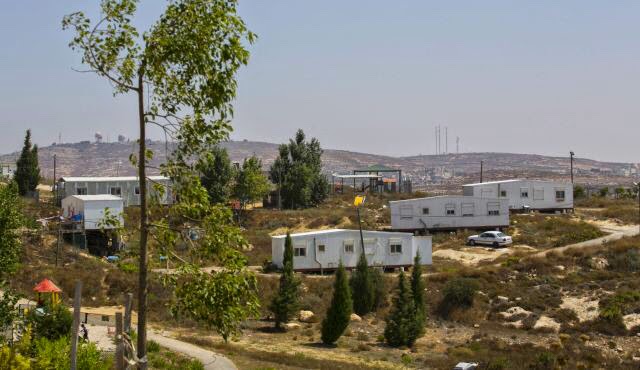
It was a bit ironic to see a small group of Israeli settlers enter the large solidarity tent stationed at the entrance of Khan al-Ahmar last Wednesday. They had come, they said, to show "solidarity" with the Palestinian Bedouins protesting a demolition order.

Since 2017, the whole Bedouin village has been threatened with demolition by the Israeli authorities. Earlier that day, Israeli soldiers attacked villagers and activists who had staged a protest, injuring 35.

"You know, I try not to be afraid, but I don't know what will happen to us. Where will we go, what will we do?

Khan al-Ahmar, a village of 180 people, is about 15km northeast of Jerusalem and falls within what is known as Area C of the occupied West Bank, as defined by the Oslo Accords. The area has been inundated with more than 300,000 Israelis living in 125 illegal settlements and is under Israeli administrative control. Under the Oslo Accords, the Palestinian Authorities was supposed to take over administering the area, but, of course, Israel never let that happen.

As a result, it is now the Israeli state that controls the land in Area C and that decides on building permits. Khan al-Ahmar existed before the state of Israel was created in 1948. In the 1950s, Palestinian Bedouins expelled from the Negev desert by the Israeli army moved to the West Bank and settled in the village, expanding it. Read More

Saturday, April 18, 2015

Teju Cole: Slow violence, cold violence – Teju Cole on East Jerusalem

Not all violence is hot. There’s cold violence too, which takes its time and finally gets its way. Children going to school and coming home are exposed to it. Fathers and mothers listen to politicians on television calling for their extermination. Grandmothers have no expectation that even their aged bodies are safe: any young man may lay a hand on them with no consequence.

The police could arrive at night and drag a family out into the street. Putting a people into deep uncertainty about the fundamentals of life, over years and decades, is a form of cold violence. Through an accumulation of laws rather than by military means, a particular misery is intensified and entrenched. This slow violence, this cold violence, no less than the other kind, ought to be looked at and understood.

Near the slopes of Mount Scopus in East Jerusalem is the neighbourhood of Sheikh Jarrah. Most of the people who live here are Palestinian Arabs, and the area itself has an ancient history that features both Jews and Arabs. The Palestinians of East Jerusalem are in a special legal category under modern Israeli law. Most of them are not Israeli citizens, nor are they classified the same way as people in Gaza or the West Bank; they are permanent residents. There are old Palestinian families here, but in a neighbourhood like Sheikh Jarrah many of the people are refugees who were settled here after the nakba ("catastrophe") of 1948. They left their original homes behind, fleeing places such as Haifa and Sarafand al-Amar, and they came to Sheikh Jarrah, which then became their home. Many of them were given houses constructed on a previously uninhabited parcel of land by the Jordanian government and by the UN Relief and Works Agency. East Jerusalem came under Israeli control in 1967, and since then, but at an increasing tempo in recent years, these families are being rendered homeless a second or third time.

There are many things about Palestine that are not easily seen from a distance. The beauty of the land, for instance, is not at all obvious. Scripture and travellers’ reports describe a harsh terrain of stone and rocks, a place in which it is difficult to find water or to shelter from the sun. Why would anyone want this land? But then you visit and you understand the attenuated intensity of what you see. You get the sense that there are no wasted gestures, that this is an economical landscape, and that there is great beauty in this economy. The sky is full of clouds that are like flecks of white paint. The olive trees, the leaves of which have silvered undersides, are like an apparition. And even the stones and rocks speak of history, of deep time, and of the consolation that comes with all old places. This is a land of tombs, mountains and mysterious valleys. All this one can only really see at close range.

Another thing one sees, obscured by distance but vivid up close, is that the Israeli oppression of Palestinian people is not necessarily – or at least not always – as crude as western media can make it seem. It is in fact extremely refined, and involves a dizzying assemblage of laws and bylaws, contracts, ancient documents, force, amendments, customs, religion, conventions and sudden irrational moves, all mixed together and imposed with the greatest care.

The impression this insistence on legality confers, from the Israeli side, is of an infinitely patient due process that will eventually pacify the enemy and guarantee security. The reality, from the Palestinian side, is of a suffocating viciousness. The fate of Palestinian Arabs since the nakba has been to be scattered and oppressed by different means: in the West Bank, in Gaza, inside the 1948 borders, in Jerusalem, in refugee camps abroad, in Jordan, in the distant diaspora. In all these places, Palestinians experience restrictions on their freedom and on their movement. To be Palestinian is to be hemmed in. Much of this is done by brute military force from the Israeli Defence Forces – killing for which no later accounting is possible – or on an individual basis in the secret chambers of the Shin Bet. But a lot of it is done according to Israeli law, argued in and approved by Israeli courts, and technically legal, even when the laws in question are bad laws and in clear contravention of international standards and conventions.

The permanent residency of a Palestinian in East Jerusalem is anything but permanent

The reality is that, as a Palestinian Arab, in order to defend yourself against the persecution you face, not only do you have to be an expert in Israeli law, you also have to be a Jewish Israeli and have the force of the Israeli state as your guarantor. You have to be what you are not, what it is not possible for you to be, in order not to be slowly strangled by the laws arrayed against you. In Israel, there is no pretence that the opposing parties in these cases are equal before the law; or, rather, such a pretence exists, but no one on either side takes it seriously. This has certainly been the reality for the Palestinian families living in Sheikh Jarrah whose homes, built mostly in 1956, inhabited by three or four generations of people, are being taken from them by legal means.

As in other neighbourhoods in East Jerusalem – Har Homa, the Old City, Mount Scopus, Jaffa Gate – there is a policy at work in Sheikh Jarrah. This policy is two-fold. The first is the systematic removal of Palestinian Arabs, either by banishing individuals on the basis of paperwork, or by taking over or destroying their homes by court order. Thousands of people have had their residency revoked on a variety of flimsy pretexts: time spent living abroad, time spent living elsewhere in occupied Palestine, and so on. The permanent residency of a Palestinian in East Jerusalem is anything but permanent, and once it is revoked, is almost impossible to recover.

The second aspect of the policy is the systematic increase of the Jewish populations of these neighbourhoods. This latter goal is driven both by national and municipal legislation (under the official rubric of "demographic balance") and is sponsored in part by wealthy Zionist activists who, unlike some of their defenders in the western world, are proud to embrace the word "Zionist". However, it is not the wealthy Zionists who move into these homes or claim these lands: it is ideologically and religiously extreme Israeli Jews, some of whom are poor Jewish immigrants to the state of Israel. And when they move in – when they raise the Israeli flag over a house that, until yesterday, was someone else’s ancestral home, or when they begin new constructions on the rubble of other people’s homes – they act as anyone would who was above the law: callously, unfeelingly, unconcerned about the humiliation of their neighbours. This two-fold policy, of pushing out Palestinian Arabs and filling the land with Israeli Jews, is recognised by all the parties involved. And for such a policy, the term "ethnic cleansing" is not too strong: it is in fact the only accurate description.

Each Palestinian family that is evicted in Sheikh Jarrah is evicted for different reasons. But the fundamental principle at work is usually similar: an activist Jewish organisation makes a claim that the land on which the house was built was in Jewish hands before 1948. There is sometimes paperwork that supports this claim (there is a lot of citation of 19th-century Ottoman land law), and sometimes the paperwork is forged, but the court will hear and, through eccentric interpretations of these old laws, often agree to the claim. The violence this legality contains is precisely that no Israeli court will hear a corresponding claim from a Palestinian family. What Israeli law supports, de facto, is the right of return for Jews into East Jerusalem. What it cannot countenance is the right of return of Palestinians into the innumerable towns, villages and neighbourhoods all over Palestine, from which war, violence and law have expelled them.

History moves at great speed, as does politics, and Zionists understand this. The pressure to continue the ethnic cleansing of East Jerusalem is already met with pressure from the other side to stop this clear violation of international norms. So Zionist lawyers and lawmakers move with corresponding speed, making new laws, pushing through new interpretations, all in order to ethnically cleanse the land of Palestinian presence. And though Palestinians make their own case and though many young Jews, beginning to wake up to the crimes of their nation, have marched in support of the families evicted or under threat in Sheikh Jarrah – the law and its innovative interpretations evolve at a speed that makes self-defence all but impossible.

This cannot go on. The example of Sheikh Jarrah, the cold violence of it, is echoed all over Palestine. Side by side with this cold violence is, of course, the hot violence that dominates the news: Israel’s periodic wars on Gaza, its blockades on places such as Nablus, the random unanswerable acts of murder in places such as Hebron. In no sane future of humanity should the deaths of hundreds of children continue to be accounted collateral damage, as Israel did in the summer of 2014.

In the world’s assessment of the situation in Palestine, in coming to understand why the Palestinian situation is urgent, the viciousness of law must be taken as seriously as the cruelties of war. As in other instances in which world opinion forced a large-scale systemic oppression to come to an end, we must begin by calling things by their proper names. Israel uses an extremely complex legal and bureaucratic apparatus to dispossess Palestinians of their land, hoping perhaps to forestall accusations of a brutal land grab. No one is fooled by this. Nor is anyone fooled by the accusation, common to many of Israel’s defenders, that any criticism of Israeli policies amounts to antisemitism. The historical suffering of Jewish people is real, but it is no less real than, and does not in any way justify, the present oppression of Palestinians by Israeli Jews.

A neighbourhood like Sheikh Jarrah is an x-ray of Israel at the present moment: a limited view showing a single set of features, but significant to the entire body politic. The case that is being made, and that must continue to be made to all people of conscience, is that Israel’s occupation of Palestine is criminal. This case should also include the argument that the proliferation of bad laws by the legislature and courts of Israel is itself antisemitic in effect, to the extent that they fuel the ancient calumnies against Jewish people. Nothing can justify either antisemitism or the racist persecution of Arabs, and the current use of the law in Israel is a part of the grave ongoing offence to the human dignity of both Palestinians and Jews. More

• Teju Cole’s books include Open City. He is a contributor to Letters to Palestine: Writers Respond to War and Occupation, edited by Vijay Prashad (Verso).


Sunday, December 28, 2014

Palestinian landowners have waited too many years for Israeli wheels of justice to turn.

It is impossible to overstate the significance of the High Court of Justice ruling ordering the state to demolish within two years the Amona illegal outpost, which was built on private Palestinian land. After years of evasion, legal tricks, forged documents and unfulfilled pledges, even the High Court came to realize that the state cannot be trusted, not to mention the settlers, to voluntarily agree to return the land they plundered from their owners.

Amona was born in sin in 1997, when a group of settlers established residence in an area that had been earmarked for an archaeological site and a Mekorot Water Company reservoir. Cease and desist orders issued by Civil Administration inspectors in 2004 halted building for four years, but it resumed in force despite new stop-work orders.

In 2006, after the High Court ordered the demolition of Amona’s permanent structures, the settlers made clear that they were not bound by the court’s authority and they turned the “battle for Amona” into a national event in which they violently confronted the police. If there was no alternative to demolition, they would make Amona a “national trauma” that would threaten any future plans to evacuate outposts or settlements.

Even now, after the High Court ruling, the settler leaders are adamant: “We swear today to fight this with all our might,” Amona spokesman Avihai Boaron said. This is nothing but a continuation of the settlers’ common view that the state and its institutions are their servants, and when they do not fulfill their mission they must be fought. Particularly infuriating is the idea that “the left-wing government and the High Court are leading the country”; That is, in the struggle between land theft and the law, the High Court is not only a legal and ideological enemy but it also violates the political reality in which the right wing is in control. That perception is no less distorted and dangerous than the settlers’ position that the theft of Palestinian land is part of the Redemption.

The government of Israel cannot continue to avoid carrying out the High Court’s ruling, according to which “there is no possibility of authorizing the construction, even retroactively,” — a recognition of the tricks the cabinet could try. Two years is sufficient time to find alternative housing, and it would be best not to not wait until the last moment. The Palestinian landowners have waited too many years for the Israeli wheels of justice to turn. They have the right to have their property returned to them, with appropriate compensation. More


Wednesday, December 24, 2014

Israel’s looming gas empire requires a final solution in Gaza

“The destruction which I have seen coming here is beyond description,” said UN secretary-general, Ban Ki Moon, after his October tour of the Gaza Strip.

Operation Protective Edge, Israel’s military incursion into Gaza this past summer, wrought an unprecedented level of devastation on the tiny strip of land inhabited by 1.8 million people. The operation had damaged or destroyed over 100,000 homes, affecting more than 600,000 Palestinians - a third of the population.

Mowing the grass

“Basically the town is unliveable,” said Mayor Mohammed al-Kafarna about Beit Hanoun. “There is no power, water or communications. There are not basics for life.” One major sewage pipe serving nearly half a million people had been severed, sending huge quantities of raw sewage into the sea and on fields.

In 2012, a UN report warned that Gaza “will not be liveable by 2020”. The following year, Israel’s tightening of its blockade prompted Filippo Grande, commissioner-general of the UN Works and Relief Agency (UNWRA), to say that “Gaza is quickly becoming uninhabitable.”

Israel’s massive bombardment of Gaza this summer has fast-tracked that outcome. This is no accident. While Israeli officials will not admit it, this strategic goal can be surmised from the statements of those close to key officials in Netanyahu’s administration.

Dismantling Gaza

“The only durable solution,” wrote Martin Sherman in the Jerusalem Post during the summer onslaught, “requires dismantling Gaza, humanitarian relocation of the non-belligerent Arab population, and extension of Israeli sovereignty over the region”: a recipe for ethnic cleansing and colonisation. He complained that the elected Israeli government is constrained by an unelected “left-wing” political discourse wedded to “the two-state concept and the land-for-peace doctrine,” both of which must be rejected.

For Sherman, the current strategy of periodically “mowing the grass” – “a new round of fighting every time the Palestinian violence reaches levels Israel finds unacceptable” – must be replaced by a final solution: “The grass needs to be uprooted – once and for all.”

Sherman is no pariah. On the contrary, his ideas increasingly represent the thinking of senior Israeli cabinet officials. As founding director of the Israel Institute for Strategic Studies (IISS), an initiative dedicated to laying “the foundations of a new assertive Zionist-compliant paradigm,” Sherman’s platform is endorsed by the following key Israeli leaders: Yaakov Amidror, Israel’s national security adviser until 2013; Uzi Landau, minister of tourism and ex-minister for energy; and Moshe Ya’alon, vice prime minister and incumbent defence minister.

Colonisation

These connections reveal critical elements of Israel’s security strategy. Amidror, for instance, has long advocated that Israel directly occupy Gaza “for many years,” to prevent a situation where “Hamas is strengthened into an entity similar to Hezbollah.”

His successor, Yossi Cohen, who presided with Ya’alon over Operation Protective Edge and who has previously served as deputy head of Shin Bet (Israel’s domestic security agency), told Israeli Army Radio that the operation had successfully created conditions that would facilitate the Palestinian Authority’s (PA) return to power in Gaza at Hamas’ expense. Hamas needed to be “demilitarised”, he said.

Israeli foreign minister Avigdor Lieberman agreed: “As long as Hamas controls Gaza, we won’t be able to ensure the safety of Israel's citizens in the South and we won't be able to make a peace agreement.” Earlier during the latest invasion of Gaza, Lieberman recommended that Israel consider re-occupying Gaza to end rocket attacks.

Palestinian statehood: A threat to Israel’s energy hegemony?

Another Sherman endorser, Uzi Landau, who is currently minister of tourism, was minister for energy and water from 2009 to 2013. There he oversaw Israel’s resource policies, especially concerning gas discoveries and export options. In 2011, when the PA was bidding to secure formal UN recognition of Palestinian statehood, Landau told Israeli radio that Israel should unilaterally declare its sovereignty over the Jordan Valley, West Bank settlements, and all of Gaza to head off the bid. He had previously been dispatched by the foreign ministry to Chile, Colombia and Australia to lobby against the PA campaign.

Why would Landau, then energy and water minister, be sent to lobby against Palestinian statehood?

In recent years, Israel had made increasingly significant energy discoveries throwing light on the link. In December 2010, the Texas based energy company Noble energy announced that it had discovered 25 trillion cubic feet of gas in the offshore Leviathan field (downgraded more recently to 17 trillion). This followed the US Geological Survey’s (USGS) assessment earlier in the year of an estimated 122 trillion cubic feet of technically recoverable gas in the Levant basin, encompassing the waters of Israel, Syria, Lebanon, Cyprus and Gaza. This is “bigger than anything we have assessed in the United States,” said a USGS spokesperson at the time.

Landau’s advisers: Israel’s gas could deplete in decades

The new discoveries would turn Israel into a gas-export powerhouse, with potentially transformative implications across the region. But there were potential pitfalls.

In 2012, the chief scientists of Landau’s energy and water ministry warned the government that Israel did not have sufficient gas resources to sustain both exports and domestic demand. Citing a gap of “100 to 150 billion cubic metres between the demand projections that were presented to the committee and the most recent projections,” they said that Israel’s “gas reserves are likely to last even less than 40 years!"

By 2055, the chief scientists argued, even if Israel chose not to export any gas, it would entirely exhaust its offshore reserves. But if Israel exports significant quantities of gas, and if it turns out that much of its gas turns out to be not commercially extractable, then the breaking point could arrive decades earlier. “The more gas we use now, the sooner we'll need to start importing gas or oil or to find alternative technology.”

Landau and his colleagues obviously took the report seriously enough that, according to Ha'aretz, they excluded the report’s findings from the committee determining Israel’s gas export policy.

Threat of war

Complicating matters further, many of the recently discovered oil and gas resources Israel is claiming for itself are in disputed territorial waters where maritime boundaries are not clearly defined.

In the summer of 2010, Landau said that Israel would “not hesitate to use force” to protect its offshore gas discoveries. He was responding to claims that Leviathan’s deposits extend into Lebanon’s territorial waters.

Similarly, two offshore fields that Israel is already exploiting have been claimed by the Palestinian Authority to extend into Gaza's offshore territory – Mari-B, which is near depletion, and Noa North, both of which are being developed by Noble Energy.

Gaza’s gas: The key to peace?

In March 2014, just a few months before the IDF launched Operation Protective Edge in Gaza, the German Marshall Fund of the United States published a policy brief on Israel’s interests in Gaza’s gas fields by Simon Henderson, director of the Gulf and Energy Policy Program at the Washington Institute for Near East Policy (WINEP) in Washington DC. WINEP is notable for its influence amongst US foreign policymakers. Current and former WINEP members have had senior roles in successive US administrations, including Obama's, and its alumni have gone onto serve across various US government agencies on Middle East policy.

Henderon’s policy brief in particular pinpointed the Gaza Marine, where just over 1 trillion cubic feet of gas was discovered by BG Group in 2000. Gaza Marine could supply all of Palestinian power for up to 20 years. Although the election of Hamas in 2006 in Gaza left negotiations over the gas between Israel and the PA at a stalemate, according to Henderson: “In late 2011 and early 2012, there was renewed Israeli interest in devising a way to exploit the natural gas of Gaza Marine.”

International diplomatic interest further increased in 2013, with Quartet Middle East envoy Tony Blair and US secretary of state John Kerry seeing the Gaza Marine as integral to a potential peace package. In October 2013, Israeli officials conceded that the Israeli government was “very supportive” of the project. All this is corroborated by British Foreign Office files released under Freedom of Information.

Israel’s vision for the Gaza Marine includes a range of options. Apart from boosting PA revenues dramatically, “Using Gaza Marine gas may also reduce the need of Israel to consume its own natural gas to generate electricity for the Palestinians,” observed Henderson. “Such usage will also marginally lower Israel’s dependence on fields controlled by the Noble Energy/Delek group, which currently holds the licenses for the Tamar field and all the other Israeli fields likely to come on stream in the next few years.”

Gaza’s gas, Henderson continued, “would be available for transfer into Israel’s natural gas main network, feeding power stations and petrochemicals across the country.” The gas could also be used for Gaza’s power plant, or even to power the West Bank. In the latter case, “the Gaza Marine natural gas would be fed to an Israel power plant to generate electricity. That electricity would then be supplied to the West Bank.”

Gaza’s gas: The key to exports?

But there is another dimension to the strategic significance of the Gaza Marine: Israel’s gas ambitions. This was alluded to by Ariel Ezrahi, senior energy adviser in Tony Blair’s Office of the Quartet Representative in east Jerusalem, who noted that the biggest obstacle to Israel becoming a regional gas exporter is the opposition of domestic Arab populations in Jordan, Egypt, Turkey and elsewhere.

This opposition could, however, be overcome if Israel finds a way to integrate Gaza’s gas into the export equation, so that Arab publics find a way to see gas deals with Israel as acceptable: “… it would be wise for Israel to at least consider the contribution of the Palestinian dimension to these deals,” said Ezrahi. “I think it’s a mistake for Israel to rush into regional agreements without at least considering the Palestinian dimension and how it can contribute to Israeli interests.” Israel should use the Gaza Marine “as an asset as they strive to join the regional power grid, and as a bridge to the Arab world,” by selling Palestinian “gas to various markets,” or promoting a deal with the corporations developing Israel’s “Tamar and Leviathan [fields] that will allow for the sale of cheap gas to the [Palestinian] Authority.”

Hamas: The obstacle

For Israel, the existence of Hamas remains the chief obstacle to any of these scenarios. According to Simon Henderson: “The main challenge to Secretary Kerry’s vision is that the Gaza Marine natural gas field is offshore the Gaza Strip, controlled by Hamas, whose authority is not recognised by the PA, which is based in Ramallah. Additionally, the United States regards Hamas as a terrorist organisation and Washington is therefore legally constrained from cooperating with it.”

In other words, from the perspective of Israeli hawks and the entities of the Quartet - the US, EU, UN and Russia - the fundamental obstacle to both the proposed ‘peace package’ and Israel’s interests in becoming a regional energy hegemony, is the continued existence of Hamas in Gaza.

In 2007, incumbent defence minister Ya’alon advised in an influential policy paper that there was only one way to solve this problem: “It is clear that without an overall military operation to uproot Hamas control of Gaza, no drilling work can take place without the consent of the radical Islamic movement.” Ya’alon is yet another Israeli government official who endorses Martin Sherman’s IISS initiative.

Since then, successive Israeli military operations - including Operation Protective Edge - have aimed at degrading Hamas’ power in Gaza by making the entire civilian population of the strip pay the price. Through excessive military action to devastate Gaza’s critical infrastructure until much of the strip is virtually “uninhabitable,” Israel has successfully accelerated this process.

Strangulating Gaza

Under the new ceasefire agreement with Hamas after the operation, Israel had secured even more Draconian powers to enforce its ongoing siege of Gaza. This included a partial military re-occupation by maintaining a 100 metre buffer zone inside Gaza; a joint Israeli, UN and PA committee to supervise the process for goods being permitted into Gaza; tight monitoring of imports of construction materials, as well as their use inside Gaza, to guarantee they would not be used by Hamas to build ‘terror tunnels’ and weapons; and on the table for discussion, Israel’s top priority was to make the total demilitarisation of Gaza a precondition for reconstruction and rehabilitation.

Under this extraordinary scheme, Gaza will be under constant surveillance by Israeli drones, and the PA-UN supervisory committee will submit all details of homes needing rebuilding to an Israeli database for close monitoring and approval.

Against this context, the decision by the EU General Court to remove Hamas from a list of terrorist groups along with the European Parliament’s new resolution recognising “in principle… Palestinian statehood and the two-state solution,” takes on new meaning.

To move forward, what remains of the aborted Kerry-Quartet vision for ‘peace’ encompassing the exploitation of Gaza’s gas, requires Hamas’s military capabilities – already infinitesimal compared to Israeli’s $15.5 billion military budget – to be degraded to the point of being utterly negligible.

The EU’s latest measures appear designed to incentivize the Palestinians and Hamas to comply with this vision of a pliable, demilitarised Gaza as a step toward a ‘two-state’ solution dominated and controlled by Israel: the carrot. Israel’s threat and use of force to smash Gaza into an uninhabitable no-man’s land, in which the US and the EU are complicit through extensive trade and military aid to Israel, is the stick. More


Sunday, December 14, 2014

Israelis rattled by search for truth about the Nakba

First ‘truth commission’ avoids issue of reconciliation as veteran Israeli fighters due to confess to 1948 war crimes

Middle East Eye – 9 December 2014

The first-ever “truth commission” in Israel, to be held on Wednesday, will feature confessions from veteran Israeli fighters of the 1948 war who are expected to admit to perpetrating war crimes as hundreds of thousands of Palestinians were expelled from their homes.

The commission is the culmination of more than decade of antagonistic confrontations between a small group of activists called Zochrot, the Hebrew word for Remembering, and the Israeli authorities as well as much of the Jewish public.

Founded in 2002, Zochrot is dedicated to educating Israeli Jews about what Palestinians call the Nakba, Arabic for catastrophe, referring to Israel’s creation on the ruins of their homeland more than six decades ago. The group also campaigns for the right of return for Palestinian refugees to Israel, probably the biggest taboo in Israeli society.

The commission, which has no official standing, could be the first of several such events around Israel, to investigate atrocities and war crimes committed in different localities, said Liat Rosenberg, Zochrot’s director.

“We have looked to other such commissions around the world as models, most obviously in South Africa,” she said. “But unlike the one there, ours does not include the element of reconciliation because the conflict here has yet to be resolved.

“We cannot talk about reconciliation when the Nakba is ongoing. We are still in a situation where there is apartheid, constant violations of human rights and 70 percent of the Palestinian community are refugees.”

The commission is likely to provoke outrage from the Israeli government, which passed the so-called Nakba Law in 2011 to try to make it harder to commemorate Palestinian suffering. The impact of the law is being widely felt. Just last month, the culture ministry vowed to block a government grant to a Tel Aviv cultural centre that hosted a Zochrot film festival on the Nakba.

Names kept secret

Rosenberg said Israeli veteran fighters and Palestinian witnesses participating in the truth commission had asked for their names to be kept secret until the hearings for fear that friends and family would put pressure on them to withdraw.

The commission is being held in the city of Beersheva, a once-Bedouin town that was ethnically cleansed in 1948 and is today the largest Jewish city in the Negev region in southern Israel.

Zochrot said it had chosen the city to host the first event event because forced expulsions of Bedouin from the Negev had taken place not only in 1948, but had continued on a large scale, out of view of observers, for many years afterwards.

The commission is the latest project by Zochrot that discredits a traditional Israeli narrative that some 750,000 Palestinians left under orders from Arab leaders and that Israel’s army acted only in self-defence. Such beliefs have fed into the common assumption from the Israeli public that Israel’s army is the “most moral in the world”.

“This is not just about researching the truth,” said Rosenberg. “The truth of the Nakba is to a large degree known, but the task is to expose the truth to the Israeli Jewish public – both so that it is forced to take responsibility for what happened and so there can be accountability.”

The commission is the direct result of a project launched by Zochrot two years ago to create an alternative archive of the Nakba, based on filmed testimonies from Palestinian refugees and Israeli veterans. Activists fear that, as the generation of refugees and fighters dies off, they will take their secrets to the grave.

Israeli military archives relating to the 1948 war began being opened to academics in the late 1980s. This led to a group of so-called “new historians” overturning the traditional accounts of that period and unearthing written evidence of massacres and ethnic cleansing operations for the first time.

Archives closed

However, historians have reported in recent years that the Israeli authorities have become more reluctant to open files and many of the more controversial episodes of the 1948 war are still unclear.

Rosenberg hopes the commission will begin to fill some of the gaps.

According to Rosenberg, three Israeli fighters and three Palestinian witnesses will testify before a panel of six commissioners. The commissioners will then question them further about events and make follow up recommendations.

The hearings are due to be streamed online.

One veteran of the fighting in the Negev, Amnon Neumann, has already gone on record in testimony that can be seen in Zochrot’s film archive.

He has said the Bedouin in the Negev – contrary to popular Israeli perception – put up almost no resistance to advancing Jewish forces because they lacked “a military capacity” and “had no weapons”. Nonetheless, he said, the Israeli army terrified the Bedouin villagers out of their homes by shooting either at them, or above their heads.

“We drove them out. Women and children went to Gaza. … By the morning there was nobody there. We burnt their houses,” Neumann said.

When villagers tried to sneak back to tend crops or vineyards under the cover of night, he recounted, the soldiers opened fire. “We would shoot and kill them. This was part of the horrible things we did.”

In other filmed testimony, Mordechai Bar-On, an officer in 1948 with the Givati Brigade, confirmed that orders were to shoot “infiltrators” – a reference to refugees who tried to return to their villages. “Even if there were women and children. I remember I told myself that we would do it. … There was an order to kill, not even catch them,” Bar-On said.

For the most part, the Israeli veterans are coming forward now out of a feeling of guilt.

“At that time I did not see anything wrong with what we were doing,” Neumann said. “If I was told to do things that I do not want to mention [here], I did them with no doubts at all. … Not now. It is already 50, 60 years that I am filled with regret.”

But challenges remain, and despite veterans coming forward, piecing together events can still be difficult.

Rosenberg said many of those giving filmed testimony, including Neumann, have been reluctant to go into details of the war crimes they participated in. It is now hoped that the questioning by the commissioners will encourage participants to be even more forthcoming.

Put on trucks to Gaza

The commission will also move beyond the 1948 period and examine expulsions in the semi-desert Negev region, comprising nearly two-thirds of Israel’s landmass, for the 12 years following the war.

Isolated from the rest of the new state of Israel, the Negev was largely unmonitored as the Israeli military carried out expulsions of Bedouin throughout the 1950s, said Raneen Jeries, a Zochrot organiser.

More than 2,000 Palestinian inhabitants of al-Majdal, which later became the Jewish city of Ashkelon, were put on trucks and shipped to Gaza nearly two years after the war ended, according to Nur Masalha, a Palestinian historian and expert on Israeli “transfer” policies.

Jeries said the legacy of the events of 1948 was being felt to this day, with policies of expulsion continuing in the Negev and the occupied territories.

Haaretz reporter Amira Hass revealed three months ago that the Israeli military was planning to forcibly relocate for a second time the Jahalin tribe. The tribe was driven out of the Negev in 1948 and fled to the safety of the West Bank, then under Jordanian control. However, Israel occupied the land after the 1967 war, and it seems that Israeli authorities now want to expel some 12,500 Jahalin tribes people, this time to a site near Jericho.

Zochrot had been successful in forcing Israelis to recognise the Nakba and a darker side to the 1948 war, said Neve Gordon, a politics professor at Ben Gurion University in Beersheva, where the truth commission is to be held.

“A decade ago, if I mentioned the Nakba in a class of 150 students, hardly any of them would have known what I meant. Now 80 or 90 per cent would know,” Gordon told MEE.

Gordon also attributed the change both to Zochrot’s activities and statements by Arab legislators representing Israel’s large Palestinian minority, comprising a fifth of the total population.

Law against commemoration

But as the issue of the Nakba has become more visible in Israel, sensitivity about it has only grown. Ahead of Nakba Day last May, Prime Minister Benjamin Netanyahu lashed out at the Palestinian Authority for commemorating the day, saying: “They are standing silent to mark the tragedy of the establishment of Israel, the state of the Jewish people.”

Palestinians were educating their children with “endless propaganda” calling for the disappearance of Israel, he said.

Economy Minister Naftali Bennett went further, saying: “We need not tolerate Israeli Arabs who promote Nakba Day.”

The government has backed up its rhetoric with legislation, passing a Nakba Law in 2011 that denies public funds to institutions and organisations that commemorate the Palestinians’ dispossession. The measure is partly seen as a reaction to Zochrot’s growing success.

The original legislation, which would have criminalised any commemoration of the Nakba – making many of Zochrot’s activities illegal – was water-downed after Israel came under strong international pressure.

In Zochrot’s early years, its main efforts were directed at escorting Israeli Jews and Palestinian refugees to some of the more than 500 Palestinian villages that Israel destroyed during and after the 1948 war. The villages were razed to prevent refugees from returning home.

The remnants of most of the villages are now barely traceable, hidden under forests planted by a charity called the Jewish National Fund or lost within gated communities in which only Jews can live.

Zochrot has continued such visits, placing signposts to remind the new Jewish inhabitants that their communities are built on the ruins of Palestinian homes, often belonging to neighbours living a short distance away. A large proportion of Israel’s Palestinian minority were internally displaced by the 1948 war and live close to their original homes but are barred from returning.

Backlash on campuses

Eitan Bronstein, who founded Zochrot, said the current challenge was how to change Israeli Jews’ perception of the Nakba.

“They now recognise the word but what does it mean to them? Many, it seems, think it is simply a negative label Palestinians have attached to Israel’s establishment. We have an Independence Day that they call their Nakba,” Bronstein said.

“We need to educate them about the events of the Nakba, what occurred and our responsibility for it. They have to stop thinking of it as just propaganda against Israel.”

The right wing, including the government of Benjamin Netanyahu, has grown increasingly rattled by Zochrot’s agenda-setting programme of events.

The popularity of a far-right youth movement, Im Tirtzu, has grown rapidly on Israeli university campuses over the past few years, in part as a backlash to commemorations of the Nakba by Zochrot and Palestinian students.

Last month, when Zochrot held its second Nakba and Right of Return Film Festival in Tel Aviv, the culture minister, Limor Livnat, immediately threatened to pull a government grant worth more than $450,000 from the cinema that hosted it.

“The state cannot bear the cost of funding of an entity that encourages debate over what the Palestinians call ‘the right of return’,” Livnat said in a statement. She was reported to have based her decision on her reading of the Nakba Law.

“The antagonism towards Zochrot and the idea of the Nakba is part of the educational process,” said Bronstein. “It is a necessary phase Israel needs to pass through if we are to get to a point of reconciliation.”

Unfazed by threats

Bronstein and others have faced angry opposition from the Israeli public and police as they have tried to stage Nakba commemorations – most notably in Tel Aviv in 2012, when they were surrounded by riot police for four hours. Three Zochrot activists were arrested.

Yet Zochrot’s organisers, whose members include both Jewish and Palestinian citizens, seem largely unfazed by the threats and hostility their group generates.

Last year Zochrot arranged a conference that for the first time examined not just the principle of the right of return but practical ways to implement it.

This year the group launched a phone app, called iNakba, in three languages, which provides users with detailed maps and information on the destroyed villages.

Jeries said it had had thousands of downloads, giving Israelis for the first time the chance to peel away the subsequent layers of construction and forestation to see what was destroyed, often on their doorstep. More

Tagged as: Bedouin, destroyed villages, Nakba


Saturday, February 8, 2014

Sentenced to life at birth: What do Palestinian refugees want?

There’s something almost cruel about asking a Palestinian refugee whether he would accept living peacefully with Israel were he ever allowed to return. It feels like a sadistic exercise: treat a man like a lesser human, deny him a country, a house, a profession, keep him confined for years and once he is released expect him to stand up, dust the humiliation off his clothes and shake hands with his captor.

IDF soldiers expel the residents of Imwas from their village during the 1967 Six Day War

The Palestinian refugees I spoke to are not willing to shake hands with their captors – at least not if another Palestinian is watching. Pride is the last thing they still own, the tenacity typical of those who have nothing to lose on one hand, and no hope of gaining anything on the other. But what I learned once the conversations became private is that many of those refugees would just like to live in peace with dignity, and for that they are willing to give a pardon that has never been asked of them. In fact, pressured with a thousand hypotheses of restitution, acknowledgement of guilt and requests for forgiveness, almost every Palestinian I spoke to is ready to shake that proverbial hand and finally start a life that has been kept suspended ever since they were born.

Poster-children of their tragedy

“If there’s peace, I’m the first person ready to go back,” says 75-year-old Adnan Abu-Dhubah, his determination looking unsteady on the wooden stick he uses for a cane. There is no handle on the stick, and with the weight of his body his palm is branded with a square wound. Mr. Abu-Dhubah has known little else than life in a camp. He is one of 30,000 refugees in the Gaza camp in Jerash, Jordan, living in squalid conditions, walking through mud and sewage every day. Like most poor people, Mr. Abu-Dhubah looks older than his age. But time inflicts a heavier load on Palestinian refugees, because unlike other poor people they are denied the most precious and immaterial of all commodities: the hope to overcome one’s condition. Palestinian refugees are sentenced to life at birth, and for many of them even a winning lottery ticket wouldn’t be enough to buy the right to own property, or enough education to become a lawyer or a doctor. Most of the 5 million refugees registered with UNRWA (United Nations Relief and Works Agency for Palestine Refugees in the Near East) in five different host countries live in similar or worse conditions, permanently deprived of most rights ascribed to the citizens of any country. There are more than 70 professions denied to Palestinian refugees in Lebanon, for example, and over 80 of them in Jordan. In neither country can they work even as a taxi driver, for that would require a driver’s license and most of them cannot legally possess one. In Lebanon, even the materials necessary for building a refugee shack are regulated by law – bricks and a proper roof are too permanent, and thus illegal.

“The one who put us in this position is Israel – not Jordan, not Lebanon or any other Arab country. The Arab countries have not stood by us, it’s true, they have not fulfilled their duties towards the Palestinian, but I don’t want to mix the blame here,” says another resident of the Gaza camp, 40-year-old Faraj Chalhoub, father of eight children.

That is yet another catastrophe almost exclusive to the Palestinians. Because their expulsion is illegal under a number of international laws, and because such injustice has never been rectified, some countries fear that by accepting the refugees as citizens they would be helping Israel ‘erase the evidence.’ In their exceptionally miserable condition, Palestinian refugees are the poster-children of their tragedy, the living proof of Israeli crimes and the indelible evidence that will stay exposed for everyone to see until they are allowed to return.

“I wish I could go to smell the air of my country and die,” says 70-year-old Massioun, the wife of Mr. Abu-Dhubah, herself also using a wood stick as a cane, this time with a makeshift handle. All her brothers and sisters live in Palestine and they’ve been separated since 1967. Like all refugees in Jerash, Massioun is a victim of what they refer to as Nakbatein, or two catastrophes: her family was expelled twice, first from the village of Barbara in 1948, and then again from Gaza in 1967. Of the more than 2 million refugees registered in Jordan with UNRWA there are about 120,000 who suffered the same two Nakbas, and none got Jordanian citizenship, unlike the refugees who came in 1948. More


Tuesday, May 14, 2013

Pretending away the Nakba only perpetuates the conflict

When the Czechs prefer to keep silent and repress their history, it’s a problem, but it is not an imminent danger to the country. When Israelis prefer to pretend there was no ethnic cleaning here, it’s a wholly different question: the conflict won’t end unless Israel admits to the injustice it caused.

A few weeks back I watched The Gatekeepers, a movie which interviews six of the chiefs of Shin Bet, from Avraham Shalom to Yuval Diskin. The movie is shocking and well worth your time. The most surprising character was Diskin, who obviously underwent a great change upon leaving the service: at the end of the movie he adamantly agrees with Yishayahu Leibowitch’s famous dictum that the occupation will turn Israel into a ”Shin Bet state.” And over the weekend we learned Diskin went through another metamorphosis: he recommended to the Turkel Committee that the Shin Bet start video-taping its interrogations, which the service has long resisted.

Diskin is merely the latest in a series of senior security officials who, as soon as they leave office, see the light and understand just how ruinous the office they headed was, and how they represented positions that were damaging to the country. The last great show in this genre was the bunch of senior commanders of the IDF’s Northern Command, who upon retirement were astonished to find out that the Security Zone in Lebanon was a huge mistake – often, after defending it in uniform as vital to security just a few weeks prior.

In that regard, the most interesting speaker is certainly Avraham Shalom, the oldest interviewee. Shalom thinks strategic errors were made, particularly by the politicians, but he himself regrets nothing. When asked about moral problems, he laughs. “Morality?” He asks, “Morality? Look for it first among the terrorists.” One assumes former chiefs, assuming they would even bother to be interviewed, would supply similar remarks. It’s very hard to see Issar Har’el, for instance, the closest thing we’ve got to J. Edgar Hoover, providing the camera with anything aside from a mocking, world-weary grin, saying in effect “you’ll never understand, so don’t even try.”

Superficially, Shalom, born in 1928, and Diskin, born in 1956, are separated by just one generation. Actually, they come from different worlds. Diskin grew up in Givatayim, possibly Tel Aviv’s most secure suburb. Shalom was born in Vienna. It was not a safe place for Jews even then, and in 1938 came the Anschluss, the annexation by Nazi Germany, which the Viennese used as an excuse for an orgy of violence against resident Jews. Shalom was lucky: his family understood early on where things were going, and fled to Palestine in 1939. They arrived penniless – this was Adolf Eichmann’s specialty, how he made his name – but they survived.

Not everyone was that lucky. Uri Ben-Ari, who would one day create the IDF’s doctrines of tank warfare, saw as an eight-year-old child in Berlin (he was still called Heinz Benner) how a gang of SA gunmen severely beat his father, after which they urinated on him. On Kristallnacht, the father and son saw the synagogue where he had recently celebrated his bar mizvah being set on fire. Several days later, Benner was kicked out of his school in a humiliating public spectacle: “Heinz Benner! You are a member of the Jewish race which committed heinous crimes against mankind and against the German people! The school vomits you from its ranks and you are hereby expelled! Go through our gate and be gone from our sight forever. Forward march! Heil Hitler!” Ben-Ari emigrated to Palestine, alone, in March 1939. His father was left behind.

In that regard, Ben-Ari was more typical than Shalom. The Palmach generation is often described as composed of native-born, but a significant number of them were European refugees, not natives. For a generation, the symbol of the Palmach sabra was Dan Ben-Amotz. He was actually born in the Ukraine under the name Moise Tehilimzuger. Like Ben-Ari, he too came to Palestine alone; his family, too, was murdered. The number of Jews then residing in Palestine who lost their family in Europe was staggering. To the rest of their trouble – the relative poverty and primitiveness of Palestine, at least when compared to central Europe; the conflict with the Arabs; the significant suffering inflicted on teenaged refugees by teenage sabras and often even by the grown-ups, who couldn’t comprehend what was happening “over there” – must be added survivor’s guilt. The refugees who made it to Palestine prior to 1941 believed they were pioneers, and that their family and friends would join them after a while; many of them saved money diligently to aid in this immigration. At the end of 1945, most of them would realize they were either the last survivors of their family or very nearly so. The fact that they not merely survived, but lived in relative comfort, must also have been a burden.

Ben-Ari and Shalom joined the Palmach in 1946, the year the organization began preparing itself for the coming independence war, which would come within 18 months. This was the same period in which Eastern Europe convulsed in a series of terrifying national struggles which followed the border changes the Soviet Union forced on the region following its victory over Nazi Germany. These struggles – a more apt title would be “ethnic cleansing” – were bloody, and included the murder of possibly millions of people: Ukrainians, Poles, and many Germans. The Czechs murdered, in a savage outburst of hatred only occupied people who felt their chains slip away can understand, some 20,000 Germans in the days immediately following liberation. Most of the victims were women, children and the elderly. The Czech don’t talk much about it nowadays, nor are they fond of speaking of the expulsion of some 1.5 million Germans, or the pillaging of their property. During a tour in Prague two months ago, the tour guide described what happened there as ‘genocide.’ Most of his people prefer to look the other way. The Poles made it clear to Jews who thought they could return home, with the pogrom in Kielce and by hundreds and thousands of terror killings on the roads and on trains, that they, too, are an ethnic minority whose historical role is over. Without understanding these events, it’s impossible to understand some of Alterman’s most haunting, poisoned lines in “The Child Avram”: More


Wednesday, November 14, 2012

Gaza Under Attack: Israeli Military Assassinates Hamas Leader in First Salvo of Bombing Campaign

The Israeli military launched a campaign of air strikes against the Hamas-ruled Gaza Strip November 14 by assassinating the head of the Palestinian group’s armed wing.

Ahmed Al-Jabari, the head of Hamas’ Qassam military brigades, was killed when an Israeli jet dropped a bomb on a car he was traveling in along with another man, whose name is not yet known.

The Israel Defense Forces announced that the assassination was the beginning of “Operation Pillar of Defense,” a campaign targeting Hamas and Islamic Jihad, another armed group in Gaza.

The New York Times reports [3] that Al-Jabari was “the most senior official of the group to be killed by the Israelis since their invasion of Gaza four years ago.”

After the assassination, the Israeli Air Force continued to pound the Gaza Strip with air strikes, leading to the deaths of more people, including a one-year-old baby, according to a French photographer [4] on the ground there. Gaza is home to 1.5 million civilians, half of whom are children. The Strip has endured a devastating air, land and sea blockade from Israel ever since Hamas came to power after winning elections in the Palestinian territories in 2006.

Israel has long used extrajudicial assassinations as a favored tool against Palestinian armed groups.

“Israel's latest bombing campaign in Gaza, and in particular its assassination of Palestinian leaders, highlights once again that Israel views itself as above the law,” said Diana Buttu, a former advisor to the Palestine Liberation Organization, in a statement. “This is precisely why the international community, and in particular the United States, must hold Israel accountable for its provocative and illegal actions, in order to stop another bloodbath in Gaza before it happens. It is time for the world to send Israel the message that it is not above the law and the Palestinians are not beneath it.”

In response to the killing of Al-Jabari, Hamas promised to make Israel “pay a high price.” Rockets fired from Palestinian armed groups have already been shot into Israel in response, according to the Israeli daily Haaretz. And like clockwork, the U.S. military has come out in support of Israel’s campaign. “We're monitoring the situation closely. We stand by our Israeli partners in their right to defend themselves against terrorism,” said a Pentagon spokesperson. [5] More

It is beyond the time that the international community stood with Palestine and Gaza against Israeli terrorism and theft of the majority of the Palestinain's territory. Editor


Sunday, October 28, 2012

Between anger and denial: Israeli collective memory and the Nakba

A strange thing regarding the debate on the Nakba: the responses it generates in Israeli society are becoming more and more hostile, while at the same time, the Nakba is mentioned more and more often.

Those contradicting elements live side by side, as if the more we work to forget the Nakba, the harder it gets – the recent campaign regarding “the Jewish refugees” that the Foreign Office launched is just one example.

Israeli-Russian-Canadian journalist Lia Tarachansky (from The Real News) is presently finishing up work on a documentary that tries to deal with the complexity of Israeli sentiments towards the Nakba. “Seven Deadly Myths” (working title) tells the stories of four veterans from 1948, linking them to the lives of modern-day Palestinian refugees and to Tarachansky’s own childhood in a West Bank settlement. When I wrote about the memory of the Nakba on this blog, I also began with my childhood memories. Of all the political and historical issues here, the Nakba has the most intimate feeling to it – another reason it is such a taboo.

Filming has ended, and Tarachansky is now engaged in a fundraising effort to allow her to complete editing and post-production (more details on the film’s website). The project is also taking part in the Cuban Hat competition.

This week, I conducted an email interview with Lia Tarachansky on the roots of her project and the memory of the Nakba in Israeli society. The video above explains how this project was born.

LT: Most of the people in the film I found by word of mouth. I had asked around in the left’s circles. Then I stumbled onto Sergio Yahni of the Alternative Information Center who knew Tikva Honig-Parnass [seen in the above video] from when she edited the journal “Between The Lines” with Toufic Haddad.

Ruins of Palestinian Nakba village Qula, 2010 (photo: Deborah Bright / Zochrot.org)
Amnon Noiman I met through Zochrot ["Remembering," an Israeli NGO that deals with the memory of the Nakba – N.S], other veterans (some of whom later refused to take part in the film) I met through friends of friends or through the various war museums. At first, most were not willing to speak about the war and that period in general. They reminded me of my grandfather who until his dying years couldn’t talk about his memories of the Holocaust. I realized through their silence the immense power of memory and that’s what drove me to dig through my own.

Did you find regret in the Israelis you interviewed, or a feeling that “we did what we had to do?”

Honestly, most of the veterans, both those who are in the film and those who refused, didn’t want to “reopen that file.” One particularly profound moment in the film was in my various conversations and interviews with veteran Amnon Noiman. About three years ago, the Israeli activist Amir Hallel convinced him to give a testimony of his experience in 1948 to a small crowd in the Tel Aviv offices of Zochrot. When I heard about it I grabbed my camera and begged to film it.

I was amazed at how critical Noiman was that evening speaking about the general approach of the Israeli forces during the war, but it was clear even through his criticisms that there were corners of his memory that he refused to touch. Eitan Bronstein, the director of Zochrot asked him about one specific place – Burayr. In April 1948 its residents were expelled to Gaza by the Palmach unit Noiman was part of, and yet he refused to talk about it. It was only in our interview months later that he was ready to speak about what happened that April, 65 years ago. More