Showing posts with label war Crimes. Show all posts

Monday, November 9, 2015

New MSF Report Details Horrific Carnage as US Bombed Hospital

As the U.S. continues to refuse an independent probe, Doctors Without Borders (MSF) on Thursday released its own damning report of the American military's bombing of the medical charity's Kunduz, Afghanistan hospital last month—describing patients burning to death in their beds and people shot by a circling plane while attempting to flee.

The image on the left shows the Doctors
Without Borders hospital in Kunduz,
Afghanistan on June 21, 2015,
before the U.S. military bombing.
The image on the right shows the
facility on October 8, 2015, following
the attack.

The review (pdf), the first installment of an ongoing investigation, gives a harrowing, chronological account of the bombing, which took place while at least 105 patients were admitted, surgeries were ongoing, and people—including children—were immobilized in the intensive care unit. The report confirms that 149 MSF staff and one International Committee of the Red Cross delegate were in the hospital compound during the time of the attack.

What's more, the investigation finds that MSF was fully in control of the hospital at the time of the bombing, and its rules were in effect—including prohibitions against weapons. In addition, there was no combat "from or in the direct vicinity" of the hospital before the bombings.

"Some public reports are circulating that the attack on our hospital could be justified because we were treating Taliban," said Christopher Stokes, MSF general director, in a statement accompanying the report. "Wounded combatants are patients under international law, and must be free from attack and treated without discrimination. Medical staff should never be punished or attacked for providing treatment to wounded combatants."

"The view from inside the hospital is that this attack was conducted with a purpose to kill and destroy," Stokes continued. "But we don’t know why. We neither have the view from the cockpit, nor the knowledge of what happened within the U.S. and Afghan military chains of command."

MSF based its findings on 60 debriefings with its national and international staff employed at the trauma center, email and telephone records, and before and after photographs of the hospital. The organization also reviewed internal and publicly-available information about the bombing that killed 13 staff members, 10 patients, and 7 people whose bodies were unrecognizable.

Due to an escalation in fighting, MSF on September 29 re-confirmed its GPS coordinates to the U.S. Department of Defense and Afghan Ministry of Interior and Defense and U.S. Army in Kabul—all of whom confirmed receipt, the report states. On Friday, October 2, before the bombings took place, MSF even placed its organizational flags on the roof of the hospital, to ensure its identity would not be mistaken.

But at roughly 2:00 AM, the U.S. military unleashed a horrific bombing on the hospital, which lasted at least an hour. During this time, MSF made at least 17 calls to Afghan, U.S., and United Nations officials in attempt to stop the bombings, according to a log displayed in the report.

The first room hit was the ICU, where staff were caring for patients, some of whom were on ventilators, and at least two of whom were children. "MSF staff were attending to these critical patients in the ICU at the time of the attack and were directly killed in the first airstrikes or in the fire that subsequently engulfed the building," the report states. "Immobile patients in the ICU burned in their beds."

The strikes then moved to the main hospital building, destroying the emergency room, mental health department, operating theaters, and other areas—killing two patients while they were undergoing surgery. MSF staff described a litany of horrors: amputations, fully or partially severed limbs, and people "running while on fire and then falling unconscious on the ground."

The report states some were "shot by the circling AC-130 gunship while fleeing the burning building."

In the immediate aftermath of the bombing, surviving MSF staff fought for the lives of their colleagues and patients, inserting chest drains, halting severe bleeding, and treating shock—with at least two MSF staff dying on the operating table.

MSF's account shines light on an attack whose details have been murky, with the Pentagon changing its story at least four times, including initially denying responsibility. The U.S. and Afghan governments so far refused MSF's repeated calls for an independent investigation by the International Humanitarian Fact Finding Commission (IHFFC), which was established in 1991 under the Geneva Conventions. In addition to releasing Thursday's report to the public, MSF has also submitted it to the IHFFC. More


Monday, August 18, 2014

Hague court under western pressure not to open Gaza war crimes inquiry

The international criminal court has persistently avoided opening an investigation into alleged war crimesin Gaza as a result of US and other western pressure, former court officials and lawyers claim.

Fatou Bensouda, the international criminal court prosecutor

In recent days, a potential ICC investigation into the actions of both the Israel Defence Forces and Hamas in Gaza has become a fraught political battlefield and a key negotiating issue at ceasefire talks in Cairo. But the question of whether the ICC could or should mount an investigation has also divided the Hague-based court itself.

An ICC investigation could have a far-reaching impact. It would not just examine alleged war crimes by the Israeli military, Hamas and other Islamist militants in the course of recent fighting in Gaza that left about 2,000 people dead, including women and children. It could also address the issue of Israeli settlements in the Palestinian territories, for which the Israeli leadership would be responsible.

The ICC’s founding charter, the 1998 Rome statute (pdf), describes as a war crime “the transfer, directly or indirectly, by the occupying power of parts of its own civilian population into the territory it occupies”.

Also at stake is the future of the ICC itself, an experiment in international justice that occupies a fragile position with no superpower backing. Russia, China and India have refused to sign up to it. The US and Israel signed the accord in 2000 but later withdrew.

Some international lawyers argue that by trying to duck an investigation, the ICC is not living up to the ideals expressed in the Rome statute that “the most serious crimes of concern to the international community as a whole must not go unpunished”.

John Dugard, a professor of international law at the University of Leiden, in the Netherlands, and a longstanding critic of Israel’s human rights record, said: “I think the prosecutor could easily exercise jurisdiction. Law is a choice. There are competing legal arguments, but she should look at the preamble to the ICC statute which says the purpose of the court is to prevent impunity.”

In an exchange of letters in the last few days, lawyers for the Palestinians have insisted that the ICC prosecutor, Fatou Bensouda, has all the legal authority she needs to launch an investigation, based on a Palestinian request in 2009. However, Bensouda is insisting on a new Palestinian declaration, which would require achieving elusive consensus among political factions such as Hamas, who would face scrutiny themselves alongside the Israeli government. There is strong US and Israeli pressure on the Palestinian leader, Mahmoud Abbas, not to pursue an ICC investigation.

Western pressure on the ICC to stay away from the issue has caused deep rifts within the prosecutor’s office. Some former officials say the Palestinians were misled in 2009 into thinking their request for a war crimes investigation – in the wake of an earlier Israeli offensive on Gaza, named Cast Lead – would remain open pending confirmation of statehood. That confirmation came in November 2012 when the UN general assembly (UNGA) voted to award Palestine the status of non-member observer state, but no investigation was launched.

Bensouda initially appeared open to reviewing the standing Palestinian request, but the following year issued a controversial statement (pdf) saying the UNGA vote made no difference to the “legal invalidity” of the 2009 request.

Luis Moreno Ocampo, who was prosecutor at the time of the Palestinian 2009 declaration, backed Bensouda, saying in an email to the Guardian: “If Palestine wants to accept jurisdiction, it has to submit a new declaration.”

But another former official from the ICC prosecutor’s office who dealt with the Palestinian declaration strongly disagreed. “They are trying to hiding behind legal jargon to disguise what is a political decision, to rule out competence and not get involved,” the official said.

Dugard said Bensouda was under heavy pressure from the US and its European allies. “For her it’s a hard choice and she’s not prepared to make it,” he argued. “But this affects the credibility of the ICC. Africans complain that she doesn’t hesitate to open an investigation on their continent.”

Moreno Ocampo took three years to make a decision on the status of the 2009 Palestinian request for an investigation, during which time he was lobbied by the US and Israel to keep away. According to a book on the ICC published this year, American officials warned the prosecutor that the future of the court was in the balance.

According to the book, Rough Justice: the International Criminal Court in a World of Power Politics, by David Bosco, the Americans suggested that a Palestine investigation “might be too much political weight for the institution to bear. They made clear that proceeding with the case would be a major blow to the institution.”

Although the US does not provide funding for the ICC, “Washington’s enormous diplomatic, economic and military power can be a huge boon for the court when it periodically deployed in support of the court’s work,” writes Bosco, an assistant professor of international politics at American University.

In his book, Bosco reports that Israeli officials held several unpublicised meetings with Moreno Ocampo in The Hague, including a dinner at the Israeli ambassador’s residence, to lobby against an investigation.

A former ICC official who was involved in the Palestinian dossier said: “It was clear from the beginning that Moreno Ocampo did not want to get involved. He said that the Palestinians were not really willing to launch the investigation, but it was clear they were serious. They sent a delegation with two ministers and supporting lawyers in August 2010 who stayed for two days to discuss their request. But Moreno Ocampo was aware that any involvement would spoil his efforts to get closer to the US.”

Moreno Ocampo denied that he had been influenced by US pressure. “I was very firm on treating this issue impartially, but at the same time respecting the legal limits,” he said in an email on Sunday. “I heard all the arguments. I received different Oxford professors who were explaining the different and many times opposing arguments, and I concluded that the process should … go first to the UN. They should decide what entity should be considered a state.”

He added: “Palestine was using the threat to accept jurisdiction to negotiate with Israel. Someone said that if you have nine enemies surrounding you and one bullet, you don’t shoot, you try to use your bullet to create leverage.”

A spokeswoman for his successor, Fatou Bensouda, rejected allegations of bias in the prosecutor’s choice of investigations. “The ICC is guided by the Rome statute and nothing else,” she said. “Strict rules about jurisdiction, about where and when ICC can intervene should be not be deliberately misrepresented … Geographical and political consideration will thus never form part of any decision making by the office.”

The French lawyer representing the Palestinians, Gilles Devers, argued that it was for the court’s preliminary chamber, not the ICC’s prosecutor, to decide on the court’s jurisdiction in the Palestinian territories. Devers said negotiations were continuing among the Palestinian parties on whether to file a new request for an investigation, even though he believed it to be unnecessary in legal terms. Ultimately, he said, the outcome would be determinedly politically.

“There is enormous pressure not to proceed with an investigation. This pressure has been exerted on Fatah and Hamas, but also on the office of the prosecutor,” Devers said. “In both cases, it takes the form of threats to the financial subsidies, to Palestine and to the international criminal court.”

Among the biggest contributors to the ICC budget are the UK and France, which have both sought to persuade the Palestinians to forego a war crimes investigation. More


Saturday, August 2, 2014

Israel accused of war crimes (UK Parliament)

Israel accused of war crimes (UK Parliament)

265,718 views

Published on Jul 15, 201 4 • Highlights from a UK parliamentary debate in which MPs variously accused Israel of war crimes, disproportionate violence, ruining peace negotiations by building illegal settlements, running the worlds largest outdoor prison, collective punishment, and attacking water supplies, hospitals, supply centres and all manner of other civilian targets. I have edited out the contributions of Foreign Secretary, William Hague, because nearly all of them displayed a shameful lack of compassion for the sufferings of the Palestinian people (Hague is a prominent member of an organisation called the "Conservative Friends of Israel" and is well aware of the funding that involvement brings to his party and his own political campaigns) The debate took place on the 14th of July 2014

Wednesday, July 16, 2014

Palestinian factions reportedly set 10 conditions for 10-year truce with Israel

Reports in Israeli and Palestinian media say that the two Palestinian resistance groups Hamas and Islamic Jihad have set forth ten conditions for a ceasefire and ten-year truce with Israel.

Israel’s Maariv said that an unnamed "senior Palestinian official" passed it a copy of the demands, which have been transmitted by the factions to Egypt.

They include an end to all armed hostilities, the end of the siege of Gaza, and the construction of internationally supervised air and seaports.

Palestinians sleep in UN school

While Hamas has not as yet officially stated these demands, they are in line with the group’s long-standing policy of offering Israel a multi-year truce.

The reported conditions come after nine days of Israeli bombardment of the Gaza Strip that has killed more than 200 people, injured close to 1,400, and destroyed the homes of 8,200 others. Almost 80 percent of the dead, who include more than thirty children, are civilians, according to the UN.

Yesterday, Hamas refused to respond to a unilateral "ceasefire" declared by Israel that would have left the situation of siege on the Gaza Strip unchanged.

Airport, seaport and an end to violence

The ten conditions were translated by The Electronic Intifada from an Arabic version published by Ma’an News Agency:

  • Mutual cessation of the war and withdrawal of tanks to previous locations and the return of farmers to work their land in the agricultural border areas.
  • Release of all the Palestinians detained since 23 June 2014 and improvement of the conditions of Palestinian prisoners, especially the prisoners from Jerusalem, Gaza and Palestinians of the interior [present-day Israel].
  • Total lifting of the siege of Gaza and opening the border crossings to goods and people and allowing in all food and industrial supplies and construction of a power plant sufficient to supply all of Gaza.
  • Construction of an international seaport and an international airport supervised by the UN and non-biased countries.
  • Expansion of the maritime fishing zone to 10 kms and supplying fishermen with larger fishing and cargo vessels.
  • Converting the Rafah crossing into an international crossing under supervision of the UN and Arab and friendly countries.
  • Signing a 10-year truce agreement and deployment of international monitors to the borders.
  • A commitment by the occupation government not to violate Palestinian airspace and easing of conditions for worshipers in Al-Aqsa Mosque.
  • The occupation will not interfere in the affairs of the Palestinian government and will not hinder national reconciliation.
  • Restoration of the border industrial areas and their protection and development.
"Should have been met years ago"

Dr. Ramy Abdu, chair of the independent group Euro-Mid Observer for Human Rights (euromid.org, told The Electronic Intifada from Gaza City this morning:

I believe that these requirements should have been met years ago. The core of these requirements are not political but purely humanitarian and legally binding. The international community has called many times for their implementation. Palestinians have the right to move in and out freely like others in the world. They have the right to import and export, to control their borders and airspace. Israel argues that it left Gaza, so it should stop controlling the lives of Palestinians.

Abdu noted that his organization recently published a detailed proposal to establish a maritime link from Gaza to the rest of the world with an international role that could "alleviate security concerns." More


Friday, June 20, 2014

Kill the Messenger: Israel orders dismantling of camera that captured murder of Palestinian boys

On 15 May, Israeli security forces fatally shot Nadim Nuwara, 17, and Muhammad Abu al-Thahir, 16, at a demonstration near the Ofer military prison in the occupied West Bank village of Beitunia. Four days after the killings, on 19 May, Defence for Children International—Palestine (DCI-Palestine) released footage from Zayed’s security cameras that showed the boys walking slowly in a calm scene when they were shot.

Now the Israeli military has ordered Fakher Zayed, the man whose security cameras captured the closed circuit TV footage that shows Israeli security forces shooting the two teenaged boys, to dismantle his cameras within 24 hours or face legal proceedings (The footage and an earlier interview with Zayed can be seen in the DCI-Palestine video above).

The Israeli military had already confiscated Zayed’s recording equipment on 22 May, and on 13 June seized all other recording equipment in the area — such as that owned by other shopkeepers. They now demand that Zayed remove his security camera as well, from which a live stream can be watched but not saved for subsequent viewing or examination.

On 22 May, CNN released its own footage from the day’s events showing an Israeli security officer shoot in the direction of Nuwara. The soldier caught firing the gun in that footage was suspended. On 11 June the autopsy on Nuwara was completed. It indicated the boy had been killed by live ammunition, confirming all other physical evidence and eyewitness reports.

In the face of the autopsy and video footage, the Israeli military continues to claim that the footage was doctored and that no live ammunition was fired. It is currently conducting its own investigation into the killings.

“You are nothing”

According to statements given to Human Rights Watch (HRW) and DCI-Palestine, on the afternoon of 17 June, four Israeli military vehicles and over twenty Israeli soldiers arrived at Zayed’s carpentry shop in Beitunia while he was making deliveries, and warned an unnamed witness, “if [Zayed] is not here in five minutes we are going to burn this carpentry shop down.”

When Zayed returned, the Israeli soldiers “confiscated his identification document, told him and his employees that he was not being arrested but taken for questioning, and drove him to the nearby Ofer military base,” as DCI-Palestine and HRW reported.

At the military base, the military officers repeated their original allegation that his footage was forged; and told Zayed that he was “up against a very powerful force.” He said that they told him, “We will squish you like a bug, you are nothing” and threatened to “unleash dogs on my children.”

The videos prompted international attention and outcry. After reviewing the footage, witness statements, and photographs, Human Rights Watch called the shootings a “willful killing of civilians” and a “war crime.” But it must be noted: while the attention these killings garnered is exceptional, the use of lethal force by the Israeli military during demonstrations by Palestinians is not: in February, Amnesty International published “Trigger-happy: Israel’s use of excessive force in the West Bank,” a report that documented Israel’s use of force against Palestinians protesters. In 2013 alone, for example, 22 people were killed, 14 during demonstrations.

Speaking about his interrogation by the Israeli military, Zayed told HRW and DCI-Palestine:“They told me that the video I gave to the press was fabricated, that everything I said and all my testimonies are a lie, that this is a serious violation of the law, and that I made the IDF [Israel Defense Forces] look bad and caused a lot of problems.”

On 13 June, the Israeli military, led by “Sabri” (the same commander that detained Zayed this Tuesday) came to Beitunia and confiscated all video recording equipment in the vicinity of Zayed’s shop.

DCI—Palestine and Human Rights Watch have stated that these actions suggest the military is not conducting “good faith investigations” into the killings.

Israeli impunity has always been guaranteed by the military’s insistence on conducting internal investigations — for most of which the findings have yet to be revealed. Clearly, Zayed’s camera poses a threat to this impunity. More

Monday, April 28, 2014

Karen Greenberg, Abu Ghraib Never Left Us

In mid-April, Abu Ghraib was closed down. It was a grim end for the Iraqi prison where the Bush administration gave autocrat Saddam Hussein a run for his money.

The Iraqi government feared it might be overrun by an al-Qaeda offshoot that calls itself the Islamic State of Iraq and the Levant. By then, the city of Fallujah for which American troops had fought two bitter, pitched battles back in 2004 had been in the hands of those black-flag-flying insurgents for months. Needless to say, the American project in Iraq, begun so gloriously -- remember Iraqi exiles assuring Vice President Cheney that the invaders would be greeted with “sweets and flowers” -- was truly in ruins. By then, hundreds of thousands had died in the aftermath of the 2003 invasion, the insurgencies that followed, and the grimmest of sectarian civil wars. And the temperature was rising anew in that divided land, where only the Kurdish north was relatively peaceful. Iraq was once again threatening to fracture, with suicide bombers and car bombs daily occurrences, especially in Shiite areas of the country, and the body count rising rapidly.

The legacy of America’s Iraq is essentially an oil-producing wreck of a state withanother autocrat in power, a Shiite government allied to Iran in Baghdad, and a Sunni population in revolt. That, in short, is the upshot of Washington’s multi-trillion-dollar war. It might be worth a painting by George W. Bush. Or maybe the former president should reserve his next round of oils not for the world leaders he met (and Googled), but for those iconic photos from the prison that might have closed in Iraq, but will never close in the American mind. From the torture troves of Abu Ghraib, there are so many scenes that the former president could focus on in his days of tranquil retirement.

Those photos from hell were, at the time, so run-of-the-mill for the new American Iraq (“as common as cornflakes”) that they were used as screen-savers by U.S. military guards at that prison. The images then returned to the United States as computer "wallpaper" before making it onto "60 Minutes II" and into our collective brains. They revealed to this country for the first time that, post-9/11, Washington had taken a cue from the Marquis de Sade and any other set of sadists you cared to invoke. Of course, the photos and the systematic torture and abuse that went with them at Abu Ghraib were quickly blamed on the usual “few bad apples” and “some hillbilly kids out of control.”

As it happened, those photos that first entered public consciousness 10 years ago this week exposed a genuine American nightmare that led right to the top in Washington and has never ended. Included in the debacle were Justice Department lawyers who, at the bidding of the highest officials in the land, redefined torture in remarkable ways. They made it clear, for instance, that the only person who could affirm whether torture had actually taken place was the torturer himself. (If he didn’t think he had tortured, he hadn’t, or so the reasoning then went.)

No one has followed this endlessly grim tale more assiduously than TomDispatch regular Karen Greenberg, the chronicler of the creation of the prison at Guantanamo Bay and the editor of The Torture Papers: The Road to Abu Ghraib. Today, she explores the shameful tale of why, a decade later, the Abu Ghraib affair remains without an end. Tom

The Road From Abu Ghraib
A Torture Story Without a Hero or an Ending

It’s mind-boggling. Torture is still up for grabs in America. No one questions anymore whether the CIA waterboarded one individual 83 times or another 186 times. The basic facts are no longer in dispute either by those who champion torture or those who, like myself, despise the very idea of it. No one questions whether some individuals died being tortured in American custody. (They did.) No one questions that it was a national policy devised by those at the very highest levels of government. (It was.) But many, it seems, still believe that the torture policy, politely renamed in its heyday “the enhanced interrogation program,” was a good thing for the country.

Now, the nation awaits the newest chapter in the torture debate without having any idea whether it will close the book on American torture or open a path of pain and shame into the distant future. No one yet knows whether we will be allowed to awake from the nightmarish and unacceptable world of illegality and obfuscation into which torture and the network of offshore prisons, or “black sites,” plunged us all.

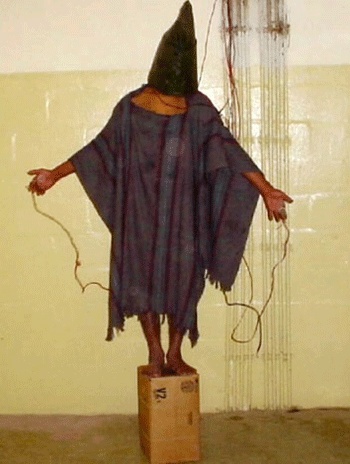
April 28th marks the tenth anniversary of the moment that the horrors of Abu Ghraib were made public in this country. On that day a decade ago, the TV news magazine "60 Minutes II" broadcast the first photographs from that American-run prison in “liberated” Iraq. They showed U.S. military personnel humiliating, hurting, and abusing Iraqi prisoners in a myriad of perverse ways. While American servicemen and women smiled and gave a thumbs up, naked men were threatened by dogs, or were hooded, forced into sexual positions, placed standing with wires attached to their bodies, or left bleeding on prison floors.

Thus began America’s public odyssey with torture, a story in many chapters and still missing an ending. As the Abu Ghraib anniversary nears and the White House, the CIA, and various senators still battleover the release of a summary of a 6,300-page report by the Senate Intelligence Committee on Bush-era torture policies, it’s worth considering the strange journey we’ve taken and wondering just where we as a nation mired in the legacy of torture might be headed.

Chapter One: Revelations

The odyssey started with the shock of those "60 Minutes II" photos, followed two days later by the reporting of veteran New Yorker writerSeymour Hersh. Having seen even more grim photographs and interviewed many in the chain of command stretching from Abu Ghraib to the Joint Chiefs of Staff and the Pentagon, Hersh painted a picture of a deliberate policy of abuse. He traced Abu Ghraib’s crimes to pressure from “military-intelligence teams, which included CIA officers and linguists and interrogation specialists from private defense contractors,” urging the production -- and fast -- of crucial information from U.S. captives in Iraq. Towards this end, the guards at Abu Ghraib were encouraged to “soften up” the detainees for interrogation.

That summer and fall of 2004, the Washington Post, the New York Times, the ACLU, and others got their hands on several Bush administration memos justifying and legalizing torture. These had largely been written by John Yoo and Jay Bybee, lawyers in the Office of Legal Counsel at the Department of Justice, and they proved grim reading indeed. The documents provided uniquely tortured definitions of torture that made almost any act in which the infliction of pain didn’t rise to the level of “organ failure, impairment of bodily function, or even death” acceptable. As if that weren’t enough, they developed no less tortured theories of executive power in which the president as commander-in-chief retained the right to authorize torture for national security reasons, despite its illegality under domestic, military, and international law.

With this anything-goes green light switched on, the memos proceeded to expressly approve individual methods of abuse (previously defined as torture) for American interrogators. Used in combination and repeatedly, these were known to destroy the human psyche and bring severe pain to the body as well. Specifically, they put the Bush administration’s stamp of approval on graphically described “techniques,” including sleep deprivation, slapping, the dangling of trussed prisoners from beams, and especially waterboarding, a process in which individuals essentially experience drowning, only to be saved at the last moment.

The trail of evidence went right to the top. The office of Defense Secretary Donald Rumsfeld told the interrogators of “the American Taliban,” John Walker Lindh, to “take the gloves off.” Vice President Dick Cheney, who famously said it was time to “work the dark side,” hasrepeatedly defended the policy of harsh interrogation techniques, including waterboarding, as effective and essential in keeping the nation safe. Top officials reportedly had various “enhanced interrogation techniques” demonstrated in the White House. The 2002 torture memos were addressed to White House Counsel and later Attorney General Alberto Gonzales. More


Wednesday, October 9, 2013

The Hard Times Facing Humanity by Fidel Castro Ruz

The world is ever more misinformed in the midst of a turmoil of events that occur at a speed never before expected.

Fidel Castro Ruz

Those of us who have lived a few more years and experienced a certain eagerness for information can attest to the amount of ignorance with which we used to approach facts.

While an increasing number of persons lack housing, bread, water, health, education and employment in the planet, the wealth of the Earth is being wasted and squandered to manufacture weapons and wage endless fratricidal wars. This has become –and is ever more becoming- a more frequent and abominable world practice.

Our glorious and heroic people, despite an inhumane blockade that has been in place for more than half a century, has never given in: it has struggled and will continue to struggle against the sinister empire. That is our humble merit and our humble contribution.

At the opposite side of our planet, in Seoul, the capital of South Korea, President Barack Obama is attending a Summit on Nuclear Security to impose policies related to the distribution and use of nuclear weapons.

These are, no doubt, unheard of events.

I personally did not become aware of these realities just by mere chance. The experience lived throughout more than fifteen years since the triumph of the Cuban Revolution –after the battle in Girón, the criminal Yankee blockade that intended to subdue us by hunger; the pirate attacks, the dirty war and the nuclear missile crisis in October, 1962, which pushed the world to the verge of a sinister hecatomb- led me to the conviction that Marxist and honest Christians –of whom I had met many- regardless of their political and religious beliefs, should and could struggle for justice and peace among human beings.

I proclaimed so and I have maintained so without any hesitation whatsoever. The reasons I have today are absolutely valid and even more important, because all the events that have occurred for almost 40 years now confirm that. Today there are more reasons than ever, because neither Marxists or Christians, whether Catholic or not; Muslims, Shiites or Sunnites; freethinkers, dialectical materialists or even persons who think would like to see the premature disappearance of our irreplaceable thinking species, and wait until the complex laws of evolution could give rise to another similar species with the capacity to think.

Tomorrow I will gladly greet His Excellency Pope Benedict XVI, as I did with John Paul II, a man in whom the contact with children and the humble citizens of the people always aroused feelings of affection.

That is why I decided to ask him for some minutes of his very busy schedule when I knew from our Foreign Minister Bruno Rodríguez that he would be glad to have that modest and simple contact. More


Tuesday, October 1, 2013

The BBC's subjective view of Israel's occupation should concern us all

Just over a week ago, Israeli armed forces dragged a French diplomat out of an aid vehicle in the occupied West Bank. The international news agency Reuters released subsequent photographs of the woman, Marion Fesneau-Castaing, lying in the dust at the feet of Israeli soldiers, a gun pointed at her face. Fesneau-Castaing and others had been attempting to deliver humanitarian aid to the villagers of Khirbet al-Makhul, whose homes had been demolished by the Israeli army four days earlier, on 16 September.

Amena Saleem

The BBC responded with an online story headlined: "Diplomats protest over West Bank clash with Israel troops"

As is the norm with the BBC's coverage of Palestine and Israel, the story was written without context or background. Israel's presence in the West Bank, its military occupation, is illegal under international law. Its demolition of Palestinian houses and the displacement of their inhabitants are in violation of the Geneva Convention. In a feature on the demolition of Khirbet al-Makhul, the Independent quotes Bill Van Esveld of Human Rights Watch as saying, "All the criteria appear to be met for this to be considered forcible transfer, which is a war crime."

None of this was reported by the BBC, whose headline reduced all of the above to "a clash with Israel troops". In the BBC's use of the word "clash" there is an implication that the diplomats were also at fault, that they waged some kind of battle against armed soldiers.

Khirbet al-Makhul is in the fertile Jordan Valley, a key area for Israeli settlement building. To obtain the necessary land for the illegal settlements, Palestinian villages have to be destroyed and the villagers moved on.

BBC Online's story chose to put the process this way: "The homes in Khirbet al-Makhul were knocked down on Monday after Israel's High Court ruled that they had been built without the correct permits."

The fault, then, seems to lie with the Palestinians who appear to be attempting to operate outside the planning system. A planning system, the average reader will assume, is fair, open and transparent, but nothing could be further from the truth. Under the practices of Israel's military occupation, it is a rarity for Palestinians to be granted a building permit, either to build new homes or extend existing ones.

The Israeli human rights group B'Tselem reports that the Israeli military refuses to give building permits to Palestinians in 99 per cent of Area C, which is where the Jordan Valley, containing the village of Khirbet al-Makhul, lies.

Oxfam reports: "Israel's planning policy in Area C is used to maintain reserves of land for future development of Israeli settlements. Palestinians are often left with no choice other than to build without a permit, despite the ever present risk of demolition which threatens thousands of buildings and puts thousands of families at risk of forced displacement."

Who, reading the BBC's report, would know that? There was nothing in this report to provide a context for the events of a week of Palestinian house demolitions and the manhandling of European diplomats.

To add insult to injury, the Palestinians, who were presented as infringing Israel's honest planning laws, are then depicted as being too intransigent to comply with the consequences. The article continues: "... the Bedouin villagers of Khirbet al-Makhul have refused to leave the land where they say they have grazed sheep for generations."

The fact that the Palestinians have indeed been on this land for generations is furthermore presented as no more than a claim with the addition of two simple words: "they say". The Palestinians' existence on this land and their dispossession of it is not a fact for the BBC, it is merely a claim.

Why is the way the BBC presents Israel's occupation of Palestinian land an issue? After all, it is not as if much of the mainstream media does any better on the subject.

There are several key reasons. According to the BBC's own figures, BBC News reaches 81 per cent of the UK each week across all platforms (television, news, online). That's a quite staggering percentage of the population consuming the BBC's output, including what it has to say on Palestine and the occupation. No other news organisation can claim to be reaching and influencing the vast majority of the British population in this way.

Even more worrying, the BBC Media Centre reports that, "The BBC remains the news provider that the UK public trusts the most by far." It quotes an Ipsos Mori survey, conducted in February 2013, in which 58 per cent of respondents said that the BBC was the "one source they would most likely turn to for news they trust". This was significantly ahead of the nearest other provider, ITV, on 14 per cent.

So here we have a news organisation with a vast reach, commanding a high level of trust, publicly funded, which is failing to tell its audiences the ugly truth of Israel's occupation.

As demonstrated by the article on Marion Fesneau-Castaing and Khirbet al-Makhoul, the BBC will leave out the facts and the context which, if included, would show Israel to be the rogue state it is. And, wherever possible, it will present its audience with the official Israel line only; in this report, for example, that the Palestinians allegedly had no legal right to build where they did. The Palestinian perspective, indeed the fact that Israel almost never gives planning permission to Palestinians, forcing them to build "illegally" is omitted.

Four days after publishing this article, BBC Online ran another piece, headlined "Israel 'to act' over West Bank diplomats scuffle". This contained a video showing Fesneau-Castaing pushing an Israeli soldier in the face as she was lifted up from the ground and led away. The BBC reports that "...video emerged of her lashing out at an Israeli border policeman."

The video that BBC audiences will not see is that of Israeli forces destroying the tents in which the homeless Palestinian villagers were sheltering, while they were still inside. Once again, the true extent of Israel's aggression against the Palestinian people has been carefully hidden from those receiving their news via the BBC.

Through its massive omissions in reporting, the BBC is keeping its audience, 81 per cent of the British population, in the dark about the reality of Israel's occupation. Where are the BBC's reports on the arbitrary arrests and detention without trial of Palestinian civilians; the dragging of Palestinian children from their beds at night by Israeli soldiers to be thrown into jail; the destruction of Palestinian farmland and olive groves by armed Israeli settlers; the ethnic cleansing of Palestinians from East Jerusalem in ever-increasing numbers; and the impact of the apartheid wall and the checkpoints which contain Palestinian movement?

They are not there in the BBC's world; they are non-existent. Instead we have offerings from BBC Online such as, "West Bank: Why do some UK Jews settle in Israeli occupied land?"

The article begins: "Every year hundreds of British Jews make the life-changing decision to emigrate to Israel. A small number of these decide to join settlements in the Israeli-occupied West Bank." What follows is a 1,000 word paean to Israeli settlers. They are not an obstacle to peace, they tell BBC reporter, Samantha Dalton, they are in the West Bank to "contribute to civil society" and are simply misunderstood.

This cosy little article, given to us by a news organisation funded by our licence-fees, somehow seems oblivious to the fact that the settlers' very presence in the occupied West Bank contravenes international law. It is not bothered by the fact that UN Resolution 446 says settlements "constitute a serious obstruction to achieving a comprehensive, just and lasting peace in the Middle East." From that point of view alone, this feature on the "life-changing" experiences of those who would be settlers is incredibly irresponsible.

And where is the Palestinian perspective? Again, as so often with the BBC, there is none. Not a single Palestinian is interviewed about the impact of settlers and settlements on Palestinians in the West Bank. There is nothing about the land theft necessary for the creation of settlements; nothing about the violent extremism of settlers in Hebron and elsewhere; and nothing about the allocation of 70 times more water to illegal Israeli settlers than to Palestinians.

For the BBC to include that kind of balanced information would be to inform its huge audience of the Palestinian experience of occupation and to expose too clearly the horrors of Israel's apartheid system. As we've seen, it's not the kind of information that the BBC is in the habit of giving out. That the BBC chooses to withhold important information which is vital for its audience to understand what is happening in Palestine and Israel is something that should concern us all. More

Amena Saleem is a journalist and activist, working closely with Palestine Solidarity Campaign in the UK. She has twice driven on convoys to Gaza with PSC. More information on PSC's solidarity work is available at www.palestinecampaign.org


Tuesday, April 30, 2013

6 Horrifying Facts Every American Should Know About Guantanamo Bay and the Ongoing Hunger Strike

As the hunger strike grows, the U.S. is sending more medical personnel to help force-feed the prisoners. Here are some of the facts you should know about the protest and the prison camp.

The hunger strike at Guantanamo Bay continues to grow. The U.S. recently forced many prisoners into solitary confinement. The military now admits that 100 prisoners at the camp are refusing to eat. But lawyers for Guantanamo detainees say that more than 130 detainees are on hunger strike.

While the claims and counter-claims bounce back and forth, the situation continues to deteriorate. Here’s 6 facts you should know about Guantanamo Bay and the ongoing act of protest most of the prisoners are participating in.

1. U.S. Medical Reinforcements Have Arrived to Force-Feed Prisoners

One of the latest news items is that “medical reinforcements” from the U.S. Navy have arrived at Guantanamo Bay to cope with the growing hunger strike. The Naval nurses and specialists are there to help facilitate the process of force-feeding the detainees.

“We will not allow a detainee to starve themselves to death, and we will continue to treat each person humanely,” Guantanamo prison spokesman Samuel House told the New York Times. But the practice of force-feeding has been criticized by human rights groups.

When detainees are force-fed, they are shackled to a “restraint chair.” Then, U.S. military officials force a tube into their nose to pump nutrients into their body. The American Medical Association has come out strongly against the practice. “Every competent patient has the right to refuse medical intervention, including life-sustaining interventions,” AMA President Jeremy Lazarus wrote in a letter to Secretary of Defense Chuck Hagel, the Miami Herald reports.

In a harrowing New York Times Op-Ed, Guantanamo prisoner Samir Naji al Hasan Moqbel described the process of force-feeding. “I will never forget the first time they passed the feeding tube up my nose. I can’t describe how painful it is to be force-fed this way. As it was thrust in, it made me feel like throwing up,” he wrote. “I wanted to vomit, but I couldn’t. There was agony in my chest, throat and stomach. I had never experienced such pain before. I would not wish this cruel punishment upon anyone.”

2. Hunger Strike Sparked By Raids, Fueled By Indefinite Detention

Detainees began the hunger strike in early February after they said personnel at the camp raided cells, confiscated personal items and treated the Qu’ran disrespectfully. The military disputes this narrative. But what is clear is that, as the New York Times reported, the strike is being driven by “a growing sense among many prisoners, some of whom have been held without trial for more than 11 years, that they will never go home.”

“The men are not starving themselves so they can become martyrs...They’re doing this because they’re desperate. They’re desperate to be free from Guantanamo. They don’t see any alternative to leaving in a coffin. That’s the bottom line,” Wells Dixon, an attorney for five Guantamano detainees, told AlterNet earlier this month.

3. 86 Detainees Have Been Cleared for Release--But They’re Still There

There are currently 166 detainees at Guantanamo. And over half of them--86--have been cleared for release out of the hellish prison camp. But they’re still there, a fact that is helping to drive the hunger strike. More


Sunday, April 28, 2013

Israel gives up white phosphorus, because 'it doesn't photograph well'

A certain air of nostalgia dominated Maarivs headline last Thursday: “Due to criticism in the world, IDF parts ways with white phosphorus”: just like the old Galil assault rifle and the old two-way radios that generations of soldiers grew familiar with.

Ghada Abu Halima injured by white phosphorus

A couple of years ago we learned the IDF was giving up its cans of preserved meat (the kosher version of SPAM). Now, it’s white phosphorus that we say goodbye to.

[Twilight. The IDF and white phosphorus exchange a final gaze. A sad violin tune is heard. Curtain down.]

So the IDF is looking for a replacement for the white phosphorus bombs. A senior officer in the ground forces explained: “As we learned during Cast Lead, it [white phosphorus] doesn’t photograph well, so we are reducing the supply and we will not purchase beyond what we already have.”

“It doesn’t photograph well.” In all honesty, the man is right.

This item caught me by surprise. The IDF is giving up white phosphorus? Wait a minute; the IDFnever used white phosphorus during Cast Lead. So how exactly do you give up something you we never had? Chemical weapons are something the Syrians use, no?

Okay, after a while the army did remember that it had been confused, and it did use white phosphorus, but only in open territories and not against people.

Okay, then the IDF remembered that it got it wrong again and that it did use white phosphorus in urban areas. Two hundred bombs, actually. But this was only in order to create a “smoke screen,” and there is nothing wrong with that. And if there was something wrong, it’s insignificant and unintentional, and it would be thoroughly investigated, so that no stone is left unturned.

That’s all nice and well, except that at least 12 Gazans met their horrific death this way, burned to death by white phosphorus. Among them were three women, six children and a 15-month-old baby girl. Dozens more suffered burns from the material which continues to burn through flesh and tissue until it reaches the bone. Doctors in Gaza were helpless in treating the unfamiliar burns. Israel didn’t give them time to prepare themselves; white phosphorus shells hit Al-Quds Hospital and completely burned the top two floors.

These facts were already known in the first days of Cast Lead. Human Rights Watch published a thorough investigation – one of the most thorough I have read – of Israel’s use of white phosphorus and its devastating effects. IDF soldiers who took part in the Gaza campaign alsotestified on the extensive use of white phosphorus, including direct fire on houses suspected of being booby-trapped (and not for “masking” purposes as the IDF later claimed). More


Friday, March 1, 2013

The unequal right to water in unrecognized Bedouin villages

On February 20, the Israeli Supreme Court dismissed an appeal by residents of the unrecognized Bedouin village of Umm El-Hiran in the Naqab (Negev), demanding minimum access to drinking water. which holds 500 residents.

The appeal was filed by Adalah, the Legal Center for Arab Minority Rights in Israel on behalf of the village’s 500 residents.

The residents of the village Umm El-Hiran arrived in 1956 when they were forced to move there by the Israeli military commander. Today, 58 years later, they get their drinking water from a water tank provided by the Israeli Water Authority, which decided to locate the tank eight kilometers away from the village. Alternately, the residents can to purchase drinking water from a private family that lives four kilometers away. The latter option is complicated by the fact that there are disputes between some villagers and that private family. More importantly, the family charges a higher price for water than the one set by the Water Authority.

In other words, although the state is responsible for providing drinking water directly and equally to all its citizens, the village residents can either get the water by themselves from the water tank a lengthy distance away or live under the grace of a private family and pay more than all other citizens. Meanwhile, the nearby Jewish community of “Amos,” which consists of only one family numbering a few persons, is connected to water infrastructure that reaches directly to their home with proper facilities – just like the other 30 or more individual Jewish settlements in the Naqab.

The Supreme Court’s decision in February ended an eight-year legal struggle in different Israeli courts. This situation did not come about as a result of lack of natural resources but rather because of an intentional governmental policy not to connect Umm El-Hiran, as well as another 90,000 other Bedouin living on their ancestral lands in 34 unrecognized villages, which are unconnected to water sources to this day. The government has made it clear that the policy is intended to pressure and coerce the Bedouin residents to leave their land by denying them services. The purpose of this evacuation policy is to enable the establishment of new Jewish towns on the same land, create industrial zones under the jurisdiction of Jewish towns or even for the mere purpose of forestation.

This court decision follows a previous ruling issued by the Israeli Supreme Court in June 2006, which dealt with the villagers’ demand to connect their houses to drinking water infrastructure. In a precedent ruling, the court held that the right to water is part of the constitutional right to minimum standard of living, which itself is anchored in the constitutional right to dignity. However, it ruled that citizens living in those unrecognized villages are not entitled to a direct connection to drinking water in their homes. The court basically accepted the state’s argument that the purpose of the refusal to connect the villages to water is the fact they are not recognized by the state, and thus the villagers are trespassers. As such, they are not entitled to any of these services, no matter how basic and essential, including water, electricity, education and health, etc.

The state also declared in court that if it connects the unrecognized villages to water it will “encourage the continuing phenomenon of the unrecognized villages,” and thus by denying permanent water sources it can create an “incentive for the Bedouins to move to villages established by the state itself” – further evidence that the state is using the water issue to pressure villagers to evacuate their land. The court confirmed that the purpose of this policy is adequate and reasonable.

However, the court added that the villagers are entitled to minimum access to water, as an essential resource, without defining “minimum access.” The only exception for which the court allowed direct water connection to the residents’ houses was for “special humanitarian considerations.” After reviewing the case of Umm El-Hiran, the court concluded it is not clear that the water tank eight kilometers away meets the criteria of “minimum access,” and ruled that their case should go back to the Water Authority for re-examination. Adalah appealed on behalf of the villagers to the Water Authority to reconsider providing “minimum access” to water closer to the village; the Authority dismissed the request. Adalah’s next appeal, to the Water Tribunal, was dismissed as well.

As a result the case reached the Supreme Court again. This late action resulted in the most recent court decision, which once again justified the government’s policy of “encouraging” the villagers to move from their lands while declaring again that the current circumstances sufficiently meet the “minimum access” to water criteria.

With this ruling, the court established that the rule of law does not apply to Bedouin citizens of Israel. In upholding the state’s argument that denying the water could pressure Bedouin citizens to move from their land and that the villagers are entitled to “minimum access” to water rather than “equal access” like other citizens, the Israeli court basically justified the refusal to connect citizens to drinking water as a tool for punishing all Bedouin who refuse to leave their land. This goes hand-in-hand with the fact that Israeli authorities intentionally resist recognizing Bedouin land ownership rights.

The resulting situation is intolerable for a country that claims to be a democracy, but it is tolerable for a country that defines itself only as a “Jewish state.” The court refused to acknowledge that this group of its citizens is entitled to “equal” access to water, sticking instead with “minimum access.” That places Bedouin citizens on a lower level than other Israeli citizens in terms of constitutional rights. More