Showing posts with label arabs. Show all posts

Tuesday, July 10, 2018

Bulldozing Palestine, one village at a time

Bulldozing Palestine, one village at a time | Israel | Al Jazeera

It was a bit ironic to see a small group of Israeli settlers enter the large solidarity tent stationed at the entrance of Khan al-Ahmar last Wednesday. They had come, they said, to show "solidarity" with the Palestinian Bedouins protesting a demolition order.

Since 2017, the whole Bedouin village has been threatened with demolition by the Israeli authorities. Earlier that day, Israeli soldiers attacked villagers and activists who had staged a protest, injuring 35.

"You know, I try not to be afraid, but I don't know what will happen to us. Where will we go, what will we do?

Khan al-Ahmar, a village of 180 people, is about 15km northeast of Jerusalem and falls within what is known as Area C of the occupied West Bank, as defined by the Oslo Accords. The area has been inundated with more than 300,000 Israelis living in 125 illegal settlements and is under Israeli administrative control. Under the Oslo Accords, the Palestinian Authorities was supposed to take over administering the area, but, of course, Israel never let that happen.

As a result, it is now the Israeli state that controls the land in Area C and that decides on building permits. Khan al-Ahmar existed before the state of Israel was created in 1948. In the 1950s, Palestinian Bedouins expelled from the Negev desert by the Israeli army moved to the West Bank and settled in the village, expanding it. Read More

Sunday, February 11, 2018

Shades of the Third Reich

The shocking story of Israel's disappeared babies | Israel News | Al Jazeera

The first consequence is likely to be mounting pressure on the government to open the state's adoption files so that the true extent of the disappearances can be gauged and families reunited.

But Hanegbi's otherwise evasive comments will do little to end suspicions that officials are still actively trying to avoid confronting the most contentious questions: Why were the infants taken from their families? Did hospitals and welfare organisations traffic children in Israel's early years? And were state bodies complicit in the mass abductions?

When asked by Israeli TV programme Meet the Press whether government officials were involved, Hanegbi would say only: "We may never know." Read More

Thursday, November 13, 2014

Why is a Colorado firm selling apartments in Israel’s illegal settlements?

The Colorado-based real estate firm RE/MAX is profiting from Israel’s relentless theft of Palestinian land.

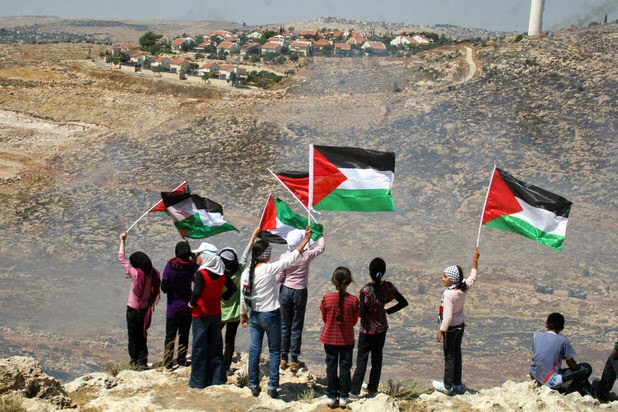
Palestinians protesting Illegal settlements

Active in the Israeli market since 1995, RE/MAX sells and rents houses and apartments in colonies reserved exclusively for Jews in the occupied West Bank, including East Jerusalem. Much of that work is coordinated in an office that the Israeli subsidiary of RE/MAX runs in Maale Adumim, a major settlement in the West Bank.

A United Nations report published last year suggested that the firm’s parent company in the US could be “held accountable” for assisting Israel’s crimes. RE/MAX International, which is headquartered in Denver, “has constant interaction and influence” over its franchises around the world. The company also provides “brand name affiliation,” training and other services, according to Richard Falk, the report’s author, who was then the UN special rapporteur for the West Bank and Gaza.

“Closet space” for settlers

On its website, RE/MAX offers properties in a number of settlement colonies in East Jerusalem, which has been under Israeli occupation since 1967. A four-room apartment with “lots of closet space” can be rented for 4,400 shekels ($1,100) per month. Among the apartment’s attractions listed by RE/MAX are proximity to the light rail system which links Israeli settlements in East Jerusalem to the city center.

Screen grab from RE/MAX Israel’s website

Such settlements violate the Fourth Geneva Convention, which forbids an occupying power from transfering its civilian population into a territory that it occupies.

Proespective settlers with a larger budget were recently offered what RE/MAX describes as “a beautiful old Arab house” in the Abu Tor neighborhood for 7 million shekels ($1.8 million).

Posing as a prospective buyer, an Electronic Intifada reporter phoned Orly Raz, a RE/MAX agent for East Jerusalem. Raz said that “we have just sold everything” that the firm was handling in Abu Tor.

Claiming that he would be moving to Jerusalem in early 2015, the reporter enquired if there would be any legal difficulties in buying a house or an apartment that previously belonged to Palestinians. “You don’t have to worry about these things,” Raz replied. “All our properties legally belong to Jewish owners. They didn’t take them from anyone.”

“Of course, if you are worried about the ‘67 border line, this is not a good area to buy property,” she added.

“Check very carefully”

Raz then asked: “Are you Jewish?” When the reporter responded that he was not, she said: “You have to check the properties — if their owners say they can sell an apartment to non-Jewish people.” She added, however, that such conditions are not mentioned on the firm’s website.

When the reporter feigned surprise that a real estate firm might discriminate based on religion or ethnicity, Raz said: “I’m just saying this is an issue to check very carefully.”

Ateret Cohanim, a Zionist organization, has been known to buy Palestinian homes in Abu Tor, so that they can be passed on to Israeli settlers.

Abu Tor has also witnessed considerable brutality by Israeli forces against its Palestinian residents lately. In late October, Israeli police officers broke into a house of a Palestinian living in Abu Tor, shooting him dead.

And in the first week of November, two Palestinian buildings were demolished in Abu Tor at the instruction of the Israeli authorities.

RE/MAX has enjoyed fawning coverage in the Israeli press. In 2004, the newspaper Haaretz published a profile of Bernard Raskin, the chief executive of RE/MAX Israel. Zimbabwean-born Raskin claimed that his firm had become a leading player in the Israeli property market because its competitors had “no professionalism.”

During a 2013 real estate conference in South Africa, Raskin noted that the Israeli economy has not suffered as severely as many others during the recession of recent years. One problem he identified was that “there is generally a shortage of stock.”

He added, however, that “more and more building is taking place outside of Tel Aviv, where property is expensive.”

Money from crime

The Israeli authorities have ensured that RE/MAX will have new business, thanks to the ongoing expansion of Jewish-only settlements in East Jerusalem and the wider West Bank. Earlier this month, the Israeli-controlled Jerusalem municipality announced that it had rubber-stamped the construction of new housing units in Ramot, a settlement in East Jerusalem. RE/MAX is already active in Ramot.

Although the US government says it is opposed to the construction of Israeli settlements, it has refused to impose sanctions on Israel. Because of that refusal, RE/MAX can continue turning violations of international law into a money-making opportunity.

The Colorado headquarters of RE/MAX International did not respond to requests for comment.

While the company’s Israeli operations may have some autonomy, RE/MAX International cannot claim that these matters have nothing to do with it. As the UN made clear in its aforementioned 2013 report, RE/MAX wields considerable influence over its franchises around the world.

The Palestinian-led boycott, divestment and sanctions movement has succeeded in putting the spotlight on how corporations like Veolia and G4S aid the Israeli occupation. Given that RE/MAX is so directly involved in the settlements that are central to that occupation, there is a strong case for putting the firm under the same kind of pressure. More


Tuesday, September 9, 2014

Replacing the peace process with a civil rights struggle

What would happen if Israeli progressives and their supporters demanded an end to the military court system, or called for freedom of movement for Palestinians? The answer: a lot.

The two-state solution has long become a means (to solving the problem of the occupation) to an end. As I wrote here in the past, this change has had severe consequences as far as the Israeli political opposition is concerned. Those range from a de-facto acceptance of the status quo to a political alliance with the Right and support for all the latest rounds of violence. The excuses are always the same – that we are on the road to the two-state solution and “this is the only game in town.”

The truth is that we aren’t on the road to two states or to one state. We are deep in the status-quo solution. Israel directly controls the lives of some 4 million Palestinians (and indirectly almost two more million in Gaza), and only a minority of them have the rights of full citizens, and even then only formally. The debate over the correct term for this state of affairs (‘occupation’ or ‘apartheid’ or ‘status quo’) is not half as important as recognizing this reality itself, which is stable, institutionalized and not going to change in the foreseeable future.

As a matter of fact, a final status agreement seems as far off as I can remember. The two-state solution is highly unlikely to take place in the coming years, and there is no way of knowing what the more distant future holds. Regional events along with internal developments in Israeli society serve those who oppose an agreement. The occupation empowers those who support it.

The common wisdom in Israel today is that every territory that is evacuated will eventually become another hub for Middle Eastern anarchy. The security establishment believes that only the IDF can prevent forces such as Islamic State from crossing the Jordan River. Israel would also like to make sure that Hamas doesn’t take over the West Bank. In other words, even if a Palestinian “state” is formed, it won’t have even the minimal degree of independence. No credible Palestinian leadership can be expected to agree to that.

I also don’t see any form of international pressure that would force the two-state solution on Israel. Much of the international community is clearly unhappy with Israel’s policies of the last decade, but this is nowhere near the mobilization against South Africa in the 1980s or, more recently, Iran. In both cases the tipping point was the U.S. decision to support and impose sanctions. And while the U.S. might end up distancing itself from Jerusalem, it will continue to use its power to prevent sanctions against it. The EU is also unlikely to expend its measures beyond some steps against the settlements. So there is truly no end in sight.

Facing this new reality, Israeli progressives that supported the peace process are turning to one of a few options: There are those who join the Right in maintaining the status quo; those who continue to believe that some recent events – the war, the ceasefire, American elections, the lack of American elections, etc. – opened a “window of opportunity for peace;” while in fact there is no window, not even a crack. And there are also those who are crying, not without some perverse pleasure, that “all is lost.”

On a more positive note, I believe there is renewed recognition in Israel of the dominance of the occupation on all other political problems, in the long-term threat it presents before Israeli society. I used to hear people say that the Left should focus on social issues and leave the Palestinian problem aside, but not anymore. You even see conservatives voicing some concern over the failure to solve the Palestinian issue. In other words, there is some new recognition of the problem, but there is no political strategy to accompany it among progressives, except for continuing to bang one’s head against the peace process wall.

***

The solution is to replace the diplomatic process with a civil rights struggle, to break the occupation into pieces, and deal with each one of them: The fact that Palestinians do not enjoy freedom of movement. The fact that they have been tried in military courts for almost half a century. The limits on their freedom of speech and their right to freely assemble. The lack of proper detainee rights (including minors). The disrespect for their property rights, and, of course, their lack of political rights.

A civil rights struggle doesn’t necessarily mean a single-state solution, nor two states. Civilian rights for Palestinians can lead to any final status agreement. As I wrote here last week, there is little point in debating solutions right now.

A civil rights struggle is not a new idea, and many Palestinians have been engaging in it for a long time. But Israeli progressives and peaceniks have always placed it second only to the diplomatic process. In other words, instead of the Palestinian state becoming a means for the fulfillment of Palestinian rights, it was made the only desired political object; those rights no longer bared value once they were separated from the idea of statehood – as if because the Palestinians have no state they don’t deserve freedom of movement or a fair trial. Thus, progressives find themselves justifying an authoritarian regime in Ramallah in the name of Palestinians rights, and many other absurdities.

On a tactical level, a civil rights struggle opens the door for Arab-Jewish cooperation on both sides of the Green Line, and leaves aside the questions of statehood and historical narratives that people love to debate. Instead, it focuses on the lives of real people under occupation.

The equal rights of all men and women is such a simple and broadly accepted notion that it’s easy to explain and for everyone to understand. Israelis have adopted all sorts of revisionist readings of the conflict in recent years; for example the idea that the territories aren’t occupied because they were never claimed by any other state. But the most important problem with the occupation is the millions of people held under a military regime for decades, and not just the legal status of the land.

The target of a civil rights struggle is not the settlers, or any other Israeli community, but the state and its practices. It might not make progressives more popular with the Israeli public, but it could make their work more effective.

What could such a struggle look like? It should raise specific political demands that touch the basic liberties and rights of human beings; such as the right to a fair trial, to equality before the law, and to political representation.

The military court system is a good place to start. Military tribunals could be accepted in very specific contexts and for a limited period of time. They aren’t meant – nor could they be used – to run the lives of a civilian population for decades, as Israel does.

There is no way to justify military commanders ruling over civilian issues for half a century, the way they do in the West Bank. There is no way to justify administrative detentions. What prevents a “pro-peace” party or organization – say, Meretz or Labor or J Street – from right now demanding an end to the military court system, regardless of diplomatic developments? The fact that such an idea is not even debated demonstrates the degree to which even the “pro-peace” camp has adopted the mentality of the occupation.

What about freedom of movement? The Palestinians are held like Israel’s prisoners, not only in the West Bank but also in Gaza. It takes a permit from a military commander to allow a Palestinian to visit his or her family in Jordan. Why not demand turning this policy on its head, right now, and have the security authorities state who they forbid from traveling, and allow everybody else free passage? Surely this is a reasonable enough request?

Human rights groups have been monitoring and discussing these issues for decades, but they have yet to enter progressive politics, which is still chained to the endless peace process. Imagine what would happen if mobilization by the international community around Israeli relations with the PA or its settlement policies was directed at the rights of Palestinians.

To some this might seem like back-door annexation by Israel – an idea that most Israelis and Palestinians still oppose. But the fact of the matter is that de-facto annexation has already taken place, only without allowing the civilian population their basic human and civil rights. Recent cries over the appropriation of some 1,000 acres of land by Israel sound hollow compared to the massive human rights violations that have been taking place for decades. I actually believe that even if Israel was to hand the Palestinians full voting rights in the Knesset tomorrow we could end up with some version of a two-state solution or a confederative model, because both people here are interested in national sovereignty.

Make no mistake: Keeping the Palestinians without rights is not some temporary holding pattern on the way to a final status solution (or peace). For Israel, this is the solution. And giving Palestinians their rights will not postpone an agreement – quite the opposite. It would force Israelis to really think about the kind of future they want, alongside the Palestinians. More


Thursday, June 19, 2014

Israel elected to leadership of UN committee on “Decolonization”

Just when it appeared that the United Nations could not be more ineffective in protecting Palestinian rights and holding Israel accountable for violating them, here comes the news that Israel has been elected as vice-chair of the UN Special Commitee on Decolonization – which deals among other things with matters related to Palestinian refugees.

Palestinians examine the ruins of
buildings demolished by Israeli
occupation forces in eastern Jerusalem,

According to UN minutes, the representative of Israel, the world’s last settler-colonial power, received 74 votes for the post, despite strong opposition from the Arab Group of UN member states.

Qatar, speaking on behalf of the Arab states, described Israel as a “State that violated the United Nations Charter and international law. Because its track record was rife with murder and its occupation had lasted more than 66 years, Israel was not qualified to preside over questions pertaining to Palestinian refugees, peacekeeping and the investigation of its own illegal practices.”

The Arab states had demanded a recorded vote, an unusual step, prompting objections from the ambassador of the United Kingdom which is a member of the Group of Western European and Other States that nominated Israel.

The Balfour Declaration

Canada took the opportunity to express its “unflinching support for Israel” and the United States said it “unequivocally supported Israel’s election.”

Saudi Arabia – whose own membership of the UN Human Rights Council has drawn much criticism – said that Israel’s election was “the moral equivalent of placing the apartheid regime of South Africa in charge of a committee to end racism.”

Theater of the absurd

Israel thanked its supporters, but perhaps its actions spoke louder than words. While this theater of the absurd was playing out in New York, Israeli occupation forces stepped up demolitions of Palestinian homes to make way for colonial settlements.

Its election comes just weeks after Israel announced yet another massive expansion of illegal colonies in the occupied West Bank.

On Wednesday alone, Israeli demolitions left seven Palestinian families homelessin the West Bank.

And take a look at the photostory by Silvia Boarini documenting Israel’s ongoing ethnic cleansing of Palestinian Bedouins in the southern Naqab (“Negev”) region of present-day Israel.

These latest measures of ethnic cleansing come amid Israel’s assault on West Bank cities over the past week, allegedly in search of three missing colonial settlers. Israel has so far abducted more than 300 Palestinians, raided 750 homes as well as dozens of charities and the Birzeit University campus.

If there were a UN Committee on How to Occupy and Colonize, Israel would indeed be the best candidate to lead it. More

The British are at the root of the Palestinian's problems as they, via the illegal Balfour Declaration, allowed the Jews to settle in Palestine (there was no israel then). And they did so while running the southern part of the ex-Ottoman Empire under a Mandate from the League of Nations. A mandate to govern the State of Trans-Jordan and Iraq on behalf of the citizens thereof. Editor


Monday, June 9, 2014

“I felt something hot inside”: Palestinian teen describes Nakba Day shooting by Israeli soldiers

On 15 May, two Palestinian teens – Muhammad Abu al-Thahir and Nadim Nuwara – were fatally shot in cold blood by one or more Israeli snipers, during a Nakba Day demonstration in the village of Beitunia, near the Ofer military prison in the occupied West Bank.

That same day, a third teenager, 15-year-old Muhammad al-Azzeh, was shot and seriously injured, suffering a gunshot wound to the chest and left lung. “I felt something hot inside,” he tells Defence for Children International-Palestine Section in a hospital bed interview seen in the video above.

New security camera footage, also shown in the video, captures the moment he was hit. It shows that al-Azzeh was nowhere near any Israeli soldiers and could have posed no plausible threat to anyone.

Al-Azzeh says he was about sixty meters from the positions of the Israeli occupation forces when he was shot.

Despite widespread media attention and calls for investigations from international and local human rights organizations, Israel continues to cover up and guarantee the impunity of the occupation soldiers responsible for the Nakba Day Beitunia killings.

Wednesday, June 4, 2014

Israel plans to outlaw Islamic party

NAZARETH, Israel - Israel’s prime minister, Benjamin Netanyahu, told his cabinet last week that the northern branch of the Islamic Movement should be outlawed as a terror organisation, according to a leak published in the Israeli media.

Netanyahu has reportedly already established a ministerial team to examine banning the movement, which is led by Sheikh Raed Salah. Three sources at the cabinet meeting provided confirmation to the Haaretz newspaper.

The planned crackdown coincides with claims by the Israeli security services that the Islamic Movement is cooperating with Hamas, the Palestinian Islamic faction that rules Gaza, to help the latter retain influence in East Jerusalem.

“Outlawing the Islamic Movement is intended to send a clear message to all Palestinians, in Israel and the occupied territories, that Israel will not tolerate political Islam,” said Asad Ghanem, a politics professor at Haifa University.

Strengthen terror

Israel has intensified its attempts to isolate and weaken Hamas since the Gaza group signed a reconciliation deal in April with Fatah, the party of the Palestinian president, Mahmoud Abbas. Netanyahu is fearful that the agreement may bolster Palestinian efforts in the international arena towards statehood.

The formal declaration this week of a Hamas-Fatah unity government prompted Netanyahu to warn: “This will not strengthen peace; it will strengthen terrorism.” Ahmad Saadi, a Palestinian political analyst, said moves against the Islamic Movement should also be seen as part of a wider attack on the political representation of Israel’s 1.5 million Palestinian citizens, who comprise a fifth of the population.

He noted that Israeli parliament had raised the electoral threshold in March to the point where it was doubtful any Palestinian parties could be elected. “Israel would prefer that there is no Arab leadership of any sort organising the community.”

Al-Aqsa in danger

The Islamic Movement, in particular, has been successful in challenging key Israeli policies at the highly sensitive site of the al-Aqsa mosque compound in the Old City of Jerusalem and among the Bedouin in the Negev region.

Israel has been seeking to strengthen its control over the mosque site, which it refers to as the Temple Mount because it is assumed to have been built over two long-destroyed Jewish temples. Salah has mobilised tens of thousands of Muslim followers in Israel to take an active role there under the campaign slogan “al-Aqsa is in danger”. In recent weeks, following the collapse of the Israeli-Palestinian peace talks late April, there has been a spate of violent clashes between young Muslims and Israeli security forces at the site.

Meanwhile, the Islamic Movement’s popularity has soared among the Negev’s Bedouin in recent years. Israeli officials have blamed the movement for being behind mass protests last year that scotched controversial legislation to move 40,000 Bedouin off their ancestral lands to make way for Jewish communities. “Judaisation of Jerusalem and the Negev are big issues for the Israeli right,” said Saadi.

Israel not recognised

In the 1990s, the Islamic Movement split into two branches. A southern wing is represented in the Israeli parliament, while the northern branch refuses to recognise Israel and does not participate in national elections.

Although the Islamic Movement has ideological sympathies with Hamas, Salah has publicly disavowed violence.

The movement’s popularity among the Palestinian minority is based largely on its charitable and welfare work, and on an image of Salah as incorruptible and persecuted by Israel.

He has been arrested many times. On several occasions charges have been later withdrawn or convictions secured with evidence provided solely by security officials.

Last month Salah was fined £1,500 for obstructing security officials, after he tried to stop his wife being strip-searched three years ago as the couple returned from a trip to Jordan. Zahi Nujeidat, a spokesman, said the Islamic Movement’s legitimacy derived from its wide support. “We do not need a licence from the government. We will stick to our principles and not be intimidated.”

Comparison with Kach

At last week’s cabinet meeting, Netanyahu compared the northern wing of the Islamic Movement to Kach, a Jewish extremist group that was declared a terror organisation in 1994. That was shortly after one of its members, Baruch Goldstein, massacred 28 Muslim worshippers in Hebron’s Ibrahimi mosque.

“There was no problem outlawing Kach, so there ought to be no problem doing this in the case of the Islamic Movement,” the Israeli prime minister reportedly told his ministers.

He was backed by the transport minister, Yisrael Katz, who noted that the Muslim Brotherhood had been designated a terror organisation in Egypt, Syria, Saudi Arabia, Bahrain and the United Arab Emirates. “Only in Israel do they [the Brotherhood] freely incite against the existence of the state. There has to be a stop to that,” he said.

Ofer Zalzberg, an Israeli analyst with the International Crisis Group, a Brussels-based conflict resolution organisation, said: “Israeli decision-makers are seizing an opportunity to act on long-standing concerns about political Islam. Given events in Egypt, the timing is convenient.” Saadi said the success of anti-Islamic parties in last month’s European elections may also have spurred Netanyahu into action.

Democracy at risk

According to the Israeli media, a ban on the Islamic Movement has been delayed by the justice ministry, which is concerned that the decision might not survive a petition to the Israeli supreme court.

Ghanem dismissed the suggestion that the Islamic Movement could be compared to Kach.

“Kach was a racist organisation with a clear intention to harm Arabs individually and collectively. It is still active and carrying out attacks through its supporters in the settler movement. Kach is a real threat, not the Islamic Movement.”

That assessment was shared in a Haaretz editorial, which feared that a ban would redefine terror in a way that “puts the principles of democracy at risk”. It noted that Netanyahu had refused to classify as terror organisations Jewish extremist groups that in recent years have been attacking Christian and Muslim sites in Israel and the occupied territories.

As a result of the hostile regional climate in the past few years, the Islamic Movement had adopted less radical and confrontational positions than a decade ago, said Ghanem.

“It espouses a political view of what kind of state Israel should be - a position different from, but certainly no more extreme than, that taken by some members of Netanyahu’s government.” Both wanted their own religious-ethnic group to dominate, he said.

Hamas link?

Leaks from last week’s cabinet meeting were followed by reports that a Hamas leader, Mahmoud Toameh, had revealed during interrogation that his group was directing money to the Islamic Movement in Israel.

Toameh, who was arrested at an Israeli-controlled crossing between Jordan and the West Bank on 14 April, reportedly said Hamas was paying youths from the Islamic Movement to study at seminaries in the al-Aqsa compound.

According to the Israeli media, the youths were chiefly employed to fight with Israeli police and “harass Jews” - a reference to mounting tensions over an influx of Jewish extremists trying to pray at the compound.

Zalzberg said Israel was worried that religious activism at the al-Aqsa compound of the kind promoted by the Islamic Movement might lead to intensified clashes with Israeli police that could damage relations with Egypt and Jordan.

Both Hamas and the Islamic Movement have been concerned that most Muslims in the West Bank and Gaza are unable to reach the al-Aqsa site because of Israeli movement restrictions, leaving the compound vulnerable to an Israeli takeover. Israeli politicians recently tried to introduce legislation to force Islamic authorities to share control of the site with Israel.

Hamas leaders have been barred from occupied East Jerusalem in recent years too. Following Palestinian national elections in 2006, three legislators from Jerusalem had their residency revoked and were expelled to the West Bank. In their absence, the Islamic Movement has taken an increasingly prominent role in Jerusalem and at al-Aqsa.

Anti-Israeli crusade

Moshe Arens, a former defence minister from Netanyahu’s Likud party, wrote this week that Salah’s party was “far more dangerous” than either Hamas or Hizbullah, the Lebanese Shiite group that Israel engaged in a month-long war in 2006. He called it “an enemy within” that was “gradually mobilising the Muslim population in Israel in an anti-Israeli crusade”.

Discussions on outlawing the Islamic Movement took place as the cabinet approved plans to set up a ministerial committee to examine the economic development of Israel’s Palestinian minority. It will be headed by Yaacov Perry, a former head of the Shin Bet, Israel’s domestic intelligence service.

Zalzberg said the committee was intending to create a distinction between loyal and disloyal Arab citizens.

“The government’s strategy is to offer incentives to those who are considered loyal, and limit the rights of groups not seen as acting in accordance with the state’s objectives.”

Last week the Islamic Movement announced that it had discovered bugging equipment on a phone line in Salah’s office recently installed by Israel’s national telecom company. More


Tuesday, May 20, 2014

It's time to call a spade a spade: Israel and apartheid

South Australian Senator Nick Xenophon's comments following his recent trip to the Palestinewill have come as a shock to many. Describing his experiences of visiting the West Bank city of Hebron, he declared "What I saw in Hebron was heartbreaking - the division, the segregation, the palpable fear in the community".

He went on to offer a rather blunt prognosis: "It seems unsustainable that you have two different legal systems for people living in the same community".

Xenophon's words come in the wake of similar comments made in private (but since widely publicised) just a couple of weeks earlier, by US Secretary of State John Kerry. Israel, Kerry said, risked becoming "an apartheid state" should a two-state solution remain elusive. His comments have since been widely criticised by the Israeli government and their supporters. However in subsequent clarifications Kerry, expresses regret merely for the choice of the word "apartheid" but was otherwise unapologetic over his concerns about developments on the ground word. He continued to stress that "in the long term, a unitary, binational state cannot be the democratic Jewish state that Israel deserves or the prosperous state with full rights that the Palestinian people deserve." In fact Kerry's clarification concludes with a veiled challenge to Israeli government policies: "While Justice Minister Livni, former Prime Ministers Barak and Ohlmert have all invoked the spectre of apartheid to underscore the dangers of a unitary state for the future, it is a word best left out of the debate here at home."

With all this focus on the A-Word, it is important to be clear that in a legal sense apartheid is not limited to the South African context, but is defined in international law by the Rome Statute of the International Criminal Court. Apartheid describes acts committed with ones knowledge "as part of a widespread or systematic attack directed against any civilian population…committed in the context of an institutionalized regime of systematic oppression and domination by one racial group over any other racial group or groups and committed with the intention of maintaining that regime".

The settlements are of course considered illegal under international law by a large range of states, but Israel, the US (and now Australia) continue to contest this. However US officials reportedly blame the settlements for the collapse of the latest round of Israeli-Palestinian negotiations.

Kerry's comments may well to be the first time a senior US official has used the term apartheid to describe the situation in Israel-Palestine. Yet for all the controversy, what is most surprising and significant about Kerry's and Senator Nick Xenophon'ssimilar comments, is that their statements reflect an emerging consensus of a type very rare in one of the modern world's most intractable and internationalised conflicts. What we are seeing is emerging agreement among US, Palestinian and even Israeli government officials, along with others, that the situation in Israel-Palestine amounts to - or is rapidly descending into – apartheid.

Kerry is right that Ehud Barak as Israeli Defense Minister and former Prime Minister warned of impending apartheid. Ehud Olmert as Israeli Prime Minister also identified the threat of a South African-style anti-apartheid struggle should Palestinians in occupied territory continue to be denied the vote. Recently Israeli Justice Minister and lead peace negotiator Tzipi Livni gave a similar warning. In fact one can go back as early as the 1967 Arab-Israeli war, when David Ben-Gurion, Israel's first Prime Minister, reportedly declared that "Israel will become an Apartheid State" if the occupation was allowed to continue.

Kerry is also not alone among US officialdom. Official analysis of Israel's human rights situation by the US State Department also closely aligns with a situation of apartheid.

Outside the highly coded and sensitive language of diplomacy, a range of former top-level Israeli government officials have also shared their concerns over the reality of apartheid for

Palestinians under occupation. These include former admiral, internal security chiefand Knesset member Ami Ayalon, Yuval Diskin who is also a former internal security chief, former Israeli attorney general Michael Ben-Yair, former Israeli ambassador to South Africa Alon Liel, and Shulamit Aloni and Yossi Sarid, both former education ministers.

High-level former US officials also equate Israel's occupation of Palestinian territory with apartheid, including former US CENTCOM commander General James Mattis and former US President Jimmy Carter.

Palestinian leaders have also voiced serious concerns around Israeli apartheid, including PLO Executive Committee member Hanan Ashrawi, chief Palestinian peace negotiator Saeb Erekat, and Palestinian legislator Mustafa Barghouthi. More


Wednesday, April 16, 2014

The Palestinians and the "Jewish state

Palestinian negotiators have a miserable task – each time they approach the Israeli position, the Israelis demand more.

One would have thought that the “Palestinian Versailles” – as Edward Said called the 1993 Oslo accords – were enough of a concession to Israel. But with the illegal settlement activity and the illegal West Bank wall, Israel continues to demand more land for less peace.

For decades Israeli negotiators would sullenly say that the Palestinian parties refused to accept Israel’s right to exist. Oslo invalided that call, but of course it did not bring from Israel its corollary – namely, the right to existence of Palestine.

Not long after Oslo, the Israeli position morphed; no longer was it sufficient to demand that Palestinians recognize Israel, they also had to accept that Israel is a “Jewish state.” It has become a demand of the current negotiations ongoing in fits and starts under the auspices of US Secretary of State John Kerry. The Israeli demand is so outrageous that Kerry told US Congress on 13 March that this is a “mistake.”

On 25 March, the Arab League passed a unanimous resolution stating: “We express our total rejection of the call to consider Israel as a Jewish state.” The League followed the argument made by a new UN report – “Arab Integration” – produced by the UN’s Economic and Social Commission of West Asia (ESCWA).

“Israel insists on being recognized by the world and the Arabs as an exclusively Jewish state,” notes the report, released in early March. “It imposes this recognition as a condition for reaching a settlement with the Palestinians. This policy is based on the concept of the religious or ethnic purity of states, which brought humanity the worst crimes and atrocities of the twentieth century.”

These are strong words. It implies that a better comparison for Israel than its preferred glance to the West is to its south – to Saudi Arabia, another state that bases itself on religious supremacy and denies minority rights. It is a comparison that the Israelis do not want to adopt.

Confusion and frustration

On 5 March and 7 April, Israel’s Ambassador to the UN Ron Prosor sent strong letters to UN Secretary General Ban Ki-moon condemning Rima Khalaf, a former Jordanian cabinet minister who heads ESCWA.

In his second letter, quoted by the Israeli daily Haaretz, Ambassador Prosor says that Dr. Khalaf “may have a PhD in Systems Science, but she deserves a PhD in science fiction for her 200 page report filled with conspiracy theories. There is far more fiction than fact in this report that alleges that Israel is reviving the concept of ‘state ethnic and religious purity.’” Prosor throws in the now conventional allegations that Dr. Khalaf’s “accusations represent the epitome of modern day anti-Semitism” and that she is “demonizing Israel.”

Reading these letters one would assume that Israel does not want to be called a “Jewish state,” a concept that is indeed about “state ethnic and religious purity.” If this is the case then there is confusion in many quarters, where there is indeed frustration with the new demand coming from Tel Aviv.

On 4 March, at his favorite venue, the Washington, DC conference of AIPAC, the powerful Israel lobby group, Israeli Prime Minister Benjamin Netanyahu asked Palestinian leader Mahmoud Abbas to “recognize the Jewish state,” making clear that this would mean the invalidation of the Palestinian “right of return” (“You would be telling Palestinians to abandon the fantasy of flooding Israel with refugees”).

What is Israel’s definition of a Jewish state if it does not conform to “ethnic and religious purity?” Israel has not been able to settle this question. Parliamentarian Avi Dichter (Kadima) has put bills before the Knesset in 2010 and 2011 calling for an end to Arabic as an official language, with Jewish religious law taking the place of Israel’s Basic Law. These bills were withdrawn.

Last year, two sets of bills from Yariv Levin (Likud) and Ayelet Shaked (Jewish Home) as well as Ruth Calderon (Yesh Atid) tried to define the term “Jewish State,” but again could not find consensus. How can the Palestinian leadership agree to a vague term that Israeli lawmakers cannot define?

“Apartheid law”

The Israeli Ministry of Foreign Affairs has an anodyne definition, linking the term to the idea of nationality: “Since their emergence in antiquity, the Jewish people have constituted a nation, a people and a civilization, anchored in basic aspects of their identity, such as Judaism and the Hebrew language. Israel is to the Jewish people what France is to the French people, Ireland is to the Irish and Japan is to the Japanese.”

But the Israeli state-building exercise – by the displacement of the Palestinians – is different from that of the French, Irish and Japanese. However, the comparison is salient in terms of minority rights. France suffers today from an absence of robust statutory and social protection for minority rights, and it also suffers from the growth of a xenophobic political force (captured to some extent by the National Front) that seeks to subordinate minorities.

This is precisely what Levin and Shaked’s bill sought, which is why the Israeli newspaper Haaretz called it an “apartheid law” (“Basic Law: Apartheid in Israel,” 30 March 2013).

This kind of law, the newspaper’s editorial board writes, is shockingly low on tolerance for minorities. “Arabs will enjoy at best the status of a tolerated minority, with the option of turning them into a non-tolerated minority down the line, one which needs to be rid of because its presence spoils the state’s Jewish purity.”

Is this the “Jewish state” that the Israeli negotiators want the Palestinian leadership to accept? If so, then the ESCWA report is correct, and Ambassador Prosor needs to apologize to Dr. Khalaf.

“Torpedo the negotiations”

Frustration with Israel’s new demand – that the Palestinians accept it as a Jewish state – has gone into the heart of the US diplomatic establishment. In an open letter published by on 8 April, six leading US diplomats (including former National Security Advisor Zbigniew Brzezinski and former Secretary of Defense Frank Carlucci) reject the Israeli demand and ask John Kerry to “stand firm.”

Israeli politicians “do not have the right to demand that Palestinians abandon their own national narrative,” they write, “and the United States should not be a party to such a demand … Israeli demands that Palestinians recognize that Israel has been and remains the national homeland of the Jewish people is intended to require the Palestinians to affirm the legitimacy of Israel’s replacement of Palestine’s Arab population with its own. It also raises fears of continuing differential treatment of Israel’s Arab citizens.”

In late March, Knesset member Zehava Galon (Meretz) said that Netanyahu’s insistence that the Palestinians recognize Israel as a Jewish state “was meant to torpedo the negotiations.”

This seems to be the case. As the “peace process” goes once more into deep freeze, the Israeli government waits to change the “facts on the ground” with greater resolution — more settlements, more security barriers, less rights to Palestinians, and less chance of any political dialogue.

In 2003, Netanyahu said that the wall built to encage the West Bank would prevent a “demographic spillover” into Israel. The collapse of the “peace process” to deliver a two-state solution threatens to leave the Israelis with only two options – expel the Palestinians to Jordan and Egypt to liquidate the Palestinian question, or absorb the Palestinians into a non-racial single state.

Israeli policy leans toward the former, with the latter its nightmare. There is no seriousness of purpose in Israel toward any kind of negotiation. It has gained ground by obduracy. Why should it shift its strategy now? More

Vijay Prashad is the Edward Said Chair at the American University of Beirut. He has an essay in Githa Hariharan’s edited volume From India to Palestine: Essays in Solidarity (New Delhi: LeftWord, 2014), reviewed by The Electronic Intifada.


Friday, April 11, 2014

France’s main Jewish group fined for defaming Palestine charity

France’s highest appeal court has ordered the country’s major Jewish organization to pay damages for falsely claiming that a charity supporting Palestinians collected money for Hamas.

The 11 March judgment from the Court of Cassation in the northeastern city of Nancy was first reported by the website Al Kanz this week.

In June 2010, CRIF, the main umbrella group for Jewish organizations in France, published an article by Marc Knobel alleging that the Committee for Charity and Assistance to the Palestinians – known by its French initials CBSP – was actually raising money for Hamas.

The article was published days after Israeli forces stormed the ship Mavi Marmara, which was part of a flotilla to Gaza, in international waters, and murdered nine civilians.

Youcef Benderbal, a CBSP official, was aboard the ship and among hundreds of passengers forcibly taken to the Israeli-controlled port of Ashdod.

In the days before and after the massacre, the Israeli government engaged in intense propaganda efforts to portray the people aboard the flotilla as dangerous extremists and terrorists.

According to its own website, CBSP, founded in 1990, supports initiatives for Palestinian refugees in Lebanon and Jordan and such projects as constructing water purification equipment for Gaza.

Defamation

Knobel has worked with a number of Jewish communal and pro-Israel organizations in France, including the Simon Wiesenthal Center, and is described by CRIFas its chief researcher.

Knobel has written a number of articles attacking the boycott, divestment and sanctions (BDS) movement and has called on French authorities to prosecute BDS activists – something the country’s judicial authorities have done vigorously.

The court ruled that the Knobel article’s “accusation that CBSP was collecting money for Hamas is defamatory” because no evidence had been provided to support the allegations, which had also been previously spread by the Simon Wiesenthal Center.

The judgment also found that the article’s claim that CBSP had been defined as a “radical” organization by French authorities was false, and therefore “defamatory.”

The court ordered the CRIF researchers who wrote and published the article to pay CBSP a total of 3,000 euros ($4,200) in damages.

The defamatory article has been removed from CRIF’s website.

CRIF controversy

CRIF has been involved in spreading false allegations on other occasions.

One year ago, CRIF president Richard Prasquier apologized for spreading the “false news” that Israeli film director Yariv Horowitz was “lynched” during a visit to France in what was widely claimed to be an anti-Semitic attack by “Arabs.”

Attack on Palestine groups

The defamatory CRIF article resembles a similar attack, also launched in 2010, against the Palestinian Return Centre (PRC), an advocacy organization in London.

As The Electronic Intifada reported, the Israeli army published claims – without any substantiation – accusing PRC of being a “Hamas affiliate” that was “involved in initiating and organizing radical and violent activity against Israel in Europe.”

As I note in my book, UK authorities said they never received any information from Israel supporting these claims and never took any action against PRC.

That smear campaign was part of Israel’s strategy of “sabotage” and “attack”against the Palestine solidarity movement.

CRIF’s false allegations against CBSP look like they were part of a similar initiative aimed at discrediting civil society groups that keep Israel’s crimes against Palestinians in the public eye. More