Showing posts with label drought. Show all posts

Saturday, March 9, 2013

Researcher uncovers hidden facts of Israeli-Palestinian water politics

The Israeli government has been forcing the Palestinian Authority into approving water infrastructure for illegal West Bank settlements for the past 15 years, according to research by a University of Sussex academic.

The research by Senior Lecturer in International Relations Dr Jan Selby is published today (5 February 2013) in the journal Water Alternatives.1

It presents the first known evidence of the Palestinian Authority lending its official consent to parts of Israel’s settlement expansion programme.

Settlements and related infrastructure are illegal under international law, and are recognised as one of the major obstacles to a two-state solution to the Israeli-Palestinian conflict.

The research is based on minutes of the Joint Water Committee – an Israeli-Palestinian body often upheld as an example of good Israeli-Palestinian relations – and interviews with participants. Dr Selby concludes that:

  • Israel has repeatedly made its approval of improvements to Palestinian water supplies conditional upon Palestinian Authority approval of new water facilities for Israeli settlements;
  • the Palestinians, who face serious water shortage issues and an underdeveloped supply system, have given this approval in almost every case;
  • the arrangement was known about by former Palestinian leader Yasser Arafat and current President Abu Mazen;
  • international donors have known that Israel’s approval of donor-funded projects for Palestinians is conditional on Palestinian approval of Israeli settlement infrastructures, but have preferred to remain silent on the issue;
  • the Palestinian water crisis in the West Bank has significantly worsened since the creation of the Joint Water Committee.


Dr Selby says: “None of the parties emerge very well from these findings. Israel has been exploiting Palestinian desperation for improved water supplies. The Palestinian Authority has been pressured into consenting to its own colonisation and has not contested Israel’s cynical tactics as forcefully as it might have done.

“And international donors have variously stood by or been complicit in activity which is contrary to international law, and contrary to their own policies on the peace process, and which has helped to undermine the possibility of a two state solution.” More

 

Saturday, August 25, 2012

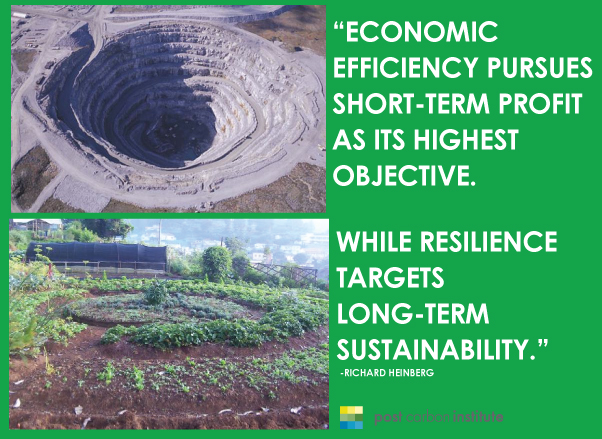
Building Resilience In A Changing Climate - Richard Heinberg

Climate shocks are on the way. We’ve already spewed so much carbon into the atmosphere that a cascade of worsening crop failures, droughts, floods, and freak storms is virtually guaranteed. You, your family, and your community will feel the effects.

Ironically, however, avoiding climate change also has its costs. It makes sense from a climate-protection standpoint to dramatically and rapidly reduce our use of fossil fuels, which drive global warming. But these fuels largely, well, fueled the spectacular economic growth of the past 200 years, and weaning ourselves from them quickly now—while most industrial economies are over-indebted and starved for growth—could risk financial upheaval.

Oil, the most economically pivotal of the fossil fuels, is getting more expensive anyway. Cheap, onshore, conventional crude is depleting; its replacements—deepwater oil, tar sands, and tight oil—cost more to produce, in both dollar and environmental terms. Though high oil prices discourage driving (good for the climate), they also precipitate recessions (bad for the economy). While renewable energy sources are our hope for the future and we should be doing everything we can to develop them, it will be decades before they can supply all our energy needs.

In the face of impending environmental and economic shocks, our best strategy is to build resilience throughout society. Resilience is the subject of decades of research by ecologists and social scientists who define it as “the capacity of a system to tolerate disturbance without collapsing into a qualitatively different state that is controlled by a different set of processes.” In other words, resilience is the capacity to absorb shocks, reorganize, and continue functioning.

In many respects a resilient society defies the imperative of economic efficiency. Resilience needs dispersed inventories and redundancy, while economic efficiency—in its ruthless pursuit of competitive advantage—eliminates inventories and redundancies everywhere it can. Economic efficiency leads toward globalization, resilience toward localization. Economic efficiency pursues short-term profit as its highest objective, while resilience targets long-term sustainability. It would appear that industrial society circa 2012 has gone about as far in the direction of economic efficiency as it is possible to go, and that a correction is necessary and inevitable. Climate change simply underscores the need for that course correction.

Building resilience means helping society to work more like an ecosystem—and that has major implications for how we use energy. Ecosystems conserve energy by closing nutrient loops: plants capture and chemically store solar energy, which is then circulated as food throughout the food web. Nothing is wasted. We humans—having developed the ability to draw upon ancient, concentrated, cheap, and abundant (though ultimately finite) fossil fuels—have simultaneously adopted the habit of wasting energy on a colossal scale. Our food, transport, manufacturing, and dwelling systems burn through thirty billion barrels of oil and eight billion tons of coal per year; globally, humans use over four hundred quadrillion BTUs of energy in total. Even where energy is not technically going to waste, demand for it could be substantially reduced by redesigning our basic systems. More


Thursday, August 23, 2012

We'll make a killing out of food crisis, Glencore trading boss Chris Mahoney boasts

Drought is good for business, says world's largest commodities trading company

23 August 2012 - The United Nations, aid agencies and the British Government have lined up to attack the world's largest commodities trading company, Glencore, after it described the current global food crisis and soaring world prices as a "good" business opportunity.

With the US experiencing a rerun of the drought "Dust Bowl" days of the 1930s and Russia suffering a similar food crisis that could see Vladimir Putin's government banning grain exports, the senior economist of the UN's Food and Agriculture Organisation, Concepcion Calpe, told The Independent: "Private companies like Glencore are playing a game that will make them enormous profits."

Ms Calpe said leading international politicians and banks expecting Glencore to back away from trading in potential starvation and hunger in developing nations for "ethical reasons" would be disappointed.

"This won't happen," she said. "So now is the time to change the rules and regulations about how Glencore and other multinationals such as ADM and Monsanto operate. They know this and have been lobbying heavily around the world to water down and halt any reform."

Glencore's director of agriculture trading, Chris Mahoney, sparked the controversy when he said: "The environment is a good one. High prices, lots of volatility, a lot of dislocation, tightness, a lot of arbitrage opportunities.

"We will be able to provide the world with solutions... and that should also be good for Glencore."

Glencore announced pre-tax global profits of £1.4bn. The G20 is considering holding an emergency summit on the world food crisis.

Oxfam was scathing about Glencore's exploitation of volatile world food prices. Jodie Thorpe, from the aid agency's Grow Campaign, said: "Glencore's comment that 'high prices and lots of volatility and dislocation' was 'good' gives us a rare glimpse into the little-known world of companies that dominate the global food system." More