Showing posts with label eu. Show all posts

Wednesday, January 10, 2018

Brexit: 89% of Britons want dual citizenship after leaving EU, finds survey


89 per cent of UK citizens would like to have a second citizenship and many of them are prepared to spend a considerable amount for the privilege, according to a new survey.

Some 58 per cent admitted Brexit has been the motivating factor in their decision. According to the "Citizenship Survey", conducted by CS Global Partners, three in four participants believed a second passport would give them the ability to travel and explore the world with greater ease.

The second most popular reason was the belief that a second non-UK citizenship would mean "increased freedom and human rights" - with nearly three in five citing this as their concern. One in six people wanted a second passport for business and career opportunities.

CS Global Partners - a law firm specialising in citizenship and residence solutions - spoke to 500 people between the ages of 18 and 50 years old within the last month. Read More

Saturday, August 1, 2015

We Are All Greece

The cast of heroes and villains in Greece’s ongoing battle to save its economy varies depending on who’s telling the story.

One simplified narrative depicts the German people as rich and callous overlords inflicting hardship on the downtrodden Greeks.

The austerity measures they insist upon are essentially meant to punish the Greeks for spending too much on social programs for the sick and elderly.

In an opposing storyline, the Greeks have only themselves to blame: they lived beyond their means, evaded taxation, were generally corrupt, and irresponsibly piled up debts they simply could not repay. In this scenario the Germans are like parental figures administering discipline on the immature Greeks.

Neither of these narratives is accurate or helpful; rather than providing real insight, they merely serve to heighten nationalistic and xenophobic impulses in both countries. In order to make sense of what’s going on, we need to go behind the scenes to look more broadly at the underpinnings of the crisis.

It is widely assumed that the European Union was formed in order to prevent conflict. This notion can be traced to the aftermath of the Second World War, when well-intentioned statesmen promoted the notion that economic integration was a path to peace and harmony. And until this day many idealists support the EU for this reason. However, for many in my network – particularly in Scandinavia – it was clear from the beginning that the EU was primarily about big business.

In the end, the economic problem in Greece is the product of a global system that puts the needs of corporations and banks ahead of people and the planet.

Before countries were linked together into an economic union, Europe’s many regions were home to a great variety of cultures, languages and customs. But the Union erodes this rich diversity, which was born of human adaptation to different climates and ecological realities. The many borders, currencies, and differing regulations made trade difficult for big business, while the diversity of languages and cultural traditions put limits on mass marketing.

None of these were obstacles to businesses operating within their own countries – in fact, the borders and cultural diversity helped protect the markets of domestic producers from the predations of mobile capital, helping to ensure their survival. But for big corporations and financial institutions, diversity is an impediment, monoculture is ‘efficient’. For them, a single Europe-wide market of 500 million people was an essential step to further growth. Meeting that goal required a single currency, ‘harmonized’ regulations, the elimination of borders, and centralized management of the European economy.

The European Union is an extension of the Bretton Woods institutions – The World Bank, the International Monetary Fund (IMF), and the General Agreement on Tariffs and Trade (GATT) – founded at the end of World War II. Their stated purpose was global economic integration in order to avoid another depression and to avert war. But the result was a form of economic development – based on debt, global trade and consumerism – that systematically favored corporate interests while hollowing out local economies worldwide. Sadly, many people still idealistically embrace the Bretton Woods institutions, as well as the European Union.

Neither the media nor academia has focused on the role of transnational banks and corporations in promoting this economic path. Instead they continue to reinforce the notion that European “economic integration” is about peaceful coexistence among countries that would otherwise be at war with each other. The benefits to big business, meanwhile, are hardly mentioned at all. It is no wonder that the public continues to be beguiled by this message, and that many statesmen have internalized the notion that centralization is in the public interest.

However, Greece reveals clearly where a centralized economy dominated by corporations and banks leads. In country after country, TNCs have been able to evade taxes by ‘offshoring’ their activities, and to bargain for lower tax rates and higher subsidies by threatening to move where even less in taxes will be demanded, and even more in subsidies provided. At the same time, governments must pay from their depleted treasuries to provide support for the growing ranks of unemployed, to retrain displaced workers, to mend the unraveling social fabric, and to clean up the despoiled environments left behind by deregulated, mobile corporations. Forced to go hat-in-hand to banks – which can create money out of thin air by issuing loans – countries can easily find themselves on a downward spiral, with interest payments consuming an increasing proportion of national output. It’s no wonder that so many governments today are struggling to stay afloat, while global corporations and banks are flush with cash.

In the end, the economic problem in Greece is the product of a global system that puts the needs of corporations and banks ahead of people and the planet. The same system is responsible for the polluted rivers and air in China, for the sweatshop conditions in Bangladesh, for the economic refugees from Africa desperately seeking asylum in Europe, and for the collapsing economies of Puerto Rico, Greece, and beyond. The internal logic of this global system favors no nation – not Germany, not even the United States – but only the footloose corporations and banks that dominate the global economy.

There is an alternative to starving our own people to enrich foreign banks: it involves moving away from ever-more specialized production for export, towards prioritizing diversified production to meet people’s genuine needs; away from centralized, corporate control, towards diverse, localized economies that are more equitable and sustainable. This means encouraging greater regional self-reliance, and using our taxes, subsidies and regulations to support enterprises embedded in society, rather than transnational monopolies.

Although the localization path is not yet visible in the media, more and more economists, environmentalists and social activists are embracing it. Awareness is growing, as people around the world recognize this simple truth: “we are all Greece.” More


Friday, July 19, 2013

Upholding the Rule of Law

BRUSSELS (Reuters) - In the years-long campaign to tie a web of sanctions around Iran and stall its nuclear programme, the European Union may just have met its biggest obstacle: its own law courts.

Fearing Tehran is seeking the means to make bombs, Europe's governments have been combing through Iran's political elites and businesses to find people and companies linked to the financing and technical aspects of its nuclear work.

They have frozen their assets, refused visas and banned companies in the European Union from doing business with them. But dozens of those targeted have challenged the restrictions in court and some are beginning to win, embarrassing Europe's policymakers and causing alarm in the United States.

None of the court judgments are yet final. But with Israel brandishing threats against a nuclear programme that Iran insists has no military purpose, Washington worries that any weakening of sanctions may raise the risk of war.

At the heart of the issue is the refusal by EU governments to disclose evidence linking their targets to Iran's nuclear work. Doing so in court, they say, may expose confidential intelligence, undermining efforts to combat the programme.

The courts have effectively rejected that argument, saying that if a case is to be made, evidence must be presented. Lawyers for the Iranians argue there simply is no evidence that proves any link to the nuclear programme - a view supported by British judges who did review some secret material this year.

"It is very clear there is no evidence," said Sarosh Zaiwalla, senior partner at Zaiwalla & Co, a London law firm which has successfully represented Iran's Bank Mellat in litigation against sanctions imposed by the EU.

The bank, one of the biggest private lenders in Iran, won a case in January in the European Union's Luxembourg-based second-highest court. It had challenged an EU move in 2010 to freeze its assets, saying the EU had failed to prove the bank provided banking services for the nuclear programme. The court agreed.

"The chairman of the court asked the EU lawyers, 'can you show me the evidence?'. And they said 'no, it's Iran, and you must presume there is evidence'," Zaiwalla said.

"The judge was very upset and said 'this is a court of law and you cannot assume things'."

In its January 29 judgment, using dense legal language, the General Court said the council of EU governments was "in breach of the obligation to state reasons and the obligation to disclose to the applicant ... the evidence adduced against it".

SECRECY DILEMMA

The lifting of sanctions against Bank Mellat is postponed for now, pending an appeal by EU governments to Europe's highest court. But the case illustrates the dilemma facing the European Union in its push to stop Iran from advancing the atom work.

Government lawyers are telling the courts to trust them and the courts are refusing. To safeguard its sanctions policy and its economic pressure on Iran, the EU may have to present evidence - including sensitive intelligence - in court.

But because of rules governing pan-European courts, all evidence would then become public which may damage clandestine operations and unravel the process of devising sanctions.

"There is nothing in the current rules to enable us to consider sharing information without it becoming public," said one European diplomat, speaking on condition of anonymity.

"This is the crux of the issue. We cannot just be handing information around."

In Washington, anxiety over court rulings is mounting.

"It's a real concern of ours that the EU is having difficulties sustaining some of its designations," David Cohen, the U.S. Treasury Department's Under Secretary for Terrorism and Financial Intelligence, told Reuters.

Lawyers for the Iranian plaintiffs paint the conflict as a human rights issue, praising the Luxembourg court for decisions they say amount to taking a stand against government abuse.

"It may be politically embarrassing," said Maya Lester, a London-based lawyer who represents companies and individuals in litigation concerning European sanctions, including the Iranian central bank and the country's main tanker company, NITC.

"But in terms of upholding the rule of law, what the European court has done is impressive and quite brave. It shows it to be a court upholding human rights ... which is not easy given how political Iranian sanctions are." More


Tuesday, July 16, 2013

EU takes dramatic measures on Israeli settlements in occupied territories

The European Union is to start treating Israeli settlements in the occupied Palestinian territories as separate from Israel and exclude them from all kinds of cooperation.

Catherine Ashton

According to Tuesday's edition of Haaretz newspaper, the "binding" decision is expected to take effect on the ground this Friday.

"The European Union has published a binding directive to all 28 member states forbidding any funding, cooperation, awarding of scholarships, research funds or prizes to anyone residing in the Jewish settlements in the West Bank and East Jerusalem," Haaretz said.

The newspaper reported anonymous officials in the Israeli foreign ministry calling the move an "earthquake." The reason, he explained, is that "understandings and quiet agreements that the Union does not work beyond the Green Line were turned into formal, binding policy."

Haaretz also reported that the decision included a demand by the EU for Israel to make clear when it signs any agreement with Brussels that the Israeli settlements are not part of the state of Israel.

Israeli Radio said in the morning that the occupied Syrian Golan Heights is also included in the decision based on the EU position which does not recognise Israeli occupation after 1967.

Europe has long opposed much of Israel's policy in the West Bank and East Jerusalem. It said in a statement issued in December its "longstanding position is that Israeli settlements are illegal under international law," and it does not recognise Israel's sovereignty over the occupied territories.

In March EU foreign policy Chief Catherine Ashton called for implementing the labelling of products produced in the settlements for sale in Europe. More


Friday, March 8, 2013

US Drone Strikes Putting 'Global Order At Risk', Warn European Politicians

The United States is putting "global stability and international order at risk" by pursuing a policy of targeted extrajudicial drone strikes against suspected terrorists, European politicians have warned.

At least to 3,000 people, including a large number of civilians, are said to have been killed by controversial CIA drone strikes in Pakistan, Somalia and Yemen since 2004.

This week members of the European Parliament said they were "deeply concerned about the legal basis, as well as the moral, ethical and human rights implications" of the drone attacks and urged European Union member states to "contest the US attempt to pervert international law".

In a statement the MEPs said: "We cannot remain silent. The European Union and its Member States must speak up against a practice that will set a dangerous and unwelcome precedent for International Law."

British MEP Baroness Sarah Ludford, the Liberal Democrat European justice and human rights spokeswoman, said on Friday: "US drone killings operate in disregard of the long-established international legal framework about when it is lawful to kill people. This sets an extremely dangerous precedent and risks a destabilising effect on international relations. It could even furnish Al-Qaida with a licence to kill in return."

"European complicity in the ‘War on Terror’ after 9/11, in defiance of legal norms whereby terrorist criminals must be brought to justice through due process, still haunts Europe as well as the US. It is incredible that the US is making renewed and reckless attempts to rewrite the international legal code, and we could get hurt again too."

"Without agreed law the international community cannot hope to justify military action and prevent human rights abuses. As leaders of that community along with the US, the EU and its Member States must boldly state their opposition to this programme, which disregards our common international legal heritage. Silence will be taken as European acquiescence, with potentially disastrous results."

The condemnation came after a briefing in Brussels from United Nations Special Rapporteur for Counter Terrorism and Human Rights, Ben Emmerson QC, who is conducting a UN investigation into the UK and US policy of targeted killings.

Senior British parliamentarians have also raised concerns in Westminster over president Obama's use of drones in Pakistan. Former British Foreign Office minister Baroness Kinnock of Holyhead has warned "action must be taken to ensure that there is accountability and reparations when a drone attack goes wrong".

And Lord West of Spithead, the former head of the Royal Navy and a security minister in the last Labour government, told the House of Lords last month: "War is horrible. Death is horrible. Being involved in the risk is horrible. When one does this remotely from a leafy suburb in your own country and killing people that does make it remote and that does have huge implications and is very worrying and needs a lot of control."

The House of Commons defence committee announced it would conduct an investigation into the British military's use of drones after the RAF decided to expand its use and number of Unmanned Ariel Vehicles.

Pressed by MPs and peers, the UK government has insisted it has only used its own drones inside Afghanistan as the British military's presence there is at the request of the Afghan government. However British intelligence agencies have been accused of passing information to the CIA to help the Americans carry out strikes in Pakistan.

And last month it was reported the UK had a policy of stripping British citizens of their passports on national security grounds - two of who were then killed by US drones.

President Obama's use of drones has recently climbed up the American news agenda following the controversial confirmation of John Brennan as head of the Central Intelligence Agency and Republican senator Rand Paul's thirteen hour senate filibuster against extrajudicial drone killings.

Brennan has previously claimed that no civilians have been killed by drones, based on the Obama administration's decision to designate every military-age male in the target area as a combatant.

On Thursday the White House tried to shut down the debate over whether, as had been initially suggested, Obama had the power to order a drone strike on US soil.

A series of HuffPost/YouGov surveys showed that while a majority of Americans support their use to kill people suspected of being "high-level members of al Qaeda", this is reversed if they are told civilians are at risk of being killed. More


Monday, October 8, 2012

Iran sanctions now causing food insecurity, mass suffering

Yet again, the US and its allies spread mass human misery though a policy that is as morally indefensible as it is counter-productive.


The Economist this week describes the intensifying suffering of 75 million Iranian citizens as a result of the sanctions regime being imposed on them by the US and its allies [my emphasis]:

"Six years ago, when America and Europe were putting in place the first raft of measures to press Iran to come clean over its nuclear ambitions, the talk was of "smart" sanctions. The West, it was stressed, had no quarrel with the Iranian people—only with a regime that seemed bent on getting a nuclear bomb, or at least the capacity for making one. Yet, as sanctions have become increasingly punitive in the face of Iran's intransigence, it is ordinary Iranians who are paying the price.

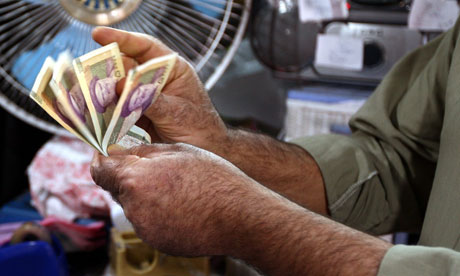
"On October 1st and 2nd Iran's rial lost more than 25% of its value against the dollar. Since the end of last year it has depreciated by over 80%, most of that in just the past month. Despite subsidies intended to help the poor, prices for staples, such as milk, bread, rice, yogurt and vegetables, have at least doubled since the beginning of the year. Chicken has become so scarce that when scant supplies become available they prompt riots. On October 3rd police in Tehran fired tear-gas at people demonstrating over the rial's collapse. The city's main bazaar closed because of the impossibility of quoting accurate prices. . . .

"Unemployment is thought to be around three times higher than the official rate of 12%, and millions of unskilled factory workers are on wages well below the official poverty line of 10m rials (about $300) a month."

Pervasive unemployment, inflation, medicine shortages, and even food riots have been reported elsewhere.

That sanctions on Muslim countries cause mass human suffering is not only inevitable but part of their design. In 2006, the senior Israeli official Dov Weisglass infamously described the purpose of his nation's blockade on Gaza with this candid admission: "'The idea is to put the Palestinians on a diet, but not to make them die of hunger." Democratic Rep. Brad Sherman justified the Iran sanctions regime this way: "Critics of sanctions argue that these measures will hurt the Iranian people. Quite frankly, we need to do just that."

Even more infamously, the beloved former Democratic Secretary of State Madeleine Albright - when asked in 1996 by 60 Minutes' Lesley Stahl about reports that 500,000 Iraqi children had died as a result of US-imposed sanctions on that country - stoically replied: "I think this is a very hard choice, but the price - we think the price is worth it." So extreme was the suffering caused by sanctions in Iraq that one former UN official, Denis Halliday, resigned in protest, saying that the sanctions policy met the formal definition of "genocide". More