Showing posts with label icrc. Show all posts

Sunday, November 23, 2014

IDF trainer: 'No need to resuscitate Palestinians'

An IDF medic was surprised to hear two new orders given by his superiors: only Jews are worthy of resuscitation, and that attackers who pose no threat should be shot dead.
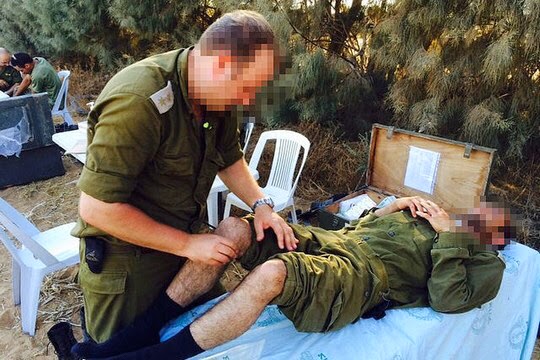
New orders in the Israeli army? D., a medic in the infantry, was surprised last week to find out during training for an operation in the occupied territories that at least two orders typically given to soldiers have been refreshed.

“During the refresher course the instructor, who works as a medic on the base, told us that the orders of the IDF are not to give mouth-to-mouth resuscitation to people we do not know. When asked about it he said that it basically means that we do not need to resuscitate Palestinians,” says D., who took part in the course at the Lakhish base in southern Israel. D. has since then left for duty in the West Bank.

“It sounds strange but he repeated it twice, so I have no doubt that that was what he meant. I was very surprised by the order not to resuscitate anyone who needs it. Since then I have come to understand that Magen David Adom (Israel’s national emergency medical, disaster and ambulance service) came up with the order regarding mouth-to-mouth resuscitation several years ago. The emphasis on the Palestinians was probably the instructor “thinking ahead.” I assume that he goes these trainings all the time. That’s worrying.”

Furthermore over the course of the week, D. participated in a refresher on the rules of engagement, where he said he was given permission to kill people who pose no threat. “They told us that the order regarding someone who stabs, ditches the knife and begins running is shoot to kill. The company commander said he doesn’t want anyone like that “to see a judge.”

Did anyone protest or critique these orders?

“The company seemed very bitter over the rules of engagement. The company commander almost apologized every time he forbade. So when he finally gave us permission to shoot an unarmed terrorist, most of the company was okay with that.”

It was only two weeks ago that Public Security Minister Yitzhak Aharonovich gave a similar order to Israeli Police in the wake of the vehicular attack in Sheikh Jarrah. Two days later police shot Kheir Hamdan to death in Kafr Kanna.

=======================

A policy such as this would be in contravention of International Humanitarian Law and Geneva Conventions.

The International Committee of the Red Cross states; Without renewed commitment from governments to address growing social inequities and other sources of instability in the region, any quest for peace and prosperity will remain elusive. As a neutral and independent humanitarian organisation, the ICRC can only remind the parties to these conflicts that without respecting the basic tenets of international humanitarian law (IHL) in these testing times, it is most unlikely that the various communities will find their way toward reconciliation or be prepared to share the burden of a just peace after decades of conflict. Considering that the customary core of that law is older than the state- based system itself, the specific nature and extraordinary significance of IHL in today’s armed conflicts provide a legitimacy beyond the current international system. Far from being outdated, humanitarian law is very much a contemporary and future-oriented body of law. Turning specifically to the situation in Israel and the Occupied Palestinian Territory, the particular challenges facing humanitarian action there cannot be tackled without an honest look at certain Israeli policies that have become key features of the occupation. Israel has exercised ‘actual authority’ 1 over the West Bank and the Gaza Strip for almost half a century, making its presence in these areas one of the longest sustained military occupations in modern history. While the shape and degree of this military occupation have varied, Israel has continuously maintained effective control over the territories it occupied as a result of the Six Day War in 1967, and over the Palestinian population living there. The constant pressure that Israeli occupation has imposed on the Palestinian population has had a profound impact on both the Palestinian and theIsraeli economies, cultures, andsocieties.Beyondtherecurringexcessesof armed violence, the ensuing grief among the people affected, and the trauma among the broader community, the lack of progress on issues of major humanitarian concern further illustrates the inability of a generation of decision-makers to find constructive ways to bring concrete improvements to the lives of millions of Palestinians. See: Challenges to international humanitarian law: Israel’s occupation policy Download PDF


Wednesday, May 8, 2013

A Guantanamo Detainee's Perspective

Sami El-haj was working as a cameraman with Al Jazeera when he was captured and consequently detained at Guantanamo. He spent six years at the facility and is now the Manager the of Public Liberties and Human Rights Department at Al-Jazeera Network.

My story of the International Committee of the Red Cross (ICRC) is not exceptional. It more or less reflects the situation of all those who have languished or are languishing in the depths of Guantanamo or any dark prisons of injustice. However, it is my hope that, by telling this story and by clarifying certain notions and presenting some proposals, I may help to improve the ICRC’s humanitarian services and its relations with detainees.

The history of this time-honoured organization and its role in alleviating the suffering of victims of war, torture, and imprisonment are too well known to require an introduction. As for me, I regard the ICRC as having been born on the day that I came to know it and it came to know me, when I came to accept it – after rejecting it for a long time, because I was unaware of what it did and how, when it presented to me its system of values, which I had previously failed to understand.

Thus, my story began in January 2002, with a blank sheet of paper handed to me by the American investigator at Bagram who requested that I write a letter to my family and specify their address. I distrusted this request because I thought it was part of the investigation. My fellow prisoners and I felt the same distrust for the second time that year during our encounter with the ICRC in Kandahar prison when its delegates asked us to give them an account of how we had been detained and transferred there. The first instance of positive appreciation came shortly before the Eid al-Adha (Feast of the Sacrifice) when the ICRC presented us with copies of the Holy Qur’an that it had brought to Kandahar prison. It also brought us dishes of mutton from ritually sacrificed sheep, which had a highly positive effect on us. Someone had remembered us during the Eid and compensated us to a certain extent for our privation on that great occasion.

I received the first letter from my family, through the Qatar Red Crescent, in September 2002. It enclosed a photograph of my baby son Muhammad, whom I had left while he was taking his first faltering steps. The feeling was indescribable: a strange mixture of solace and sadness; tears were my first reaction. All my fellow prisoners in the neighbouring cells also broke into tears because they thought that something bad had happened to my family. This continued for more than an hour during which time I was unable to explain the situation or even to read the letter. The mere fact that I had received it, together with that photograph, had a tremendous impact, and not only on me!

Subsequently, there was a regular exchange of letters with my family through the ICRC, and my trust in it, and in its role, increased with the arrival of the first Arab delegate, from the Arab Maghreb, in whom we had even greater confidence when we found that he knew the Qur’an by heart. My reason for mentioning this is to draw attention to the prevalent notion among the detainees that an organization displaying a cross as its emblem must be a crusader organization. The fact that the ICRC delegate was a Muslim who had memorized the Qur’an rectified the misconceptions that we were harbouring concerning the organization with which we had not previously had any dealings in our countries.

He was followed by a succession of Arab delegates, which had a very positive effect on our attitude towards the ICRC insofar as their presence made us feel comfortable and confident since they were fellow Arabs with whom we could communicate more easily. At the very least, we could understand their facial expressions in which we perceived genuine feelings and a sympathy that seemed more authentic to us because of cultural similarities.

Later, the ICRC brought specialists and doctors. The availability of medical care gave us a feeling of relief and this feeling became stronger with the arrival of jurists who answered our questions. The provision of a library was even more welcome since the ICRC supplied more than 10,000 books, ranging from the principal Islamic reference works to the best detective stories. We were able to take advantage of this store of knowledge in order to organize a programme between the sunset and evening prayers. During these evening sessions one of us would read a book and summarize it for the others. We read to those who did not know how to read, and some of them began to master the Arabic language. Even more importantly, reading and exercising our imagination was very helpful in enabling us to preserve our sanity. In this connection, it is noteworthy that a consultant from the prison’s administration – this time of Arabic origin – deprived us of these books by warning the prison administration that it was ‘training theologians’. After that we started receiving Tintin and Milou stories and books bearing offensive titles such as A Donkey from the East!

The ICRC improved its interaction with the detainees by developing the means of communication between them and their families to include the Internet and a telephone line.

In the light of my above-mentioned experiences, I can point out some negative aspects that could have been avoided in the ICRC’s contacts with the detainees:

1. The dispatch of non-Arab delegates created a psychological barrier because of cultural and linguistic differences, resulting in a lack of trust in the ICRC on the part of the detainees.

2. Regarding the ICRC’s emblem, it would obviously be unreasonable to ask the organization to change its emblem in order to build bridges of confidence with the recipients of its humanitarian services. However, it would be extremely helpful if the ICRC could pay attention to this point and endeavour to clarify the issue of the emblem by giving a historical explanation in order to dispel people’s misconceptions, and especially those of people from Islamic backgrounds who might be unaware of the true facts. More