Showing posts with label international committee of the red cross. Show all posts

Tuesday, January 26, 2016

Israel continues to sow the seeds of discontent

The National – 26 January 2016 - Israel, it seems, has found a new weapon against Palestinian attacks – the humble cucumber seed.

Soldiers have been handing out seeds at checkpoints with advice to Palestinians – a nation of farmers until their lands were swallowed up by Jewish settlements – to stop their recent knife attacks on Israelis and invest in a peaceful future.

Palestinians were not fooled. The seeds, the packets revealed, were produced by the very settlements that corralled them into their urban enclaves.

Israel’s image-laundering is directed at western nations that have propped up the occupation – economically and diplomatically – for decades. As ever, Israel hopes to persuade outsiders that the occupation is benevolent.

The futility of its PR, however, is highlighted by the latest initiative of prime minister Benjamin Netanyahu’s government.

New legislation is designed to intimidate and silence Israeli human rights organisations – the international community’s eyes and ears in the occupied territories. These groups are to be defined as “moles”, or agents of foreign governments. Justice minister Ayelet Shaked warned that such foreign intervention “endangers democracy”.

The problem is that the governments funding the human rights activity are not Israel’s enemies, but some of its staunchest supporters – European states.

Israel treats Europe’s support for human rights as malign interference, but it welcomes the vast sums channelled its way via the European Union’s special trade agreement and the billions in US military aid. It is this kind of foreign intervention that sustains the occupation.

The new legislation, however, risks leaving the EU and US exposed. Removing the minimal restraints imposed on the Israeli army by monitoring activity, the crimes of occupation – and western complicity in them – will be all the starker. More


Wednesday, April 22, 2015

The Human Cost of Secret U.S. Drone Strikes in Yemen


For more than a decade now, the United States has been using armed drones to secretly kill suspected terrorists in Yemen. The public knows very little about these attacks. Neither the U.S. nor the Yemeni government has systematically disclosed who was killed and why, or whether civilians were among those killed.

Now, working with the Open Society Justice Initiative, researchers from the Yemeni nongovernmental organization Mwatana Organization for Human Rights have spent two years visiting the sites where some of these attacks took place. Their findings are detailed in a new report, Death by Drone: Civilian Harm Caused by U.S. Targeted Killings in Yemen, which gives the world a look at the reality of a counterterrorism strategy that the Obama administration has hailed as a model program.

The findings raise serious concerns over the lawfulness of U.S. drone strikes in Yemen. It also provides credible evidence that U.S. strikes continued to kill civilians even after President Obama said in a May 2013 speech that “before any strike is taken, there must be near-certainty that no civilians will be killed or injured.” This raises serious questions about the extent to which the United States is complying with its own policy guidelines.

As Yemen sinks further into instability, the report seeks to ensure that the civilian victims of these strikes are not forgotten to new and future crises. And as the United States implements a new drone export policy purporting to be part of a broader effort to shape international standards on drone use, the report warns of the dangers associated with promoting the U.S. model of drone use.

The report, which documents civilian harm caused by nine U.S. airstrikes between May 2012 and April 2014, describes the experiences of civilians directly affected by U.S. drone strikes, individuals whose voices are all too easily forgotten because they are poor and without political influence, and because the drone strikes were conducted in secret, in remote locations far away from the United States.

The report is based on 96 interviews with injured survivors and eyewitnesses of the attacks, relatives of individuals killed or injured in these attacks, local community leaders, doctors and hospital staff who were involved in the treatment of victims, and Yemeni government officials. Where available, Yemeni government statements, photographs and videos of the aftermath of the drone strikes, and medical records corroborated these accounts. An independent munitions expert provided additional analysis.

But, as our report explains, this research was conducted in a context of pervasive U.S. and Yemeni government secrecy concerning the airstrikes. There were also tense security situations in many of the regions where the strikes took place, as well as the fear of reprisals for speaking openly about the strikes.

The testimonies in this report describe desperately poor communities left to fend for themselves amid the devastation caused by U.S. drone strikes. Mothers and fathers who lost their children in drone strikes speak of inconsolable loss. They speak of their children’s bodies charred beyond recognition. Wives speak of losing their breadwinners, and of young children asking where their fathers have gone. The victims of these strikes say that these strikes will not make the United States or Yemen safer, and will only strengthen support for al-Qaeda.

The report also describes the terrorizing effects of U.S. drones on local populations. In many of the incidents documented, local residents had to live with drones continually flying overhead prior to the strikes and have lived in constant fear of another attack since. Some fled their villages for months after the strike, and lost their source of livelihood in the process. Survivors of the attacks continue to have nightmares of being killed in the next strike. Men go to their farms in fear. Children are afraid to go to school.

The civilian victims of U.S. drone strikes in Yemen want justice. They want to know why they were targeted when they had nothing to do with al-Qaeda or any other terrorist group. But none of the nine strikes documented in the report have been acknowledged by the U.S. government. Nor are the victims aware of investigations into civilian deaths and injuries caused by U.S. strikes. In most cases, civilians have not received adequate compensation.

In February 2013, then–White House counterterrorism chief John Brennan testified at his Senate confirmation hearing to become CIA director that the United States “need[s] to acknowledge … publicly” mistaken killings “in the interest of transparency.” More recently, the General Counsel for the Department of Defense publicly declared: “Transparency … strengthens our democracy and promotes accountability.”

It is time for the U.S. government to make good on these assurances. It should publicly disclose the May 2013 Presidential Policy Guidance relating to targeted killings as well as the numbers and identities of civilians killed or injured by U.S. airstrikes. It should also conduct effective investigations into unlawful killings and provide prompt and meaningful reparations for civilian harm caused by U.S. strikes. More


Saturday, January 3, 2015

The 'Land of the Free' supports one of the most repressive states in the world

Crimes against humanity in Gaza: is it really a 'buffer zone' - or a bigger plan

The international community and states parties to the United Nations should hang their heads in shame

Late last week, the White House decried Israel’s attack on a UN school in Gaza as "totally unacceptable" and "totally indefensible", then proceeded to approve $225m in funding for its Iron Dome. On Monday, the US state department went further, calling the airstrikes upon a UN school "disgraceful" – and yet America provides Israel with more than $3.1bn every year, restocking the ability of the Israel Defense Force (IDF) to hit more schools, and to wage total war against an imprisoned people, because of their nationality.

American taxpayers should not be paying for this. And the western world should stop rejecting serious inquiries about Israel’s moral inconsistencies, or allow it to benefit from cognitive dissonance and information overload amid the current crisis in Gaza.

There is a land grab going on. The Israeli prime minister, Binjamin Netanyahu, has shrunk Gaza’s habitable land mass by 44%, with an edict establishing a 3km (1.8-mile) buffer zone, a "no-go" zone for Palestinians – and that’s quite significant, because a good part of Gaza is only 3 to 4 miles wide. Over 250,000 Palestinians within this zone must leave their homes, or be bombed. As their territorial space collapses, 1.8m Gazans now living in 147 square miles will be compressed into 82 square miles.

Gaza’s entire social and physical infrastructure of housing, hospitals, places of worship, more than 130 of its schools, plus markets, water systems, sewer systems and roads are being destroyed. Under constant attack, without access to water, sanitary facilities, food and medical care, Gazans face an IDF-scripted apocalypse.

With Gaza’s land mass shrinking due to Israeli military action, it’s about time someone asked: What is the end game? Three weeks ago, Moshe Feiglin, deputy speaker of the Knesset, called for Gaza to "become part of sovereign Israel and will be populated by Jews. This will also serve to ease the housing crisis in Israel."

Israel has a housing crisis? After the "no-go" buffer zone is evacuated, there will be 21,951 Palestinians per square mile in Gaza, while Israel’s population density stands at 964 persons per square mile.

Deputy Speaker Feiglin wants the Palestinians in Gaza to lose all of their land. One must not assume that Mr Feiglin or his Likud faction speak for the main government actors like Prime Minister Netanyahu. After all, Knesset politics are complex and divergent. But since Gaza has just lost control of that 44% of its land, it may also be time to ask: does the establishment of that 3km zone represent the unfolding of a larger plan? Is that the end game?

At the very point where an aroused public becomes aghast at the slaughter of Gazans, the western world becomes inured to the violence, hypnotized by the media’s cadence of body counts. The intolerable becomes normalized, and later ignored as old news. Which would seem a perfect time to leave in place the 3km zone – for security purposes, of course – and then advance the proposal that Palestinians crammed into the remaining 56% of Gaza simply … leave.

I assume the IDF acts with deliberation, under orders from the Netanyahu government. And I think the extraordinary and illegal forced relocation of over 250,000 Palestinians from 44% of Gazan land is a crime against humanity under the guise of establishing a "buffer zone" for security purposes.

Look at the region’s maps from recent history. Look at the steady erosion of Palestinian land and the acquisition of land by Israel, and you can understand that the present attack on Gaza is not about solely about Hamas. It’s about land. It isn’t just about Hamas’s rockets. It’s about land. It isn’t just about Hamas’s tunnels. It’s about land. It isn’t about kidnappings. It is about land. It isn’t even about meeting a housing crisis in Israel. It is about grabbing land from the Palestinians in Gaza and the natural resources that go with the land, upon the occasion of Israel’s military invasion of Gaza.

Yes, Hamas’s attacks on Israel are illegal and should be condemned, and those who ordered the attacks should be held accountable under law. All policies and practices which refuse to recognize Israel’s right to exist should be condemned. Israel has a right to exist. But Israel’s right to exist is impaired when Israel decides Palestinians have no right to exist on their own land. It’s time for us to stop paying for Israel’s dubious, destructive self-righteousness. And it’s time for the solipsism syndrome afflicting Israel’s leaders to get a day of discussion in the International Criminal Court concerning their attacks on Gaza – and especially their new 3km "buffer zone". More


Sunday, December 28, 2014

Palestinian landowners have waited too many years for Israeli wheels of justice to turn.

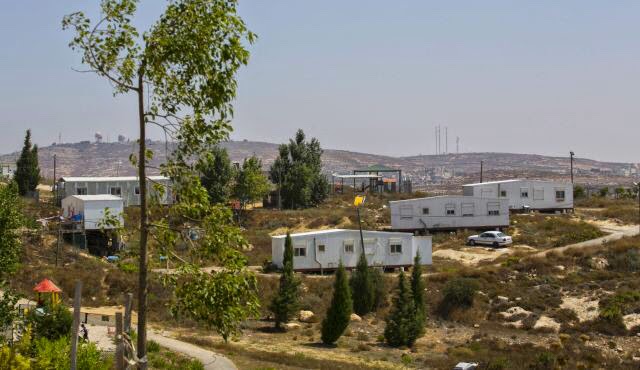
It is impossible to overstate the significance of the High Court of Justice ruling ordering the state to demolish within two years the Amona illegal outpost, which was built on private Palestinian land. After years of evasion, legal tricks, forged documents and unfulfilled pledges, even the High Court came to realize that the state cannot be trusted, not to mention the settlers, to voluntarily agree to return the land they plundered from their owners.

Amona was born in sin in 1997, when a group of settlers established residence in an area that had been earmarked for an archaeological site and a Mekorot Water Company reservoir. Cease and desist orders issued by Civil Administration inspectors in 2004 halted building for four years, but it resumed in force despite new stop-work orders.

In 2006, after the High Court ordered the demolition of Amona’s permanent structures, the settlers made clear that they were not bound by the court’s authority and they turned the “battle for Amona” into a national event in which they violently confronted the police. If there was no alternative to demolition, they would make Amona a “national trauma” that would threaten any future plans to evacuate outposts or settlements.

Even now, after the High Court ruling, the settler leaders are adamant: “We swear today to fight this with all our might,” Amona spokesman Avihai Boaron said. This is nothing but a continuation of the settlers’ common view that the state and its institutions are their servants, and when they do not fulfill their mission they must be fought. Particularly infuriating is the idea that “the left-wing government and the High Court are leading the country”; That is, in the struggle between land theft and the law, the High Court is not only a legal and ideological enemy but it also violates the political reality in which the right wing is in control. That perception is no less distorted and dangerous than the settlers’ position that the theft of Palestinian land is part of the Redemption.

The government of Israel cannot continue to avoid carrying out the High Court’s ruling, according to which “there is no possibility of authorizing the construction, even retroactively,” — a recognition of the tricks the cabinet could try. Two years is sufficient time to find alternative housing, and it would be best not to not wait until the last moment. The Palestinian landowners have waited too many years for the Israeli wheels of justice to turn. They have the right to have their property returned to them, with appropriate compensation. More


Sunday, December 14, 2014

Israelis rattled by search for truth about the Nakba

First ‘truth commission’ avoids issue of reconciliation as veteran Israeli fighters due to confess to 1948 war crimes

Middle East Eye – 9 December 2014

The first-ever “truth commission” in Israel, to be held on Wednesday, will feature confessions from veteran Israeli fighters of the 1948 war who are expected to admit to perpetrating war crimes as hundreds of thousands of Palestinians were expelled from their homes.

The commission is the culmination of more than decade of antagonistic confrontations between a small group of activists called Zochrot, the Hebrew word for Remembering, and the Israeli authorities as well as much of the Jewish public.

Founded in 2002, Zochrot is dedicated to educating Israeli Jews about what Palestinians call the Nakba, Arabic for catastrophe, referring to Israel’s creation on the ruins of their homeland more than six decades ago. The group also campaigns for the right of return for Palestinian refugees to Israel, probably the biggest taboo in Israeli society.

The commission, which has no official standing, could be the first of several such events around Israel, to investigate atrocities and war crimes committed in different localities, said Liat Rosenberg, Zochrot’s director.

“We have looked to other such commissions around the world as models, most obviously in South Africa,” she said. “But unlike the one there, ours does not include the element of reconciliation because the conflict here has yet to be resolved.

“We cannot talk about reconciliation when the Nakba is ongoing. We are still in a situation where there is apartheid, constant violations of human rights and 70 percent of the Palestinian community are refugees.”

The commission is likely to provoke outrage from the Israeli government, which passed the so-called Nakba Law in 2011 to try to make it harder to commemorate Palestinian suffering. The impact of the law is being widely felt. Just last month, the culture ministry vowed to block a government grant to a Tel Aviv cultural centre that hosted a Zochrot film festival on the Nakba.

Names kept secret

Rosenberg said Israeli veteran fighters and Palestinian witnesses participating in the truth commission had asked for their names to be kept secret until the hearings for fear that friends and family would put pressure on them to withdraw.

The commission is being held in the city of Beersheva, a once-Bedouin town that was ethnically cleansed in 1948 and is today the largest Jewish city in the Negev region in southern Israel.

Zochrot said it had chosen the city to host the first event event because forced expulsions of Bedouin from the Negev had taken place not only in 1948, but had continued on a large scale, out of view of observers, for many years afterwards.

The commission is the latest project by Zochrot that discredits a traditional Israeli narrative that some 750,000 Palestinians left under orders from Arab leaders and that Israel’s army acted only in self-defence. Such beliefs have fed into the common assumption from the Israeli public that Israel’s army is the “most moral in the world”.

“This is not just about researching the truth,” said Rosenberg. “The truth of the Nakba is to a large degree known, but the task is to expose the truth to the Israeli Jewish public – both so that it is forced to take responsibility for what happened and so there can be accountability.”

The commission is the direct result of a project launched by Zochrot two years ago to create an alternative archive of the Nakba, based on filmed testimonies from Palestinian refugees and Israeli veterans. Activists fear that, as the generation of refugees and fighters dies off, they will take their secrets to the grave.

Israeli military archives relating to the 1948 war began being opened to academics in the late 1980s. This led to a group of so-called “new historians” overturning the traditional accounts of that period and unearthing written evidence of massacres and ethnic cleansing operations for the first time.

Archives closed

However, historians have reported in recent years that the Israeli authorities have become more reluctant to open files and many of the more controversial episodes of the 1948 war are still unclear.

Rosenberg hopes the commission will begin to fill some of the gaps.

According to Rosenberg, three Israeli fighters and three Palestinian witnesses will testify before a panel of six commissioners. The commissioners will then question them further about events and make follow up recommendations.

The hearings are due to be streamed online.

One veteran of the fighting in the Negev, Amnon Neumann, has already gone on record in testimony that can be seen in Zochrot’s film archive.

He has said the Bedouin in the Negev – contrary to popular Israeli perception – put up almost no resistance to advancing Jewish forces because they lacked “a military capacity” and “had no weapons”. Nonetheless, he said, the Israeli army terrified the Bedouin villagers out of their homes by shooting either at them, or above their heads.

“We drove them out. Women and children went to Gaza. … By the morning there was nobody there. We burnt their houses,” Neumann said.

When villagers tried to sneak back to tend crops or vineyards under the cover of night, he recounted, the soldiers opened fire. “We would shoot and kill them. This was part of the horrible things we did.”

In other filmed testimony, Mordechai Bar-On, an officer in 1948 with the Givati Brigade, confirmed that orders were to shoot “infiltrators” – a reference to refugees who tried to return to their villages. “Even if there were women and children. I remember I told myself that we would do it. … There was an order to kill, not even catch them,” Bar-On said.

For the most part, the Israeli veterans are coming forward now out of a feeling of guilt.

“At that time I did not see anything wrong with what we were doing,” Neumann said. “If I was told to do things that I do not want to mention [here], I did them with no doubts at all. … Not now. It is already 50, 60 years that I am filled with regret.”

But challenges remain, and despite veterans coming forward, piecing together events can still be difficult.

Rosenberg said many of those giving filmed testimony, including Neumann, have been reluctant to go into details of the war crimes they participated in. It is now hoped that the questioning by the commissioners will encourage participants to be even more forthcoming.

Put on trucks to Gaza

The commission will also move beyond the 1948 period and examine expulsions in the semi-desert Negev region, comprising nearly two-thirds of Israel’s landmass, for the 12 years following the war.

Isolated from the rest of the new state of Israel, the Negev was largely unmonitored as the Israeli military carried out expulsions of Bedouin throughout the 1950s, said Raneen Jeries, a Zochrot organiser.

More than 2,000 Palestinian inhabitants of al-Majdal, which later became the Jewish city of Ashkelon, were put on trucks and shipped to Gaza nearly two years after the war ended, according to Nur Masalha, a Palestinian historian and expert on Israeli “transfer” policies.

Jeries said the legacy of the events of 1948 was being felt to this day, with policies of expulsion continuing in the Negev and the occupied territories.

Haaretz reporter Amira Hass revealed three months ago that the Israeli military was planning to forcibly relocate for a second time the Jahalin tribe. The tribe was driven out of the Negev in 1948 and fled to the safety of the West Bank, then under Jordanian control. However, Israel occupied the land after the 1967 war, and it seems that Israeli authorities now want to expel some 12,500 Jahalin tribes people, this time to a site near Jericho.

Zochrot had been successful in forcing Israelis to recognise the Nakba and a darker side to the 1948 war, said Neve Gordon, a politics professor at Ben Gurion University in Beersheva, where the truth commission is to be held.

“A decade ago, if I mentioned the Nakba in a class of 150 students, hardly any of them would have known what I meant. Now 80 or 90 per cent would know,” Gordon told MEE.

Gordon also attributed the change both to Zochrot’s activities and statements by Arab legislators representing Israel’s large Palestinian minority, comprising a fifth of the total population.

Law against commemoration

But as the issue of the Nakba has become more visible in Israel, sensitivity about it has only grown. Ahead of Nakba Day last May, Prime Minister Benjamin Netanyahu lashed out at the Palestinian Authority for commemorating the day, saying: “They are standing silent to mark the tragedy of the establishment of Israel, the state of the Jewish people.”

Palestinians were educating their children with “endless propaganda” calling for the disappearance of Israel, he said.

Economy Minister Naftali Bennett went further, saying: “We need not tolerate Israeli Arabs who promote Nakba Day.”

The government has backed up its rhetoric with legislation, passing a Nakba Law in 2011 that denies public funds to institutions and organisations that commemorate the Palestinians’ dispossession. The measure is partly seen as a reaction to Zochrot’s growing success.

The original legislation, which would have criminalised any commemoration of the Nakba – making many of Zochrot’s activities illegal – was water-downed after Israel came under strong international pressure.

In Zochrot’s early years, its main efforts were directed at escorting Israeli Jews and Palestinian refugees to some of the more than 500 Palestinian villages that Israel destroyed during and after the 1948 war. The villages were razed to prevent refugees from returning home.

The remnants of most of the villages are now barely traceable, hidden under forests planted by a charity called the Jewish National Fund or lost within gated communities in which only Jews can live.

Zochrot has continued such visits, placing signposts to remind the new Jewish inhabitants that their communities are built on the ruins of Palestinian homes, often belonging to neighbours living a short distance away. A large proportion of Israel’s Palestinian minority were internally displaced by the 1948 war and live close to their original homes but are barred from returning.

Backlash on campuses

Eitan Bronstein, who founded Zochrot, said the current challenge was how to change Israeli Jews’ perception of the Nakba.

“They now recognise the word but what does it mean to them? Many, it seems, think it is simply a negative label Palestinians have attached to Israel’s establishment. We have an Independence Day that they call their Nakba,” Bronstein said.

“We need to educate them about the events of the Nakba, what occurred and our responsibility for it. They have to stop thinking of it as just propaganda against Israel.”

The right wing, including the government of Benjamin Netanyahu, has grown increasingly rattled by Zochrot’s agenda-setting programme of events.

The popularity of a far-right youth movement, Im Tirtzu, has grown rapidly on Israeli university campuses over the past few years, in part as a backlash to commemorations of the Nakba by Zochrot and Palestinian students.

Last month, when Zochrot held its second Nakba and Right of Return Film Festival in Tel Aviv, the culture minister, Limor Livnat, immediately threatened to pull a government grant worth more than $450,000 from the cinema that hosted it.

“The state cannot bear the cost of funding of an entity that encourages debate over what the Palestinians call ‘the right of return’,” Livnat said in a statement. She was reported to have based her decision on her reading of the Nakba Law.

“The antagonism towards Zochrot and the idea of the Nakba is part of the educational process,” said Bronstein. “It is a necessary phase Israel needs to pass through if we are to get to a point of reconciliation.”

Unfazed by threats

Bronstein and others have faced angry opposition from the Israeli public and police as they have tried to stage Nakba commemorations – most notably in Tel Aviv in 2012, when they were surrounded by riot police for four hours. Three Zochrot activists were arrested.

Yet Zochrot’s organisers, whose members include both Jewish and Palestinian citizens, seem largely unfazed by the threats and hostility their group generates.

Last year Zochrot arranged a conference that for the first time examined not just the principle of the right of return but practical ways to implement it.

This year the group launched a phone app, called iNakba, in three languages, which provides users with detailed maps and information on the destroyed villages.

Jeries said it had had thousands of downloads, giving Israelis for the first time the chance to peel away the subsequent layers of construction and forestation to see what was destroyed, often on their doorstep. More

Tagged as: Bedouin, destroyed villages, Nakba


Friday, December 5, 2014

The injustices being inflicted by Israel on the Palestinians

Via Jonathan Cook, journalist

I did a brief speaking tour of Montreal and Ottawa in the spring during which I met many inspiring individuals finding their own ways to help from afar end the injustices being inflicted by Israel on the Palestinians.

One seminar I participated in was on the Jewish National Fund, a Zionist "charity" whose funds have been used to plant forests to conceal Israel's eradication of Palestinian villages during and after the 1948 war and which continues to ethnically cleanse Palestinians from areas like the Negev, or Naqab.

It's great to see that the organisers have put together a powerful short video presentation that shows pictorially what the JNF is really doing with those charitable donations.

http://youtu.be/rnm-HKf6MJU

Sunday, November 23, 2014

IDF trainer: 'No need to resuscitate Palestinians'

An IDF medic was surprised to hear two new orders given by his superiors: only Jews are worthy of resuscitation, and that attackers who pose no threat should be shot dead.

New orders in the Israeli army? D., a medic in the infantry, was surprised last week to find out during training for an operation in the occupied territories that at least two orders typically given to soldiers have been refreshed.

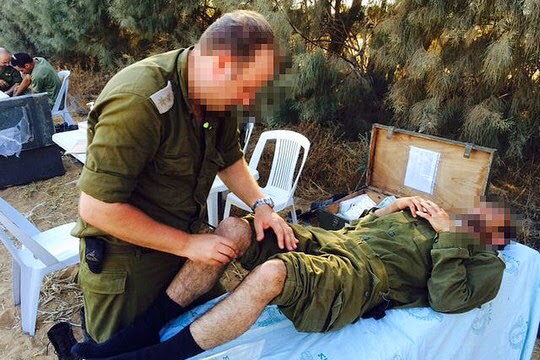
“During the refresher course the instructor, who works as a medic on the base, told us that the orders of the IDF are not to give mouth-to-mouth resuscitation to people we do not know. When asked about it he said that it basically means that we do not need to resuscitate Palestinians,” says D., who took part in the course at the Lakhish base in southern Israel. D. has since then left for duty in the West Bank.

“It sounds strange but he repeated it twice, so I have no doubt that that was what he meant. I was very surprised by the order not to resuscitate anyone who needs it. Since then I have come to understand that Magen David Adom (Israel’s national emergency medical, disaster and ambulance service) came up with the order regarding mouth-to-mouth resuscitation several years ago. The emphasis on the Palestinians was probably the instructor “thinking ahead.” I assume that he goes these trainings all the time. That’s worrying.”

Furthermore over the course of the week, D. participated in a refresher on the rules of engagement, where he said he was given permission to kill people who pose no threat. “They told us that the order regarding someone who stabs, ditches the knife and begins running is shoot to kill. The company commander said he doesn’t want anyone like that “to see a judge.”

Did anyone protest or critique these orders?

“The company seemed very bitter over the rules of engagement. The company commander almost apologized every time he forbade. So when he finally gave us permission to shoot an unarmed terrorist, most of the company was okay with that.”

It was only two weeks ago that Public Security Minister Yitzhak Aharonovich gave a similar order to Israeli Police in the wake of the vehicular attack in Sheikh Jarrah. Two days later police shot Kheir Hamdan to death in Kafr Kanna.

=======================

A policy such as this would be in contravention of International Humanitarian Law and Geneva Conventions.

The International Committee of the Red Cross states; Without renewed commitment from governments to address growing social inequities and other sources of instability in the region, any quest for peace and prosperity will remain elusive. As a neutral and independent humanitarian organisation, the ICRC can only remind the parties to these conflicts that without respecting the basic tenets of international humanitarian law (IHL) in these testing times, it is most unlikely that the various communities will find their way toward reconciliation or be prepared to share the burden of a just peace after decades of conflict. Considering that the customary core of that law is older than the state- based system itself, the specific nature and extraordinary significance of IHL in today’s armed conflicts provide a legitimacy beyond the current international system. Far from being outdated, humanitarian law is very much a contemporary and future-oriented body of law. Turning specifically to the situation in Israel and the Occupied Palestinian Territory, the particular challenges facing humanitarian action there cannot be tackled without an honest look at certain Israeli policies that have become key features of the occupation. Israel has exercised ‘actual authority’ 1 over the West Bank and the Gaza Strip for almost half a century, making its presence in these areas one of the longest sustained military occupations in modern history. While the shape and degree of this military occupation have varied, Israel has continuously maintained effective control over the territories it occupied as a result of the Six Day War in 1967, and over the Palestinian population living there. The constant pressure that Israeli occupation has imposed on the Palestinian population has had a profound impact on both the Palestinian and theIsraeli economies, cultures, andsocieties.Beyondtherecurringexcessesof armed violence, the ensuing grief among the people affected, and the trauma among the broader community, the lack of progress on issues of major humanitarian concern further illustrates the inability of a generation of decision-makers to find constructive ways to bring concrete improvements to the lives of millions of Palestinians. See: Challenges to international humanitarian law: Israel’s occupation policy Download PDF