Showing posts with label jerusalem. Show all posts

Sunday, December 28, 2014

Palestinian landowners have waited too many years for Israeli wheels of justice to turn.

It is impossible to overstate the significance of the High Court of Justice ruling ordering the state to demolish within two years the Amona illegal outpost, which was built on private Palestinian land. After years of evasion, legal tricks, forged documents and unfulfilled pledges, even the High Court came to realize that the state cannot be trusted, not to mention the settlers, to voluntarily agree to return the land they plundered from their owners.

Amona was born in sin in 1997, when a group of settlers established residence in an area that had been earmarked for an archaeological site and a Mekorot Water Company reservoir. Cease and desist orders issued by Civil Administration inspectors in 2004 halted building for four years, but it resumed in force despite new stop-work orders.

In 2006, after the High Court ordered the demolition of Amona’s permanent structures, the settlers made clear that they were not bound by the court’s authority and they turned the “battle for Amona” into a national event in which they violently confronted the police. If there was no alternative to demolition, they would make Amona a “national trauma” that would threaten any future plans to evacuate outposts or settlements.

Even now, after the High Court ruling, the settler leaders are adamant: “We swear today to fight this with all our might,” Amona spokesman Avihai Boaron said. This is nothing but a continuation of the settlers’ common view that the state and its institutions are their servants, and when they do not fulfill their mission they must be fought. Particularly infuriating is the idea that “the left-wing government and the High Court are leading the country”; That is, in the struggle between land theft and the law, the High Court is not only a legal and ideological enemy but it also violates the political reality in which the right wing is in control. That perception is no less distorted and dangerous than the settlers’ position that the theft of Palestinian land is part of the Redemption.

The government of Israel cannot continue to avoid carrying out the High Court’s ruling, according to which “there is no possibility of authorizing the construction, even retroactively,” — a recognition of the tricks the cabinet could try. Two years is sufficient time to find alternative housing, and it would be best not to not wait until the last moment. The Palestinian landowners have waited too many years for the Israeli wheels of justice to turn. They have the right to have their property returned to them, with appropriate compensation. More


Thursday, November 13, 2014

Why is a Colorado firm selling apartments in Israel’s illegal settlements?

The Colorado-based real estate firm RE/MAX is profiting from Israel’s relentless theft of Palestinian land.

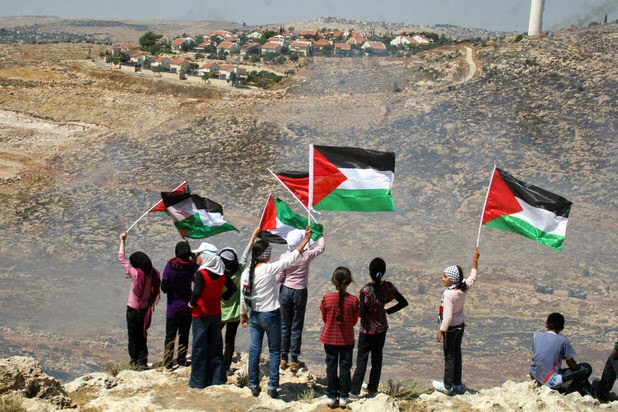
Palestinians protesting Illegal settlements

Active in the Israeli market since 1995, RE/MAX sells and rents houses and apartments in colonies reserved exclusively for Jews in the occupied West Bank, including East Jerusalem. Much of that work is coordinated in an office that the Israeli subsidiary of RE/MAX runs in Maale Adumim, a major settlement in the West Bank.

A United Nations report published last year suggested that the firm’s parent company in the US could be “held accountable” for assisting Israel’s crimes. RE/MAX International, which is headquartered in Denver, “has constant interaction and influence” over its franchises around the world. The company also provides “brand name affiliation,” training and other services, according to Richard Falk, the report’s author, who was then the UN special rapporteur for the West Bank and Gaza.

“Closet space” for settlers

On its website, RE/MAX offers properties in a number of settlement colonies in East Jerusalem, which has been under Israeli occupation since 1967. A four-room apartment with “lots of closet space” can be rented for 4,400 shekels ($1,100) per month. Among the apartment’s attractions listed by RE/MAX are proximity to the light rail system which links Israeli settlements in East Jerusalem to the city center.

Screen grab from RE/MAX Israel’s website

Such settlements violate the Fourth Geneva Convention, which forbids an occupying power from transfering its civilian population into a territory that it occupies.

Proespective settlers with a larger budget were recently offered what RE/MAX describes as “a beautiful old Arab house” in the Abu Tor neighborhood for 7 million shekels ($1.8 million).

Posing as a prospective buyer, an Electronic Intifada reporter phoned Orly Raz, a RE/MAX agent for East Jerusalem. Raz said that “we have just sold everything” that the firm was handling in Abu Tor.

Claiming that he would be moving to Jerusalem in early 2015, the reporter enquired if there would be any legal difficulties in buying a house or an apartment that previously belonged to Palestinians. “You don’t have to worry about these things,” Raz replied. “All our properties legally belong to Jewish owners. They didn’t take them from anyone.”

“Of course, if you are worried about the ‘67 border line, this is not a good area to buy property,” she added.

“Check very carefully”

Raz then asked: “Are you Jewish?” When the reporter responded that he was not, she said: “You have to check the properties — if their owners say they can sell an apartment to non-Jewish people.” She added, however, that such conditions are not mentioned on the firm’s website.

When the reporter feigned surprise that a real estate firm might discriminate based on religion or ethnicity, Raz said: “I’m just saying this is an issue to check very carefully.”

Ateret Cohanim, a Zionist organization, has been known to buy Palestinian homes in Abu Tor, so that they can be passed on to Israeli settlers.

Abu Tor has also witnessed considerable brutality by Israeli forces against its Palestinian residents lately. In late October, Israeli police officers broke into a house of a Palestinian living in Abu Tor, shooting him dead.

And in the first week of November, two Palestinian buildings were demolished in Abu Tor at the instruction of the Israeli authorities.

RE/MAX has enjoyed fawning coverage in the Israeli press. In 2004, the newspaper Haaretz published a profile of Bernard Raskin, the chief executive of RE/MAX Israel. Zimbabwean-born Raskin claimed that his firm had become a leading player in the Israeli property market because its competitors had “no professionalism.”

During a 2013 real estate conference in South Africa, Raskin noted that the Israeli economy has not suffered as severely as many others during the recession of recent years. One problem he identified was that “there is generally a shortage of stock.”

He added, however, that “more and more building is taking place outside of Tel Aviv, where property is expensive.”

Money from crime

The Israeli authorities have ensured that RE/MAX will have new business, thanks to the ongoing expansion of Jewish-only settlements in East Jerusalem and the wider West Bank. Earlier this month, the Israeli-controlled Jerusalem municipality announced that it had rubber-stamped the construction of new housing units in Ramot, a settlement in East Jerusalem. RE/MAX is already active in Ramot.

Although the US government says it is opposed to the construction of Israeli settlements, it has refused to impose sanctions on Israel. Because of that refusal, RE/MAX can continue turning violations of international law into a money-making opportunity.

The Colorado headquarters of RE/MAX International did not respond to requests for comment.

While the company’s Israeli operations may have some autonomy, RE/MAX International cannot claim that these matters have nothing to do with it. As the UN made clear in its aforementioned 2013 report, RE/MAX wields considerable influence over its franchises around the world.

The Palestinian-led boycott, divestment and sanctions movement has succeeded in putting the spotlight on how corporations like Veolia and G4S aid the Israeli occupation. Given that RE/MAX is so directly involved in the settlements that are central to that occupation, there is a strong case for putting the firm under the same kind of pressure. More


Tuesday, September 9, 2014

Replacing the peace process with a civil rights struggle

What would happen if Israeli progressives and their supporters demanded an end to the military court system, or called for freedom of movement for Palestinians? The answer: a lot.

The two-state solution has long become a means (to solving the problem of the occupation) to an end. As I wrote here in the past, this change has had severe consequences as far as the Israeli political opposition is concerned. Those range from a de-facto acceptance of the status quo to a political alliance with the Right and support for all the latest rounds of violence. The excuses are always the same – that we are on the road to the two-state solution and “this is the only game in town.”

The truth is that we aren’t on the road to two states or to one state. We are deep in the status-quo solution. Israel directly controls the lives of some 4 million Palestinians (and indirectly almost two more million in Gaza), and only a minority of them have the rights of full citizens, and even then only formally. The debate over the correct term for this state of affairs (‘occupation’ or ‘apartheid’ or ‘status quo’) is not half as important as recognizing this reality itself, which is stable, institutionalized and not going to change in the foreseeable future.

As a matter of fact, a final status agreement seems as far off as I can remember. The two-state solution is highly unlikely to take place in the coming years, and there is no way of knowing what the more distant future holds. Regional events along with internal developments in Israeli society serve those who oppose an agreement. The occupation empowers those who support it.

The common wisdom in Israel today is that every territory that is evacuated will eventually become another hub for Middle Eastern anarchy. The security establishment believes that only the IDF can prevent forces such as Islamic State from crossing the Jordan River. Israel would also like to make sure that Hamas doesn’t take over the West Bank. In other words, even if a Palestinian “state” is formed, it won’t have even the minimal degree of independence. No credible Palestinian leadership can be expected to agree to that.

I also don’t see any form of international pressure that would force the two-state solution on Israel. Much of the international community is clearly unhappy with Israel’s policies of the last decade, but this is nowhere near the mobilization against South Africa in the 1980s or, more recently, Iran. In both cases the tipping point was the U.S. decision to support and impose sanctions. And while the U.S. might end up distancing itself from Jerusalem, it will continue to use its power to prevent sanctions against it. The EU is also unlikely to expend its measures beyond some steps against the settlements. So there is truly no end in sight.

Facing this new reality, Israeli progressives that supported the peace process are turning to one of a few options: There are those who join the Right in maintaining the status quo; those who continue to believe that some recent events – the war, the ceasefire, American elections, the lack of American elections, etc. – opened a “window of opportunity for peace;” while in fact there is no window, not even a crack. And there are also those who are crying, not without some perverse pleasure, that “all is lost.”

On a more positive note, I believe there is renewed recognition in Israel of the dominance of the occupation on all other political problems, in the long-term threat it presents before Israeli society. I used to hear people say that the Left should focus on social issues and leave the Palestinian problem aside, but not anymore. You even see conservatives voicing some concern over the failure to solve the Palestinian issue. In other words, there is some new recognition of the problem, but there is no political strategy to accompany it among progressives, except for continuing to bang one’s head against the peace process wall.

***

The solution is to replace the diplomatic process with a civil rights struggle, to break the occupation into pieces, and deal with each one of them: The fact that Palestinians do not enjoy freedom of movement. The fact that they have been tried in military courts for almost half a century. The limits on their freedom of speech and their right to freely assemble. The lack of proper detainee rights (including minors). The disrespect for their property rights, and, of course, their lack of political rights.

A civil rights struggle doesn’t necessarily mean a single-state solution, nor two states. Civilian rights for Palestinians can lead to any final status agreement. As I wrote here last week, there is little point in debating solutions right now.

A civil rights struggle is not a new idea, and many Palestinians have been engaging in it for a long time. But Israeli progressives and peaceniks have always placed it second only to the diplomatic process. In other words, instead of the Palestinian state becoming a means for the fulfillment of Palestinian rights, it was made the only desired political object; those rights no longer bared value once they were separated from the idea of statehood – as if because the Palestinians have no state they don’t deserve freedom of movement or a fair trial. Thus, progressives find themselves justifying an authoritarian regime in Ramallah in the name of Palestinians rights, and many other absurdities.

On a tactical level, a civil rights struggle opens the door for Arab-Jewish cooperation on both sides of the Green Line, and leaves aside the questions of statehood and historical narratives that people love to debate. Instead, it focuses on the lives of real people under occupation.

The equal rights of all men and women is such a simple and broadly accepted notion that it’s easy to explain and for everyone to understand. Israelis have adopted all sorts of revisionist readings of the conflict in recent years; for example the idea that the territories aren’t occupied because they were never claimed by any other state. But the most important problem with the occupation is the millions of people held under a military regime for decades, and not just the legal status of the land.

The target of a civil rights struggle is not the settlers, or any other Israeli community, but the state and its practices. It might not make progressives more popular with the Israeli public, but it could make their work more effective.

What could such a struggle look like? It should raise specific political demands that touch the basic liberties and rights of human beings; such as the right to a fair trial, to equality before the law, and to political representation.

The military court system is a good place to start. Military tribunals could be accepted in very specific contexts and for a limited period of time. They aren’t meant – nor could they be used – to run the lives of a civilian population for decades, as Israel does.

There is no way to justify military commanders ruling over civilian issues for half a century, the way they do in the West Bank. There is no way to justify administrative detentions. What prevents a “pro-peace” party or organization – say, Meretz or Labor or J Street – from right now demanding an end to the military court system, regardless of diplomatic developments? The fact that such an idea is not even debated demonstrates the degree to which even the “pro-peace” camp has adopted the mentality of the occupation.

What about freedom of movement? The Palestinians are held like Israel’s prisoners, not only in the West Bank but also in Gaza. It takes a permit from a military commander to allow a Palestinian to visit his or her family in Jordan. Why not demand turning this policy on its head, right now, and have the security authorities state who they forbid from traveling, and allow everybody else free passage? Surely this is a reasonable enough request?

Human rights groups have been monitoring and discussing these issues for decades, but they have yet to enter progressive politics, which is still chained to the endless peace process. Imagine what would happen if mobilization by the international community around Israeli relations with the PA or its settlement policies was directed at the rights of Palestinians.

To some this might seem like back-door annexation by Israel – an idea that most Israelis and Palestinians still oppose. But the fact of the matter is that de-facto annexation has already taken place, only without allowing the civilian population their basic human and civil rights. Recent cries over the appropriation of some 1,000 acres of land by Israel sound hollow compared to the massive human rights violations that have been taking place for decades. I actually believe that even if Israel was to hand the Palestinians full voting rights in the Knesset tomorrow we could end up with some version of a two-state solution or a confederative model, because both people here are interested in national sovereignty.

Make no mistake: Keeping the Palestinians without rights is not some temporary holding pattern on the way to a final status solution (or peace). For Israel, this is the solution. And giving Palestinians their rights will not postpone an agreement – quite the opposite. It would force Israelis to really think about the kind of future they want, alongside the Palestinians. More
 

Wednesday, April 23, 2014

Israel tightens grip around al-Aqsa mosque

A right-wing Israeli settlement group has been put in charge of two controversial new projects to develop the area around al-Haram al-Sharif, or Noble Sanctuary, the compound of holy sites that includes al-Aqsa mosque and the golden-topped Dome of the Rock.

Dome of the Rock

Elad received planning approval this month to develop a huge visitors’ centre, called the Kedem complex, in a former car park just outside the Old City walls in the Palestinian neighbourhood of Silwan. While the visitors’ centre will give Elad a base less than 20 metres from the Old City, a second project could extend its reach to the retaining wall of al-Aqsa mosque itself.

Al-Haram al-Sharif compound has been the most contested piece of territory in the Holy Land since Israel occupied Jerusalem’s Old City in 1967, along with the West Bank and Gaza Strip. Tensions have been heightened recently, as extremist Jews have begun entering the compound in larger numbers, with quiet backing from Israeli officials. The groups have sought to overturn a long-standing rabbinical prohibition on praying on the Temple Mount.

Israeli housing minister Uri Ariel, a hardline settler himself, chose Elad to manage an area known as the Jerusalem Archaeological Park, immediately south of the Western Wall. Renovations there will extend the prayer area for Jews. Last week, the Jerusalem Magistrates Court put Elad’s management of the park on hold until it ruled on the deal.

Al-Aqsa Mosque

Yehudit Oppenheimer, director of Ir Amim, an Israeli group advocating fair treatment for Palestinians in Jerusalem, said the Kedem complex was the final piece Israel needed to secure its complete control over the area around al-Haram al-Sharif: “Now tourists will enter from Jaffa Gate [an entrance from West Jerusalem into the Old City], walk through the Jewish quarter, see the Western Wall, visit the City of David and get their information from the Kedem complex,” she told Al Jazeera.

She said the experience would reinforce both the idea of Israel’s physical control of the area and a hardline nationalist narrative associated with Israel’s far right. “The sites and signs will look Israeli; all the information and tours will consolidate an exclusively Jewish narrative,” Oppenheimer said. “Most Israeli and foreign tourists will have no idea that they are in Palestinian territory. It will feel to them like they are still in Israel.”

Israeli authorities have already given Elad large areas of Silwan, even though it is located in occupied East Jerusalem, to excavate an archaeological park called theCity of David, disrupting the lives of 35,000 Palestinians. Elad had helped some 300 settlers take over Palestinian homes in the area, creating armed encampments around the park, according to Ahmed Qaraeen, a Silwan community leader. More


Wednesday, February 26, 2014

Arab League convenes to discuss Israeli aggressions against Al-Aqsa Mosque

The Arab League is to hold an urgent meeting on Wednesday to discuss the escalating Israeli aggressions against Al-Aqsa Mosque, including proposed legislation to impose Israeli guardianship over the third holiest site for Muslims.

Al-Aqsa Mosque

Ambassador of the Palestinian Authority in Cairo Barakat Al-Farrah explained that: "The permanent membership of the State of Palestine filed a call to the Arab League to hold the meeting."

In a statement, Al-Farrah noted that the call invited all permanent members to attend the meeting in order to discuss the escalating Israeli aggressions against Al-Aqsa Mosque.

Al-Farrah reiterated that if the Israeli settlers, under the protection of Israeli occupation forces, are freely allowed to continuously storm the Mosque then this could trigger a wave of violence in the region. "This might be a religious conflict with unneeded consequences," he warned.

The Israeli Knesset held a discussion on Tuesday about replacing Jordanian guardianship over Al-Aqsa Mosque with Israeli control.

During the Knesset debate, extremist Knesset member Miri Regev from the Likud Party challenged the right of Muslims to their holy site. "Why can a Muslim cry out loud in his own language that 'there is no God but Allah and Muhammad is his prophet and messenger,' yet a Jew cannot enter the Temple Mount and recite out loud 'Hear O Israel the Lord our God the Lord is One?'" Regev asked, concluding that, "he who gives up on the [Temple] Mount will be left without a home." More


Thursday, August 1, 2013

When they fail, peace talks will only deepen crisis for Palestinians

It may not have reached the level of fevered expectation unleashed by that famous handshake between Israeli and Palestinian leaders on the White House lawn in 1993, but the sense of hope inspired by the long-awaited revival of peace talks is both tangible and deeply misplaced.

Jerusalem

The talks, which are set to begin in earnest in mid-August, are taking place not because either Israel’s prime minister, Benjamin Netanyahu, or the Palestinian Authority president, Mahmoud Abbas, believes a deal is in reach. The two sides are talking to avoid being blamed for embarrassing John Kerry, the US secretary of state.

The mistaken mood of “change is in the air” was illustrated last week by a much-touted poll showing that 55 per cent of Israelis would vote for an agreement if presented with it, with 25 per cent opposed. Overlooked was the fact that many more – 70 per cent – believe an agreement cannot be reached, with 60 per cent saying Mr Netanyahu will never partition the land.

Palestinians are no more sanguine. A recent poll revealed that a measly eight per cent had any degree of trust in the US as mediator.

If ordinary Israelis and Palestinians are either despondent or uninterested, their leaders and many observers are talking up the chances of a breakthrough. In part, this optimism is underpinned by the European Union’s unexpected and largely symbolic decision recently to penalise the settlements. From next year, the EU is supposed to deny funding to Israeli institutions in the occupied territories.

That is a bitter pill for Israel to swallow – and it is already seeking to punish Europe. Last weekend it emerged that the Israeli military was denying EU staff access to Gaza and blocking European projects in Area C, the nearly two-thirds of the West Bank controlled by Israel.

But while Europe’s move has infuriated Israel, it looks suspiciously like it paved Mr Netanyahu’s way to the negotiating table.

Israel and its supporters have long cultivated the idea that strong-arm tactics, such as boycotts and sanctions, serve only to push the Israeli public and politicians further to the right. This has been the US and Europe’s rationale for treating Israel with kid gloves since the Oslo process began two decades ago.

And yet the EU’s anti-settlement initiative suggests the opposite to be true. Both Mr Netanyahu and Mr Abbas hurried into the talks in the wake of the EU announcement – and for much the same reason.

For Mr Netanyahu, Europe’s move was a stick he wielded to frighten into compliance those to his right in the government. He could argue persuasively that continuing Israeli intransigence on talks would only intensify the country’s isolation – the substance of his opaque references to “Israel’s strategic interests”.

For Mr Abbas, the same EU decision was a carrot to disarm critics who have been warning that the revival of futile negotiations will damage the Palestinian national cause. Claiming that the Europeans had forced Israel on to the backfoot, Mr Abbas could argue that the moment to negotiate had finally arrived.

Uncharacteristically, the US has not appeared overly troubled by Israel’s patent displeasure at the sudden stiffening of EU resolve. Or as a senior US official told the Israeli media: “The Europeans are giving us the time and allowing us to try and get the talks going.”

But while the US, Europe, Mr Netanyahu and even Mr Abbas will gain some breathing space from months of empty talk about peace, there is no sign that the pressure bringing Israel to the table will continue once talks begin.

The most worrying indication that the US is heading down the same failed path is the announcement of Martin Indyk’s return as mediator. Mr Indyk, a long-time Israel lobbyist, has been intimately tied to previous diplomatic failures.

There is also something puzzling about a peace process driven by a nine-month timetable rather than the logic of the negotiations. A possible motivation for the White House’s push on the talks was suggested by an official on Wednesday: the US desperately wanted to avoid the “train wreck” of the Palestinians returning to the UN in September.

Another barometer for judging the chances of a breakthrough are the relaxed smiles of Mr Netanyahu’s far-right ministers, who are clearly undisturbed by thoughts that the settlements are in imminent jeopardy.

In fact, quite the reverse. Israel has announced it will build 1,000 settler homes over the coming months, in addition to continuing private construction. A train line linking the settlements to Israeli towns, making them even more accessible and attractive, has also been unveiled.

Regarding the peace process, Mr Kerry has previously warned that there is “a year, a year-and-a-half, or two years and it’s over”. But what would “over” actually entail?

For one thing, someone will have to be blamed and all past evidence suggests that the someone in question will be the Palestinians. For another, Mr Netanyahu will be able to argue that, just as Mr Kerry feared, the peace process is dead. No Palestinian leadership, he will claim, will ever be capable of making peace. More


Friday, May 17, 2013

Senior BBC official insists that all of Jerusalem is an “Israeli” city

The BBC has provided evidence this week that it prefers to use the territorial claims of the Israeli government to the whole of Jerusalem as a framework for its reporting, rather than acknowledging international law.

International law considers only West Jerusalem, conquered in 1948 — amid the expulsion by Zionist militias of tens of thousands of Palestinians — to be under de facto Israeli control, while East Jerusalem, conquered in 1967 is occupied territory. This is reflected in the UK government’s position, which, since 1950, has recognized Israeli de facto authority in West Jerusalem, but not sovereignty, and considers East Jerusalem to be under military occupation.

However, in a 15 May email sent to the Palestine Solidarity Campaign (PSC), the BBC’s Senior Editorial Strategy Advisor, Leanne Buckle, has confirmed that the BBC is happy to refer to the whole of Jerusalem as an “Israeli” city. It sees no need for its journalists to make the facts of international law, or even UK government policy, clear to its audiences.

As part of ongoing correspondence between the BBC and the PSC on the subject of Jerusalem, Buckle writes: “a passing reference to Jerusalem as an Israeli city would not [give] listeners a misleading impression of the city’s status under international law.”

The failure to make a distinction between East and West Jerusalem, or to note that Israeli sovereignty over Jerusalem — East or West — has not been recognized, plays straight into the hands of Israel’s propagandists whose aim has long been to establish Jerusalem as the “undivided capital of Israel” in the minds of Western journalists, so that they can, in turn, convey this lie to their audiences.

And it is a failure that occurs across the BBC’s output, including on its permanent webpage, “Israel profile”, part of its “country profiles” section. On the page for Israel, the BBC writes: “seat of government: Jerusalem, though most foreign embassies are in Tel Aviv.” However, no country recognizes Jerusalem as Israel’s capital.

East Jerusalem, as any informed person knows, is occupied Palestinian territory which has been illegally annexed by Israel. There is no “united Jerusalem,” as Israel asserts, and the status of the city is a controversial and sensitive issue; its final status supposedly to be decided by “peace talks.” As such, all reporting on it should be subject to the highest standards of accuracy by responsible news organisations.

Inexplicable

The BBC, however, operates by its own inexplicable standards. Buckle’s email to the PSC was in response to ongoing correspondence over a report on Radio 4’s Todayprogram in October. During the course of the report, which was about the establishment of a university in the West Bank settlement of Ariel, the BBC’s correspondent, Kevin Connolly, referred to, “Israeli cities with better established academic institutions, like Jerusalem.”

The PSC wrote to the Today programme to point out that Jerusalem is not an Israeli city, and should not be referred to as such.

Initially, the BBC wrote back to say: “It would not be possible to explore or describe the full complexity of [Jerusalem’s] status in every such reference – such a practice would simply fall outside the scope of daily journalism.”

How the simple insertion of one word — “West” — for instance, would be beyond the scope of the BBC’s daily journalism was not explained. Rather, as the PSC pointed out, its inclusion would remove the need to “explore or describe the full complexity of [Jerusalem’s] status” in any reference to the city. Moreover, how difficult would it be to add the word “occupied” before references to “East Jerusalem”?

Unfortunately, providing accurate and clear information to its audiences does not seem to be the BBC’s main concern when reporting on Israel. Ensuring that its journalists report on Palestine and Israel in a manner which reflects Israel’s agenda would appear to be the priority for this taxpayer-funded broadcaster. More


Thursday, March 21, 2013

WATCH: The Israeli-Palestinian Conflict Zone series produced by National Geographic

Just over a year ago I started filming for a web series produced by National Geographic. My goal was to highlight the conflicting narratives and the different points of view while inspiring hope. As Obama is visiting the region, I no longer believe that he or other leaders will bring an end to this conflict. It must be people who lead the leaders. However, I have found that the majority of Israelis and Palestinians are indifferent and ineffective. Indifference is the greatest enemy to peace and justice. In this series, I try to understand why this conflict is still going on. I try to examine the narratives and perspectives. But most importantly I also explore the effect of interactions between the sides.

This special online 4-part video series, Conflict Zone, follows Aziz Abu Sarah, a cultural educator, a native of Jerusalem, and a National Geographic Emerging Explorer who works in international conflict resolution.

Part 1: Uneasy Coexistence
This first segment shows Israelis and Palestinians trying to lead ordinary lives, but the complications of living in a conflict zone can be extraordinary.

Part 2: Israel Defense Force

This segment features the Nabi Saleh protest from the Israeli military’s point of view.


Part 3: Palestinian Protesters

This segment features the Nabi Saleh protest from the Palestinians’ point of view.

Part 4: A Space to Talk

This segment highlights the process of creating safe places for dialogue among people who are on opposing sides of a conflict.


For more original analysis and breaking news, visit +972 Magazine's Facebook page or follow us on Twitter. Our newsletter features a comprehensive round-up of the week's events. Sign uphere.

Miko Peled telling the truth about Palestine

Miko Peled is a peace activist who dares to say in public what others still choose to deny. He has credibility, so when he debunks myths that Jews around the world hold with blind loyalty, people listen. Miko was born in Jerusalem in 1961 into a well known Zionist family. His grandfather, Dr. Avraham Katsnelson was a Zionist leader and signer on the Israeli Declaration of Independence. His father, Matti Peled was a young officer in the war of 1948 and a general in the war of 1967 when Israel conquered the West Bank, Gaza, Golan Heights and the Sinai.

Wednesday, March 20, 2013

The truth, that has long been obvious, is revealed.


Obama comes to bless Israel’s government of settlers

Jonathan-cook.net – 20 March 2013

Those who hoped that Barack Obama would be arriving in Israel to bang Israeli and Palestinian heads together, after four years of impasse in the peace process, will be sorely disappointed.

The US president’s trip beginning today may be historic – the first of his presidency to Israel and the Palestinian territories – but he has been doing everything possible beforehand to lower expectations.

At the weekend, Arab-American leaders revealed that Obama had made it clear he would not present a peace plan, because Israel has indicated it is not interested in an agreement with the Palestinians.

Any lingering doubts about Israel’s intentions were removed by the announcement of a new cabinet, hurriedly sworn in before the president’s visit. This government makes Benjamin Netanyahu’s last one, itself widely considered the most hardline in Israel’s history, look almost moderate.

"The world is ruled by terror, not international law"- Noam Chomsky

Chomsky was speaking yesterday at Imperial College, London. He was referring to the USA, not Iraq, Afghanistan, North Korea, Iran or any other states labelled 'rogue' by the controlled media

Ynet, Israel’s popular news website, reported that settler leaders hailed this as their “wet dream” cabinet.

Zahava Gal-On, leader of the opposition Meretz party, concurred, observing that it would “do a lot for the settlers and not much at all for the rest of Israeli society”.

The settlers’ dedicated party, Jewish Home, has been awarded three key ministries – trade and industry, Jerusalem, and housing – as well as control of the parliamentary finance committee, that will ensure that the settlements flourish during this government’s term.

There is no chance Jewish Home will agree to a settlement freeze similar to the one Obama insisted on in his first term. Rather, the party will accelerate both house-building and industrial development over the Green Line, to make the settlements even more attractive places to live.

Uzi Landau, of Avigdor Lieberman’s far-right Yisraeli Beiteinu party, has the tourism portfolio and can be relied on to direct funds to the West Bank’s many Biblical sites, to encourage Israelis and tourists to visit.

The new defence minister, who oversees the occupation and is the only official in a practical position to obstruct this settler free-for-all, is Likud’s Moshe Yaalon, a former military chief of staff known for his ardent support of the settlements.

True, Yair Lapid’s large centrist party Yesh Atid is represented too. But its influence on diplomacy will be muted, because its five ministers will handle chiefly domestic issues such as welfare, health and science.

The one exception, Shai Piron, the new education minister, is a settler rabbi who can be expected to expand the existing programme of school trips to the settlements, continuing the settlers’ successful efforts to integrate themselves into the mainstream.

Far from preparing to make concessions to the US president, Netanyahu has all but declared his backing for Jewish Home’s plan to annex large parts of the West Bank.

The only minister with any professed interest in diplomatic talks, and that mostly driven by her self-serving efforts to stay popular with the White House, is Tzipi Livni. She is well aware that opportunities for negotiations are extremely limited: the peace process received just one perfunctory mention in the coalition agreement.

Obama, apparently only too aware he is facing an Israeli government even more intransigent than the last one, has chosen to avoid addressing the Knesset. Instead he will direct his speech to a more receptive audience of Israeli students, in what US officials have termed a “charm offensive”.

We can expect grand words, a few meagre promises and total inaction on the occupation.

In a sign of quite how loath the White House is to tackle the settlements issue again, its representatives at the United Nations refused on Monday to take part in a Human Rights Council debate that described the settlements as a form of “creeping annexation” of the West Bank and East Jerusalem. More


Monday, March 18, 2013

My Neighbourhood

My Neighbourhood (directed by Julia Bacha and Rebekah Wingert-Jabi) tells the story of Mohammed El Kurd, a Palestinian teenager growing up in the heart of East Jerusalem. When Mohammed's family is forced to give up a part of their home to Israeli settlers, local residents begin peaceful protests, and in a surprising turn, are quickly joined by scores of Israeli supporters. Mohammed comes of age in the face of unrelenting tension with his neighbours and unexpected co-operation with Israeli allies in his backyard. My Neighbourhood is latest short film by Just Vision, an organisation that uses film and media to increase the power and legitimacy of Palestinians and Israelis working to end the occupation and resolve the conflict nonviolently. Learn more about Just Vision at www.justvision.org


Tuesday, October 9, 2012

Israeli assaults on Al-Aqsa Mosque increase

Israeli officials, protected by Israeli police officers, entered the Noble Sanctuary to perform religious rituals.

On the 43rd anniversary of the arson attack on Al-Aqsa Mosque by an Israeli extremist, Al-Quds International Institution has issued a report detailing the increasing number of Israeli assaults against the Noble Sanctuary. Observers believe that are all part of Israel's "Judaisation" programme for the Holy City and Islamic religious sites.

The report, which covers the year to 21 August 2012, shows a clear increase in the scale of Judaisation activities. So much so that the Institution says that the situation needs national, regional and international action to stop Israeli aggression against Al-Aqsa and the city of Jerusalem.

According to the report, the most serious issue is the attempt by Israel to divide Al-Aqsa Mosque between Muslims and Jews. Apparently, a Knesset Member for the National Union, Aryeh Eldad, has submitted a draft law for discussion which would allow Jews to perform Talmudic rituals in the mosque, at which times Muslims will be excluded. "The situation is reminiscent of the division of the Mosque of Ibrahim in Hebron," said the report.

Details have also been revealed in the report about the Israeli judiciary's attempts to stop maintenance works at Al-Aqsa on the pretext of protecting alleged Jewish remains. The Temple Mount and Land of Israel Faithful Movement presented a petition to the Israeli Supreme Court on 16 July 2012, the report said, asking for an immediate halt of construction and maintenance works in Al-Aqsa Mosque for this reason. It all adds up, it is claimed, to an attempt to cancel the role of the Islamic Waqf (Religious Endowment) authority in the mosque.

The head of the Temple Mount group, Gershon Salomon, also presented a petition to the Supreme Court in February in which he asked for a permission to perform Talmudic rituals on top of Al-Aqsa Mosque: "The petition was turned down, but the Supreme Court confirmed the right of all Israelis to perform Jewish rituals in the Mosque; that right is currently restricted because of public security concerns."

Substantial excavations by the Israelis have been reported, including the works to develop the so-called "City of David" to the north and west of the Old City of Jerusalem. A notable increase in excavations has been noted in the Silwan neighbourhood.

"Six new sites were opened during the last year," the report said, "four to the west of Al-Aqsa Mosque and two to the north." These bring the total of such excavations in and around Al-Aqsa to 47, all threatening the foundations of the mosque and sanctuary walls.

Physical incursions at the mosque have seen extremist Jewish groups, including senior Israeli officials, protected by Israeli police officers, entering the Noble Sanctuary to perform religious rituals.

Israeli aggression against Al-Aqsa Mosque has drawn some international support. During his recent visit to Jerusalem, the Russian president Vladimir Putin recognised the Western Wall as Jewish and called for the reconstructions of the "Temple". Documents from the British Mandate period demonstrate that the ownership of the Western ("Wailing") Wall lies with the Palestinians. More