Showing posts with label protest. Show all posts

Thursday, December 7, 2017

Why does Canada spy on its own indigenous communities?


6 December 2017 - Indigenous nations have emerged as vocal defenders of land and water, but state surveillance of these groups is disproportionate, and speaks of the broad criminalisation of Indigenous peoples.

“Researchers and journalists have begun to reveal the extent to which Indigenous activists and organisations in Canada are subject to surveillance by police, military, national security intelligence agencies and other government bodies. While security agencies have long looked beyond ‘traditional’ national security threats and set their sights on activists – even in the absence of evidence linking these individuals or organisations to any violent criminal activity – this reality is increasingly the subject of media and public scrutiny. As Jeffrey Monaghan and Kevin Walby have written, the language of “aboriginal and multi-issue extremists” in security discourse blurs the line between threats to national security, matters of ordinary law enforcement, and lawful, democratic advocacy.

In this piece, we summarise some of what is known about the surveillance practices employed to keep tabs on Indigenous leaders and activists, and describe their impact on Charter-protected and internationally recognised human rights and freedoms.

Indigenous nations and peoples have emerged, worldwide, as vocal defenders of land and water, organising to protect ancestral territories and ways of life. In Canada, while aboriginal and treaty rights are constitutionally recognised and affirmed, the interpretation of those rights is highly contested and a matter frequently before the country’s highest court. Indigenous activists and organisations in Canada have led popular resistance to the development of new oil and gas pipelines, hydroelectric dams, mining operations, and other extractive industries that have significant environmental impact and which frequently encroach on Indigenous territories.

This resistance – with tactics ranging from peaceful protest and strategic litigation to the establishment of creative action camps and blockades – has frequently been met with a forceful police response. Through diligent research and investigative reporting, a pattern of extensive surveillance of these activities has also emerged – implicating law enforcement, intelligence agencies and numerous other government bodies.” https://goo.gl/2mnBGi

Tuesday, August 19, 2014

A Movement Grows in Ferguson

Is the Ferguson Movement the begining of a Nationwide Movement driven by Racism and Economic Disparity?

In the eight days since Michael Brown, an eighteen-year-old, was killed by a police officer named Darren Wilson in Ferguson, Missouri, what began as an impromptu vigil evolved into a sustained protest; it is now beginning to look like a movement. The local QuikTrip, a gas station and convenience store that was looted and burned on the second night of the protests, has now been repurposed as the epicenter for gatherings and the exchange of information. The front of the lot bears an improvised graffiti sign identifying the area as the “QT People’s Park.” With the exception of a few stretches, such as Thursday afternoon, when it was veiled in clouds of tear gas, protesters have been a constant presence in the lot. On Sunday afternoon the area was populated by members of local churches, black fraternity and sorority groups, Amnesty International, the Outcast Motorcycle Club, and twenty or so white supporters from the surrounding area. On the north side of the station, a group of volunteers with a mobile grill served free hot dogs and water, and a man stood on a crate, handing out bright yellow T-shirts with the logo of the National Action Network, the group led by Al Sharpton.

The conversation here has shifted from the immediate reaction to Michael Brown’s death and toward the underlying social dynamics. Two men I spoke with pointed to the disparity in education funding for Ferguson and more affluent municipalities nearby. Another talked about being pulled over by an officer who claimed to smell marijuana in the car as a pretense for searching him. “I’m in the United States Navy,” he told me. “We have to take drug tests in the military so I had proof that there were no drugs in my system. But other people can’t do that.” Six black men I spoke to, nearly consecutively, pointed to Missouri’s felon-disfranchisement laws as part of the equation. “If you’re a student in one of the black schools here and you get into a fight you’ll probably get arrested and charged with assault. We have kids here who are barred from voting before they’re even old enough to register,” one said. Ferguson’s elected officials did not look much different than they had years earlier, when it was a largely white community.

Ferguson had, instead, recently seen two highly visible African-American public officials lose their jobs. Two weeks before Brown was shot, Charles Dooley, an African-American who has served as St. Louis County Executive for a decade, lost a bitter primary election to Steve Stenger, a white county councilman, in a race that, whatever the merits of the candidates, was seen as racially divisive. Stenger lobbed allegations of financial mismanagement and incompetence, and worse. Bob McCulloch, the county prosecutor appeared in an ad for Stenger, associating Dooley with corruption; McCulloch would also be responsible for determining whether to charge Darren Wilson. In December, the largely white Ferguson-Florissant school board fired Art McCoy, the superintendent, who is African-American. Those who were gathered at the QuikTrip parking lot on Saturday were as inclined to talk about the underlying political issues as they were about the hail of bullets that ended Brown’s life.

When word came that afternoon that the governor had announced a curfew, to take effect at midnight, the mood shifted to defiance and disbelief. Few thought that the curfew would do much practical good; many thought it was counterproductive, a move back to militarized police response earlier in the week. Curfew or no, the protesters felt that, with the exception of last Thursday, when Captain Ron Johnson of the Missouri State Highway Patrol, a black Ferguson native, took charge of operations, the amalgam of county and local law enforcement rolling through Ferguson had tried to clear the streets each day at dusk.

On Johnson’s first night in charge, the police presence in the neighborhood was hardly visible; officers withdrew to the perimeter and removed a roadblock that had cut off Florissant Road, which runs just south of the QuikTrip. The protests that night had a giddy quality. Cars drove up and down the strip, the sounds of honking horns accompanying shouts of Brown’s name and “Hands Up, Don’t Shoot,” which has emerged as the signature slogan here.

But as early as Friday morning people began to wonder if Johnson really was in charge, in any meaningful way. Ferguson Police Chief Thomas Jackson began the day by releasing Officer Wilson’s name, which had been kept from the public until then. He undercut that gesture by simultaneously releasing a video that appeared to show Brown menacing a local store owner soon before his encounter with Wilson—thus suggesting that Wilson had been pursuing Brown as a suspect. It took a few hours, and a second press conference, for Jackson to acknowledge that Wilson hadn’t stopped Brown because he thought he was a robber but because Brown was walking in the street and not, as Wilson believed he should, on the sidewalk.

Ron Johnson had to concede that he had not even known that the video would be released; he saw it on television just as everyone else had. (“I would like to have been consulted,” he said at his own press conference.) After sporadic looting on Saturday night—halted largely by other protestors who rushed to protect the establishments being vandalized—Governor Jay Nixon declared a curfew, further undercutting Johnson’s authority. In the span of twenty-four hours, Johnson had gone, in the community’s eyes, from empowered native son to black token. One of the local activists I’d met in Feguson sent me a text message after the curfew announcement saying, “Johnson has good intentions but no power. This is beyond him.”On Sunday, Johnson stepped into the pulpit at Greater Grace Church, the site of a rally, and apologized to Brown’s family, saying, “I wear this uniform and I feel like that needs to be said.” With that, he implicitly condemned the Ferguson Police Department for their failure to do so. Johnson had promised not to use tear gas in the streets of Ferguson but, during a skirmish with looters on Saturday night, police tear-gassed the crowd. Johnson’s address at the church carried the message that his allegiances were, nonetheless, with the people of Ferguson. James Baldwin remarked that black leaders chronically find themselves in a position of asking white people to hurry up while pleading with black people to wait. Johnson finds himself asking black people to remain calm while imploring white police officers not to shoot. The problem here is that few people in Ferguson believe that the former is any guarantee of the latter.

Brown remains unburied. His family, whose faith evaporated early on, refused to simply trust the autopsy performed by local authorities and held out for a second post mortem, by federal authorities. Attorney Eric Holder granted that request late Sunday morning. It might produce a definitive answer to some of the basic questions—like how many times Brown was shot, and whether any of the bullets hit him in the back—that, a week later, remain murky. From the outset, the overlapping bureaucracies in Ferguson handled the case in ways that suggested ineptitude. Yet subsequent developments—the stonewalling followed by contradictory statements, the detention of reporters, the clumsy deployment of sophisticated military equipment—all point not to a department too inept to handle this investigation objectively but one too inept to cloak the fact that they never intended to do so. One protestor held a sign that said, “Ferguson Police Need Better Scriptwriters.” More


In an article by Alex Kane entitled 11 Eye-Opening Facts About America’s Militarized Police Forces the author writing in AlterNet states; The “war on terror” has come home — and it’s wreaking havoc on innocent American lives. The culprit is the militarization of the police.

The weapons that destroyed Afghanistan and Iraq have made their way to local law enforcement. While police forces across the country began a process of militarization — complete with SWAT teams and flash-bang grenades — when President Reagan intensified the “war on drugs,” the post-9/11 “war on terror” has added fuel to the fire.

Through laws and regulations like a provision in defense budgets that authorizes the Pentagon to transfer surplus military gear to police forces, local law enforcement agencies are using weapons found on the battlefields of South Asia and the Middle East.

A recent New York Times article by Matt Apuzzo reported that in the Obama era, “police departments have received tens of thousands of machine guns; nearly 200,000 ammunition magazines; thousands of pieces of camouflage and night-vision equipment; and hundreds of silencers, armored cars and aircraft.” The result is that police agencies around the nation possess military-grade equipment, turning officers who are supposed to fight crime and protect communities into what looks like an invading army. And military-style police raids have increased in recent years, with one count putting the number at 80,000 such raids last year.

In June, the American Civil Liberties Union (ACLU) brought more attention to police militarization when it issued a comprehensive, nearly 100-page report titled, War Comes Home: The Excessive Militarization of American Policing. Based on public records requests to more than 260 law enforcement agencies in 26 states, the ACLU concluded that this police militarization “unfairly impacts people of color and undermines individual liberties, and it has been allowed to happen in the absence of any meaningful public discussion.”

The information contained in the ACLU report — and in other investigations into the phenomenon — is sobering. From the killing of innocent people to the almost complete lack of debate on these policies, police militarization has turned into a key issue for Americans. It is harming civil liberties, ramping up the “war on drugs,” impacting the most marginalized members of society and transforming neighborhoods into war zones. Here are 11 important — and horrifying — things you should know about the militarization of police. More

One has to question the reason for militatising the police departments in the United States and where this is leading? Is the government expecting insurrection or invasion? Are their citizens now enemies of the state? Editor


Sunday, August 10, 2014

Life in occupied Palestine

A video that Israel and the United States does not want you to see. Anna, a Jewish American from the International Womens Peace Service (IWPS) speaks about documenting human rights abuses in occupied Palesting and supporting non-violent resistance.

Thursday, April 24, 2014

US Workers Were Once Massacred Fighting for the Protections Being Rolled Back Today

On April 20, 1914, the Colorado National Guard and a private militia employed by the Colorado Fuel & Iron Company (CF&I) opened fire on a tent camp of striking coal miners at Ludlow, Colo. At least 19 people died in the camp that day, mostly women and children.

A century later, the bloody incident might seem a relic of the distant past, but the Ludlow Massacre retains a powerful, disturbing and growing relevance to the present. After a century of struggling against powerful interests to make American workplaces safer and corporations responsive to their employees, the US is rapidly returning to the conditions of rampant exploitation that contributed to Ludlow.

That’s especially true in mining, where a coordinated union-busting campaign, the corporate capture of federal regulatory agencies, and widespread environmental degradation leave coal miners unsafe and mining communities struggling to deal with the massive environmental impact of modern mining practices.

A century ago, miners led the fight for workers’ rights. The Gilded Age of the late 19th and early 20th centuries was a period of great upheaval for the American working class. For decades, the United Mine Workers of America (UMWA) had worked to organize the nation’s coal miners. Its success often hinged on whether the government helped mining companies crush strikes or protected workers. In 1897, deputies in Luzerne County, Pa., killed 19 striking miners in the Lattimer Massacre. But five years later, when Pennsylvania miners struck again, President Theodore Roosevelt intervened on their behalf, providing them with a partial victory. Roosevelt’s actions, while hardly indicative a new pro-labor federal government, reflected a growing belief that labor deserved a fair shake.

On April 20, 1914, the Colorado National Guard and a private militia employed by the Colorado Fuel & Iron Company (CF&I) opened fire on a tent camp of striking coal miners at Ludlow, Colo. At least 19 people died in the camp that day, mostly women and children.

A century later, the bloody incident might seem a relic of the distant past, but the Ludlow Massacre retains a powerful, disturbing and growing relevance to the present. After a century of struggling against powerful interests to make American workplaces safer and corporations responsive to their employees, the US is rapidly returning to the conditions of rampant exploitation that contributed to Ludlow.

That’s especially true in mining, where a coordinated union-busting campaign, the corporate capture of federal regulatory agencies, and widespread environmental degradation leave coal miners unsafe and mining communities struggling to deal with the massive environmental impact of modern mining practices.

A century ago, miners led the fight for workers’ rights. The Gilded Age of the late 19th and early 20th centuries was a period of great upheaval for the American working class. For decades, the United Mine Workers of America (UMWA) had worked to organize the nation’s coal miners. Its success often hinged on whether the government helped mining companies crush strikes or protected workers. In 1897, deputies in Luzerne County, Pa., killed 19 striking miners in the Lattimer Massacre. But five years later, when Pennsylvania miners struck again, President Theodore Roosevelt intervened on their behalf, providing them with a partial victory. Roosevelt’s actions, while hardly indicative a new pro-labor federal government, reflected a growing belief that labor deserved a fair shake. More


Tuesday, August 20, 2013

British police detain protesters at anti-fracking demo

BALCOMBE, England (Reuters) - British police dispersed hundreds of protesters who blocked access to an oil exploration site in rural England on Monday in an intensification of an almost month-long standoff over the nascent shale gas extraction industry in Britain.

A total of 36 people were detained, both in the village of Balcome and in London, in the first of two days of "direct action" against the drilling process known as fracking, which protesters fear may trigger small earthquakes and pollute water supplies.

Hundreds of protesters converged on the West Sussex village and repeatedly scuffled with around 400 police who were bussed in from 10 different forces around Britain.

While many played drums and sang, others chained themselves to each other at the entrance of the Cuadrilla Resources-owned site, behind tall metal fences down a country lane bordered by dense woodland.

"This protest is part of a huge wave that's building up," 32-year-old Mark Weaver from London told Reuters. "There's a lot of people who are going to be watching what's happening here."

Desperate to stimulate a U.S.-style production boom and offset dwindling North Sea oil and gas reserves, the Conservative-led government has backed fracking as an "energy revolution" that can create jobs and lower energy prices.

Activists argue the government should invest in renewable energy rather than fracking, the retrieval of gas and oil from rock by injection of high-pressure water, sand and chemicals.

Caroline Lucas, Britain's only elected Green Party member of parliament, was among those detained. "Along with everyone else who took action today, I'm trying to stop a process which could cause enormous damage for decades to come," she said.

ANGER

Thirty people were detained after protesters refused to move from the entrance of the Cuadrilla site in Balcombe, about 35 miles south of London. The protests have already forced Cuadrilla to halt drilling at the site.

Six other people were detained in London after gluing themselves to glass doors at the public relations firm employed by the privately-owned energy company, chaired by former BP chief Lord Browne, and blocking the entrance.

Cuadrilla, which is drilling a conventional oil well in Balcombe, is the only company to have fracked a shale gas well in Britain, making its activities a target for protesters.

The debate has turned angry in recent weeks with death threats sent to the head of Cuadrilla and around 75 people arrested at the Balcombe site since protesters set up camp there in July, including those held on Monday.

With natural gas imports from outside the North Sea set to surpass domestic production by 2015, Britain has been looking for new gas sources to meet rising import needs, with a eye on the U.S., where a massive expansion of shale gas extraction has driven down energy prices and cut dependence on imports.

Imports for Britain have so far mostly come from Norway and, increasingly Qatar. Last year it imported around 50 billion cubic meters of gas via pipelines and liquefied natural gas (LNG) ships.

The country has potentially vast shale gas resources in underground rock formations; the government said last month there may be 1,300 trillion cubic feet of gas present in the north of England alone.

"Why would you want fracking on your doorstep?" said protester Melanie Strickland, 30, who works for a health charity. "It pollutes water, it causes earthquakes. It's profoundly undemocratic because it tends to happen without any consultation so I think there'll be resistance everywhere." More


Thursday, October 11, 2012

Third Northwest activist jailed for staying silent

“Today is October 10th, 2012, and I am ready to go to prison,”announced 24-year-old Leah-Lynn Plante yesterday. By Thursday morning, the Portland activist was in custody and could remain incarcerated in a U.S. federal prison for 18 months, although she has not been charged with a crime.

Along with two others in the Pacific Northwest, Plante was remanded into federal custody for her refusal to provide a grand jury testimony regarding activists in the region. Matt Duran and Kteeo Olejnik were jailed in previous weeks for, like Plante, refusing to cooperate with a grand jury. All three are now being held in U.S. federal prison, not because they are being punished for crime, but, as the National Lawyers Guild’s executive director Heidi Boghosian told me earlier this year, “to coerce cooperation.”

Writing for Truth-Out in August about the Northwest grand juries and those resisting cooperation, I noted that grand juries “are among the blackest boxes in the federal judiciary system.” The closed-door procedures are rare instances in which an individual loses the right to remain silent. As was the case with the Northwest grand juries resistors, the grand jury can grant a subpoenaed individual personal immunity; Fifth Amendment rights against self-incrimination are therefore protected, but silence is not. In these instances, refusal to speak can be considered civil contempt. Non-cooperators can be jailed for the 18-month length of the grand jury. More


Friday, April 27, 2012

On Wednesday, Israeli police detained activists raising awareness of 1948 "Nakba."

While hundreds of thousands celebrated, the police arrested three activists for trying to question the history of this day. More at therealnews.com

Monday, March 19, 2012

"The house is dark without them": Israel kills father and daughter as they water vegetables

Muhammad al-Hisoumi is mourned during his funeral in the northern Gaza Strip town of Beit Lahiya.(Ashraf Amra / APA images)

Said al-Hisoumi lost both his father and his sister when Israel bombed the northern Gaza Strip town of Beit Lahiya earlier this month.

“My father [Muhammad Awad] struggled throughout his life up to 12 March 2012,” al-Hisoumi said. “At noon on that day, my father and my sister Fayza were bending down, working in a greenhouse right here, when an Israeli missile tore their bodies apart.” As he spoke, al-Hisoumi pointed to the spot where the Israeli missile struck.

Muhammad al-Hisoumi, a 72-year-old native of Beit Lahiya and his daughter Fayza, 30, were watering vegetables when an Israeli drone attacked their greenhouse.

This was part of an Israeli air offensive on the coastal territory that left 24 Palestinians dead and 74 injured, according to the Palestinian Center for Human Rights’ weekly report for 8–14 March, and damaged or 32 houses, a school, a Palestine Red Crescent Society center and a workshop.

The Israeli assault began on Friday 8 March, when Israel carried out the extrajudicial execution of Popular Resistance Committee leader Zuhair al-Qaisi.

In retaliation, Palestinian resistance factions began firing rockets at Israel, and Israel escalated its attacks on the Gaza Strip until a ceasefire, brokered by Egypt, was reached four days later. More


Friday, February 24, 2012

Israeli Forces Destroy Hundreds of Olive Trees and Two Wells in Surif

24 FEBRUARY 2012 In the early hours on February 23, 2012, a combined group of Israeli settlers and soldiers came to Surif, a Palestinian village near the Separation Barrier in the southern West Bank, and cut down 700 trees and destroyed two water wells.

Surif, a large community of 17,000 Palestinian residents, routinely faces large scale acts of destruction and harassment from Israeli settlers and soldiers.

In this attack, Israeli Forces entered the area between the hours of 2am and 6am and cut down 400 olive trees and 300 apricot trees belonging to Ishaq Abdel Fatah Al Qadi.

Ishaq and his family are counting on the support of solidarity activists all over the world in order to buy and plant new trees in his field so that they can support themselves off of the land as they have done for decades. More

Tuesday, February 21, 2012

Palestinians Hear the Water

JERUSALEM, Feb 21, 2012 (IPS) - After a recent Israeli Supreme Court decision allowed Israeli companies to maintain quarrying and mining activities in the occupied West Bank, local human rights groups and activists say the decision has opened the door dangerously to Israel’s pillaging of other Palestinian resources.

"On its face, the new rule allows the occupier (in a long-term occupation) to make endless use of the variety of objects found in the occupied territory," Israeli human rights group Yesh Din stated. "To pump its water sources, to transfer its archeological artifacts to elsewhere outside the territory, to use areas within it for garbage disposal, to sell public real estate, and more."

In late December of last year, the Israeli Supreme Court dismissed a petition put forth by Yesh Din, challenging the legality of Israeli mining and quarrying operations taking place in the occupied West Bank.

The court argued that the laws of occupation change when the occupation is long-term; in other words, the powers of an occupying power can expand, while the prohibitions against it become increasingly flexible, in a long-standing occupation.

The court also inferred that the Palestinian Authority (PA) had consented to the quarries’ operation, since the Israeli-Palestinian interim agreement, which was meant to expire in 1999, left the quarries under complete Israeli control in Area C of the West Bank. Shutting down Israeli quarrying activities would harm the local Palestinian population, the court added, since the industry employs Palestinian workers.

On the ground, however, the ruling has left Palestinians concerned that Israel’s illegal exploitation of other resources in the West Bank, including water, will now be viewed as legitimate.

"This law is dangerous. We are talking about one of the main humanitarian needs: water. I don’t think that anybody, any law, any state, has the right to steal one of the main necessary needs for people," said Fathy Khdirat, a Palestinian resident of Jordan Valley and coordinator of the Jordan Valley Solidarity campaign. More


Saturday, February 18, 2012

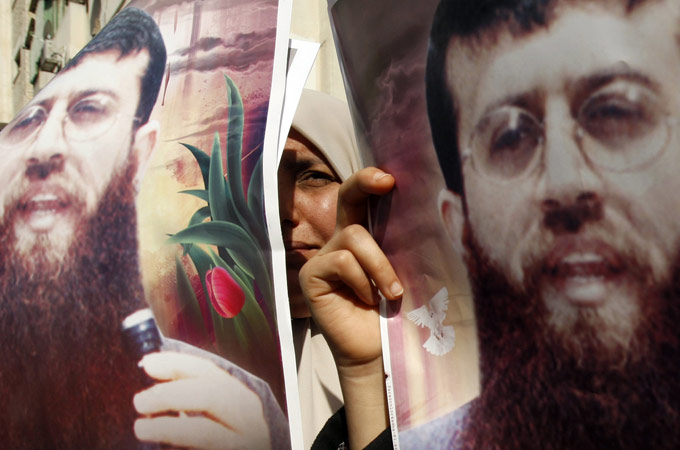
Khader Adnan: No food without freedom

Friday is the 62nd day of the Palestinian prisoner's protest against his detention by Israel.

Sixty-one days. That is how long it’s been since Khader Adnan has eaten.

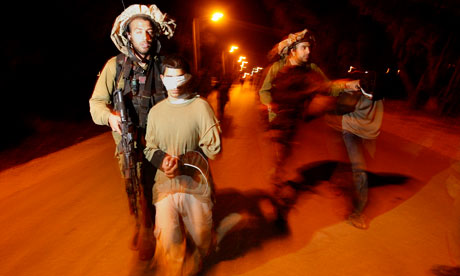
The 33-year-old Palestinian was taken from his home in Arrabeh village near Jenin in the occupied West Bank at 3:30am on December 17. One day later he began his hunger strike to protest against the "humiliation and policy of administrative detention". Adnan, like hundreds of other Palestinians, was arrested under a military order that Israel has named "administrative detention", which allows prisoners to be held without charge or trial for periods of up to six months, spells that can be renewed indefinitely.

Sahar Francis is a lawyer with Addameer, a prisoner rights groups based in the West Bank city of Ramallah, and a member of Khader Adnan’s legal team. She visited the hunger striker in Ziv hospital in Safad, Israel, on Friday.

She described her client, who remains shackled to his hospital bed, as "mentally perfect, but physically very weak".

Francis told Al Jazeera that Adnan was being given only glucose and other sugars through an intravenous drip, but refusing anything else that would be considered a breach of his protest. Doctors told Francis that he could suffer from a heart attack or from the failure of other internal organs and die at any moment.

Adnan's family and legal team were hoping that he would be released this week when his case went before a military appeals court. However, the appeal was denied and the court ordered that Adnan must finish the four month administrative detention, set to end on May 8.

In response to Al Jazeera’s request for an interview, the Israeli military sent a statement that read:

"Khader Adnan was arrested with an administrative arrest warrant for activities that threaten regional security. This warrant was authorised by a judicial review."

Francis and Adnan's legal team argue that, after losing some 40kg from more than 60 days without food, Adnan is wheelchair-bound and too weak to pose a risk to anyone.

Amnesty International and Human Rights Watch have both called on the Israeli authorities either to release Adnan or immediately charge him with criminal offences and have him tried. More


The Carter Center Calls on Israel to Release Hunger Striker Khader Adnan

Atlanta…The Carter Center calls on the Israeli government to immediately charge or release Palestinian prisoner Khader Adnan, who was arrested on Dec. 17, 2011, based on "secret evidence" and has been held in administrative detention without charge.

<P><SPAN class=colCHeading>Press Releases</SPAN></P>

Mr. Adnan has undertaken a hunger strike since his arrest 62 days ago and his life is in imminent danger. His grave medical condition has been verified by Physicians for Human Rights-Israel.

Mr. Adnan's case highlights the inconsistencies of Israel's administrative detention policies with internationally recognized rights to due process.

As of Jan. 15, 2012, Israel is holding 307 Palestinians in administrative detention. Read the Carter Center's recent statement on the administrative detention of elected Palestinian legislators. More


Thursday, February 16, 2012

The West Bank's Bobby Sands

 Khader Adnan's two-month hunger strike has made him a hero among Palestinians outraged by Israel's policy of arbitrary detention.
 
It was only after talking with lucidity and animation for an hour about her husband's 61-day hunger strike that Randa Jihad Adnan's eyes, visible though the opening of her nekab, filled with tears. Until then, this articulate 31-year-old graduate in sharia law from Al Najar University in Nablus, the pregnant mother of two young daughters aged four and one and half, had described with almost disconcerting poise the two months following the arrest of her husband, Khader Adnan, on 17 December.
He was seized at 3.30am by some of the scores of Israeli military and security personnel who surrounded the family home in a West Bank village south of Jenin, and is now being held in the Israeli Rebecca Ziv hospital in Safed. Yesterday she was allowed to visit him with the children and her father-in-law.
There they found him, weak and extremely thin, his beard unkempt and his fingernails long. He was shackled by two legs and one arm to his bed, and was connected to a heart monitor. Though mentally alert, he could speak only with difficulty. "I was shocked," she said yesterday. "I couldn't speak for about three minutes, and it was the same for my daughters."
Mrs Adnan is convinced that the Israeli authorities only allowed the visit because they wanted the family to put pressure on her husband to end his hunger strike. He had started this on 18 December in protest at his arrest, his treatment and the subsequent detention order served on him.
"My father-in-law said to him: 'We want you to stay alive. You cannot defeat this state on your own.' He told him he wanted him to end the strike. I told him I wished he would drink a cup of milk. But he said: 'I did not expect this from you. I know you are with me all the time. Please stop it." Mrs Adnan said yesterday: "I know my husband. He will not change his mind. I expect him to die." More
 

Monday, February 13, 2012

Thousands of Palestinians in the Jordan Valley risk forced displacement, says UN body

Sixty thousand Palestinians live under harsh conditions in the Jordan Valley and the Dead Sea area - one of the most isolated and restricted areas in occupied Palestine. 
The UN Office for the Coordination of Humanitarian Affairs (OCHA) has summarized their humanitarian situation in its February 2012 fact sheet.
The Jordan Valley and Dead Sea area covers about one third of the West Bank. Eighty-seven percent of the land is designated as Area C, where Israeli exercises full control over security, planning and construction. The area is earmarked for the use of the Israeli military or falls under the jurisdiction of the illegal Israeli settlements. An additional 7% is designated as a nature reserve. In total, Palestinians are prohibited from using 94% of their own land.
Meanwhile, 9,500 Israeli settlers have established 37 settlements in the occupied Jordan Valley in contravention of international law. The Fourth Geneva Convention prohibits Israel from transferring parts of its own civilian population into occupied territory. Supported by Israel, the settlers have developed highly profitable agricultural, tourist, mineral and other businesses, including Ahava cosmetics.
Severe restrictions on Palestinians
One quarter of the Palestinian population of the Jordan Valley and Dead Sea area - around 15,000 – live in Area C, including some 7,900 Bedouins and herders. The Israeli authorities obstruct construction activity by the Palestinian communities by withholding building permits for homes, schools, clinics, roads and water networks.
Palestinians in the area have restricted access to water resources. Water consumption in most herding communities is about 20 liters per person per day. This stands in sharp contrast to the World Health Organization’s recommendation of 100 liters per person a day. The settlers in the area consume a shocking 300 liters per person per day.
In addition, Palestinian access to and from the Jordan Valley is highly constrained. Four of the six access routes to the Jordan Valley are controlled by Israeli checkpoints. Non-residents are only allowed to cross these checkpoints as pedestrians or by traveling via registered public transportation. Palestinians who own commercial vehicles have to coordinate the crossing in advance, according to OCHA. Numerous checkpoints, roadblocks and trenches in the area are an obstacle impeding Palestinian access to grazing and agricultural land, services, and markets for agricultural produce. Moreover, the restricted freedom of movement undermines family and social ties. The map printed in OCHA’s fact sheet provides a clear overview of the situation.
Israel’s full military control of Area C has resulted in food scarcity and water scarcity. A joint survey by UNRWA, Unicef and the World Food Program revealed that 79% of the Bedouin and Palestinian herders in Area C in the West Bank – the Jordan Valley and the Dead Sea area included - are food insecure. The food insecurity in the herding communities in Area C is much higher than among the Palestinian population in the West Bank and the Gaza Strip where respectively 25% and 61% of the households are food insecure.
Forced displacement and evictions
In 2011, the Israeli authorities demolished over 200 Palestinian-owned structures in the area, displacing around 430 people and affecting the livelihoods of another 1,200 Palestinians. According to OCHA, thousands of Palestinians in the area are at risk of forced displacement due to home demolitions, forced evictions from closed military zones and a range of restrictions imposed by Israel.
However, the Palestinians are determined to continue living on their land. For example, Abed Yasin Rashaida, who has lived for 15 years in Fasayil in the occupied Jordan Valley, says on video: ”We are Bedouin. Once we were nomads – we used to move from one place to another. Eventually we settled here to let our children study at school.” On 20 December 2012, the Israeli army demolished some houses and animal shelters in Fasayil. “They started demolishing at eight in the morning. The bulldozers destroyed everything and covered the mattresses with soil. Flour, sugar, lentils, oil – they destroyed everything,” according to Rashaida. More
 

Friday, January 27, 2012

Palestinian families denied rights by Israel’s racist marriage laws

 One used to be able to take the Hijaz railway from Akka to Jenin and then to Nablus. The railway, built by Sultan Abdel Hamid II at the turn of the twentieth century, was intended to consolidate his own power over the Ottoman Empire, but perhaps its more lasting impact was to unify the inhabitants of Palestine.

Jenin and Akka are less than 50 kilometers away from each other, but in order to travel between the two cities one must pass through a military checkpoint positioned between the wall Israel is building in the West Bank and the rest of historic Palestine.  
The “security” pretext
In 2006, Taiseer and Lana were married, allowing her for the first time to be granted a permit to visit her husband and his family at their home in Akka. Before that, Taiseer routinely visited Lana at her home in Jenin. But upon marrying Taiseer, Lana did not receive citizenship, nor could she begin an application for citizenship. 
In 2003, when Taiseer and Lana met, the Knesset (Israel’s parliament) passed a temporary law that forbade Palestinians from becoming Israeli citizens upon marrying an Israeli. Called the Nationality and Entry into Israel Law, the law was introduced under the pretext of security — despite there being scant evidence that suggests Palestinian spouses are threats to Israel. More

Sunday, January 22, 2012

The Palestinian children – alone and bewildered – in Israel's Al Jalame jail

 The room is barely wider than the thin, dirty mattress that covers the floor. Behind a low concrete wall is a squat toilet, the stench from which has no escape in the windowless room. The rough concrete walls deter idle leaning; the constant overhead light inhibits sleep. The delivery of food through a low slit in the door is the only way of marking time, dividing day from night.

This is Cell 36, deep within Al Jalame prison in northern Israel. It is one of a handful of cells where Palestinian children are locked in solitary confinement for days or even weeks. One 16-year-old claimed that he had been kept in Cell 36 for 65 days. The only escape is to the interrogation room where children are shackled, by hands and feet, to a chair while being questioned, sometimes for hours.
Most are accused of throwing stones at soldiers or settlers; some, of flinging molotov cocktails; a few, of more serious offences such as links to militant organisations or using weapons. They are also pumped for information about the activities and sympathies of their classmates, relatives and neighbours.
At the beginning, nearly all deny the accusations. Most say they are threatened; some report physical violence. Verbal abuse – "You're a dog, a son of a whore" – is common. Many are exhausted from sleep deprivation. Day after day they are fettered to the chair, then returned to solitary confinement. In the end, many sign confessions that they later say were coerced. More
 

Sunday, January 15, 2012

UN chief slams settlements, calls for end to occupation

 UN Secretary-General Ban Ki-moon on Sunday slammed Israeli settlements as illegal and called for an end to the “occupation,” AFP reported.

Speaking at a conference on democracy in the Arab world in Beirut, Ban said that “the Israeli occupation of Arab and Palestinian territories” and “violence against civilians” must end. 

“Settlements, new and old, are illegal. They work against the emergence of a viable Palestinian state,” the UN chief stated.

Ban added: “A two-state solution is long overdue. The status quo offers only the guarantee of future conflict.”  


The UN secretary general also addressed the wider Arab world, calling on Syrian President Bashar Assad to “stop killing” his people. Ban angered Hezbollah during his visit to Lebanon, when he called on the Shi’ite group to give up its weapons on Friday. Ban said he was “deeply concerned about the military capacity of Hezbollah and … the lack of progress in disarmament.”

Hezbollah leader Hassan Nasrallah shot back, “We want you (the UN), the US and Israel to be concerned.”

“Our concern is that our people are comforted that there is a resistance in Lebanon and we will not allow a new occupation or another violation,” Nasrallah said in a video message to a Shi’ite religious event on Saturday. More

Thursday, January 12, 2012

EU on verge of abandoning hope for a viable Palestinian state

 Israel's foreign ministry denied that Israeli settlers were taking water resources from the West Bank

The Palestinian presence in the largest part of the occupied West Bank – has been, "continuously undermined" by Israel in ways that are "closing the window" on a two-state solution, according to an internal EU report seen by The Independent.

The report, approved by top Brussels officials, argues that EU support, including for a wide range of building projects, is now needed to protect the rights of "ever more isolated" Palestinians in "Area C", a sector that includes all 124 Jewish settlements – illegal in international law – and which is under direct Israeli control. It comprises 62 per cent of the West Bank, including the "most fertile and resource rich land". 

With the number of Jewish settlers now at more than double the shrinking Palestinian population in the largely rural area, the report warns bluntly that, "if current trends are not stopped and reversed, the establishment of a viable Palestinian state within pre-1967 borders seem more remote than ever".

The 16-page document is the EU's starkest critique yet of how a combination of house and farm building demolitions; a prohibitive planning regime; relentless settlement expansion; the military's separation barrier; obstacles to free movement; and denial of access to vital natural resources, including land and water, is eroding Palestinian tenure of the large tract of the West Bank on which hopes of a contiguous Palestinian state depend. More