Wednesday, January 18, 2017
Friday, August 22, 2014
The Historical Perspective of the 2014 Gaza Massacre
August 23, 2014 "ICH" - "PIPR" - - People in Gaza and elsewhere in Palestine feel disappointed at the lack of any significant international reaction to the carnage and destruction the Israeli assault has so far left behind it in the Strip.

The inability, or unwillingness, to act seems to be first and foremost an acceptance of the Israeli narrative and argumentation for the crisis in Gaza. Israel has developed a very clear narrative about the present carnage in Gaza.
It is a tragedy caused by an unprovoked Hamas missile attack on the Jewish State, to which Israel had to react in self-defence. While mainstream western media, academia and politicians may have reservations about the proportionality of the force used by Israel, they accept the gist of this argument. This Israeli narrative is totally rejected in the world of cyber activism and alternative media. There it seems the condemnation of the Israeli action as a war crime is widespread and consensual.
The main difference between the two analyses from above and from below is the willingness of activists to study deeper and in a more profound way the ideological and historical context of the present Israeli action in Gaza. This tendency should be enhanced even further and this piece is just a modest attempt to contribute towards this direction.
Ad Hoc Slaughter?
An historical evaluation and contextualization of the present Israeli assault on Gaza and that of the previous three ones since 2006 expose clearly the Israeli genocidal policy there. An incremental policy of massive killing that is less a product of a callous intention as it is the inevitable outcome of Israel’s overall strategy towards Palestine in general and the areas it occupied in 1967, in particular.
This context should be insisted upon, since the Israeli propaganda machine attempts again and again to narrate its policies as out of context and turns the pretext it found for every new wave of destruction into the main justification for another spree of indiscriminate slaughter in the killing fields of Palestine.
The Israeli strategy of branding its brutal policies as an ad hoc response to this or that Palestinian action is as old as the Zionist presence in Palestine itself. It was used repeatedly as a justification for implementing the Zionist vision of a future Palestine that has in it very few, if any, native Palestinians. The means for achieving this goal changed with the years, but the formula has remained the same: whatever the Zionist vision of a Jewish State might be, it can only materialize without any significant number of Palestinians in it. And nowadays the vision is of an Israel stretching over almost the whole of historic Palestine where millions of Palestinians still live.
This vision ran into trouble once territorial greed led Israel to try and keep the West Bank and the Gaza Strip within its rule and control ever since June 1967. Israel searched for a way to keep the territories it occupied that year without incorporating their population into its rights-bearing citizenry. All the while it participated in a ‘peace process’ charade to cover up or buy time for its unilateral colonization policies on the ground.
With the decades, Israel differentiated between areas it wished to control directly and those it would manage indirectly, with the aim in the long run of downsizing the Palestinian population to a minimum with, among other means, ethnic cleansing and economic and geographic strangulation. Thus the West Bank was in effect divided into a ‘Jewish’ and a ‘Palestinian’ zones – a reality most Israelis can live with provided the Palestinian Bantustans are content with their incarceration within these mega prisons. The geopolitical location of the West Bank creates the impression in Israel, at least, that it is possible to achieve this without anticipating a third uprising or too much international condemnation.
The Gaza Strip, due to its unique geopolitical location, did not lend itself that easily to such a strategy. Ever since 1994, and even more so when Ariel Sharon came to power as prime minister in the early 2000s, the strategy there was to ghettoize Gaza and somehow hope that the people there — 1.8 million as of today — would be dropped into eternal oblivion.
But the Ghetto proved to be rebellious and unwilling to live under conditions of strangulation, isolation, starvation and economic collapse. There was no way it would be annexed to Egypt, neither in 1948 nor in 2014. In 1948, Israel pushed into the Gaza area (before it became a strip) hundreds of thousands of refugees it expelled from the northern Naqab and southern coast who, so they hoped, would move even farther away from Palestine.
For a while after 1967, it wanted to keep as a township which provided unskilled labour but without any human and civil rights. When the occupied people resisted the continued oppression in two intifadas, the West Bank was bisected into small Bantustans encircled by Jewish colonies, but it did not work in the too small and too dense Gaza Strip. The Israelis were unable to ‘West Bank’ the Strip, so to speak. So they cordoned it as a Ghetto and when it resisted the army was allowed to use its most formidable and lethal weapons to crash it. The inevitable result of an accumulative reaction of this kind was genocidal.
Incremental Genocide
The killing of three Israeli teenagers, two of them minors, abducted in the occupied West Bank in June, which was mainly a reprisal for killings of Palestinian children in May, provided the pretext first and foremost for destroying the delicate unity Hamas and Fatah have formed in that month. A unity that followed a decision by the Palestinian Authority to forsake the ‘peace process’ and appeal to international organizations to judge Israel according to a human and civil rights’ yardstick. Both developments were viewed as alarming in Israel.
The pretext determined the timing – but the viciousness of the assault was the outcome of Israel’s inability to formulate a clear policy towards the Strip it created in 1948. The only clear feature of that policy is the deep conviction that wiping out the Hamas from the Gaza Strip would domicile the Ghetto there.
Since 1994, even before the rise of Hamas to power in the Gaza Strip, the very particular geopolitical location of the Strip made it clear that any collective punitive action, such as the one inflicted now, could only be an operation of massive killings and destruction. In other words: an incremental genocide.
This recognition never inhibited the generals who give the orders to bomb the people from the air, the sea and the ground. Downsizing the number of Palestinians all over historic Palestine is still the Zionist vision; an ideal that requires the dehumanisation of the Palestinians. In Gaza, this attitude and vision takes its most inhuman form.
The particular timing of this wave is determined, as in the past, by additional considerations. The domestic social unrest of 2011 is still simmering and for a while there was a public demand to cut military expenditures and move money from the inflated ‘defence’ budget to social services. The army branded this possibility as suicidal. There is nothing like a military operation to stifle any voices calling on the government to cut its military expenses.
Typical hallmarks of the previous stages in this incremental genocide reappear in this wave as well. As in the first operation against Gaza, ‘First Rains’ in 2006, and those which followed in 2009, ‘Cast Lead’, and 2012, ‘Pillar of Smoke’, one can witness again consensual Israeli Jewish support for the massacre of civilians in the Gaza Strip, without one significant voice of dissent. The Academia, as always, becomes part of the machinery. Various universities offered the state its student bodies to help and battle for the Israeli narrative in the cyberspace and alternative media.
The Israeli media, as well, toed loyally the government’s line, showing no pictures of the human catastrophe Israel has wreaked and informing its public that this time, ‘the world understands us and is behind us’. That statement is valid to a point as the political elites in the West continue to provide the old immunity to the Jewish state. The recent appeal by Western governments to the prosecutor in the international court of Justice in The Hague not to look into Israel’s crimes in Gaza is a case in point. Wide sections of the Western media followed suit and justified by and large Israel’s actions.
This distorted coverage is also fed by a sense among Western journalist that what happens in Gaza pales in comparison to the atrocities in Iraq and Syria. Comparisons like this are usually provided without a wider historical perspective. A longer view on the history of the Palestinians would be a much more appropriate way to evaluate their suffering vis-à-vis the carnage elsewhere.
Conclusion: Confronting Double-Standards
But not only historical view is needed for a better understanding of the massacre in Gaza. A dialectical approach that identifies the connection between Israel’s immunity and the horrific developments elsewhere is required as well. The dehumanization in Iraq and Syria is widespread and terrifying, as it is in Gaza. But there is one crucial difference between these cases and the Israeli brutality: the former are condemned as barbarous and inhuman worldwide, while those committed by Israel are still publicly licensed and approved by the president of the United States, the leaders of the EU and Israel’s other friends in the world.
The only chance for a successful struggle against Zionism in Palestine is the one based on a human and civil rights agenda that does not differentiate between one violation and the other and yet identifies clearly the victim and the victimizers. Those who commit atrocities in the Arab world against oppressed minorities and helpless communities, as well as the Israelis who commit these crimes against the Palestinian people, should all be judged by the same moral and ethical standards. They are all war criminals, though in the case of Palestine they have been at work longer than anyone else. It does not really matter what the religious identity is of the people who commit the atrocities or in the name of which religion they purport to speak. Whether they call themselves jihadists, Judaists or Zionists, they should be treated in the same way. More
 © 2014
Wednesday, October 2, 2013
How to Kill Goyim and Influence People: Life and Loathing in Greater Israel
A controversial, racist book sparked a national uproar in Israel.

On another dry, sunny day in Jerusalem during the summer of 2010, I weaved through the crowds of tourists, baby-faced soldiers, and packs of Orthodox settlers milling around on Ben Yehuda Pedestrian Mall, and headed toward Pomeranz, a Jewish book emporium on Be’eri Street, a busy road a few blocks away.
As soon as I was inside the shop, a short, mild-mannered man greeted me in American-accented English. He was the owner, Michael Pomeranz, a former undercover narcotics agent and firefighter from New Jersey who had experienced a religious awakening and immigrated to Israel. When I inquired about the availability of a widely discussed book called Torat Ha’Melech, or the King’s Torah, a commotion immediately ensued.
“Are you sure you want it?” Pomeranz, asked me half-jokingly. A middle-aged coworker chortled from behind a shelf. “The Shabak [Israel’s internal security service] is going to want a word with you if you do,” he warned. When a few customers stopped browsing and began to stare in my direction, Pomeranz pointed to a security camera affixed to a wall. “See that?” he said. “It goes straight to the Shabak! [Shin Bet]”
Upon its publication in 2009, Torat Ha’Melech sparked a national uproar. The controversy began when the Israeli paper, Maariv, panned the book’s contents as “230 pages on the laws concerning the killing of non-Jews, a kind of guidebook for anyone who ponders the question of if and when it is permissible to take the life of a non-Jew.” The description was absolutely accurate.
According to the authors, Rabbi Yitzhak Shapira and Rabbi Yosef Elitzur, non-Jews are “uncompassionate by nature” and may have been killed in order to “curb their evil inclinations.” “If we kill a gentile who has violated one of the seven commandments [of Noah] . . . there is nothing wrong with the murder,” Shapira and Elitzur insisted. Citing Jewish law as his source (or at least a very selective interpretation of it) he declared, “There is justification for killing babies if it is clear that they will grow up to harm us, and in such a situation they may be harmed deliberately, and not only during combat with adults.”
Torat Ha’Melech was written as a guide for soldiers and army officers seeking rabbinical guidance on the rules of engagement. Drawing from a hodgepodge of rabbinical texts that seemed to support their genocidal views, Shapira and Elitzur urged a policy of ruthlessness toward non-Jews, insisting that the commandment against murder “refers only to a Jew who kills a Jew, and not to a Jew who kills a gentile, even if that gentile is one of the righteous among the nations.”
The rabbis went on to pronounce all civilians of the enemy population “rodef,”or villains who chase Jews and are therefore fair game for slaughtering. Shapira and Elitzur wrote, “Every citizen in the kingdom that is against us, who encourages the warriors or expresses satisfaction about their actions, is considered rodef and his killing is permissible.”
Shapira and Elitzur also justified the killing of Jewish dissidents. “A rodef is any person who weakens our kingdom by speech and so forth,” they wrote. Finally, the rabbis issued an extensive but crudely reasoned justification for the killing of innocent children, arguing that in order to defeat “the evil kingdom,” the rules of war “permit intentional hurting of babies and of innocent people, if this is necessary for the war against the evil people.” They added, “If hurting the children of an evil king will put great pressure on him that would prevent him from acting in an evil manner—they can be hurt.”
Shapira and Elitzur justified killing babies and small children on the grounds of satiating the national thirst for revenge. “Sometimes,” the rabbis wrote, “one does evil deeds that are meant to create a correct balance of fear, and a situation in which evil actions do not pay off . . . and in accordance with this calculus, the infants are not killed for their evil, but due to the fact that there is a general need of everyone to take revenge on the evil people, and the infants are the ones whose killing will satisfy this need.” More
Friday, May 31, 2013
Superland' and the normalization of segregation in Israel
An Israeli amusement park found itself in hot water after being caught segregating Jewish and Arab school groups. But instead of being an aberration, the incident is reflective of the dominant culture of segregation and discrimination that permeates Israeli society from the bottom up.

“Superland” – the Israeli amusement park exposed for segregating Arab and Jewish citizens this week – is the most fittingly tragic and ironic title for how I see the current Israeli zeitgeist. No screenwriter or playwright could have come up with a better concept for a tragic comedy about this place.
It captures the two most dominant concepts of politics and life here: that land is the most precious, contested and painful commodity around which the conflict revolves, and that there is nothing “amusing” about the situation we find ourselves in. It’s not all that “super,” despite the most earnest attempts to sell it as such by Israeli government and PR professionals.
While the Israeli government continues to try and “super-size” the land of Greater Israel beyond the pre-1967 borders, the story of segregation at Superland is a perfect indicator that no matter what your politics are, no matter your position on settlements, your notion of security, how you judge Palestinian resistance or any other issue, the political reality remains undeniably the same. Everyone living on this tiny piece of land — Arabs and Jews, Palestinians and Israelis — is in a perennial situation of state-sponsored division, segregation and separation that trickles down — not just in Hebron’s Shuhada Street, or in East Jerusalem, but everywhere.
After the Jaffa school teacher was unable to make a reservation for a class trip to Superland because they are Arab, management explained that many schools – both Arab and Jewish – request to visit the park on days when only other schools of the same ethnic group will be there. According to a statement by the park’s management, this makes sense for them considering they are interested in ensuring the safety of This is an amusement park and there is special importance to preserving order and preventing violent incidents in the park. As a result, Superland’s management took the requests it received into consideration, and during June 2013, set aside a few separate days for schools from different sectors.
This is the same argument that was made in pre-civil rights America about the utility of separating blacks and whites. It is the same argument that Ivy League university deans in the U.S. used to try and justify the quotas that up until the 1960s, limited the number of Jews accepted to a school; they explained that it is better for the Jews if there aren’t too many of them in any given department, since then they would surely experience greater incidents of anti-Semitism.
Instead of combatting anti-Semitism and racism at its core, this kind of backwards logic gives in to the unjust system, trying simply to manage a racist and discriminatory status quo. This is exactly the case of Superland.
It is a weird coincidence that on the same day this story broke, American author and BDS activist Alice Walker wrote an open letter to singer Alicia Keys, urging her to cancel her July concert in Israel because of the country’s segregation policies. In the letter, she specifically refers to the struggle she waged to bring an end to “apartheid America,” which she calls “less lethal than Israel’s against the Palestinian people.”
You can argue all you want that there are differences between America and Israel as far as racism goes, just as there are differences between Israel and South Africa when it comes to Apartheid. But the reality remains the same in all places: Palestinians living on the same land as Jewish Israelis are denied the dignity and equal rights they deserve because of the dominant ethnic group. More
Wednesday, April 18, 2012
Israel's leaders incite the public against peace activists
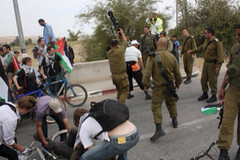
In an effort to minimize the damage to Israel's image, IDF Chief of Staff Lt. Gen. Benny Gantz swiftly suspended Eisner while Prime Minister Benjamin Netanyahu hastened to denounce the offending officer's misdeed.
Such reactions are necessary, but certainly not sufficient. Use of violence against peace activists is not an image problem that can be swept aside with a suspension and denunciation. A political and military leadership that incites the public against peace and human rights activists bears responsibility for the conduct of hot-tempered officers like Eisner.
When the prime minister and foreign minister label left-wingers "anarchists," "provocateurs" and even "terror supporters," they are sanctioning attacks on civilians implementing the right to protest. More