Showing posts with label tribal. Show all posts

Saturday, June 8, 2013

US drone strike draws angry Pakistan protest

The government of Pakistan has summoned an American envoy to lodge an official protest over the latest drone attacks that killed at least nine people in the country's northwest region, officials said.

Nawaz Sharif

US charge d'affaires Richard Hoagland was summoned to the foreign ministry on Saturday as Pakistan lodged a formal protest over the Friday night strikes, ministry spokesman Aizaz Chaudhry said.

"It was conveyed to the US charge d'affaires that Pakistan strongly condemns the drone strikes, which are a violation of Pakistan's sovereignty and territorial integrity," said Chaudhry.

"The importance of bringing an immediate end to drone strikes was emphasised," he added.

Pakistan also said that the strikes were "counter-productive, entail loss of innocent civilian lives and have human rights and humanitarian implications".

About six missiles were fired at a compound suspected to belong to a Taliban commander in the Shawal area of North Waziristan, one of seven tribal districts near the border with Afghanistan, a security official said.

"Nine militants were killed in the strike," the official said on condition of anonymity. "Those killed were from the local Bakka Khel tribe and they have been identified".

It was first attack since the government of Prime Minister Nawaz Sharif was sworn in on Wednesday.

The attack also came 10 days after a similar US strike killed the Pakistani Taliban's second-in-command, Wali-ur-Rehman, and six others in a major blow to the rebel group.

President Barack Obama said last month the United States would scale back drone strikes, only using them when a threat was "continuing and imminent".

But Sharif declared in his first speech as premier that the "chapter of drone attacks" should come to an end. More


Wednesday, June 5, 2013

America's Secret Fukushima Poisoning the Bread Basket of the World

Early in the morning of July 16, 1979, a 20-foot section of the earthen dam blocking the waste pool for the Church Rock Uranium Mill in New Mexico caved in and released 95 million gallons of highly acidic fluid containing 1,100 tons of radioactive material.

United Nuclear's uranium mine and
mill within the Navajo Nation in Church Rock,
New Mexico. (Photo: EPA)

The fluid and waste flowed into the nearby Puerco River, traveling 80 miles downstream, leaving toxic puddles and backing up local sewers along the way.

Although this release of radiation, thought to be the largest in US history, occurred less than four months after the Three Mile Island partial nuclear meltdown, the Church Rock spill received little media attention. In contrast, the Three Mile Island accident made the headlines. And when the residents of Church Rock asked their governor to declare their community a disaster area so they could get recovery assistance, he refused.

What was the difference between the Church Rock spill and the Three Mile Island partial meltdown? Church Rock is situated in the Navajo Nation, one of the areas in the US sacrificed to supply uranium for the Cold War and for nuclear power plants. That area and many others in the Navajo Nation are contaminated to this day. Another sacrifice area is the Great Sioux Nation, a region in the western part of the country comprising parts of 5 states, where thousands of open uranium mine pits continue to release radiation and heavy metals into the air, land and water.

This poisoning of the people in the Navajo and Great Sioux Nations has been going on for decades and has had serious effects on their health. Even today, it is unknown what the full effects are and what the impact is on the rest of the nation and world because the contaminated air and water are not limited by borders.

Most Americans are unaware of the story of uranium mining on tribal lands because it is a difficult story to accept. It is a story that includes the long history of human rights abuses by the United States against native indians and recognition of the full costs of nuclear energy - two stories the government and big energy have suppressed.

Many people think of nuclear power as a clean source of energy. It has been promoted as part of the transition from fossil fuels. But the reality is that nuclear power comes at a heavy price to the health of people and the planet. Like other forms of extractive energy such as coal, oil and gas, uranium needs to stay in the ground. Radiation and heavy metal poisonings are a hidden environmental catastrophe that is ongoing and must be addressed. But rather than studying the health effects and cleaning up the environment, private corporations are pushing once again to lift the ban on uranium mining.

Is Uranium Mining Poisoning the Bread Basket of America?

Thousands of open uranium mines first excavated in the 1950s continue to release radiation today. There have been inadequate assessments of the extent of contamination, but limited measurements done to date show ongoing leaks many times larger than the leakage from Fukushima. How did we get here?

After WWII, the United States Atomic Energy Commission (AEC) was created so that the United States could obtain uranium for weapons production domestically. The AEC guaranteed that it would purchase all uranium that was mined. A uranium boom ensued.

It is estimated that 60 to 80 percent of uranium in the United States is located on tribal land, particularly in the lands of the Navajo and Great Sioux Nations. Private corporations jumped in to mine these areas and, in parts of South Dakota, individuals started mining for uranium on their private lands unaware of the dangers.

Private corporations have set up thousands of underground and open pit uranium mines on tribal lands and hired local native Indians at low wages. Other than jobs, the uranium mines brought little benefit to these nations because the lands were given to non-Indian companies such as Kerr-McGee, Atlantic Richfield, Exxon and Mobil. Native Indians had little control over what took place.

Two Acts in the 19th century took the rights of self-determination away from the native population. The Indian Appropriations Act of 1851 allocated money to move Native Indians onto reservations, ostensibly to protect them from white settlers but more likely to give settlers access to natural resources. The reservations are also known as prisoner of war camps. In fact, the reservation in Pine Ridge, SD is registered as POW Camp 344.

A second Indian Appropriations Act in 1871 changed the legal status of Native Indians to wards of the Federal government, stripping them of recognition as sovereign nations and the right to make treaties. In order to make contracts for uranium mining on tribal lands, the Bureau of Indian Affairs created Tribal Councils to conduct negotiations. But the resulting contracts were not made in the best interests of the tribes.

The Native Indians who worked in these mines were not protected from exposure to radiation, nor were they adequately warned about the dangers. Though it was clear that radiation exposure was linked to cancer in the early 1950s, around the same time that the US Public Health Service also started studying the health of uranium miners, it was not until 1959 that lung cancer was mentioned as a risk in pamphlets given to the workers. In an unpublished doctoral dissertation, A.B. Hungate writes that the reasons for this are: "The government had two interests. First, it needed a steady supply of domestic uranium, and it felt that warning the workers of the hazards would result in the loss of the workforce. Secondly, it wanted an epidemiological testing program to study the long-term health effects of radiation."

Don Yellowman, president of the Forgotten Navajo People, described the extent of exposure to radiation and toxic metals. Native Indian miners would drink radioactive water that contained heavy metals dripping off of the walls deep in the mines. Some of the miners had to travel long distances to the mines, so their families would come with them. Children would play in the area around the mine, and family members would prepare and eat meals there. Other reports state that workers, primarily nonwhites, were ordered into the mines shortly after explosions were set off to gather up rocks and bring them out for processing. Also, miners would go home at night covered in toxic radioactive dust, exposing their families to health risks.

Uranium mining started in South Dakota on land included in the original treaties with the Great Sioux Nation in the 1960 and '70s. The Sioux were not included in negotiations for the mining and are still refusing to settle with the US government over land in the Black Hills that was mined. During the boom, the land was mined without regard for contamination as "large mining companies [were literally] pushing off the tops of bluffs and buttes."

A few decades after uranium mining began in the Navajo Nation, increased numbers of cancer cases, lung cancer in particular, began to show up in the miners. A 2008 literature review in New Mexico found that the "Risk of lung cancer among male Navajo uranium miners was 28 times higher than in Navajo men who never mined, and two-thirds of all new lung cancer cases in Navajo men between 1969 and 1993 was attributable to a single exposure - underground uranium mining. Through 1990, death rates among Navajo uranium miners were 3.3 times greater than the US average for lung cancer and 2.5 times greater for pneumoconioses and silicosis."

Though the health effects of radiation exposure were known, it took decades before steps were taken to protect workers. The mines were operated under lax laws established in the 1872 Mining Act. Health and safety regulations for the mines, such as requirements for ventilation, were not passed in Congress until the late 1960s. But even once they were law, the regulations were not enforced.

Beginning in the 1970s, miners and their families began to pursue legal solutions through the courts and Congress so they could be compensated for the effects of their radiation exposure. Many court cases failed, and Native Indians were excluded from hearings in Congress on miner safety. Finally, the Radiation Exposure Compensation Act (RECA) passed Congress in 1990.

RECA is desperately inadequate and restrictive. Until 2000, RECA only covered miners, not mill workers, and it does not cover families and others who lived near the mines. It also requires a very strict application process that is impossible for some to complete. A summary of RECA by academics Brugge and Goble states: "We believe that it is not possible to simultaneously apologize, set highly stringent criteria and place the burden of proof on the victims, as did the 1990 RECA."

Uranium Mine Pits Continue to Leak Radiation Today

Radiation and heavy metals from uranium mines continue to pollute the land, air and water today and very little action is being taken to stop it.

In the upper great plain states of Wyoming, Montana and the Dakotas, there are 2,885 abandoned uranium mines that are all open pits within territory that is supposed to be for the absolute use of the Great Sioux Nation under the 1868 Fort Laramie Treaty with the United States. These open mines continue to emit radiation and pollutants that are poisoning the local communities.

According to a report by Earthworks, "Mining not only exposes uranium to the atmosphere, where it becomes reactive, but releases other radioactive elements such as thorium and radium and toxic heavy metals including arsenic, selenium, mercury and cadmium. Exposure to these radioactive elements can cause lung cancer, skin cancer, bone cancer, leukemia, kidney damage and birth defects."

There are currently 1200 abandoned uranium mines in the Navajo Nation and 500 of them require reclamation. The greatest amount of radioactive contamination on Navajo land comes from solid waste called "tailings," which sits in large open piles, some as tall as 70 feet high, and was incorporated into materials used to build homes. Dust from these piles of waste blows throughout the land causing widespread contamination.

A 2008 study found that "mills and tailings disposal sites caused extensive groundwater contamination by radium, uranium, various trace metals and dissolved solids. One estimate is that 1.2 million acre-feet of groundwater (or enough to fill Elephant Butte Reservoir more than twice) have been contaminated in the Ambrosia Lake-Milan area from historic mine and mill discharges, and less than two-tenths of 1 percent has been treated to reduce contaminant levels." It is estimated that 30 percent of people living in the Navajo Nation lack access to uncontaminated water.

Charmaine White Face of Defenders of the Black Hills describes the situation in the Great Sioux Nation as "America's Chernobyl." She says, "A private abandoned, open-pit uranium mine about 200 meters from an elementary school in Ludlow, SD, emits 1170 microRems per hour, more than 4 times as much as is being emitted from the Fukushima nuclear power plant in Japan. " In addition, "Studies by the USFSshow that one mine alone has 1,400 millirems per hour (mR/hr) of exposed radiation, a level of radiation that is 120,000 times higher than normal background of 100 millirems per year (mR/yr)!" Cancer rates in Pine Ridge, SD, are the highest in the nation. More


Friday, February 22, 2013

India opens the floodgates for extinguishment of Indigenous Rights

India's central government has walked away from its position on the need to obtain consent from Indigenous peoples and forest dwellers before handing their lands over to industry.

On February 15, the central government announced that major "linear projects" such as roads, railways, transmission lines, canal systems and pipelines do not need to obtain consent from affected forest populations before clearing their lands. The announcement, which stands in sharp contrast to provisions in the Forest Rights Act, could now make way for hundreds of new industrial projects that would have never otherwise seen the light of day.

"This is serious breach of trust and a huge step back in ensuring the dignity and survival of traditional forest-dwelling people across the country", said Dr. Swati Shresth, from the Ashoka Trust for Research in Ecology and the Environment. "Forests are going to be cleared to make way for a particular kind of economic development; it will adversely impact communities and the environment."

Just four years ago, the Union Ministry of Environment and Forests (MoEF) made the matter of consent of affected communities mandatory for all projects that would destroy forests. The landmark decision came in direct response to the attempt by UK-based mining company Vedanta Resources Inc. to clear the Dongria Kondh's lands. Last week's announcement effectly revokes that mandatory rule.

On the same day of the announcement, the MoEF took another troubling step away from Indigenous Rights, while reiterating the inviolable nature of those rights.

In an affidavit that was filed in the Supreme Court in the ongoing case with Vedanta, the MoEF reiterated that mining in Niyamgiri hills cannot be permitted, stating that:

"The diversion of forest land on the proposed mining site of the Lanjigarh bauxite mining lease is violative of the fundamental rights of the Dongria Kondh tribals as well as the spirit of Forest Rights Act especially for the vulnerable tribal groups such as the Dongria Kondh and thus cannot be allowed for this reason alone.

"More than 7 sq. km. of the sacred undisturbed forests on top of the mountain, where the proposed mining lease area of the Lanjigarh bauxite mining lease is located has been protected for centuries by the Dongria Kondh, a primitive tribal group [now termed as particularly vulnerable tribe] as sacred to their deity. Diversion of these sacred areas for mining will undermine the customary rights of the Dongria Kondhs to protect their sacred places of worship and thereby amount to a violation of their fundamental right to manage their own affairs in the matter of religion and fundamental right to conserve the culture of their own. It was also in direct violation further of the specific provisions of the Forest Rights Act."

This is, of course, great news for the Dongia Kondh who continue to stand in steadfast opposition to Vedanta's mining interests on their sacred land. http://www.thehindu.com/todays-paper/tp-national/forest-land-cannot-be-diverted-for-vedanta-project-says-centre/article4420821.ece?textsize=large&test=1

Speaking on the broader issue of consent, the MoEF went on to say that "No eviction of eligible forest dwellers can take place till the process of recognition and vesting of individual and community forest right under the Scheduled Tribes and Other Traditional Forest Dwellers (Recognition of Forest Rights) Act is complete."

However, the MoEF then did an about face. As reported by Down to Earth, the Ministry stated that such consent is only required in cases where "displacement of large number of people" is involved and which "affect the quality of life of the people".

In cases where the diversion of such forest land is "unavoidable" where rights of the forest dwellers are recognized, their rights may be "circumscribed or extinguished using the eminent domain of the state". More


Monday, June 25, 2012

Jimmy Carter savages US foreign policy over drone strikes

Former president calls on Washington to regain moral leadership in wake of drone strikes and targeted assassinations?

Drone strikes and targeted assassinations abroad have seen the US violating human rights in a way that "abets our enemies and alienates our friends", according to the former president Jimmy Carter.

He said America was "abandoning its role as a champion of human rights", and called on Washington to "reverse course and regain moral leadership".

Jimmy Carter: 'America’s violation of international human rights abets our enemies and alienates our friends.' Photograph: Amr Abdallah Dalsh/Reuters

Revelations that US officials were targeting people including their own citizens abroad were "only the most recent disturbing proof" of how far such violations had extended, he wrote in the New York Times.

At a time when popular revolutions were sweeping the globe, the US should be strengthening, not weakening, "basic rules of law and principles of justice", Carter said.

Attacks on human rights after 9/11 had been "sanctioned and escalated by bipartisan executive and legislative actions, without dissent from the general public", he said. "As a result, our country can no longer speak with moral authority on these critical issues."

Carter added: "While the country has made mistakes in the past, the widespread abuse of human rights over the last decade has been a dramatic change from the past."

The Universal Declaration of Human Rights, adopted in 1948 with US leadership, "has been invoked by human rights activists and the international community to replace most of the world's dictatorships with democracies and to promote the rule of law in domestic and global affairs," he said. More


Saturday, May 5, 2012

India: Barefoot lawyers bring food security to tribes

KHAMMAM, India — It was a deal struck almost 40 years ago by a poor, illiterate Indian farmer, driven by desperation after a drought wiped out his crops and left his family close to starvation.

The agreement: Four hectares of land, the size of four soccer fieldss, for a mere 10 kg of sorghum.

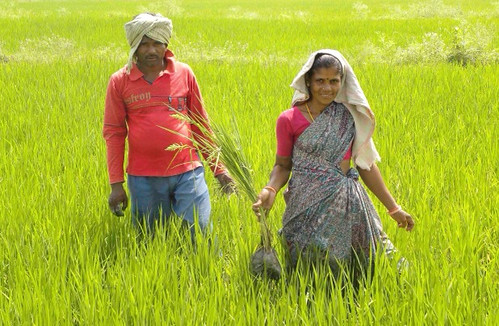
“My father-in-law pawned the land for food,” said Kowasalya Thati, lifting the hem of her grey sari and stepping into the muddy field of rice paddy in Kottasuraream village in the southern region of Andhra Pradesh.

“When he returned the grain later, the land owners refused to give it back. They claimed it and we had no document to prove otherwise. For 28 years, we had to work on the land we once owned. Without land, we had nothing ... not even enough food. It’s a miracle we got it back.”

Kowasalya’s family is one of hundreds of thousands who belong to India’s 700 listed tribes who are at last gaining legal titles to the land they have lived on for generations, thanks to a legal aid scheme run by the Andhra Pradesh government with international advocacy group Landesa.

In the scheme, which is likely to be rolled out nationally, young people often armed with only a secondary-level education are drawn from mud-and-brick villages and trained as paralegals, then sent out to help people to understand their rights and secure title, or “patta”, to their land.

For most tribal and landless families, that simple piece of paper means an end to a constant fear of hunger.

“Land is the most important factor of production,” said Pramod Joshi, South Asia director of the International Food Policy Research Institute. “It helps ensure food security for the poorest of the poor. It has been shown in many regions that if the poor have land, they are in a better position to feed themselves.” More


Sunday, April 8, 2012

Capitalism: A Ghost Story and a Land Grab

Is it a house or a home? A temple to the new India, or a warehouse for its ghosts? Ever since Antilla arrived on Altamont Road in Mumbai, exuding mystery and quiet menace, things have not been the same. “Here we are,” the friend who took me there said, “Pay your respects to our new Ruler.”

Antilla belongs to India’s richest man, Mukesh Ambani. I had read about this most expensive dwelling ever built, the twenty-seven floors, three helipads, nine lifts, hanging gardens, ballrooms, weather rooms, gymnasiums, six floors of parking, and the six hundred servants. Nothing had prepared me for the vertical lawn—a soaring, 27-storey-high wall of grass attached to a vast metal grid. The grass was dry in patches; bits had fallen off in neat rectangles. Clearly, Trickledown hadn’t worked.

But Gush-Up certainly has. That’s why in a nation of 1.2 billion, India’s 100 richest people own assets equivalent to one-fourth of the GDP.

The word on the street (and in the New York Times) is, or at least was, that after all that effort and gardening, the Ambanis don’t live in Antilla. No one knows for sure. People still whisper about ghosts and bad luck, Vaastu and Feng Shui. Maybe it’s all Karl Marx’s fault. (All that cussing.) Capitalism, he said, “has conjured up such gigantic means of production and of exchange, that it is like the sorcerer who is no longer able to control the powers of the nether world whom he has called up by his spells”.

In India, the 300 million of us who belong to the new, post-IMF “reforms” middle class—the market—live side by side with spirits of the nether world, the poltergeists of dead rivers, dry wells, bald mountains and denuded forests; the ghosts of 2,50,000 debt-ridden farmers who have killed themselves, and of the 800 million who have been impoverished and dispossessed to make way for us. And who survive on less than twenty rupees a day.

Mukesh Ambani is personally worth $20 billion. He holds a majority controlling share in Reliance Industries Limited (RIL), a company with a market capitalisation of $47 billion and global business interests that include petrochemicals, oil, natural gas, polyester fibre, Special Economic Zones, fresh food retail, high schools, life sciences research and stem cell storage services. RIL recently bought 95 per cent shares in Infotel, a TV consortium that controls 27 TV news and entertainment channels, including CNN-IBN, IBN Live, CNBC, IBN Lokmat, and ETV in almost every regional language. Infotel owns the only nationwide licence for 4G Broadband, a high-speed “information pipeline” which, if the technology works, could be the future of information exchange. Mr Ambani also owns a cricket team.

RIL is one of a handful of corporations that run India. Some of the others are the Tatas, Jindals, Vedanta, Mittals, Infosys, Essar and the other Reliance (ADAG), owned by Mukesh’s brother Anil. Their race for growth has spilled across Europe, Central Asia, Africa and Latin America. Their nets are cast wide; they are visible and invisible, over-ground as well as underground. The Tatas, for example, run more than 100 companies in 80 countries. They are one of India’s oldest and largest private sector power companies. They own mines, gas fields, steel plants, telephone, cable TV and broadband networks, and run whole townships. They manufacture cars and trucks, own the Taj Hotel chain, Jaguar, Land Rover, Daewoo, Tetley Tea, a publishing company, a chain of bookstores, a major brand of iodised salt and the cosmetics giant Lakme. Their advertising tagline could easily be: You Can’t Live Without Us.

According to the rules of the Gush-Up Gospel, the more you have, the more you can have.

The era of the Privatisation of Everything has made the Indian economy one of the fastest growing in the world. However, like any good old-fashioned colony, one of its main exports is its minerals. India’s new mega-corporations—Tatas, Jindals, Essar, Reliance, Sterlite—are those who have managed to muscle their way to the head of the spigot that is spewing money extracted from deep inside the earth. It’s a dream come true for businessmen—to be able to sell what they don’t have to buy.

The other major source of corporate wealth comes from their land-banks. All over the world, weak, corrupt local governments have helped Wall Street brokers, agro-business corporations and Chinese billionaires to amass huge tracts of land. (Of course, this entails commandeering water too.) In India, the land of millions of people is being acquired and made over to private corporations for “public interest”—for Special Economic Zones, infrastructure projects, dams, highways, car manufacture, chemical hubs and Formula One racing. (The sanctity of private property never applies to the poor.) As always, local people are promised that their displacement from their land and the expropriation of everything they ever had is actually part of employment generation. But by now we know that the connection between GDP growth and jobs is a myth. After 20 years of “growth”, 60 per cent of India’s workforce is self-employed, 90 per cent of India’s labour force works in the unorganised sector. More