Showing posts with label india. Show all posts

Monday, August 28, 2017

The west’s wealth is based on slavery. Reparations should be paid

The scientific, political and industrial revolutions the British school system is so proud to proclaim, were only possible because of the blood, toil and bounty exploited from the “darker nations” from across the globe.
Colonialism left Africa, Asia and the Caribbean underdeveloped, as the regions were used to develop the west while holding back progress in what we now call the global south.

Any discussion of progress in racial equality in Britain or the rest of the world has to acknowledge the damage that the west has inflicted on the former colonies and their descendants. https://goo.gl/At86C1

Sunday, October 27, 2013

Sides of Dubai

Here's a snippet of an article about Dubai in the Independent:

There are three different Dubais, all swirling around each other. There are the expats, there are the Emiratis, headed by Sheikh Mohammed; and then there is the foreign underclass who built the city, and are trapped here. They are hidden in plain view. You see them everywhere, in dirt-caked blue uniforms, being shouted at by their superiors, like a chain gang – but you are trained not to look. It is like a mantra: the Sheikh built the city. The Sheikh built the city. Workers? What workers?

Every evening, the hundreds of thousands of young men who build Dubai are bussed from their sites to a vast concrete wasteland an hour out of town, where they are quarantined away. Until a few years ago they were shuttled back and forth on cattle trucks, but the expats complained this was unsightly, so now they are shunted on small metal buses that function like greenhouses in the desert heat. They sweat like sponges being slowly wrung out.

Sonapur is a rubble-strewn patchwork of miles and miles of identical concrete buildings. Some 300,000 men live piled up here, in a place whose name in Hindi means "City of Gold". In the first camp I stop at – riven with the smell of sewage and sweat – the men huddle around, eager to tell someone, anyone, what is happening to them.

Sahinal Monir, a slim 24-year-old from the deltas of Bangladesh. "To get you here, they tell you Dubai is heaven. Then you get here and realise it is hell," he says. Four years ago, an employment agent arrived in Sahinal's village in Southern Bangladesh. He told the men of the village that there was a place where they could earn 40,000 takka a month (£400) just for working nine-to-five on construction projects. It was a place where they would be given great accommodation, great food, and treated well. All they had to do was pay an up-front fee of 220,000 takka (£2,300) for the work visa – a fee they'd pay off in the first six months, easy. So Sahinal sold his family land, and took out a loan from the local lender, to head to this paradise.

As soon as he arrived at Dubai airport, his passport was taken from him by his construction company. He has not seen it since. He was told brusquely that from now on he would be working 14-hour days in the desert heat – where western tourists are advised not to stay outside for even five minutes in summer, when it hits 55 degrees – for 500 dirhams a month (£90), less than a quarter of the wage he was promised. If you don't like it, the company told him, go home. "But how can I go home? You have my passport, and I have no money for the ticket," he said. "Well, then you'd better get to work," they replied.

Sahinal was in a panic. His family back home – his son, daughter, wife and parents – were waiting for money, excited that their boy had finally made it. But he was going to have to work for more than two years just to pay for the cost of getting here – and all to earn less than he did in Bangladesh.

He shows me his room. It is a tiny, poky, concrete cell with triple-decker bunk-beds, where he lives with 11 other men. All his belongings are piled onto his bunk: three shirts, a spare pair of trousers, and a cellphone. The room stinks, because the lavatories in the corner of the camp – holes in the ground – are backed up with excrement and clouds of black flies. There is no air conditioning or fans, so the heat is "unbearable. You cannot sleep. All you do is sweat and scratch all night." At the height of summer, people sleep on the floor, on the roof, anywhere where they can pray for a moment of breeze.

The water delivered to the camp in huge white containers isn't properly desalinated: it tastes of salt. "It makes us sick, but we have nothing else to drink," he says.

The work is "the worst in the world," he says. "You have to carry 50kg bricks and blocks of cement in the worst heat imaginable ... This heat – it is like nothing else. You sweat so much you can't pee, not for days or weeks. It's like all the liquid comes out through your skin and you stink. You become dizzy and sick but you aren't allowed to stop, except for an hour in the afternoon. You know if you drop anything or slip, you could die. If you take time off sick, your wages are docked, and you are trapped here even longer."

He is currently working on the 67th floor of a shiny new tower, where he builds upwards, into the sky, into the heat. He doesn't know its name. In his four years here, he has never seen the Dubai of tourist-fame, except as he constructs it floor-by-floor.

Is he angry? He is quiet for a long time. "Here, nobody shows their anger. You can't. You get put in jail for a long time, then deported." Last year, some workers went on strike after they were not given their wages for four months. The Dubai police surrounded their camps with razor-wire and water-cannons and blasted them out and back to work.

The "ringleaders" were imprisoned. I try a different question: does Sohinal regret coming? All the men look down, awkwardly. "How can we think about that? We are trapped. If we start to think about regrets..." He lets the sentence trail off. Eventually, another worker breaks the silence by adding: "I miss my country, my family and my land. We can grow food in Bangladesh. Here, nothing grows. Just oil and buildings."

Since the recession hit, they say, the electricity has been cut off in dozens of the camps, and the men have not been paid for months. Their companies have disappeared with their passports and their pay. "We have been robbed of everything. Even if somehow we get back to Bangladesh, the loan sharks will demand we repay our loans immediately, and when we can't, we'll be sent to prison."

This is all supposed to be illegal. Employers are meant to pay on time, never take your passport, give you breaks in the heat – but I met nobody who said it happens. Not one. These men are conned into coming and trapped into staying, with the complicity of the Dubai authorities.

Sahinal could well die out here. A British man who used to work on construction projects told me: "There's a huge number of suicides in the camps and on the construction sites, but they're not reported. They're described as 'accidents'." Even then, their families aren't free: they simply inherit the debts. A Human Rights Watch study found there is a "cover-up of the true extent" of deaths from heat exhaustion, overwork and suicide, but the Indian consulate registered 971 deaths of their nationals in 2005 alone. After this figure was leaked, the consulates were told to stop counting.

At night, in the dusk, I sit in the camp with Sohinal and his friends as they scrape together what they have left to buy a cheap bottle of spirits. They down it in one ferocious gulp. "It helps you to feel numb", Sohinal says through a stinging throat. In the distance, the glistening Dubai skyline he built stands, oblivious. www.independant.co.uk


Saturday, April 13, 2013

Seeds of suicide

“Monsanto is an agricultural company.

We apply innovation and technology to help farmers around the world produce more while conserving more.”

“Producing more, Conserving more, Improving farmers lives.”

Mar 27, 2013 - Control over seed is the first link in the food chain because seed is the source of life. When a corporation controls seed, it controls life, especially the life of farmers.

Monsanto’s concentrated control over the seed sector in India as well as across the world is very worrying. This is what connects farmers’ suicides in India to Monsanto vs Percy Schmeiser in Canada, to Monsanto vs Bowman in the US, and to farmers in Brazil suing Monsanto for $2.2 billion for unfair collection of royalty.

These are the promises Monsanto India’s website makes, alongside pictures of smiling, prosperous farmers from the state of Maharashtra. This is a desperate attempt by Monsanto and its PR machinery to delink the epidemic of farmers’ suicides in India from the company’s growing control over cotton seed supply — 95 per cent of India’s cotton seed is now controlled by Monsanto.

Monsanto’s talk of ‘technology’ tries to hide its real objectives of control over seed where genetic engineering is a means to control seed

Through patents on seed, Monsanto has become the “Life Lord” of our planet, collecting rents for life’s renewal from farmers, the original breeders.

Patents on seed are illegitimate because putting a toxic gene into a plant cell is not “creating” or “inventing” a plant. These are seeds of deception — the deception that Monsanto is the creator of seeds and life; the deception that while Monsanto sues farmers and traps them in debt, it pretends to be working for farmers’ welfare, and the deception that GMOs feed the world. GMOs are failing to control pests and weeds, and have instead led to the emergence of superpests and superweeds.

The entry of Monsanto in the Indian seed sector was made possible with a 1988 Seed Policy imposed by the World Bank, requiring the Government of India to deregulate the seed sector. Five things changed with Monsanto’s entry: First, Indian companies were locked into joint-ventures and licensing arrangements, and concentration over the seed sector increased. Second, seed which had been the farmers’ common resource became the “intellectual property” of Monsanto, for which it started collecting royalties, thus raising the costs of seed. Third, open pollinated cotton seeds were displaced by hybrids, including GMO hybrids. A renewable resource became a non-renewable, patented commodity. Fourth, cotton which had earlier been grown as a mixture with food crops now had to be grown as a monoculture, with higher vulnerability to pests, disease, drought and crop failure. Fifth, Monsanto started to subvert India’s regulatory processes and, in fact, started to use public resources to push its non-renewable hybrids and GMOs through so-called public-private partnerships (PPP).

In 1995, Monsanto introduced its Bt technology in India through a joint-venture with the Indian company Mahyco. In 1997-98, Monsanto started open field trials of its GMO Bt cotton illegally and announced that it would be selling the seeds commercially the following year. India has rules for regulating GMOs since 1989, under the Environment Protection Act. It is mandatory to get approval from the Genetic Engineering Approval Committee under the ministry of environment for GMO trials. The Research Foundation for Science, Technology and Ecology sued Monsanto in the Supreme Court of India and Monsanto could not start the commercial sales of its Bt cotton seeds until 2002.

And, after the damning report of India’s parliamentary committee on Bt crops in August 2012, the panel of technical experts appointed by the Supreme Court recommended a 10-year moratorium on field trials of all GM food and termination of all ongoing trials of transgenic crops.

But it had changed Indian agriculture already.

Monsanto’s seed monopolies, the destruction of alternatives, the collection of superprofits in the form of royalties, and the increasing vulnerability of monocultures has created a context for debt, suicides and agrarian distress which is driving the farmers’ suicide epidemic in India. This systemic control has been intensified with Bt cotton. That is why most suicides are in the cotton belt.

An internal advisory by the agricultural ministry of India in January 2012 had this to say to the cotton-growing states in India — “Cotton farmers are in a deep crisis since shifting to Bt cotton. The spate of farmer suicides in 2011-12 has been particularly severe among Bt cotton farmers.”

The highest acreage of Bt cotton is in Maharashtra and this is also where the highest farmer suicides are. Suicides increased after Bt cotton was introduced — Monsanto’s royalty extraction, and the high costs of seed and chemicals have created a debt trap. According to Government of India data, nearly 75 per cent rural debt is due to purchase inputs. As Monsanto’s profits grow, farmers’ debt grows. It is in this systemic sense that Monsanto’s seeds are seeds of suicide.

The ultimate seeds of suicide is Monsanto’s patented technology to create sterile seeds. (Called “Terminator technology” by the media, sterile seed technology is a type of Gene Use Restriction Technology, GRUT, in which seed produced by a crop will not grow — crops will not produce viable offspring seeds or will produce viable seeds with specific genes switched off.) The Convention on Biological Diversity has banned its use, otherwise Monsanto would be collecting even higher profits from seed.

Monsanto’s talk of “technology” tries to hide its real objectives of ownership and control over seed where genetic engineering is just a means to control seed and the food system through patents and intellectual property rights.

A Monsanto representative admitted that they were “the patient’s diagnostician, and physician all in one” in writing the patents on life-forms, from micro-organisms to plants, in the TRIPS’ agreement of WTO. Stopping farmers from saving seeds and exercising their seed sovereignty was the main objective. Monsanto is now extending its patents to conventionally bred seed, as in the case of broccoli and capsicum, or the low gluten wheat it had pirated from India which we challenged as a biopiracy case in the European Patent office.

That is why we have started Fibres of Freedom in the heart of Monsanto’s Bt cotton/suicide belt in Vidharba. We have created community seed banks with indigenous seeds and helped farmers go organic. No GMO seeds, no debt, no suicides.

The writer is the executive director of the Navdanya Trust More


Seeds of suicide

“Monsanto is an agricultural company.

We apply innovation and technology to help farmers around the world produce more while conserving more.”

“Producing more, Conserving more, Improving farmers lives.”

Mar 27, 2013 - Control over seed is the first link in the food chain because seed is the source of life. When a corporation controls seed, it controls life, especially the life of farmers.

Monsanto’s concentrated control over the seed sector in India as well as across the world is very worrying. This is what connects farmers’ suicides in India to Monsanto vs Percy Schmeiser in Canada, to Monsanto vs Bowman in the US, and to farmers in Brazil suing Monsanto for $2.2 billion for unfair collection of royalty.

These are the promises Monsanto India’s website makes, alongside pictures of smiling, prosperous farmers from the state of Maharashtra. This is a desperate attempt by Monsanto and its PR machinery to delink the epidemic of farmers’ suicides in India from the company’s growing control over cotton seed supply — 95 per cent of India’s cotton seed is now controlled by Monsanto.

Monsanto’s talk of ‘technology’ tries to hide its real objectives of control over seed where genetic engineering is a means to control seed

Through patents on seed, Monsanto has become the “Life Lord” of our planet, collecting rents for life’s renewal from farmers, the original breeders.

Patents on seed are illegitimate because putting a toxic gene into a plant cell is not “creating” or “inventing” a plant. These are seeds of deception — the deception that Monsanto is the creator of seeds and life; the deception that while Monsanto sues farmers and traps them in debt, it pretends to be working for farmers’ welfare, and the deception that GMOs feed the world. GMOs are failing to control pests and weeds, and have instead led to the emergence of superpests and superweeds.

The entry of Monsanto in the Indian seed sector was made possible with a 1988 Seed Policy imposed by the World Bank, requiring the Government of India to deregulate the seed sector. Five things changed with Monsanto’s entry: First, Indian companies were locked into joint-ventures and licensing arrangements, and concentration over the seed sector increased. Second, seed which had been the farmers’ common resource became the “intellectual property” of Monsanto, for which it started collecting royalties, thus raising the costs of seed. Third, open pollinated cotton seeds were displaced by hybrids, including GMO hybrids. A renewable resource became a non-renewable, patented commodity. Fourth, cotton which had earlier been grown as a mixture with food crops now had to be grown as a monoculture, with higher vulnerability to pests, disease, drought and crop failure. Fifth, Monsanto started to subvert India’s regulatory processes and, in fact, started to use public resources to push its non-renewable hybrids and GMOs through so-called public-private partnerships (PPP).

In 1995, Monsanto introduced its Bt technology in India through a joint-venture with the Indian company Mahyco. In 1997-98, Monsanto started open field trials of its GMO Bt cotton illegally and announced that it would be selling the seeds commercially the following year. India has rules for regulating GMOs since 1989, under the Environment Protection Act. It is mandatory to get approval from the Genetic Engineering Approval Committee under the ministry of environment for GMO trials. The Research Foundation for Science, Technology and Ecology sued Monsanto in the Supreme Court of India and Monsanto could not start the commercial sales of its Bt cotton seeds until 2002.

And, after the damning report of India’s parliamentary committee on Bt crops in August 2012, the panel of technical experts appointed by the Supreme Court recommended a 10-year moratorium on field trials of all GM food and termination of all ongoing trials of transgenic crops.

But it had changed Indian agriculture already.

Monsanto’s seed monopolies, the destruction of alternatives, the collection of superprofits in the form of royalties, and the increasing vulnerability of monocultures has created a context for debt, suicides and agrarian distress which is driving the farmers’ suicide epidemic in India. This systemic control has been intensified with Bt cotton. That is why most suicides are in the cotton belt.

An internal advisory by the agricultural ministry of India in January 2012 had this to say to the cotton-growing states in India — “Cotton farmers are in a deep crisis since shifting to Bt cotton. The spate of farmer suicides in 2011-12 has been particularly severe among Bt cotton farmers.”

The highest acreage of Bt cotton is in Maharashtra and this is also where the highest farmer suicides are. Suicides increased after Bt cotton was introduced — Monsanto’s royalty extraction, and the high costs of seed and chemicals have created a debt trap. According to Government of India data, nearly 75 per cent rural debt is due to purchase inputs. As Monsanto’s profits grow, farmers’ debt grows. It is in this systemic sense that Monsanto’s seeds are seeds of suicide.

The ultimate seeds of suicide is Monsanto’s patented technology to create sterile seeds. (Called “Terminator technology” by the media, sterile seed technology is a type of Gene Use Restriction Technology, GRUT, in which seed produced by a crop will not grow — crops will not produce viable offspring seeds or will produce viable seeds with specific genes switched off.) The Convention on Biological Diversity has banned its use, otherwise Monsanto would be collecting even higher profits from seed.

Monsanto’s talk of “technology” tries to hide its real objectives of ownership and control over seed where genetic engineering is just a means to control seed and the food system through patents and intellectual property rights.

A Monsanto representative admitted that they were “the patient’s diagnostician, and physician all in one” in writing the patents on life-forms, from micro-organisms to plants, in the TRIPS’ agreement of WTO. Stopping farmers from saving seeds and exercising their seed sovereignty was the main objective. Monsanto is now extending its patents to conventionally bred seed, as in the case of broccoli and capsicum, or the low gluten wheat it had pirated from India which we challenged as a biopiracy case in the European Patent office.

That is why we have started Fibres of Freedom in the heart of Monsanto’s Bt cotton/suicide belt in Vidharba. We have created community seed banks with indigenous seeds and helped farmers go organic. No GMO seeds, no debt, no suicides.

The writer is the executive director of the Navdanya Trust More


Wednesday, April 3, 2013

The "Massive Con" Causing a Suicide Every 30 Minutes

According to the authors of the NYU report:

"While striking on their own, these figures considerably underestimate the actual number of farmer suicides taking place. Women, for example, are often excluded from farmer suicide statistics because most do not have title to land—a common prerequisite for being recognized as a farmer in official statistics and programs."

The general trend over time is increasing suicides, despite the generally decreasing numbers of Indians performing farming each year, which makes the statistics even starker: It's estimated that more than 250,000 Indian farmers have committed suicide so far. But this problem is not limited to India, as the suicide rate for farmers is higher worldwide than for the non-farming population.

In the Midwestern U.S., suicide rates among male farmers are twice that of the overall population. In Britain, one farmer commits suicide every week.v

For every Indian farmer who takes his own life, a family is hounded by the debt he leaves behind, typically resulting in children dropping out of school to become farmhands, and surviving family members themselves frequently committing suicide out of hopelessness and despair. The Indian government's response to the crisis—largely in the form of limited debt relief and compensation programs—has failed to address the magnitude and scope of the problem or its underlying causes.

More

Friday, February 22, 2013

India opens the floodgates for extinguishment of Indigenous Rights

India's central government has walked away from its position on the need to obtain consent from Indigenous peoples and forest dwellers before handing their lands over to industry.

On February 15, the central government announced that major "linear projects" such as roads, railways, transmission lines, canal systems and pipelines do not need to obtain consent from affected forest populations before clearing their lands. The announcement, which stands in sharp contrast to provisions in the Forest Rights Act, could now make way for hundreds of new industrial projects that would have never otherwise seen the light of day.

"This is serious breach of trust and a huge step back in ensuring the dignity and survival of traditional forest-dwelling people across the country", said Dr. Swati Shresth, from the Ashoka Trust for Research in Ecology and the Environment. "Forests are going to be cleared to make way for a particular kind of economic development; it will adversely impact communities and the environment."

Just four years ago, the Union Ministry of Environment and Forests (MoEF) made the matter of consent of affected communities mandatory for all projects that would destroy forests. The landmark decision came in direct response to the attempt by UK-based mining company Vedanta Resources Inc. to clear the Dongria Kondh's lands. Last week's announcement effectly revokes that mandatory rule.

On the same day of the announcement, the MoEF took another troubling step away from Indigenous Rights, while reiterating the inviolable nature of those rights.

In an affidavit that was filed in the Supreme Court in the ongoing case with Vedanta, the MoEF reiterated that mining in Niyamgiri hills cannot be permitted, stating that:

"The diversion of forest land on the proposed mining site of the Lanjigarh bauxite mining lease is violative of the fundamental rights of the Dongria Kondh tribals as well as the spirit of Forest Rights Act especially for the vulnerable tribal groups such as the Dongria Kondh and thus cannot be allowed for this reason alone.

"More than 7 sq. km. of the sacred undisturbed forests on top of the mountain, where the proposed mining lease area of the Lanjigarh bauxite mining lease is located has been protected for centuries by the Dongria Kondh, a primitive tribal group [now termed as particularly vulnerable tribe] as sacred to their deity. Diversion of these sacred areas for mining will undermine the customary rights of the Dongria Kondhs to protect their sacred places of worship and thereby amount to a violation of their fundamental right to manage their own affairs in the matter of religion and fundamental right to conserve the culture of their own. It was also in direct violation further of the specific provisions of the Forest Rights Act."

This is, of course, great news for the Dongia Kondh who continue to stand in steadfast opposition to Vedanta's mining interests on their sacred land. http://www.thehindu.com/todays-paper/tp-national/forest-land-cannot-be-diverted-for-vedanta-project-says-centre/article4420821.ece?textsize=large&test=1

Speaking on the broader issue of consent, the MoEF went on to say that "No eviction of eligible forest dwellers can take place till the process of recognition and vesting of individual and community forest right under the Scheduled Tribes and Other Traditional Forest Dwellers (Recognition of Forest Rights) Act is complete."

However, the MoEF then did an about face. As reported by Down to Earth, the Ministry stated that such consent is only required in cases where "displacement of large number of people" is involved and which "affect the quality of life of the people".

In cases where the diversion of such forest land is "unavoidable" where rights of the forest dwellers are recognized, their rights may be "circumscribed or extinguished using the eminent domain of the state". More


Monday, October 8, 2012

Colonised and coloniser, empire's poison infects us all

Over the gates of Auschwitz were the words "Work Makes You Free". Over the gates of the Solovetsky camp in Lenin's gulag: "Through Labour – Freedom!". Over the gates of the Ngenya detention camp, run by the British in Kenya: "Labour and Freedom". Dehumanisation appears to follow an almost inexorable course.

Illustration by Daniel Pudles
Last week three elderly Kenyans established the right to sue the British government for the torture that they suffered – castration, beating and rape – in the Kikuyu detention camps it ran in the 1950s.

Many tens of thousands were detained and tortured in the camps. I won't spare you the details: we have been sparing ourselves the details for far too long. Large numbers of men were castrated with pliers. Others were raped, sometimes with the use of knives, broken bottles, rifle barrels and scorpions. Women had similar instruments forced into their vaginas. The guards and officials sliced off ears and fingers, gouged out eyes, mutilated women's breasts with pliers, poured paraffin over people and set them alight. Untold thousands died.

The government's secret archive, revealed this April, shows that the attorney general, the colonial governor and the colonial secretary knew what was happening. The governor ensured that the perpetrators had legal immunity: including the British officers reported to him for roasting prisoners to death. In public the colonial secretary lied and kept lying.

Little distinguishes the British imperial project from any other. In all cases the purpose of empire was loot, land and labour. When people resisted (as some of the Kikuyu did during the Mau Mau rebellion), the response everywhere was the same: extreme and indiscriminate brutality, hidden from public view by distance and official lies.

Successive governments have sought to deny the Kikuyu justice: destroying most of the paperwork, lying about the existence of the rest, seeking to have the case dismissed on technicalities. Their handling of this issue, and the widespread British disavowal of what happened in Kenya, reflects the way this country has been brutalised by its colonial history. Empire did almost as much harm to the imperial nations as it did to their subject peoples. More

• A fully referenced version of this article can be found atwww.monbiot.com


Saturday, May 5, 2012

India: Barefoot lawyers bring food security to tribes

KHAMMAM, India — It was a deal struck almost 40 years ago by a poor, illiterate Indian farmer, driven by desperation after a drought wiped out his crops and left his family close to starvation.

The agreement: Four hectares of land, the size of four soccer fieldss, for a mere 10 kg of sorghum.

“My father-in-law pawned the land for food,” said Kowasalya Thati, lifting the hem of her grey sari and stepping into the muddy field of rice paddy in Kottasuraream village in the southern region of Andhra Pradesh.

“When he returned the grain later, the land owners refused to give it back. They claimed it and we had no document to prove otherwise. For 28 years, we had to work on the land we once owned. Without land, we had nothing ... not even enough food. It’s a miracle we got it back.”

Kowasalya’s family is one of hundreds of thousands who belong to India’s 700 listed tribes who are at last gaining legal titles to the land they have lived on for generations, thanks to a legal aid scheme run by the Andhra Pradesh government with international advocacy group Landesa.

In the scheme, which is likely to be rolled out nationally, young people often armed with only a secondary-level education are drawn from mud-and-brick villages and trained as paralegals, then sent out to help people to understand their rights and secure title, or “patta”, to their land.

For most tribal and landless families, that simple piece of paper means an end to a constant fear of hunger.

“Land is the most important factor of production,” said Pramod Joshi, South Asia director of the International Food Policy Research Institute. “It helps ensure food security for the poorest of the poor. It has been shown in many regions that if the poor have land, they are in a better position to feed themselves.” More


Sunday, April 8, 2012

Capitalism: A Ghost Story and a Land Grab

Is it a house or a home? A temple to the new India, or a warehouse for its ghosts? Ever since Antilla arrived on Altamont Road in Mumbai, exuding mystery and quiet menace, things have not been the same. “Here we are,” the friend who took me there said, “Pay your respects to our new Ruler.”

Antilla belongs to India’s richest man, Mukesh Ambani. I had read about this most expensive dwelling ever built, the twenty-seven floors, three helipads, nine lifts, hanging gardens, ballrooms, weather rooms, gymnasiums, six floors of parking, and the six hundred servants. Nothing had prepared me for the vertical lawn—a soaring, 27-storey-high wall of grass attached to a vast metal grid. The grass was dry in patches; bits had fallen off in neat rectangles. Clearly, Trickledown hadn’t worked.

But Gush-Up certainly has. That’s why in a nation of 1.2 billion, India’s 100 richest people own assets equivalent to one-fourth of the GDP.

The word on the street (and in the New York Times) is, or at least was, that after all that effort and gardening, the Ambanis don’t live in Antilla. No one knows for sure. People still whisper about ghosts and bad luck, Vaastu and Feng Shui. Maybe it’s all Karl Marx’s fault. (All that cussing.) Capitalism, he said, “has conjured up such gigantic means of production and of exchange, that it is like the sorcerer who is no longer able to control the powers of the nether world whom he has called up by his spells”.

In India, the 300 million of us who belong to the new, post-IMF “reforms” middle class—the market—live side by side with spirits of the nether world, the poltergeists of dead rivers, dry wells, bald mountains and denuded forests; the ghosts of 2,50,000 debt-ridden farmers who have killed themselves, and of the 800 million who have been impoverished and dispossessed to make way for us. And who survive on less than twenty rupees a day.

Mukesh Ambani is personally worth $20 billion. He holds a majority controlling share in Reliance Industries Limited (RIL), a company with a market capitalisation of $47 billion and global business interests that include petrochemicals, oil, natural gas, polyester fibre, Special Economic Zones, fresh food retail, high schools, life sciences research and stem cell storage services. RIL recently bought 95 per cent shares in Infotel, a TV consortium that controls 27 TV news and entertainment channels, including CNN-IBN, IBN Live, CNBC, IBN Lokmat, and ETV in almost every regional language. Infotel owns the only nationwide licence for 4G Broadband, a high-speed “information pipeline” which, if the technology works, could be the future of information exchange. Mr Ambani also owns a cricket team.

RIL is one of a handful of corporations that run India. Some of the others are the Tatas, Jindals, Vedanta, Mittals, Infosys, Essar and the other Reliance (ADAG), owned by Mukesh’s brother Anil. Their race for growth has spilled across Europe, Central Asia, Africa and Latin America. Their nets are cast wide; they are visible and invisible, over-ground as well as underground. The Tatas, for example, run more than 100 companies in 80 countries. They are one of India’s oldest and largest private sector power companies. They own mines, gas fields, steel plants, telephone, cable TV and broadband networks, and run whole townships. They manufacture cars and trucks, own the Taj Hotel chain, Jaguar, Land Rover, Daewoo, Tetley Tea, a publishing company, a chain of bookstores, a major brand of iodised salt and the cosmetics giant Lakme. Their advertising tagline could easily be: You Can’t Live Without Us.

According to the rules of the Gush-Up Gospel, the more you have, the more you can have.

The era of the Privatisation of Everything has made the Indian economy one of the fastest growing in the world. However, like any good old-fashioned colony, one of its main exports is its minerals. India’s new mega-corporations—Tatas, Jindals, Essar, Reliance, Sterlite—are those who have managed to muscle their way to the head of the spigot that is spewing money extracted from deep inside the earth. It’s a dream come true for businessmen—to be able to sell what they don’t have to buy.
The other major source of corporate wealth comes from their land-banks. All over the world, weak, corrupt local governments have helped Wall Street brokers, agro-business corporations and Chinese billionaires to amass huge tracts of land. (Of course, this entails commandeering water too.) In India, the land of millions of people is being acquired and made over to private corporations for “public interest”—for Special Economic Zones, infrastructure projects, dams, highways, car manufacture, chemical hubs and Formula One racing. (The sanctity of private property never applies to the poor.) As always, local people are promised that their displacement from their land and the expropriation of everything they ever had is actually part of employment generation. But by now we know that the connection between GDP growth and jobs is a myth. After 20 years of “growth”, 60 per cent of India’s workforce is self-employed, 90 per cent of India’s labour force works in the unorganised sector. More


Sunday, April 1, 2012

Delhi Disgraces Itself (Again)

The past week brought fresh evidence of just how deeply India abounds in contradiction. On the one hand, New Delhi won international plaudits for standing up for democratic norms in Asia by voting at the United Nations Human Rights Council to investigate alleged war crimes in neighboring Sri Lanka.

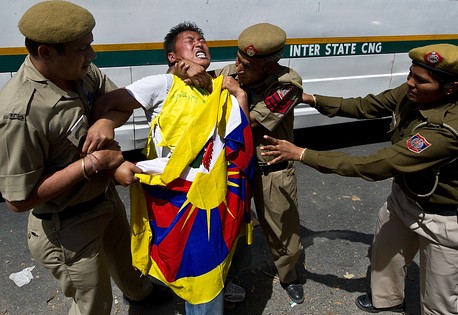
Inside its own borders, however, it further tarnished its credentials as a liberal democracy. Eager to avoid discomforting Chinese President Hu Jintao, in town for the annual BRICS (Brazil, Russia, India, China, South Africa) summit, New Delhi invoked a colonial-era law to impose a heavy-handed police lockdown of the Tibetan exile community. Police units sealed off Tibetan neighborhoods in the capital, denying residents the right of assembly and peaceful protest, or even free movement. People elsewhere in New Delhi who even looked Tibetan were harassed by police, an action that the Delhi High Court reprimanded as “racial profiling.”

Adopting the Chinese practice of rounding up dissidents in advance of politically-sensitive dates, Indian police placed over 300 Tibetans in preventive custody, including two Tibetan exiles who were detained while speaking at the Press Club of India. Tenzin Tsundue, an influential Tibetan poet, was forcibly dragged away while addressing a women’s forum. Tsewang Rigzin, an American citizen who serves as president of the Tibetan Youth Congress, was deported the moment he arrived at New Delhi’s international airport.

These measures – instituted after a Tibetan exile, Jamphel Yeshi, set himself ablaze at a large anti-Hu rally held near the Indian parliament – are the latest instance of the country’s timorous commitment to the ideals of free expression. The past year has witnessed other notable examples, including the imbroglio over Salman Rushdie’s abortive appearance at the Jaipur Literary Festival as well as the invective directed at Joseph Lelyveld’s biography of Mahatma Gandhi. The Hindu newspaper called the Rushdie affair “a national shame” and charged that “India has again betrayed its heritage of providing sanctuary to persecuted individuals and ideas, not to speak of its Constitution.” More


Wednesday, March 28, 2012

Tibet, India, China, and the Yearning for Freedom

Jamphel Yeshi was one of the hundreds of Tibetans who gathered in New Delhi earlier this week to demonstrate against Chinese president Hu Jintao’s visit to India as part of the annual BRICS summit. As the Indian police attempted to thwart their peaceful protest, Yeshi doused himself with kerosene and set fire to his body. Engulfed in flames, he charged through the street, screaming pro-freedom slogans – and joined the dozens who have immolated their bodies to draw attention to the brutal crackdown in Tibet by Chinese forces.

India spent the last decade trumpeting its democracy as it steered closer to the United States. And yet its response to Yeshi’s sacrifice would make a dictator proud. Eager to not offend the visiting Chinese head of state, India invoked a colonial-era law against the Tibetans in New Delhi. As of today, every Tibetan in the city is effectively under house arrest.

Students are holed up inside their hostels. Families are barred from leaving their homes. Children have been forced to miss school. Patients cannot visit the hospital. Any gathering of Tibetans – however small and whatever its purpose – is cause for arrest.

In America’s imagination, India often appears as the democratic counterweight to authoritarian China’s rise. “If America’s future competitor in the world is likely to be China,” Robert Kagan recently wrote in a celebrated essay, “then a richer and more powerful India will be an asset, not a liability, to the United States.”

In reality, it was a considerably poorer and weaker India that ever truly challenged China in the name of liberal democratic values. India granted asylum to the Dalai Lama in 1959 despite Zhou Enlai’s threats, and Beijing’s persistent demand that Tibetans be banned from protesting against China elicited a brief answer from India’s foreign office: “There is by law and Constitution complete freedom of expression of opinion in Parliament and the press and elsewhere in India”. More