Wednesday, May 7, 2014
 © 2014
Monday, May 5, 2014
The Woman Who Breaks Mega-Dams
Ruth Buendía Mestoquiari has built her career, and staked the fate of her people, on the law.
 |
| Ruth Buendía Mestoquiari |
But she doesn't have a law degree. In fact, she didn't even start elementary school until she was a teenager and didn't finish high school until age 25. While her peers went to class, she spent her childhood in the 1980s and 90s shuttling between her native village of Cutivireni, the town of Satipo, and the city of Lima, as Peru's two-decade civil war devastated her community and claimed her father, who was killed in the violence when Buendía was only 12.
What Buendía does have is five children, all 18 and younger, and a "wonderful husband." She has the distinction of being the first female president of CARE, an organization representing roughly 10,000 indigenous Asháninka who live along the banks of the Ene River in the Peruvian Amazon. And she has a knack for blocking massive hydroelectric dams, having thwarted not one but two planned projects that she believed would displace the Asháninka and destroy the ancestral lands they depend on for their livelihoods. It's a threat she characterizes as "economic terrorism," in an allusion to the armed terrorism she experienced during the civil war.
Through it all, she's managed to redeem what we've come to consider something of a dark art: the lawsuit.
The 37-year-old, who received a Goldman Environmental Prize this week for her efforts, has employed several tactics in her duels with the dams, which were first proposed as part of an energy agreement between Peru and Brazil in 2010. She's marshaled technology, using a laptop and computer simulation to show constituents how the dams would flood the Ene River Valley. She's courted media attention, established international partnerships, and mobilized her people in regional assemblies.

But above all, she's insisted, again and again, that she has the law on her side—specifically an International Labor Organization treaty that Peru ratified in 1994 andnational legislation that the country passed in 2011. Both require the government to consult with indigenous communities before launching development projects—be they infrastructure initiatives or mining concessions—that will affect them. The concept is known as "prior consultation."
Buendía's primary argument isn't that the dams are illegal per se, but rather that Peruvian authorities must first secure her people's consent about how the projects should proceed—if, that is, there are grounds to proceed in the first place. By filing lawsuits in Peruvian courts with the help of legal advisors and making her case to bodies like the D.C.-based Inter-American Commission on Human Rights, Buendía has pressured Peruvian officials and Brazilian companies to halt the construction of the Pakitzapango and Tambo-40 dams—at least for now.
In prioritizing legal strategies over others, Buendía's key insight is to fight fire with fire. After all, the proposed dams are a product of a compact between governments—a 50-year energy agreement that Peru and Brazil struck in 2010. The plan was for Brazilian corporations to dam rivers in the Amazon rainforest in Peru and produce up to 7,200 megawatts of hydropower.
Peru's leaders trumpeted the numerous benefits the dams would bring: Brazilian companies would be investing heavily in one of the country's few energy sources—its rivers—and leveraging a renewable energy source at that. The projects would create thousands of jobs for Peruvians and bring affordable energy to rural areas. But under the deal, most of the power generated would have been exported to Brazil. And the Asháninka, along with several studies by conservation groups, have warned of the grave environmental and social impacts of the plants. The dams, for instance, could flood the surrounding jungle, submerging arable land, threatening water quality, endangering the forest's biodiversity and the rivers' fish populations, and forcing Asháninka to migrate.
"They think we're going to break windows and protest like in Conga, but we aren't,” Buendía told The New York Times in 2012, in reference to fierce demonstrations in northern Peru against a gold-mine project. "Just as they do to us with legal documents we are going to do to them."
International treaties and national laws have granted the Asháninka rights, she reasons. Now it's up to the Asháninka to apply the law. More

Sunday, May 4, 2014
The Jewish National Fund’s list of projects in the settlements
On its website, The Jewish National Fund (JNF-KKL) presents itself as an environmental friendly non-governmental organization, with deep roots in Zionist history. The JNF often leads supporters and donors to believe that it does not fund projects in the occupied territories, which are highly controversial even among Zionists.

In the past, the JNF used sub-contractors for projects across the Green Line, including ones that demanded the evacuation of Palestinian families from their homes in East Jerusalem.
However, a 2012 document obtained by investigative journalist Raviv Druker reveals a list of projects in the settlements funded by the Jewish National Fund. In some cases, the JNF even insists on public credit for the projects.
Here is a link to the Hebrew document on Raviv Druker’s blog (PDF). These are the projects themselves (I added some of the locations of the settlements in brackets):
1. Amphitheatre in Shilo – 2 million NIS
2. Infrastructure projects in Ariel – 4.5 million NIS
3. Central Park in Avnei Hefetz [near Tulkarem] – 2.5 million NIS
4. Promenade in Gush Ezion [south of Jerusalem]: 250,000 NIS. Will be called “JNF Promenade”.
5. Promenade in Kfar Adumin [East of Jerusalem]: almost 1.5 million NIS.
6. Bike Lane in the Mateh Binyamin Regional Council: 1.7 million NIS.
7. Agriculture farm in Eitam: 2.5 million NIS
8. A park and observation point in Mitzpe Yericho [near Jericho]: 600,000 NIS
9. Historical site in Rosh Tzurim [near Bethlehem]: 400,000 NIS
10. Habanim Park in Hebron: 700,000 NIS
11. Infrastructure work in Alon Moreh’s Yeshiva [near Nablus]: 300,000 NIS
12. Public ground in Shavei Shomron: 350,000 NIS
13. Public ground in Har Bracha [near Nablus]: Almost 1 million NIS
14. Kikar Park in Beit El (near Ramallah]: 120,000 NIS.
This is, according to Druker, from 2012. Recently, he says, “the rate of investments has grown.”
The context for the publication is Tzipi Linvi’s attempt to extend the State’s Comptroller’s oversight to the JNF – claiming that the fund is an arm of the government (it is), so it must be audited like any other. Housing Minister Uri Ariel of the settlers’ Jewish Home party opposes the move, claiming that JNF is involved in important activities that should be kept out of the public’s eye. Now we know what he means.
Related
Despite denials, JNF to continue eviction effort of J’lem Palestinians
Lying by omission: The JNF’s role in setting Negev land policy
For additional original analysis and breaking news, visit +972 Magazine's Facebook page or follow us on Twitter.
Thursday, May 1, 2014
Anti-Palestinian arson attacks on the rise
This week, Giacinto-Boulos Marcuzzo, the Roman Catholic Bishop of Nazareth had a note delivered at his home, warning that he and his followers had until May 5 to leave the “land of Israel”. On Tuesday April 29, Israeli police announced that a Jewish man from Safed had been arrested after delivering the note.
 |
| Jonathan Cook |
In a similar incident, vandals also targeted a church at Tabgha on the Sea of Galilee that marks the site where Christians believe Jesus performed the miracle of the loaves and fishes. A cross was smashed and several pews damaged.
“The Christian community feels increasingly threatened,” Samuel Barhoum, the Episcopalian archdeacon of Jerusalem, told Al Jazeera. “We see that Israel is going further and further to the right. It does not matter whether you are Muslim or Christian, in these people’s eyes we are the enemy.”
A wave of violence over the past fortnight, including attacks on two mosques and a church, has shocked Israel’s Palestinian citizens, who comprise a fifth of the population, and raised fears that Israeli right-wing extremists are growing bolder as they shift attention to targeting Palestinian areas inside Israel.
One such incident took place in Umm al-Fahm, the second largest Palestinian city in Israel.
‘Dangerous epidemic’
On April 18, Palestinian worshippers, arriving at the Araq al-Shabab mosque in Umm al-Fahm for morning prayers, discovered the mosque had been the target of an arson attack. The doors, according to Jamil Mahajana, the local imam, were still smouldering and the words “Arabs out!” had been sprayed nearby.
The attacks prompted Amir Peretz, a dovish minister in Israel’s government, to speak out, warning that violence by Jewish extremists had become a “dangerous epidemic”.
Palestinians have been protesting against the attacks and demanding action. This week, some 2,500 residents of Fureidis, a town south of Haifa, marched to demand action from the police and the government of Israeli Prime Minister Benjamin Netanyahu, the day after a local mosque was defaced with a Star of David and graffiti saying “Shut down mosques”. Some 20 cars parked nearby had their tyres slashed.
The protesters chanted, “Netanyahu is a coward” and “Racism is spreading.”
Mohammed Barakeh, a Palestinian member of Israel’s parliament who led a protest last week in Umm al-Fahm, personally blamed Netanyahu for the spate of attacks.
“Extremist groups are being encouraged by Netanyahu’s constant sloganeering that Israel is a Jewish state, suggesting that an Arab population has no right to be here,” Barakeh told Al Jazeera.
“The extremists see Netanyahu has made recognition of Israel’s Jewishness a central demand in the peace talks. They see the racist legislation his government adopts. They see the police do nothing to tackle this phenomenon. And they conclude that the government quietly approves of their behaviour.”
Price-tag campaign
In January, a report by a United Nations agency, OCHA, documented 2,100 incidents of settler violence in the occupied territories alone since 2006.
Right-wing extremists describe violence against Palestinians, whether in the occupied territories or in Israel, as “price tag” attacks. The term is meant to indicate that there will be a cost to Palestinians if either the power of the settlers is challenged or the Palestinians seek diplomatic concessions from Israel.
The first major price-tag attack inside Israel occurred in late 2011, when a mosque in the Galilee village of Tuba-Zangaria was set on fire. No one has been charged for the attack.
There may be several possible triggers for this current wave of attacks, including the Israeli right’s concern that the peace talks, which formally came to an end this week, do not make headway. Jewish nationalists are also reportedly angry at the impending visit of the pope.
Israeli officials have indicated recently that they intend to take price-tag attacks more seriously, after several outbreaks of violence by extremist settlers against Israeli security forces. In the most recent incident last month, police were beaten as they tried to demolish unauthorised buildings in the militant settlement of Yitzhar.
‘Acts of terror’
In response, Israeli Defence Minister Moshe Yaalon said he was considering – for the first time – using administrative detention orders against right-wing extremists. That would allow them to be locked up on secret evidence, as is currently the case with the Palestinians.
However, the government has so far refused to categorise settler violence as “acts of terror”, which would give the security forces stronger powers. During a cabinet debate on the subject last summer, Netanyahu reportedly said such a move would be a diplomatic mistake, encouraging observers to draw a comparison between the settlers and the Palestinian movement Hamas.
Micky Rosenfeld, a spokesman for the Israeli police, confirmed that there has been a recent “escalation” in violence by hardline nationalists inside Israel, as well as in occupied Jerusalem and the West Bank.
Rosenfeld denied that the police were not doing enough to stop the attacks. A special task force was established last year to investigate price-tag attacks. Its activities, however, are limited to the West Bank. Police say they face serious difficulties in tracking down suspects.
“There is no network planning these incidents. They are sporadic and committed by individuals who often decide on the spur of the moment to carry out an attack,” said Rosenfeld.
Calling the attacks “unsettling”, Netanyahu promised that the government would invest more resources, including bringing in the Shin Bet, the domestic intelligence service that is more commonly used against Palestinians.
Palestinian leaders, however, accused Israeli authorities of repeatedly turning a blind eye to attacks by Jewish extremist groups. “If these crimes were being committed by Palestinians against Jews, the culprits would be caught within hours or days,” said Awad Abdel Fattah, a member of the Higher Follow-Up Committee, the main political body for Palestinians inside Israel. More
Monday, April 28, 2014
Karen Greenberg, Abu Ghraib Never Left Us
In mid-April, Abu Ghraib was closed down. It was a grim end for the Iraqi prison where the Bush administration gave autocrat Saddam Hussein a run for his money.

The Iraqi government feared it might be overrun by an al-Qaeda offshoot that calls itself the Islamic State of Iraq and the Levant. By then, the city of Fallujah for which American troops had fought two bitter, pitched battles back in 2004 had been in the hands of those black-flag-flying insurgents for months. Needless to say, the American project in Iraq, begun so gloriously -- remember Iraqi exiles assuring Vice President Cheney that the invaders would be greeted with “sweets and flowers” -- was truly in ruins. By then, hundreds of thousands had died in the aftermath of the 2003 invasion, the insurgencies that followed, and the grimmest of sectarian civil wars. And the temperature was rising anew in that divided land, where only the Kurdish north was relatively peaceful. Iraq was once again threatening to fracture, with suicide bombers and car bombs daily occurrences, especially in Shiite areas of the country, and the body count rising rapidly.
The legacy of America’s Iraq is essentially an oil-producing wreck of a state withanother autocrat in power, a Shiite government allied to Iran in Baghdad, and a Sunni population in revolt. That, in short, is the upshot of Washington’s multi-trillion-dollar war. It might be worth a painting by George W. Bush. Or maybe the former president should reserve his next round of oils not for the world leaders he met (and Googled), but for those iconic photos from the prison that might have closed in Iraq, but will never close in the American mind. From the torture troves of Abu Ghraib, there are so many scenes that the former president could focus on in his days of tranquil retirement.
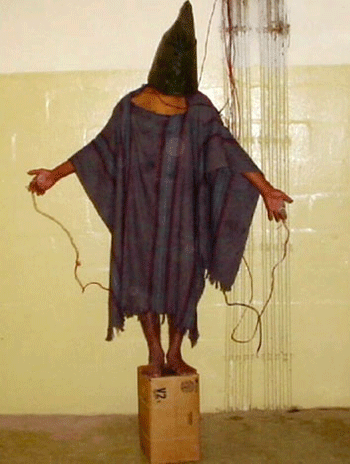


Those photos from hell were, at the time, so run-of-the-mill for the new American Iraq (“as common as cornflakes”) that they were used as screen-savers by U.S. military guards at that prison. The images then returned to the United States as computer "wallpaper" before making it onto "60 Minutes II" and into our collective brains. They revealed to this country for the first time that, post-9/11, Washington had taken a cue from the Marquis de Sade and any other set of sadists you cared to invoke. Of course, the photos and the systematic torture and abuse that went with them at Abu Ghraib were quickly blamed on the usual “few bad apples” and “some hillbilly kids out of control.”
As it happened, those photos that first entered public consciousness 10 years ago this week exposed a genuine American nightmare that led right to the top in Washington and has never ended. Included in the debacle were Justice Department lawyers who, at the bidding of the highest officials in the land, redefined torture in remarkable ways. They made it clear, for instance, that the only person who could affirm whether torture had actually taken place was the torturer himself. (If he didn’t think he had tortured, he hadn’t, or so the reasoning then went.)
No one has followed this endlessly grim tale more assiduously than TomDispatch regular Karen Greenberg, the chronicler of the creation of the prison at Guantanamo Bay and the editor of The Torture Papers: The Road to Abu Ghraib. Today, she explores the shameful tale of why, a decade later, the Abu Ghraib affair remains without an end. Tom
The Road From Abu GhraibA Torture Story Without a Hero or an EndingIt’s mind-boggling. Torture is still up for grabs in America. No one questions anymore whether the CIA waterboarded one individual 83 times or another 186 times. The basic facts are no longer in dispute either by those who champion torture or those who, like myself, despise the very idea of it. No one questions whether some individuals died being tortured in American custody. (They did.) No one questions that it was a national policy devised by those at the very highest levels of government. (It was.) But many, it seems, still believe that the torture policy, politely renamed in its heyday “the enhanced interrogation program,” was a good thing for the country.
Now, the nation awaits the newest chapter in the torture debate without having any idea whether it will close the book on American torture or open a path of pain and shame into the distant future. No one yet knows whether we will be allowed to awake from the nightmarish and unacceptable world of illegality and obfuscation into which torture and the network of offshore prisons, or “black sites,” plunged us all.
April 28th marks the tenth anniversary of the moment that the horrors of Abu Ghraib were made public in this country. On that day a decade ago, the TV news magazine "60 Minutes II" broadcast the first photographs from that American-run prison in “liberated” Iraq. They showed U.S. military personnel humiliating, hurting, and abusing Iraqi prisoners in a myriad of perverse ways. While American servicemen and women smiled and gave a thumbs up, naked men were threatened by dogs, or were hooded, forced into sexual positions, placed standing with wires attached to their bodies, or left bleeding on prison floors.
Thus began America’s public odyssey with torture, a story in many chapters and still missing an ending. As the Abu Ghraib anniversary nears and the White House, the CIA, and various senators still battleover the release of a summary of a 6,300-page report by the Senate Intelligence Committee on Bush-era torture policies, it’s worth considering the strange journey we’ve taken and wondering just where we as a nation mired in the legacy of torture might be headed.
Chapter One: Revelations
The odyssey started with the shock of those "60 Minutes II" photos, followed two days later by the reporting of veteran New Yorker writerSeymour Hersh. Having seen even more grim photographs and interviewed many in the chain of command stretching from Abu Ghraib to the Joint Chiefs of Staff and the Pentagon, Hersh painted a picture of a deliberate policy of abuse. He traced Abu Ghraib’s crimes to pressure from “military-intelligence teams, which included CIA officers and linguists and interrogation specialists from private defense contractors,” urging the production -- and fast -- of crucial information from U.S. captives in Iraq. Towards this end, the guards at Abu Ghraib were encouraged to “soften up” the detainees for interrogation.
That summer and fall of 2004, the Washington Post, the New York Times, the ACLU, and others got their hands on several Bush administration memos justifying and legalizing torture. These had largely been written by John Yoo and Jay Bybee, lawyers in the Office of Legal Counsel at the Department of Justice, and they proved grim reading indeed. The documents provided uniquely tortured definitions of torture that made almost any act in which the infliction of pain didn’t rise to the level of “organ failure, impairment of bodily function, or even death” acceptable. As if that weren’t enough, they developed no less tortured theories of executive power in which the president as commander-in-chief retained the right to authorize torture for national security reasons, despite its illegality under domestic, military, and international law.
With this anything-goes green light switched on, the memos proceeded to expressly approve individual methods of abuse (previously defined as torture) for American interrogators. Used in combination and repeatedly, these were known to destroy the human psyche and bring severe pain to the body as well. Specifically, they put the Bush administration’s stamp of approval on graphically described “techniques,” including sleep deprivation, slapping, the dangling of trussed prisoners from beams, and especially waterboarding, a process in which individuals essentially experience drowning, only to be saved at the last moment.
The trail of evidence went right to the top. The office of Defense Secretary Donald Rumsfeld told the interrogators of “the American Taliban,” John Walker Lindh, to “take the gloves off.” Vice President Dick Cheney, who famously said it was time to “work the dark side,” hasrepeatedly defended the policy of harsh interrogation techniques, including waterboarding, as effective and essential in keeping the nation safe. Top officials reportedly had various “enhanced interrogation techniques” demonstrated in the White House. The 2002 torture memos were addressed to White House Counsel and later Attorney General Alberto Gonzales. More
Friday, April 25, 2014
Everest avalanche: Climbers descend amid uncertainty
Climbers are descending from Everest base camp, amid uncertainty over this year's climbing season after 16 guides were killed in an avalanche.
 |
| Nepalese Guides discuss danger of their Jobs |
A row over local guides' share of revenue from foreign climbers erupted after last week's deadly accident, prompting some to threaten a boycott.
Sherpas also want better rescue and treatment facilities for guides.
If others descend, some fear it could effectively end plans to climb the world's highest mountain this year.
Ang Tshering Sherpa, the president of the Nepal Mountaineering Association (NMA), told BBC Nepali's Surendra Phuyal that was a distinct possibility if the majority of climbers decided to abandon climbing.
But Madhusudan Burlakoti, a tourism ministry official, hoped that some teams might still climb.
More than 300 foreign climbers were preparing to climb Everest this year, but the tense aftermath of the avalanche that killed 13 Sherpas and left 3 missing presumed dead dashed hopes and left many climbers disturbed and shocked, our correspondent reports.
Last Friday's avalanche was the single deadliest accident in modern mountaineering on the world's highest peak.
It struck an area just above Everest base camp at 5,800m (19,000ft).
Sherpa conditions
Sherpas can earn up to $8,000 (£4,800) in the three-month Everest climbing season, more than 10 times the average wage in Nepal, which remains one of Asia's poorest nations.
But BBC South Asia correspondent Andrew North says that does not look so good when the government is earning millions of dollars each year in fees for climbing permits. Some guiding companies charge clients up to $60,000 (£36,000) per person. Sherpas have also been angered by the government offering families of the victims $400 (£238) which will only cover funeral costs.
The guides who lost their lives had climbed up the slope early in the morning to fix ropes for climbers and prepare the route.
The avalanche struck a passage called the Khumbu Icefall, which is riddled with crevasses and ice boulders that can break free without warning.
Although relatively low on the mountain, it is one of its most dangerous points - but there are no safer paths along the famous South Col route first scaled by Sir Edmund Hillary and Tenzing Norgay in 1953.
Sherpas often make 20-25 round trips to carry kit and supplies to advanced camps, exposing them to greater risk. Everest has been scaled by more than 3,000 climbers since 1953.
__________________
The Government of Nepal brings in millions of dollars from climbing expaditions, but the Nepalese Sherpa Guides get only $8000 dollars per year for some of the most dangerous work on the planet.
Working in the 'death zone' high on Everest and where they are responsible for getting inexperienced climbers, some of whom they have to physically pull to the top and help back down, these men should be very well compensated and should be provided with health and life insurance. Furthermore, there should have first class medical and search and rescue (SAR) facilities available locally. Editor
Thursday, April 24, 2014
US Workers Were Once Massacred Fighting for the Protections Being Rolled Back Today
On April 20, 1914, the Colorado National Guard and a private militia employed by the Colorado Fuel & Iron Company (CF&I) opened fire on a tent camp of striking coal miners at Ludlow, Colo. At least 19 people died in the camp that day, mostly women and children.

A century later, the bloody incident might seem a relic of the distant past, but the Ludlow Massacre retains a powerful, disturbing and growing relevance to the present. After a century of struggling against powerful interests to make American workplaces safer and corporations responsive to their employees, the US is rapidly returning to the conditions of rampant exploitation that contributed to Ludlow.
That’s especially true in mining, where a coordinated union-busting campaign, the corporate capture of federal regulatory agencies, and widespread environmental degradation leave coal miners unsafe and mining communities struggling to deal with the massive environmental impact of modern mining practices.
A century ago, miners led the fight for workers’ rights. The Gilded Age of the late 19th and early 20th centuries was a period of great upheaval for the American working class. For decades, the United Mine Workers of America (UMWA) had worked to organize the nation’s coal miners. Its success often hinged on whether the government helped mining companies crush strikes or protected workers. In 1897, deputies in Luzerne County, Pa., killed 19 striking miners in the Lattimer Massacre. But five years later, when Pennsylvania miners struck again, President Theodore Roosevelt intervened on their behalf, providing them with a partial victory. Roosevelt’s actions, while hardly indicative a new pro-labor federal government, reflected a growing belief that labor deserved a fair shake.
On April 20, 1914, the Colorado National Guard and a private militia employed by the Colorado Fuel & Iron Company (CF&I) opened fire on a tent camp of striking coal miners at Ludlow, Colo. At least 19 people died in the camp that day, mostly women and children.
A century later, the bloody incident might seem a relic of the distant past, but the Ludlow Massacre retains a powerful, disturbing and growing relevance to the present. After a century of struggling against powerful interests to make American workplaces safer and corporations responsive to their employees, the US is rapidly returning to the conditions of rampant exploitation that contributed to Ludlow.
That’s especially true in mining, where a coordinated union-busting campaign, the corporate capture of federal regulatory agencies, and widespread environmental degradation leave coal miners unsafe and mining communities struggling to deal with the massive environmental impact of modern mining practices.
A century ago, miners led the fight for workers’ rights. The Gilded Age of the late 19th and early 20th centuries was a period of great upheaval for the American working class. For decades, the United Mine Workers of America (UMWA) had worked to organize the nation’s coal miners. Its success often hinged on whether the government helped mining companies crush strikes or protected workers. In 1897, deputies in Luzerne County, Pa., killed 19 striking miners in the Lattimer Massacre. But five years later, when Pennsylvania miners struck again, President Theodore Roosevelt intervened on their behalf, providing them with a partial victory. Roosevelt’s actions, while hardly indicative a new pro-labor federal government, reflected a growing belief that labor deserved a fair shake. More
Subscribe to:
Posts (Atom)