Showing posts with label Africa. Show all posts

Monday, October 12, 2015

Roy Sesana's Speech Is One of The Most Powerful I have Ever Read: This Is What Leadership Looks Like

By Roy Sesana / survivalinternational.org

Roy Sesana gave this speech when he accepted the Right Livelihood Award in Stockholm in 2005. We read this years ago and wanted to share it with you, because it's one of those rare speeches that we have wanted to read again and again over the years. It is profound and important beyond words.

Roy Sesana

Above all, it is so inspiring to us. This is what true leadership looks like. In its entirety it is wisdom that transcends time and culture, and perhaps that's why we think everyone will find something beautiful in this. - Films For Action

"My name is Roy Sesana; I am a Gana Bushman from the Kalahari in what is now called Botswana. In my language, my name is 'Tobee' and our land is 'T//amm'. We have been there longer than any people has been anywhere.

When I was young, I went to work in a mine. I put off my skins and wore clothes. But I went home after a while. Does that make me less Bushman? I don't think so.I am a leader. When I was a boy we did not need leaders and we lived well. Now we need them because our land is being stolen and we must struggle to survive. It doesn't mean I tell people what to do, it's the other way around: they tell me what I have to do to help them.

I cannot read. You wanted me to write this speech, so my friends helped, but I cannot read words – I'm sorry! But I do know how to read the land and the animals. All our children could. If they didn't, they would have all died long ago. I know many who can read words and many, like me, who can only read the land. Both are important. We are not backward or less intelligent: we live in exactly the same up-to-date year as you. I was going to say we all live under the same stars, but no, they're different, and there are many more in the Kalahari. The sun and moon are the same.

I grew up a hunter. All our boys and men were hunters. Hunting is going and talking to the animals. You don't steal. You go and ask. You set a trap or go with bow or spear. It can take days. You track the antelope. He knows you are there, he knows he has to give you his strength. But he runs and you have to run. As you run, you become like him. It can last hours and exhaust you both. You talk to him and look into his eyes. And then he knows he must give you his strength so your children can live. When I first hunted, I was not allowed to eat. Pieces of the steenbok were burnt with some roots and spread on my body. This is how I learned. It's not the same way you learn, but it works well.

The farmer says he is more advanced than the backward hunter, but I don't believe him. His herds give no more food than ours. The antelope are not our slaves, they do not wear bells on their necks and they can run faster than the lazy cow or the herder. We run through life together. When I wear the antelope horns, it helps me talk to my ancestors and they help me. The ancestors are so important: we would not be alive without them. Everyone knows this in their heart, but some have forgotten. Would any of us be here without our ancestors? I don't think so.

I was trained as a healer. You have to read the plants and the sand. You have to dig the roots and become fit. You put some of the root back for tomorrow, so one day your grandchildren can find it and eat. You learn what the land tells you. When the old die, we bury them and they become ancestors. When there is sickness, we dance and we talk to them; they speak through my blood. I touch the sick person and can find the illness and heal it.

We are the ancestors of our grandchildren's children. We look after them, just as our ancestors look after us. We aren't here for ourselves. We are here for each other and for the children of our grandchildren.

Why am I here? Because my people love their land, and without it we are dying. Many years ago, the president of Botswana said we could live on our ancestral land forever. We never needed anyone to tell us that. Of course we can live where God created us! But the next president said we must move and began forcing us away.

They said we had to go because of diamonds. Then they said we were killing too many animals: but that's not true. They say many things which aren't true. They said we had to move so the government could develop us. The president says unless we change we will perish like the dodo. I didn't know what a dodo was. But I found out: it was a bird which was wiped out by settlers. The president was right. They are killing us by forcing us off our land. We have been tortured and shot at. They arrested me and beat me.

Thank you for the Right Livelihood Award. It is global recognition of our struggle and will raise our voice throughout the world. When I heard I had won I had just been let out of prison. They say I am a criminal, as I stand here today.

I say what kind of development is it when the people live shorter lives than before? They catch HIV/AIDS. Our children are beaten in school and won't go there. Some become prostitutes. They are not allowed to hunt. They fight because they are bored and get drunk. They are starting to commit suicide. We never saw that before. It hurts to say this. Is this 'development'?

We are not primitive. We live differently to you, but we do not live exactly like our grandparents did, nor do you. Were your ancestors 'primitive'? I don't think so. We respect our ancestors. We love our children. This is the same for all people.

We now have to stop the government stealing our land: without it we will die.

If anyone has read a lot of books and thinks I am primitive because I have not read even one, then he should throw away those books and get one which says we are all brothers and sisters under God and we too have a right to live.

That is all. Thank you."

Roy Sesana - First People of the Kalahari, Botswana

http://www.filmsforaction.org/articles/roy-sesana-right-livelihood-speech/


Tuesday, October 1, 2013

Professor Paul Jackson: The unintended consequences of foreign intervention

After the horrors of the Westgate Mall attack in Nairobi, there will be inevitable questions about the nature of Islamic terrorism in East Africa. However, the attack itself is part of an on-going conflict in Kenya that in turn is part of a bigger regional conflagration based on Somalia. In fact the attack on the mall can be traced back to an international intervention that produced a number of unintended consequences, one of which has been the transformation of the group that perpetrated the attack, Al-Shabaab.

Kenyan troops at Westgate Mall

In fact the continued fighting in Somalia and the relative success of the African Union forces against Al-Shabaab fighters may have made the situation less stable and more dangerous for a number of reasons, not least because the movement may have splintered in to a number of cells capable of perpetrating terrorist atrocities rather than holding territory.

What of Al-Shabaab itself? A rather shady organisation that grew out of the youth wing (‘shabaab’ means ‘youth’) of a wider organisation, al-Ittihad al-Islami, one of the Somali extremist groups that existed in the 1980s and 90s, al-Shabaab itself remained relatively unimportant until 2007 following the invasion of Somalia by Ethiopian troops. At that time, al-Shabaab was serving as the military wing of a group known as the Islamic Courts Union (ICU), which established a form of governance within Mogadishu and in parts of the countryside. Following the Ethiopian invasion, the ICU collapsed and al-Shabaab took up arms against the Ethiopian forces, retreating in to a swampy area in the South.

At this point, the movement runs a very conventional guerrilla war against the Ethiopians, at various times supported by the Eritreans in a proxy war against her Ethiopian rival. However, the growing prominence of al-Shabaab and its Islamic roots make it fertile ground for the growth of Al-Qaeda links, as part of a regional spread of Islamic radicalism from Yemen, into the Horn and down the East coast. The increased links are attended by a change in philosophy of violence and a move to the use of suicide bombing as a means of spreading terror at the same time as continuing its conventional warfare against international forces.

In 2008 al-Shabaab mounts a series of suicide bombings against government offices and international agencies as well as the Ethiopian consulate, stating that the attacks are retaliation against the international community for the invasion of Somalia. With the advent of AMISOM in Somalia and African Union troops from Uganda and Burundi, al-Shabaab widened its terrorist campaign and in 2010 mounted its first international attack against an Ethiopian restaurant and rugby club in Uganda.

The AMISOM forces have been very successful on the ground in Somalia and al-Shabaab does not control the same level of territory as they did in 2008. The Kenyan military incursion that started in 2011 has been particularly successful, with the effective Kenyan military pushing back the fighters significantly, including capturing one of al-Shabaab’s last strongholds, Kismayo, a key source of revenue. It was this that led al-Shabaab to call the Westgate attack revenge for Kenyan involvement in Somalia.

The horrific attack can therefore be traced right back to an international intervention in a regional conflict. Not only does this point to a close link between terrorism and more conventional warfare, but also to the transnational nature of much conflict within Africa. The purpose of the attack itself was clearly to send a signal to the Kenyans that they should not send troops to Somalia, and yet it was also a signal that the African Union Somali offensive was being successful.

Losing territory and increasingly unable to hold territory against troops, al-Shabaab has been forced to rethink its strategy. Unfortunately the most logical model for a new strategy is localised cells of terrorists, usually connected to the Somali diaspora, which is very developed following twenty years of conflict. There are approximately 250,000 Somalis in Nairobi alone, which could provide a fertile breeding ground for radicalism, let alone other groups in Uganda and Tanzania.

The blueprint for this type of incident was the Mumbai hotel attack of 2008, which showed the weakness of many public areas frequented by westerners and wealthy locals and was capable of provoking an over-reaction by security forces that could lead to further radicalisation. More


Friday, March 8, 2013

US Drone Strikes Putting 'Global Order At Risk', Warn European Politicians

The United States is putting "global stability and international order at risk" by pursuing a policy of targeted extrajudicial drone strikes against suspected terrorists, European politicians have warned.

At least to 3,000 people, including a large number of civilians, are said to have been killed by controversial CIA drone strikes in Pakistan, Somalia and Yemen since 2004.

This week members of the European Parliament said they were "deeply concerned about the legal basis, as well as the moral, ethical and human rights implications" of the drone attacks and urged European Union member states to "contest the US attempt to pervert international law".

In a statement the MEPs said: "We cannot remain silent. The European Union and its Member States must speak up against a practice that will set a dangerous and unwelcome precedent for International Law."

British MEP Baroness Sarah Ludford, the Liberal Democrat European justice and human rights spokeswoman, said on Friday: "US drone killings operate in disregard of the long-established international legal framework about when it is lawful to kill people. This sets an extremely dangerous precedent and risks a destabilising effect on international relations. It could even furnish Al-Qaida with a licence to kill in return."

"European complicity in the ‘War on Terror’ after 9/11, in defiance of legal norms whereby terrorist criminals must be brought to justice through due process, still haunts Europe as well as the US. It is incredible that the US is making renewed and reckless attempts to rewrite the international legal code, and we could get hurt again too."

"Without agreed law the international community cannot hope to justify military action and prevent human rights abuses. As leaders of that community along with the US, the EU and its Member States must boldly state their opposition to this programme, which disregards our common international legal heritage. Silence will be taken as European acquiescence, with potentially disastrous results."

The condemnation came after a briefing in Brussels from United Nations Special Rapporteur for Counter Terrorism and Human Rights, Ben Emmerson QC, who is conducting a UN investigation into the UK and US policy of targeted killings.

Senior British parliamentarians have also raised concerns in Westminster over president Obama's use of drones in Pakistan. Former British Foreign Office minister Baroness Kinnock of Holyhead has warned "action must be taken to ensure that there is accountability and reparations when a drone attack goes wrong".

And Lord West of Spithead, the former head of the Royal Navy and a security minister in the last Labour government, told the House of Lords last month: "War is horrible. Death is horrible. Being involved in the risk is horrible. When one does this remotely from a leafy suburb in your own country and killing people that does make it remote and that does have huge implications and is very worrying and needs a lot of control."

The House of Commons defence committee announced it would conduct an investigation into the British military's use of drones after the RAF decided to expand its use and number of Unmanned Ariel Vehicles.

Pressed by MPs and peers, the UK government has insisted it has only used its own drones inside Afghanistan as the British military's presence there is at the request of the Afghan government. However British intelligence agencies have been accused of passing information to the CIA to help the Americans carry out strikes in Pakistan.

And last month it was reported the UK had a policy of stripping British citizens of their passports on national security grounds - two of who were then killed by US drones.

President Obama's use of drones has recently climbed up the American news agenda following the controversial confirmation of John Brennan as head of the Central Intelligence Agency and Republican senator Rand Paul's thirteen hour senate filibuster against extrajudicial drone killings.

Brennan has previously claimed that no civilians have been killed by drones, based on the Obama administration's decision to designate every military-age male in the target area as a combatant.

On Thursday the White House tried to shut down the debate over whether, as had been initially suggested, Obama had the power to order a drone strike on US soil.

A series of HuffPost/YouGov surveys showed that while a majority of Americans support their use to kill people suspected of being "high-level members of al Qaeda", this is reversed if they are told civilians are at risk of being killed. More


Thursday, October 4, 2012

Owen Jones: William Hague is wrong... we must own up to our brutal colonial past

Remember all that national soul-searching and self-flagellation over Empire and all the horrors committed in its name? No, me neither.


But this is the fictional Britain that has been conjured up by our Foreign Secretary, William Hague. "We have to get out of this post-colonial guilt," he declared in Friday's Evening Standard. "Be confident in ourselves."

Here is an echo of Gordon Brown's assertion in 2005 that "the days of Britain having to apologise for its colonial history are over". It was a straw man argument, because there has never been an apology for British imperialism. The British Empire has been virtually erased by collective amnesia; like an embarrassing, sordid secret that should never be mentioned in polite company. A foreign country such as Turkey can rightly be berated for failing to come to terms with an atrocity like the Armenian genocide, but the darkest moments of our own history are intentionally forgotten.

Consider India, the "jewel in the crown" of the British Empire. At the beginning of the 18th-century – before it was conquered – its share of the world economy was well over a fifth, nearly as large as all of Europe put together. By the time the country won independence, it had dropped to less than 4 per cent. India was treated as a cash cow; the revenues that flowed into London's Treasury were described by the Earl of Chatham as "the redemption of a nation… a kind of gift from heaven". By the end of the 19th-century, India was the world's biggest buyer of British exports and provided highly paid work for British civil servants – all at India's expense.

As India became increasingly crucial to British prosperity, millions of Indians died completely unnecessary deaths. Over a decade ago, Mike Davis wrote a seminal book entitled Late Victorian Holocausts: the title is far from hyperbole. As a result of laissez-faire economic policies ruthlessly enforced by Britain, between 12 and 29 million Indians died of starvation needlessly. Millions of tons of wheat were exported to Britain even as famine raged. When relief camps were set up, the inhabitants were barely fed and nearly all died.

The last large-scale famine to take place in India was under British rule; none has taken place since. Up to four million Bengalis starved to death in 1943 after Winston Churchill diverted food to well-fed British soldiers and countries such as Greece. "The starvation of anyway underfed Bengalis is less serious" than that of "sturdy Greeks", he argued. "I hate Indians. They are a beastly people with a beastly religion," he said to his Secretary of State for India, Leopold Amery. In any case, the famine was their fault for "breeding like rabbits". Churchill had form: back in 1919, he declared himself "strongly in favour of using poisoned gas against uncivilised tribes", arguing that it would "spread a lively terror".

We normally associate "concentration camps" with the Nazis, but the term entered into general circulation because of the British. During the Boer War at the turn of the 20th-century, up to a sixth of the Boer population – mainly women and children – perished after the British imprisoned them in camps. Their homes, farms and crops were burned, their sheep and cattle butchered in a scorched earth policy.

Elsewhere in Africa, British rule could be just as cruel. Two decades before helping to send hundreds of thousands of British Tommies to their deaths, Lord Kitchener led a brutal campaign to seize the Sudan. As historian Piers Brendon put it his The Decline and Fall of the British Empire, "British punitive expeditions in the Sudan" were extremely brutal, "at times amounting almost to genocide".

These sorts of atrocities are not all part of some distant past. In July, three survivors of the 1950s Mau Mau uprising against British rule in Kenya demanded reparations from the Government for alleged torture. In the brutal crackdown of the insurgency, thousands of members of the Kikuyu tribe were driven into detention camps, described by Harvard historian Caroline Elkins as "Britain's gulag". Estimates of deaths vary widely; historian David Anderson puts the death toll at 20,000, but Elkins believes up to 100,000 could have died. Despite courageous opposition from Labour's Barbara Castle and – oddly enough – Tory right-winger Enoch Powell, British crimes were hidden from the population back home in favour of a daily diet of Mau Mau atrocities.

Millions were forced to collect sap from rubber plants; those that missed their quotas had their hands chopped off.

None of this is to single out Britain: a conspiracy of silence remains over European colonialism as a whole. Most have never heard of Belgium's King Leopold II, but he should be regarded as a tyrant up there with Hitler and Stalin. Under his tyrannical rule over the modern-day Democratic Republic of Congo, about 10 million people – or half the population – died horrible deaths. Millions were forced to collect sap from rubber plants; those that missed their quotas had their hands chopped off. It is difficult to know where to start with other European horrors, like the forgotten German genocide against the Herero and Nama people in South-West Africa in the early 1900s, or the post-war French slaughter of hundreds of thousands in Indochina and Algeria. More


Friday, August 17, 2012

Cover-Up of Civilian Drone Deaths Revealed by New Evidence

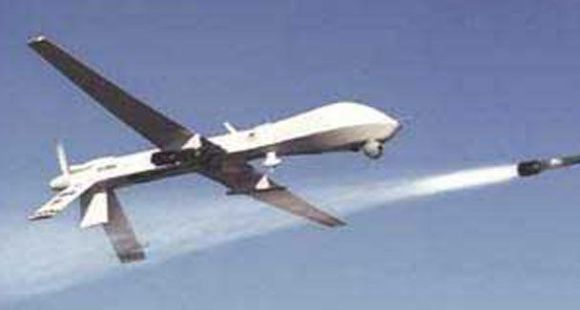
An aerial drone launches from the guided-missile frigate USS Thach. (Photo: U.S. Navy / Flickr)Detailed information from the families of those killed in drone strikes in Pakistan and from local sources on strikes that have targeted mourners and rescue workers provides credible new evidence that the majority of the deaths in the drone war in Pakistan have been civilian noncombatants - not “militants,” as the Obama administration has claimed.

The new evidence also shows that the statistical tally of casualties from drone attacks in Pakistan published on the web site of the New America Foundation (NAF) has been systematically understating the deaths of large numbers of civilians by using a methodology that methodically counts them as “militants.”

The sharply revised picture of drone casualties conveyed by the two new primary sources is further bolstered by the recent revelation that the Obama administration adopted a new practice in 2009 of automatically considering any military-age male killed in a drone strike as a “militant” unless intelligence proves otherwise.

The detailed data from the two unrelated sources covering a total 24 drone strikes from 2008 through 2011 show that civilian casualties accounted for 74 percent of the death toll, whereas the NAF tally for the same 24 strikes showed civilian casualties accounted for only 30 percent of the total.

Drone launches from the frigate USS Thach
The data on 11 drone strikes from 2008 through 2011 were collected in 2010 and 2011 from families of victims of the strikes by Pakistani lawyer Mirza Shahzad Akbar. Those 11 cases represent only a fraction of the total number on which Akbar has obtained data from victim’s relatives.

Although relatives of drone strike victims could have a personal interest in declaring the innocence of their relatives, the details provided by relatives in legal affidavits, such as the age, employment and other characteristics of the victims, appear in almost every case to support their claims that those killed were not actively involved with al-Qaeda or other military organizations.

The data on 13 drone strikes targeting rescuers and mourners from 2009 through 2011 were gathered by the London-based Bureau of Investigative Journalism (BIJ) in a three-month investigation in late 2010 and early 2011 involving interviews with eyewitnesses and others with direct knowledge of the strikes. More