Showing posts with label Drones. Show all posts

Tuesday, August 11, 2015

To avoid counting civilian deaths, Obama re-defined “militant” to mean “all military-age males in a strike zone

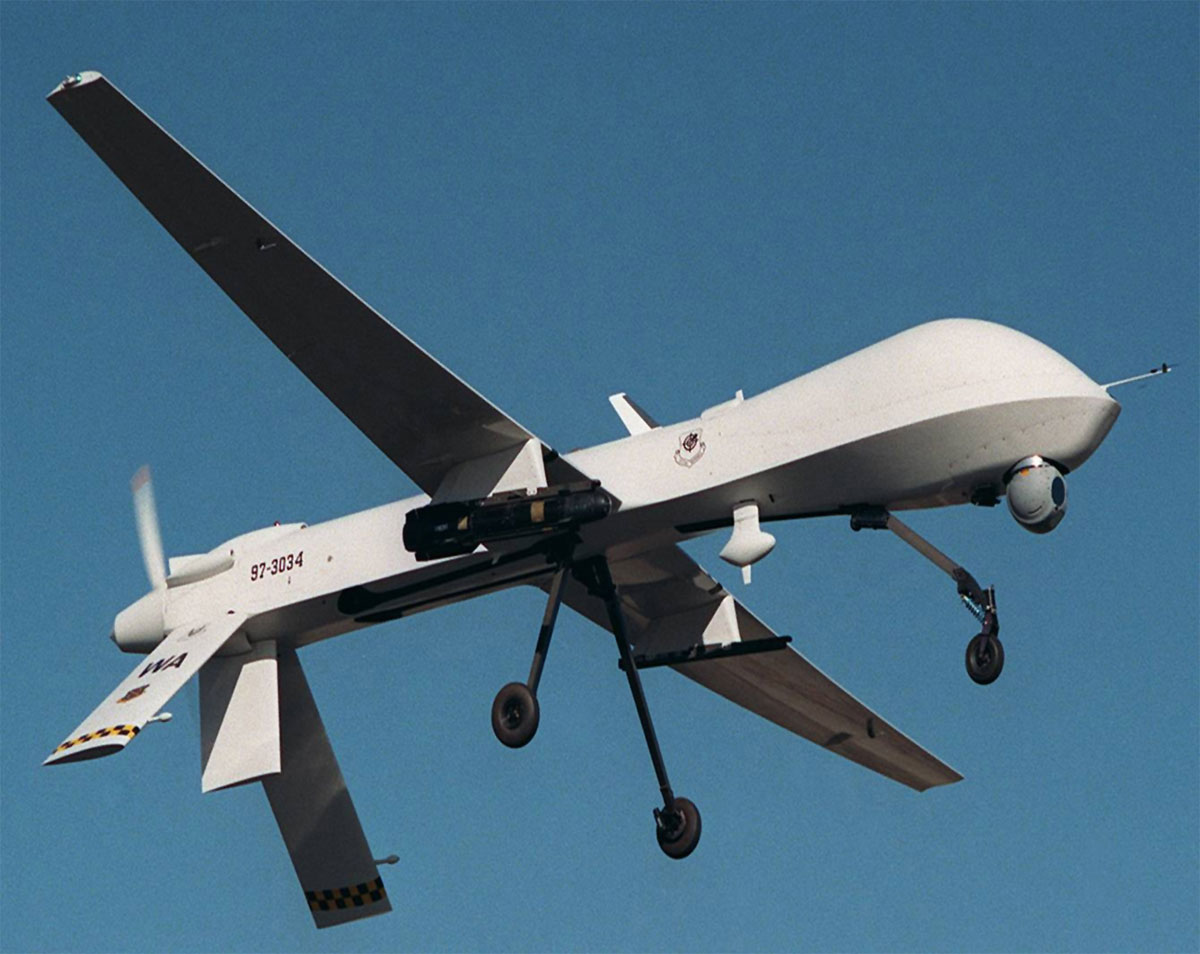
Virtually every time the U.S. fires a missile from a drone and ends the lives of Muslims, American media outlets dutifully trumpet in headlines that the dead were "militants" — even though those media outlets literally do not have the slightest idea of who was actually killed.

They simply cite always-unnamed "officials" claiming that the dead were "militants." It’s the most obvious and inexcusable form of rank propaganda: media outlets continuously propagating a vital claim without having the slightest idea if it’s true.

This practice continues even though key Obama officials have been caught lying, a term used advisedly, about how many civilians they’re killing. I’ve written and said many times before that in American media discourse, the definition of "militant" is any human being whose life is extinguished when an American missile or bomb detonates (that term was even used when Anwar Awlaki’s 16-year-old American son, Abdulrahman, was killed by a U.S. drone in Yemen two weeks after a drone killed his father, even though nobody claims the teenager was anything but completely innocent: "Another U.S. Drone Strike Kills Militants in Yemen").

This morning, the New York Times has a very lengthy and detailed article about President Obama’s counter-Terrorism policies based on interviews with "three dozen of his current and former advisers." I’m writing separately about the numerous revelations contained in that article, but want specifically to highlight this one vital passage about how the Obama administration determines who is a "militant." The article explains that Obama’s rhetorical emphasis on avoiding civilian deaths "did not significantly change" the drone program, because Obama himself simply expanded the definition of a "militant" to ensure that it includes virtually everyone killed by his drone strikes. Just read this remarkable passage;

Mr. Obama embraced a disputed method for counting civilian casualties that did little to box him in. It in effect counts all military-age males in a strike zone as combatants, according to several administration officials, unless there is explicit intelligence posthumously proving them innocent.

Counterterrorism officials insist this approach is one of simple logic: people in an area of known terrorist activity, or found with a top Qaeda operative, are probably up to no good. "Al Qaeda is an insular, paranoid organization — innocent neighbors don’t hitchhike rides in the back of trucks headed for the border with guns and bombs," said one official, who requested anonymity to speak about what is still a classified program.

This counting method may partly explain the official claims of extraordinarily low collateral deaths. In a speech last year Mr. Brennan, Mr. Obama’s trusted adviser, said that not a single noncombatant had been killed in a year of strikes. And in a recent interview, a senior administration official said that the number of civilians killed in drone strikes in Pakistan under Mr. Obama was in the "single digits" — and that independent counts of scores or hundreds of civilian deaths unwittingly draw on false propaganda claims by militants.

But in interviews, three former senior intelligence officials expressed disbelief that the number could be so low. The C.I.A. accounting has so troubled some administration officials outside the agency that they have brought their concerns to the White House. One called it "guilt by association" that has led to "deceptive" estimates of civilian casualties.

"It bothers me when they say there were seven guys, so they must all be militants," the official said. "They count the corpses and they’re not really sure who they are."

For the moment, leave the ethical issues to the side that arise from viewing "all military-age males in a strike zone as combatants"; that’s nothing less than sociopathic, a term I use advisedly, but I discuss that in the separate, longer piece I’ve written. For now, consider what this means for American media outlets. Any of them which use the term "militants" to describe those killed by U.S. strikes are knowingly disseminating a false and misleading term of propaganda. By "militant," the Obama administration literally means nothing more than: any military-age male whom we kill, even when we know nothing else about them. They have no idea whether the person killed is really a militant: if they’re male and of a certain age they just call them one in order to whitewash their behavior and propagandize the citizenry (unless conclusive evidence somehow later emerges proving their innocence).

What kind of self-respecting media outlet would be party to this practice? Here’s the New York Times documenting that this is what the term "militant" means when used by government officials. Any media outlet that continues using it while knowing this is explicitly choosing to be an instrument for state propaganda — not that that’s anything new, but this makes this clearer than it’s ever been. More


Wednesday, April 22, 2015

The Human Cost of Secret U.S. Drone Strikes in Yemen


For more than a decade now, the United States has been using armed drones to secretly kill suspected terrorists in Yemen. The public knows very little about these attacks. Neither the U.S. nor the Yemeni government has systematically disclosed who was killed and why, or whether civilians were among those killed.

Now, working with the Open Society Justice Initiative, researchers from the Yemeni nongovernmental organization Mwatana Organization for Human Rights have spent two years visiting the sites where some of these attacks took place. Their findings are detailed in a new report, Death by Drone: Civilian Harm Caused by U.S. Targeted Killings in Yemen, which gives the world a look at the reality of a counterterrorism strategy that the Obama administration has hailed as a model program.

The findings raise serious concerns over the lawfulness of U.S. drone strikes in Yemen. It also provides credible evidence that U.S. strikes continued to kill civilians even after President Obama said in a May 2013 speech that “before any strike is taken, there must be near-certainty that no civilians will be killed or injured.” This raises serious questions about the extent to which the United States is complying with its own policy guidelines.

As Yemen sinks further into instability, the report seeks to ensure that the civilian victims of these strikes are not forgotten to new and future crises. And as the United States implements a new drone export policy purporting to be part of a broader effort to shape international standards on drone use, the report warns of the dangers associated with promoting the U.S. model of drone use.

The report, which documents civilian harm caused by nine U.S. airstrikes between May 2012 and April 2014, describes the experiences of civilians directly affected by U.S. drone strikes, individuals whose voices are all too easily forgotten because they are poor and without political influence, and because the drone strikes were conducted in secret, in remote locations far away from the United States.

The report is based on 96 interviews with injured survivors and eyewitnesses of the attacks, relatives of individuals killed or injured in these attacks, local community leaders, doctors and hospital staff who were involved in the treatment of victims, and Yemeni government officials. Where available, Yemeni government statements, photographs and videos of the aftermath of the drone strikes, and medical records corroborated these accounts. An independent munitions expert provided additional analysis.

But, as our report explains, this research was conducted in a context of pervasive U.S. and Yemeni government secrecy concerning the airstrikes. There were also tense security situations in many of the regions where the strikes took place, as well as the fear of reprisals for speaking openly about the strikes.

The testimonies in this report describe desperately poor communities left to fend for themselves amid the devastation caused by U.S. drone strikes. Mothers and fathers who lost their children in drone strikes speak of inconsolable loss. They speak of their children’s bodies charred beyond recognition. Wives speak of losing their breadwinners, and of young children asking where their fathers have gone. The victims of these strikes say that these strikes will not make the United States or Yemen safer, and will only strengthen support for al-Qaeda.

The report also describes the terrorizing effects of U.S. drones on local populations. In many of the incidents documented, local residents had to live with drones continually flying overhead prior to the strikes and have lived in constant fear of another attack since. Some fled their villages for months after the strike, and lost their source of livelihood in the process. Survivors of the attacks continue to have nightmares of being killed in the next strike. Men go to their farms in fear. Children are afraid to go to school.

The civilian victims of U.S. drone strikes in Yemen want justice. They want to know why they were targeted when they had nothing to do with al-Qaeda or any other terrorist group. But none of the nine strikes documented in the report have been acknowledged by the U.S. government. Nor are the victims aware of investigations into civilian deaths and injuries caused by U.S. strikes. In most cases, civilians have not received adequate compensation.

In February 2013, then–White House counterterrorism chief John Brennan testified at his Senate confirmation hearing to become CIA director that the United States “need[s] to acknowledge … publicly” mistaken killings “in the interest of transparency.” More recently, the General Counsel for the Department of Defense publicly declared: “Transparency … strengthens our democracy and promotes accountability.”

It is time for the U.S. government to make good on these assurances. It should publicly disclose the May 2013 Presidential Policy Guidance relating to targeted killings as well as the numbers and identities of civilians killed or injured by U.S. airstrikes. It should also conduct effective investigations into unlawful killings and provide prompt and meaningful reparations for civilian harm caused by U.S. strikes. More


Friday, March 28, 2014

UN backs resolution presented by Pakistan on drones

GENEVA: The United Nations called on all states on Friday to ensure that the use of armed drones complies with international law, backing a proposal from Pakistan seen as taking aim at the United States.

A resolution presented by Pakistan on behalf of co-sponsors including Yemen and Switzerland did not single out any state. The United States is the biggest drone user in conflicts including those in Pakistan, Yemen, Afghanistan and Somalia.

“The purpose of this resolution is not to shame or name anyone, as we are against this approach,” Pakistan's ambassador Zamir Akram told the UN Human Rights Council.

“It is about supporting a principle.”

The United States prizes drones for their accuracy against al Qaeda and Taliban militants. Pakistan says they kill civilians and infringe its sovereignty.

“The United States is committed to ensuring that our actions, including those involving remotely piloted aircraft, are undertaken in accordance with all applicable domestic and international laws and with the greatest possible transparency, consistent with our national security needs,” Paula Schriefer, US deputy assistant secretary of state, told the talks.

The resolution was adopted by a vote of 27 states in favour to six against, with 14 abstentions at the 47-member Geneva forum. The United States, Britain and France voted against.

The Council “urges all states to ensure that any measures employed to counter terrorism, including the use of remotely piloted aircraft or armed drones, comply with their obligations under international law ... in particular the principles of precaution, distinction and proportionality.”

The text voiced concern at civilian casualties resulting from the use of remotely-piloted aircraft or armed drones, as highlighted by the UN special investigator on counter-terrorism Ben Emmerson in a recent report.

It called on UN human rights boss Navi Pillay to organise expert discussions on armed drones and report back in September.

The United States, Britain and France said it was not appropriate for the forum to put weapons systems on its agenda.

The Obama administration preferred to discuss drones under an initiative of Switzerland and the International Committee of the Red Cross, which it hoped would provide a “non-politicised forum” where military experts can discuss law of war issues, Schriefer said.

Akram, speaking before the vote, said opposition “can only lead to the conclusion that these states are guilty of violating applicable international law and demonstrate that they are afraid of being exposed in the expert panel.”

A separate UN human rights watchdog called on the Obama administration on Thursday to limit its use of drones and to curb US surveillance activities.


Wednesday, March 19, 2014

Confessions of a Drone Warrior

From the darkness of a box in the Nevada desert, he watched as three men trudged down a dirt road in Afghanistan.

The box was kept cold—precisely sixty-eight degrees—and the only light inside came from the glow of monitors. The air smelled spectrally of stale sweat and cigarette smoke. On his console, the image showed the midwinter landscape of eastern Afghanistan’s Kunar Province—a palette of browns and grays, fields cut to stubble, dark forests climbing the rocky foothills of the Hindu Kush. He zoomed the camera in on the suspected insurgents, each dressed in traditional shalwar kameez, long shirts and baggy pants. He knew nothing else about them: not their names, not their thoughts, not the thousand mundane and profound details of their lives.

He was told that they were carrying rifles on their shoulders, but for all he knew, they were shepherd’s staffs. Still, the directive from somewhere above, a mysterious chain of command that led straight to his headset, was clear: confirmed weapons. He switched from the visible spectrum—the muted grays and browns of “day-TV”—to the sharp contrast of infrared, and the insurgents’ heat signatures stood out ghostly white against the cool black earth. A safety observer loomed behind him to make sure the “weapon release” was by the book. A long verbal checklist, his targeting laser locked on the two men walking in front. A countdown—three…two…one…—then the flat delivery of the phrase “missile off the rail.” Seventy-five hundred miles away, a Hellfire flared to life, detached from its mount, and reached supersonic speed in seconds.

It was quiet in the dark, cold box in the desert, except for the low hum of machines.

He kept the targeting laser trained on the two lead men and stared so intently that each individual pixel stood out, a glowing pointillist dot abstracted from the image it was meant to form. Time became almost ductile, the seconds stretched and slowed in a strange electronic limbo. As he watched the men walk, the one who had fallen behind seemed to hear something and broke into a run to catch up with the other two. Then, bright and silent as a camera flash, the screen lit up with white flame.

Airman First Class Brandon Bryant stared at the scene, unblinking in the white-hot clarity of infrared. He recalls it even now, years later, burned into his memory like a photo negative: “The smoke clears, and there’s pieces of the two guys around the crater. And there’s this guy over here, and he’s missing his right leg above his knee. He’s holding it, and he’s rolling around, and the blood is squirting out of his leg, and it’s hitting the ground, and it’s hot. His blood is hot. But when it hits the ground, it starts to cool off; the pool cools fast. It took him a long time to die. I just watched him. I watched him become the same color as the ground he was lying on.”

That was Brandon Bryant’s first shot. It was early 2007, a few weeks after his twenty-first birthday, and Bryant was a remotely-piloted-aircraft sensor operator—a “sensor” for short—part of a U.S. Air Force squadron that flew Predator drones in the skies above Iraq and Afghanistan. Beginning in 2006, he worked in the windowless metal box of a Ground Control Station (GCS) at Nellis Air Force Base, a vast sprawl of tarmac and maintenance hangars at the edge of Las Vegas.

The airmen kept the control station dark so they could focus on controlling their MQ-1B Predators circling two miles above the Afghan countryside. Bryant sat in a padded cockpit chair. He had a wrestler’s compact build, a smooth-shaved head, and a piercing ice blue gaze frequently offset by a dimpled grin. As a sensor, his job was to work in tandem with the drone’s pilot, who sat in the chair next to him. While the pilot controlled the drone’s flight maneuvers, Bryant acted as the Predator’s eyes, focusing its array of cameras and aiming its targeting laser. When a Hellfire was launched, it was a joint operation: the pilot pulled a trigger, and Bryant was responsible for the missile’s “terminal guidance,” directing the high-explosive warhead by laser to its desired objective. Both men wore regulation green flight suits, an unironic Air Force nod to the continuity of military decorum in the age of drone warfare.

Since its inception, the drone program has been largely hidden, its operational details gathered piecemeal from heavily redacted classified reports or stage-managed media tours by military public-affairs flacks. Bryant is one of very few people with firsthand experience as an operator who has been willing to talk openly, to describe his experience from the inside. While Bryant considers leakers like Chelsea Manning and Edward Snowden heroes willing to sacrifice themselves for their principles, he’s cautious about discussing some of the details to which his top-secret clearance gave him access. Still, he is a curtain drawn back on the program that has killed thousands on our behalf.

Despite President Obama’s avowal earlier this year that he will curtail their use, drone strikes have continued apace in Pakistan, Yemen, and Afghanistan. With enormous potential growth and expenditures, drones will be a center of our policy for the foreseeable future. (By 2025, drones will be an $82 billion business, employing an additional 100,000 workers.) Most Americans—61 percent in the latest Pew survey—support the idea of military drones, a projection of American power that won’t risk American lives. More

======================

Chatham House Conference - Stop Killer Robots


Thursday, February 20, 2014

New Details of Attack on Yemeni Wedding Prompt More Demands Obama Explain Drone Policy

A new report on the U.S. drone missile strike that killed 12 members of a Yemeni wedding convoy has renewed calls for the Obama administration to make public its own investigations into the incident — and explain how such strikes are consistent with international laws of war.

The detailed, 28-page report from Human Rights Watch describes conflicting accounts of the December 12 attack, but nevertheless concludes that some, if not all, of the victims may have been civilians.

The laws of war prohibit attacks on civilians that are not discriminate or attacks that cause civilian loss disproportionate to the expected military advantage.

The report also calls on the U.S. government to explain how the attack could possibly have complied with the new policies President Obama announced in May 2013, and repeated less than three months before the wedding strike, that he had “limited the use of drones so they target only those who pose a continuing, imminent threat to the United States where capture is not feasible, and there is a near certainty of no civilian casualties.”

Obama administration officials have insisted since the strike that only members of al Qaeda were killed. Defense Department spokesman Bill Speaks reiterated toThe Intercept on Wednesday “that the Yemeni Government has stated that the targets of this operation were dangerous senior al Qaeda militants,” but he declined to provide any details or evidence to support that conclusion. National Security Council spokeswoman Caitlin Hayden also declined.

The Associated Press reported Thursday morning that, according to three anonymous U.S. officials, two government investigations concluded that only members of al Qaeda were hit in the strike:

Lt. Gen. Joseph Votel, commander of Joint Special Operations Command, ordered an independent investigation by an Air Force general and the White House requested another by the National Counterterrorism Center. Both concluded no civilians were killed. Votel’s staff also showed lawmakers video of the operation. Two U.S. officials who watched the video and were briefed on the investigations said it showed three trucks in the convoy were hit, all carrying armed men.

But the officials provided no details, no evidence — and were not quoted by name. The AP explained:

The officials said the Pentagon can’t release details because both the U.S. military and the CIA fly drones over Yemen. By statute, the military strikes can be acknowledged, but the CIA operations cannot. The officials said that if they explain one strike but not another, they are revealing by default which ones are being carried out by the CIA.

But at its core, the Human Rights Watch report makes the case that a swirling mix of competing accounts surrounding the strike demands a transparent investigation and publicly available findings. In an interview with The Intercept Wednesday, Letta Tayler, the author of the report, said the contradictory claims her team uncovered investigating the strike were “mind boggling.”

“It would be comical if we were not talking about human beings who were killed and yet, that is what we’re talking about,” Tayler said. “And that’s why the silence is unconscionable.”

“The contradictory accounts that we documented cry out for an official explanation,” she added. “The families of those killed deserve to know what happened and why the U.S. turned this wedding procession into a funeral.”

Tayler said her organization has “serious questions about how intelligence is gathered in Yemen and how it is being used.” But, she noted: ”We do not know if faulty intelligence led to this strike or not, because we do not know enough about the strike itself.”

A Feb. 10 article in The Intercept described the National Security Agency’s role in locating targets for lethal drone strikes, raising concerns that the U.S. has been overly relying on the activity of mobile phones that targets are believed to be using, rather than confirming a target’s identity with operatives or informants on the ground. A former Joint Special Operations Command (JSOC) drone operator and NSA analyst told The Intercept that during his time in Yemen, the U.S. gathered “almost zero” human intelligence gathered before strikes. “Every one of their strikes relies on signals and imagery for confirmation,” he said.

The level of detail in the Human Rights Watch report impressed close observers of the U.S. drone program. Micah Zenko, Douglas Dillon Fellow at Council on Foreign Relations and a leading expert on the U.S. targeted killings, told The Intercept, “It’s just a very careful and cautious study.” He said the report “raises incredibly troubling evidence” that “the United States might have blown it…might have killed civilians unintentionally.”

“The report is well documented and it is carefully measured in saying what the researchers know and don’t know,” Ryan Goodman, law professor at New York University and co-editor-in-chief of the national security blog, JustSecurity.org, said in an email to The Intercept. “Of course mistakes happen in wartime, but a key question for the laws of war is whether the mistake resulted from a failure to take the proper precautions,” Goodman added. “The report includes evidence that clearly suggests violations of the laws of war may have occurred.”

The attack took place late in the afternoon on December 12, 2013. According to the report, four Hellfire missiles slammed into a convoy of 11 cars stopped by a flat tire. The cars, Human Rights Watch confirmed, were carrying 50 to 60 wedding goers. They had been traveling from the bride’s home to the groom’s village.

Abdullah Muhammad al-Tisi, a local sheikh, was driving one of the vehicles. “Everyone was happy; everyone was celebrating the wedding,” he told Human Rights Watch. “Then the strike turned happiness to grief.”

Al-Tisi said he watched as four men piled out of 2005 Toyota Hilux pickup truck ahead of him and ran. Moments later a missile tore into the vehicle. Soon after, three more missiles rained down, throwing shards of hot metal through the air.

“Blood was everywhere, the bodies of the people who were killed and injured were scattered everywhere,” al-Tisi, a father of three, recalled. “I saw the missile hit the car that was just behind the car driven by my son. I went there to check on my son. I found him tossed to the side. I turned him over and he was dead. He was struck in his face, neck, and chest.”

In addition to the 12 men who died, 15 others were wounded. Shrapnel cut the bride’s face and tore her clothing. Roughly half the wedding party was killed or wounded. The youngest man to die was 20, the oldest 65.

Anonymous U.S. officials told reporters the military’s elite JSOC operatives carried out the strike — not the CIA.

The day after the attack, Yemen’s official news news agency cited an unnamed “official source” who claimed that a car belonging to an al Qaeda “leader” that was carrying “many terrorist members and leaders who were involved in plotting attacks against armed forces, police, and vital public facilities” had been targeted. There was no mention of civilian casualties until the following day, when a Yemeni general apologized for the attack at a local community meeting. The general said the attack was a “mistake,” and provincial officials paid the families a total of $159,000 in reparations and gave them 101 Kalashnikov assault rifles, a tribal gesture of apology.

Human Rights Watch found three government sources who disputed the official news agency account the strike. Those sources said five civilians were killed in the attack. None of the Yemeni sources said who among the dead was al Qaeda and who was a civilian wedding celebrant. One of the sources did say, however, that the dead included, “smugglers and arms dealers. They were guys for hire — shady.”

Unnamed U.S. officials later told the AP that the target was Shawqi Ali Ahmad al-Badani, a member of al Qaeda in the Arabian Peninsula (AQAP), who they said was one of Yemen’s most wanted terrorists and a key figure in the plot that resulted in the closure of 22 U.S. diplomatic posts the preceding summer. The Americans claimed he was wounded in the strike but escaped.

Human Rights Watch found two Yemeni government sources who claimed the first vehicle struck by the American missile was al-Badani’s and that he did indeed escape. Two other Yemeni sources, however, said he was residing in a city more than 100 miles from the scene of the strike.

Witnesses and relatives told Human Rights Watch they did not know al-Badani and that he was most certainly not at the wedding. Other sources who spoke to the human rights organization claimed an entirely different AQAP member – Nasr al-Hotami – was in the truck that was fired upon. Again, relatives denied the claim. Some Yemeni officials suggested AQAP “had joined the procession, possibly as ‘camouflage.’” More


Sunday, December 29, 2013

“Bride and Boom!”

We’re Number One... In Obliterating Wedding Parties By Tom Engelhardt

The headline -- “Bride and Boom!” -- was spectacular, if you think killing people in distant lands is a blast and a half. Of course, you have to imagine that smirk line in giant black letters with a monstrous exclamation point covering most of the bottom third of the front page of the Murdoch-owned New York Post. The reference was to a caravan of vehicles on its way to or from a wedding in Yemen that was eviscerated, evidently by a U.S. drone via one of those “surgical” strikes of which Washington is so proud. As one report put it, “Scorched vehicles and body parts were left scattered on the road.”

It goes without saying that such a headline could only be applied to assumedly dangerous foreigners -- “terror” or “al-Qaeda suspects” -- in distant lands whose deaths carry a certain quotient of weirdness and even amusement with them. Try to imagine the equivalent for the Newtown massacre the day after Adam Lanza broke into Sandy Hook Elementary School and began killing children and teachers. Since even the New York Post wouldn’t do such a thing, let’s posit that the Yemen Post did, that playing off the phrase “head of the class,” their headline was: “Dead of the Class!” (with that same giant exclamation point). It would be sacrilege. The media would descend. The tastelessness of Arabs would be denounced all the way up to the White House. You’d hear about the callousness of foreigners for days.

And were a wedding party to be obliterated on a highway anywhere in America on the way to, say, a rehearsal dinner, whatever the cause, it would be a 24/7 tragedy. Our lives would be filled with news of it. Count on that.

But a bunch of Arabs in a country few in the U.S. had ever heard of before we started sending in the drones? No such luck, so if you’re a Murdoch tabloid, it’s open season, no consequences guaranteed. As it happens, “Bride and Boom!” isn’t even an original. It turns out to be a stock Post headline. Google it and you’ll find that, since 9/11, the paper has used it at least twice before last week, and never for the good guys: once in 2005, for “the first bomb-making husband and wife,” two Palestinian newlyweds arrested by the Israelis; and once in 2007, for a story about a “bride,” decked out in a “princess-style wedding gown,” with her “groom.” Their car was stopped at a checkpoint in Iraq by our Iraqis, and both of them turned out to be male “terrorists” in a “nutty nuptial party.” Ba-boom!

As it happened, the article by Andy Soltis accompanying the Post headline last week began quite inaccurately. “A U.S. drone strike targeting al-Qaeda militants in Yemen,” went the first line, “took out an unlikely target on Thursday -- a wedding party heading to the festivities.”

Soltis can, however, be forgiven his ignorance. In this country, no one bothers to count up wedding parties wiped out by U.S. air power. If they did, Soltis would have known that the accurate line, given the history of U.S. war-making since December 2001 when the first party of Afghan wedding revelers was wiped out (only two women surviving), would have been: “A U.S. drone... took out a likely target.”

After all, by the count of TomDispatch, this is at least the eighth wedding party reported wiped out, totally or in part, since the Afghan War began and it extends the extermination of wedding celebrants from the air to a third country -- six destroyed in Afghanistan, one in Iraq, and now the first in Yemen. And in all those years, reporters covering these “incidents” never seem to notice that similar events had occurred previously. Sometimes whole wedding parties were slaughtered, sometimes just the bride or groom’s parties were hit. Estimated total dead from the eight incidents: almost 300 Afghans, Iraqis, and Yemenis. And keep in mind that, in these years, weddings haven’t been the only rites hit. U.S. air power has struck gatherings ranging from funerals to a baby-naming ceremony. More


Wednesday, October 30, 2013

Given that only five lawmakers turned up for this briefing will send a loud message to the people in Pakistan, Yemen and Somalia stating 'America Does Not Care'.

Despite being heralded as the first time in history that U.S. lawmakers would hear directly from the survivors of a U.S. drone strike, only five elected officials chose to attend the congressional briefing that took place Tuesday.

Pakistani schoolteacher Rafiq ur Rehman and his two children—9 year-old daughter Nabila and 13 year-old son Zubair—came to Washington, DC to give their account of a U.S. drone attack that killed Rafiq's mother, Momina Bibi, and injured the two children in the remote tribal region of North Waziristan last October.

According to journalist Anjali Kamat, who was present and tweeting live during the hearing, the only lawmakers to attend the briefing organized by Rep. Alan Grayson (D-Fla.), were Rep. John Conyers (D-Mich.), Rep. Jan Schakowsky (D-Ill.), Rep. Rush Holt (D-NJ) and Rep. Rick Nolan (D-Minn.).

Before the handful of reporters and scant lawmakers, however, Rafiq and his children gave dramatic testimony which reportedly caused the translator to break down into tears.

In her testimony, Nabila shared that she was picking okra with her grandmother when the U.S. missile struck and both children described how they used to play outside but are now too afraid.

"I no longer love blue skies. In fact, I now prefer grey skies. Drones don't fly when sky is grey," said Zubair, whose leg was injured by shrapnel during the strike.

“My grandmother was nobody’s enemy," he added.

"Nobody has ever told me why my mother was targeted that day," Rafiq wrote in an open letter to President Barack Obama last week. "The media reported that the attack was on a car, but there is no road alongside my mother's house. Several reported the attack was on a house. But the missiles hit a nearby field, not a house. All reported that five militants were killed. Only one person was killed – a 65-year-old grandmother of nine."

"But the United States and its citizens probably do not know this," Rafiq continued. "No one ever asked us who was killed or injured that day. Not the United States or my own government. Nobody has come to investigate nor has anyone been held accountable."

He concluded, "Quite simply, nobody seems to care."

You can watch a recording of the briefing below and here:

The purpose of the briefing, Grayson told the Guardian, is "simply to get people to start to think through the implications of killing hundreds of people ordered by the president, or worse, unelected and unidentifiable bureaucrats within the Department of Defense without any declaration of war."

The family was joined by their legal representative Jennifer Gibson of the UK human rights organization Reprieve. Their Islamabad-based lawyer, Shahzad Akbar, was also supposed to be present but was denied a visa by the US authorities—"a recurring problem," according to Reprieve, "since he began representing civilian victims of drone strikes in 2011."

"The onus is now on President Obama and his Administration to bring this war out of the shadows and to give answers," said Gibson.

Also present was U.S. filmmaker Robert Greenwald, who first met Rafiq when he traveled to Pakistan to interview the drone strike victims for his documentaryUnmanned: America's Drone Wars. Before the briefing, Greenwald told the Guardian that he hoped the briefing "will begin the process of demanding investigation. Innocent people are being killed." More


Tuesday, October 22, 2013

Will I Be Next?

US may be guilty of war crimes over drone use – Amnesty Intl

US officials responsible for carrying out drone strikes may have to stand trial for war crimes, according to a report by Amnesty International, which lists civilian casualties in the attacks in Pakistan.

The report is based on the investigation of the nine out of 45 drone strikes reported between January 2012 and August 2013 in North Waziristan, the area where the US drone campaign is most intensive. The research is centered on one particular case – that of 68-year-old Mamana Bibi, who was killed by a US drone last October while she was picking vegetables with her grandchildren.

The report is entitled ‘Will I be next?’ citing the woman’s eight-year-old granddaughter Nabeela, who was near when the attack occurred, but miraculously survived.

"First it whistled then I heard a "dhummm". The first hit us and the second my cousin,” Nabeela recalls.

The report also recounts an incident from July 2012, when 18 laborers, including a 14-year-old, were killed in the village of Zowi Sidgi. The men gathered after work in a tent to have a rest when the first missile hit. The second struck those who tried to help the injured.

“Amnesty International is seriously concerned that these and other strikes have resulted in unlawful killings that may constitute extrajudicial executions or war crimes,” the report reads.

Amnesty’s main point is the need for transparency and accountability, something the US has so far been reluctant to offer.

“The US must explain why these people have been killed - people who are clearly civilians. It must provide justice to these people, compensation and it must investigate those responsible for those killings,” Mustafa Qadri, the Amnesty researcher who wrote the report, says.

The report comes at a time when the US is facing growing international pressure over its drone program.

Nawaz Sharif, the Pakistani prime minister, is currently in Washington, where he is expected to talk drones with Barack Obama. And on Friday the UN General Assembly will be debating the use of remotely-piloted aircraft.

In a separate report, a UN investigation revealed some 33 drone strikes around the world - not just in Pakistan - that violated international humanitarian law and resulted in hundreds of civilian casualties. That report is also calling for more transparency and accountability from the United States. More

What the world lacks is Statesman, real leaders, leaders who, because of their record of standing up for doing the right thing, are respected. Who respects leaders today? They carryout extra-judicial killings, murder, invasions of Iraq, Afghanistan, perhaps Syria next, cause millions of deaths, so who could respect them?

We must all fight to uphold the Rule of Law. The United States has set a precedent for international extra-jucicial killings. Which will be the next country, because they feel threatened by the United States, sends drones to attack them?

Extra-judicial killings are illegal and must be stopped. The planet has enough problems facing it from climate change, energy security and food and water security without illegal killings which may be a conflict trigger.

Leaders need the vision to see the bigger, long-term issues and realize that unless we all work together for the survival of the planet we shall in all likelihood perish. Editor

Saturday, June 8, 2013

US drone strike draws angry Pakistan protest

The government of Pakistan has summoned an American envoy to lodge an official protest over the latest drone attacks that killed at least nine people in the country's northwest region, officials said.

Nawaz Sharif

US charge d'affaires Richard Hoagland was summoned to the foreign ministry on Saturday as Pakistan lodged a formal protest over the Friday night strikes, ministry spokesman Aizaz Chaudhry said.

"It was conveyed to the US charge d'affaires that Pakistan strongly condemns the drone strikes, which are a violation of Pakistan's sovereignty and territorial integrity," said Chaudhry.

"The importance of bringing an immediate end to drone strikes was emphasised," he added.

Pakistan also said that the strikes were "counter-productive, entail loss of innocent civilian lives and have human rights and humanitarian implications".

About six missiles were fired at a compound suspected to belong to a Taliban commander in the Shawal area of North Waziristan, one of seven tribal districts near the border with Afghanistan, a security official said.

"Nine militants were killed in the strike," the official said on condition of anonymity. "Those killed were from the local Bakka Khel tribe and they have been identified".

It was first attack since the government of Prime Minister Nawaz Sharif was sworn in on Wednesday.

The attack also came 10 days after a similar US strike killed the Pakistani Taliban's second-in-command, Wali-ur-Rehman, and six others in a major blow to the rebel group.

President Barack Obama said last month the United States would scale back drone strikes, only using them when a threat was "continuing and imminent".

But Sharif declared in his first speech as premier that the "chapter of drone attacks" should come to an end. More


Friday, May 24, 2013

Is a 'surgical strike' in Afghanistan any more palatable than a surgical hacking in Woolwich?

A man, a soldier, is brutally murdered on a Woolwich street. Politicians rush to emergency meetings. Reporters survey the scene, run 'terror warning' front pages and ask how such an atrocity 'could ever happen here'.

Yet, beyond the standard political condemnation and media 'examination', what more humanitarianthoughts and questions might be invoked over this horrific death?

The first compassionate thought should always be with the immediate victim, the person or persons killed, the life taken. That means all persons killed, all life taken, whether in Afghanistan, Iraq or on 'our' streets.

The next thought, equally human, but of more compassionate purpose, should be to ask ourselves why these kind of violent attacks are happening.

Is it enough, or even useful, just to feel appalled by such violence? Is it remotely helpful just to condemn? Or is it more productive and humanitarian to ask what compels or encourages it?

An ITN report on the killing noted: "A British soldier killed not in war, but at home" - war, presumably for such journalists, being something that can be visited upon others, in their countries, but not here in 'ours'.

Yet, are we really to believe that lands can be illegally invaded, their resources stolen, their people slaughtered, and that others, 'homegrown' or otherwise, will not react, often violently, to those appalling situations?

Ex-soldier turned anti-war campaigner Joe Glenton is in no doubt:

"So at the very outset, and before the rising tide of prejudice and pseudo-patriotism fully encloses us, let us be clear: while nothing can justify the savage killing in Woolwich yesterday of a man since confirmed to have been a serving British soldier, it should not be hard to explain why the murder happened. [...] It should by now be self-evident that by attacking Muslims overseas, you will occasionally spawn twisted and, as we saw yesterday, even murderous hatred at home. We need to recognise that, given the continued role our government has chosen to play in the US imperial project in the Middle East, we are lucky that these attacks are so few and far between."

As we advance that line of enquiry, further humanitarian questions occur: why was this killing announced, particularly, as a "terrorist" attack? What makes an attack on a soldier or a civilian here different from a soldier attacking and killing either a combatant or a civilian in Afghanistan?

As Glenn Greenwald asks:

How can one create a definition of "terrorism" that includes Wednesday's London attack on this British soldier without including many acts of violence undertaken by the US, the UK and its allies and partners? Can that be done? [...]The reason it's so crucial to ask this question is that there are few terms - if there are any - that pack the political, cultural and emotional punch that "terrorism" provides. When it comes to the actions of western governments, it is a conversation-stopper, justifying virtually anything those governments want to do. It's a term that is used to start wars, engage in sustained military action, send people to prison for decades or life, to target suspects for due-process-free execution, shield government actions behind a wall of secrecy, and instantly shape public perceptions around the world.

In essence, is state killing not terrorism? Are people not terrorised, terrified, by helicopter gunships? Is the killing of a person in this way any more or less gruesome than the obliteration of an Afghan child with an M16 missile? Is a 'surgical strike' any more palatable than a surgical hacking? Would the bloody outcomes of Nato strikes ever appear so graphically on front pages the way they have for the Woolwich killing?

Having dutifully repeated what official sources had briefed as a 'terrorist' attack, the BBC's Nick Robinson later tweeted: "To those offended by my describing the attacker as of "Muslim appearance" - I was directly quoting a Whitehall source quoting the police."

Robinson later apologised for the remark. Yet, alongside the insistence on a 'terrorist' crime, here, unwittingly revealed, was a consensually-loaded interpretation from police, government and the BBC.

What, does a Muslim supposedly 'look like'? Is it conceivable that any of these institutions would ever speak of an alleged attacker as being of 'Christian appearance' or 'Jewish appearance'?

Besides the 'incriminating look', various suggestions have been made about the questionable sanity of those who carried out this attack. Yet, why is this question confined to such assailants?

As Arundhati Roy notes, while Obama goes about his family life, he is ordering drone strikes that terminate other families' very existence.

Noting the public appearance of leaders like Blair and Obama, Roy describes their acts of war and violence as "psychopathic", observations that invite us to think about what separates 'respectable' appearance from true and disturbing intent.

Watching the fawning media treatment still enjoyed by Blair, the issue is not just whether his actions may be psychopathic. It's that the very suggestion of such a question is not even up for reasonable discussion, even in the liberal media.

While the precise psychiatry of people like Obama and Blair may be open to conjecture, what's certainly evident is their willingness to execute decisions that would in any other set of circumstances, like Woolwich, be deemed criminally psychotic in their ruthless disregard for other human beings.

The killers at Woolwich had visible blood on their hands. But Blair, Obama, Cameron and others have much, much more of it on theirs, even if it's unseen.

And so, a deeper question arises: watching Obama with his wife and kids, seeing him at the ball game, visiting victims of gun crime or natural disasters, how can we find it in ourselves to castigate such 'just like us' people?

Why do we so readily condemn one act of terrible killing, but not those who perpetrate horrific multiple others? Is it simply because the latter don't actually pull the trigger, fire the missile or release the bomb?

Besides the actual absence of balanced news and information exposing our governments' crimes, the psychology of mass propaganda plays upon a very basic emotionalism, encouraging a deep human reluctance to see those 'close' to us as murderous or clinically suspect.

Even now, ten years on from the decision that led to mass slaughter in Iraq, how readily might we really imagine, or wish to see, Blair jailed for high war crimes? Why is that possibility still beyond much of the public's comprehension? And why, with all their mass criminality, are leaders like Cameron still permitted to claim such 'moral authority', from calling for 'more benign intervention' in Syria to denouncing the Woolwich killers?

And remember too that those Western leaders of 'benign appearance' are the very same ones ready to support and fund those of 'Muslim appearance' and jihadi intent in Syria, just as they once expediently backed the Mujahadeen in Afghanistan.

The public may readily rationalise all this by saying 'well, politicians have a job to do, often an unenviable one'. But the basic question remains: why are those like the Woolwich killers denounced as evil and insane, terrorist and extremist, fanatical and deranged, while powerful mass killers are treated with blanket deference and respect?

As that most salient book title asks: Why Are We the Good Guys?

It's of considerable significance why power and a service media will always pose the easiest questions, while evading the most difficult.

The easiest question to answer here is why those men at Woolwich and others have committed such crimes. However mistaken in their response, and however personally responsible, it's because they see violence as way of expressing political grievances and just retribution against oppressor forces.

The harder and more useful question to pose, yet the one consistently avoided, is why those like Obama and Cameron continue to kill so criminally and mercilessly around the globe.

One may assume that such figures see killing as part of their 'office duty', caught up as they are in a world of profit-driven economies, neoliberal demands and insatiable militarism. That, by any decent moral compass, all seems pathological. Yet none of their violence or the forces behind all that are up for serious political or media discussion.