Showing posts with label drone. Show all posts

Wednesday, March 19, 2014

Confessions of a Drone Warrior

From the darkness of a box in the Nevada desert, he watched as three men trudged down a dirt road in Afghanistan.

The box was kept cold—precisely sixty-eight degrees—and the only light inside came from the glow of monitors. The air smelled spectrally of stale sweat and cigarette smoke. On his console, the image showed the midwinter landscape of eastern Afghanistan’s Kunar Province—a palette of browns and grays, fields cut to stubble, dark forests climbing the rocky foothills of the Hindu Kush. He zoomed the camera in on the suspected insurgents, each dressed in traditional shalwar kameez, long shirts and baggy pants. He knew nothing else about them: not their names, not their thoughts, not the thousand mundane and profound details of their lives.

He was told that they were carrying rifles on their shoulders, but for all he knew, they were shepherd’s staffs. Still, the directive from somewhere above, a mysterious chain of command that led straight to his headset, was clear: confirmed weapons. He switched from the visible spectrum—the muted grays and browns of “day-TV”—to the sharp contrast of infrared, and the insurgents’ heat signatures stood out ghostly white against the cool black earth. A safety observer loomed behind him to make sure the “weapon release” was by the book. A long verbal checklist, his targeting laser locked on the two men walking in front. A countdown—three…two…one…—then the flat delivery of the phrase “missile off the rail.” Seventy-five hundred miles away, a Hellfire flared to life, detached from its mount, and reached supersonic speed in seconds.

It was quiet in the dark, cold box in the desert, except for the low hum of machines.

He kept the targeting laser trained on the two lead men and stared so intently that each individual pixel stood out, a glowing pointillist dot abstracted from the image it was meant to form. Time became almost ductile, the seconds stretched and slowed in a strange electronic limbo. As he watched the men walk, the one who had fallen behind seemed to hear something and broke into a run to catch up with the other two. Then, bright and silent as a camera flash, the screen lit up with white flame.

Airman First Class Brandon Bryant stared at the scene, unblinking in the white-hot clarity of infrared. He recalls it even now, years later, burned into his memory like a photo negative: “The smoke clears, and there’s pieces of the two guys around the crater. And there’s this guy over here, and he’s missing his right leg above his knee. He’s holding it, and he’s rolling around, and the blood is squirting out of his leg, and it’s hitting the ground, and it’s hot. His blood is hot. But when it hits the ground, it starts to cool off; the pool cools fast. It took him a long time to die. I just watched him. I watched him become the same color as the ground he was lying on.”

That was Brandon Bryant’s first shot. It was early 2007, a few weeks after his twenty-first birthday, and Bryant was a remotely-piloted-aircraft sensor operator—a “sensor” for short—part of a U.S. Air Force squadron that flew Predator drones in the skies above Iraq and Afghanistan. Beginning in 2006, he worked in the windowless metal box of a Ground Control Station (GCS) at Nellis Air Force Base, a vast sprawl of tarmac and maintenance hangars at the edge of Las Vegas.

The airmen kept the control station dark so they could focus on controlling their MQ-1B Predators circling two miles above the Afghan countryside. Bryant sat in a padded cockpit chair. He had a wrestler’s compact build, a smooth-shaved head, and a piercing ice blue gaze frequently offset by a dimpled grin. As a sensor, his job was to work in tandem with the drone’s pilot, who sat in the chair next to him. While the pilot controlled the drone’s flight maneuvers, Bryant acted as the Predator’s eyes, focusing its array of cameras and aiming its targeting laser. When a Hellfire was launched, it was a joint operation: the pilot pulled a trigger, and Bryant was responsible for the missile’s “terminal guidance,” directing the high-explosive warhead by laser to its desired objective. Both men wore regulation green flight suits, an unironic Air Force nod to the continuity of military decorum in the age of drone warfare.

Since its inception, the drone program has been largely hidden, its operational details gathered piecemeal from heavily redacted classified reports or stage-managed media tours by military public-affairs flacks. Bryant is one of very few people with firsthand experience as an operator who has been willing to talk openly, to describe his experience from the inside. While Bryant considers leakers like Chelsea Manning and Edward Snowden heroes willing to sacrifice themselves for their principles, he’s cautious about discussing some of the details to which his top-secret clearance gave him access. Still, he is a curtain drawn back on the program that has killed thousands on our behalf.

Despite President Obama’s avowal earlier this year that he will curtail their use, drone strikes have continued apace in Pakistan, Yemen, and Afghanistan. With enormous potential growth and expenditures, drones will be a center of our policy for the foreseeable future. (By 2025, drones will be an $82 billion business, employing an additional 100,000 workers.) Most Americans—61 percent in the latest Pew survey—support the idea of military drones, a projection of American power that won’t risk American lives. More

======================

Chatham House Conference - Stop Killer Robots


Sunday, December 29, 2013

“Bride and Boom!”

We’re Number One... In Obliterating Wedding Parties By Tom Engelhardt

The headline -- “Bride and Boom!” -- was spectacular, if you think killing people in distant lands is a blast and a half. Of course, you have to imagine that smirk line in giant black letters with a monstrous exclamation point covering most of the bottom third of the front page of the Murdoch-owned New York Post. The reference was to a caravan of vehicles on its way to or from a wedding in Yemen that was eviscerated, evidently by a U.S. drone via one of those “surgical” strikes of which Washington is so proud. As one report put it, “Scorched vehicles and body parts were left scattered on the road.”

It goes without saying that such a headline could only be applied to assumedly dangerous foreigners -- “terror” or “al-Qaeda suspects” -- in distant lands whose deaths carry a certain quotient of weirdness and even amusement with them. Try to imagine the equivalent for the Newtown massacre the day after Adam Lanza broke into Sandy Hook Elementary School and began killing children and teachers. Since even the New York Post wouldn’t do such a thing, let’s posit that the Yemen Post did, that playing off the phrase “head of the class,” their headline was: “Dead of the Class!” (with that same giant exclamation point). It would be sacrilege. The media would descend. The tastelessness of Arabs would be denounced all the way up to the White House. You’d hear about the callousness of foreigners for days.

And were a wedding party to be obliterated on a highway anywhere in America on the way to, say, a rehearsal dinner, whatever the cause, it would be a 24/7 tragedy. Our lives would be filled with news of it. Count on that.

But a bunch of Arabs in a country few in the U.S. had ever heard of before we started sending in the drones? No such luck, so if you’re a Murdoch tabloid, it’s open season, no consequences guaranteed. As it happens, “Bride and Boom!” isn’t even an original. It turns out to be a stock Post headline. Google it and you’ll find that, since 9/11, the paper has used it at least twice before last week, and never for the good guys: once in 2005, for “the first bomb-making husband and wife,” two Palestinian newlyweds arrested by the Israelis; and once in 2007, for a story about a “bride,” decked out in a “princess-style wedding gown,” with her “groom.” Their car was stopped at a checkpoint in Iraq by our Iraqis, and both of them turned out to be male “terrorists” in a “nutty nuptial party.” Ba-boom!

As it happened, the article by Andy Soltis accompanying the Post headline last week began quite inaccurately. “A U.S. drone strike targeting al-Qaeda militants in Yemen,” went the first line, “took out an unlikely target on Thursday -- a wedding party heading to the festivities.”

Soltis can, however, be forgiven his ignorance. In this country, no one bothers to count up wedding parties wiped out by U.S. air power. If they did, Soltis would have known that the accurate line, given the history of U.S. war-making since December 2001 when the first party of Afghan wedding revelers was wiped out (only two women surviving), would have been: “A U.S. drone... took out a likely target.”

After all, by the count of TomDispatch, this is at least the eighth wedding party reported wiped out, totally or in part, since the Afghan War began and it extends the extermination of wedding celebrants from the air to a third country -- six destroyed in Afghanistan, one in Iraq, and now the first in Yemen. And in all those years, reporters covering these “incidents” never seem to notice that similar events had occurred previously. Sometimes whole wedding parties were slaughtered, sometimes just the bride or groom’s parties were hit. Estimated total dead from the eight incidents: almost 300 Afghans, Iraqis, and Yemenis. And keep in mind that, in these years, weddings haven’t been the only rites hit. U.S. air power has struck gatherings ranging from funerals to a baby-naming ceremony. More


Thursday, December 27, 2012

Drone Strikes: Where are Obama's tears for these child victims?

"For more than five years, Brandon Bryant worked in an oblong, windowless container about the size of a trailer, where the air-conditioning was kept at 17 degrees Celsius (63 degrees Fahrenheit) and, for security reasons, the door couldn't be opened. Bryant and his coworkers sat in front of 14 computer monitors and four keyboards. When Bryant pressed a button in New Mexico, someone died on the other side of the world. The container is filled with the humming of computers. It's the brain of a drone, known as a cockpit in Air Force parlance. But the pilots in the container aren't flying through the air. They're just sitting at the controls." Innocent women and children were killed by drone strikes in the al-Majala region of Yemen. The United States is responsible for a very high number of innocent civilian deaths from drone strikes; a soldier wracked with guilt told his story of dehumanizing rationalization after killing a child. The senseless deaths of innocent children in Newtown, Connecticut devastated the nation, causing President Obama to cry openly for them. Why are children in places like Yemen or Pakistan not mourned? Cenk Uygur discusses the disparity. *Read more from Nicola Abé/Spiegel.de: www.spiegel.de Read more about the deaths caused by drone strikes from Brave New Foundation: www.bravenewfoundation.org Support The Young Turks by Subscribing bit.ly Support The Young Turks by Shoppingbit.ly Like Us on Facebook: www.fb.com Follow Us on Twitter: bit.ly Buy TYT <b>...</b>

Saturday, September 22, 2012

Emmerson Calls for an end to Drone Strikes in Pakistan

In a surprising, yet positive, statement, the UN Rapporteur for Human Rights and Counter-terrorism, Ben Emmerson, called on the US to answer questions regarding the secrecy of its drone operations.


To many, the statement came as a shock as such a demand was not made on the international level in the past from the US, and coming as it did from the UN, a body supposedly favoring the US, surprised many. Emmerson has been vocal on questioning the legality of the drones and the global outrage resulting from the Predator strikes.Commenting on the issue, 20th August, he said:


“We can’t make a decision on whether it is lawful or unlawful if we do not have the data. If they (the drone technology users) do not establish a mechanism (of internal investigation), it will be my recommendation that the UN should put the mechanisms in place through the Human RightsCouncil, the General Assembly and the Office of the High Commissioner.”
Soon after taking over, Emmerson made sure that highlighting the illegal use of drones and its drastic consequences were among his top priorities. He is also in the process of preparing a comprehensive report for the next session of the UN Human Rights Council in March, where he will report on the spike in the use of drone technology by the Obama administration.


Primarily known as an accomplished lawyer in the United Kingdom, Emmerson is also working for the promotion of fair trials and compensation for innocent war victims. He is also trying to change the international narrative on terrorism and terrorists, where every war prisoner is tagged as a terrorist, with most of them not having the opportunity of a fair trial. But more importantly, his stance on drone attacks, and especially their rise in Pakistan, has started a serious debate in international circles over the morality and legality of the issue.


The recent pace of CIA-operated drone strikes increased in the month of August in Waziristan – Federally Administered Tribal Areas (FATA) – Pakistan. In total, seven drone attacks took place in a month, the highest number in a single month for the current year. The first use of drone attacks was reported in a article in New York Times in 2008, and since then their use has been carried on unabated. A total of 32 drone strikes have hit FATA in 2012. To date, close to 340 drone strikes have killed more than 800 civilians and have caused approximately 3,300 casualties, which, for reasons of media prohibitions in the region, are also dubious as to whether the victims were militants or civilians. More


This must also apply to Yemen and Somalia where the United States, throught their military and the Central Intelligence Agemcy (CIA) is operating similar programs. Editor


Wednesday, July 18, 2012

Families of U.S. citizens killed in drone strikes sue CIA

The killing of three US citizens, one a 16-year-old boy, in targeted drone strikes last year were unlawful and violated their constitutional rights by not affording them due process, according to a lawsuit filed by their relatives on Wednesday.

Anwar al-Awlaki, a radical Muslim cleric who was placed on a CIA “kill list” last year, died in a targeted strike in Yemen on 30 September that also killed Samir Khan, an alleged propagandist for al-Qaida, in the Arabian Pensinsula. Al-Awlaki’s teenage son, Abdulrahman, was killed in a separate strike 200 miles away in which six others died two weeks later.

The lawsuit accuses Leon Panetta, the secretary of defence, David Petraeus, the director of the CIA, and two military commanders of authorising and directing unlawful killings. President Barack Obama is not named in the lawsuit: presidents are immune from civil suits arising from their official actions.

The complaint alleges that the deaths are part of a broader programme of deliberate and premeditated killings by the United States, which rely on “vague legal standards, a closed executive process and evidence never presented to the courts”.

The lawsuit has been filed by the American Civil Liberties Union (ACLU) and the Center for Constitutional Rights (CCR) on behalf of Nasser al-Awlaki, the father of Anwar and grandfather of Abdulrahman, and Sarah Khan, the mother of Khan. It aims to force the Obama administration to disclose information about secret decisions behind the killing.

Jameel Jaffir, deputy legal director of the ACLU, said: “It is about accountability. We don’t want to minimise the seriousness of the allegations [against Al-Awlaki]. The question here is not whether people are guilty of crimes but whether the government is justified in killing them.” More


Thursday, July 5, 2012

Jimmy Carter calls on America to reverse course and regain moral leadership


Jimmy Carter, former US president and Nobel Peace Laureate, is calling on Americans to reverse course and regain moral leadership. In an opinion piece published by the New York Times, Carter says that in the aftermath of the 9/11 attacks, the US adopted policies that violate several articles of the Universal Declaration of Human Rights. There has been little opposition from either Democrats or Republicans or the American people. Carter cites what he calls the 'arbitrary' rule that any man killed by drones is considered a terrorist.

Monday, June 25, 2012

Jimmy Carter savages US foreign policy over drone strikes

Former president calls on Washington to regain moral leadership in wake of drone strikes and targeted assassinations?

Drone strikes and targeted assassinations abroad have seen the US violating human rights in a way that "abets our enemies and alienates our friends", according to the former president Jimmy Carter.

He said America was "abandoning its role as a champion of human rights", and called on Washington to "reverse course and regain moral leadership".

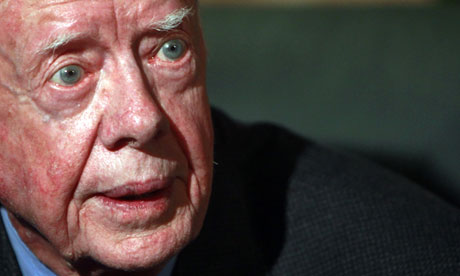
Jimmy Carter: 'America’s violation of international human rights abets our enemies and alienates our friends.' Photograph: Amr Abdallah Dalsh/Reuters

Revelations that US officials were targeting people including their own citizens abroad were "only the most recent disturbing proof" of how far such violations had extended, he wrote in the New York Times.

At a time when popular revolutions were sweeping the globe, the US should be strengthening, not weakening, "basic rules of law and principles of justice", Carter said.

Attacks on human rights after 9/11 had been "sanctioned and escalated by bipartisan executive and legislative actions, without dissent from the general public", he said. "As a result, our country can no longer speak with moral authority on these critical issues."

Carter added: "While the country has made mistakes in the past, the widespread abuse of human rights over the last decade has been a dramatic change from the past."

The Universal Declaration of Human Rights, adopted in 1948 with US leadership, "has been invoked by human rights activists and the international community to replace most of the world's dictatorships with democracies and to promote the rule of law in domestic and global affairs," he said. More


Thursday, June 7, 2012

US drone attacks in Pakistan: UN backs probe into civilian casualties

ISLAMABAD: The UN human rights chief on Thursday called for a UN investigation into US drone strikes in Pakistan, questioning their legality and saying they kill innocent civilians.


UN High Commissioner for Human Rights Navi Pillay made the remarks at the end of a four-day visit to the country, where US drone strikes have on average targeted militants once every four days under US President Barack Obama.

Islamabad is understood to have approved the strikes on al Qaeda and Taliban targets in the past. But the government has become increasingly energetic in its public opposition as relations with Washington have nosedived.

“I see the indiscriminate killings and injuries of civilians in any circumstances as human rights violations.”


Drone attacks do raise serious questions about compliance with international law,” Pillay told a news conference in Islamabad.

“The principle of distinction and proportionality and ensuring accountability for any failure to comply with international law is also difficult when drone attacks are conducted outside the military chain of command and beyond effective and transparent mechanisms of civilian or military control,” she said.

She said the attacks violate human rights.

“I see the indiscriminate killings and injuries of civilians in any circumstances as human rights violations.”

The UN human rights chief provided no statistics but called for an investigation into civilian casualties, which she said were difficult to track.

“Because these attacks are indiscriminate it is very, very difficult to track the numbers of people who have been killed,” she said.

“I suggested to the government that they invite the United Nations Special Rapporteur on Summary or Arbitrary Executions and he will be able to investigate some of the incidents.”

She said UN chief Ban Ki-moon had urged states to be “more transparent” about circumstances in which drones are used and take necessary precautions to ensure that the attacks involving drones comply with applicable international law. More


Tuesday, May 29, 2012

The face of collateral damage

Around midnight on May 21, 2010, a girl named Fatima was killed when a succession of U.S.-made Hellfire missiles, each of them five-feet long and traveling at close to 1,000 miles per hour, smashed a compound of houses in a mountain village of Mohammed Khel in North Waziristan along the Afghanistan-Pakistan border. Wounded in the explosions, which killed a half dozen men, Fatima and two other children were taken to a nearby hospital, where they died a few hours later.

Behram Noor, a Pakistani journalist, went to the hospital and took a picture of Fatima shortly before her death. Then, he went back to the scene of the explosions looking for evidence that might show who was responsible for the attack. In the rubble, he found a mechanism from a U.S.-made Hellfire missile and gave it to Reprieve, a British organization opposed to capital punishment, which shared photographs of the material with Salon. Reprieve executive director Clive Stafford Smith alluded to the missile fragments in an Op-Ed piece for the New York Times last fall. They have also been displayed in England.

“Forensically, it is important to show how the crime of murder happened (which is what it is here),” said Stafford Smith in an email. “One almost always uses the murder weapon in a case. But perhaps more important, I think this physical proof — this missile killed this child — is important to have people take it seriously.”

In the religious rhetoric used by al-Qaida’s online allies, Fatima was a “martyr.” In a statement quoted by Long War Journal, the al-Ansara forum said the senior al-Qaida commander Mustafa Abu Yazid had been killed in a “convoy of martyrs on the road with his wife and three daughters and his granddaughter; men, women and children; neighbors and loved ones.” But Fatima was not Yazid’s daughter, according to Noor, who reported from the scene. She was the daughter of another man who lost two wives and three children in the barrage. More

America is making enemies each time they murder people in places like Mohammed Khel in North Waziristan, or in Yemen or Somalia. It is a self defeating policy for the country, for all you are doing is creating more people that want revenge. This will obviously mean more wars, more drones and more enemies adinfinitum. And eventually the people of these areas, which may be remote and backward, but the people are ambitious and intelligent, will find a way to extract payback. They will then use Obama's argument that 'they have the right to kill anyone anywhere in the world who they feel is threatening them'. Where does this stop? Editor

Analysis: How Obama changed definition of ‘civilian’ in secret drone wars

Two US reports published today provide significant insights into President Obama’s personal and controversial role in the escalating covert US drone war in Pakistan, Yemen and Somalia.

In a major extract from Daniel Klaidman’s forthcoming book Kill Or Capture, the author reveals extensive details of how secret US drone strikes have evolved under Obama – and how the president knew of civilian casualties from his earliest days in office.

The New York Times has also published a key investigation exploring how the Obama Administration runs its secret ‘Kill List’ – the names of those chosen for execution by CIA and Pentagon drones outside the conventional battlefield.

The Times’ report also reveals that President Obama personally authorised a broadening of the term ‘civilian’, helping to limit any public controversy over ‘non-combatant’ deaths.

Civilian Deaths from Day Three
As the Bureau’s own data on Pakistan makes clear, the very first covert drone strikes of the Obama presidency, just three days after he took office, resulted in civilian deaths in Pakistan. As many as 19 civilians – including four children – died in two error-filled attacks.

Until now it had been thought that Obama was initially unaware of the civilian deaths. Bob Woodward has reported that the president was only told by CIA chief Michael Hayden that the strikes had missed their High Value Target but had killed ‘five al Qaeda militants.’

Now Newsweek correspondent Daniel Klaidman reveals that Obama knew about the civilian deaths within hours. He reports an anonymous participant at a subsequent meeting with the President: ‘You could tell from his body language that he was not a happy man.’ Obama is described aggressively questioning the tactics used. More


Saturday, April 14, 2012

Drone death in Yemen of an American teenager

SANAA, YEMEN— With the house still quiet with slumber, the 15-year-old left a letter for his mother begging forgiveness, then crawled out a second-storey kitchen window and dropped to the garden below.

Abdulrahman al Awlaki crossed the front yard past potted plants and a carnival ride graveyard — Dumbo, Donald Duck, an arched seal balancing a beach ball — debris from his uncle Omar’s failed business venture to install rides in local shopping malls.

The family’s guard saw the grade nine student with a mop of curly hair leave the front gate at about 6:30 a.m. that morning on Sept. 4. Abdulrahman then made his way to the gates of Bab al-Yemen to catch a bus to a cousin’s house in Shabwa province in the south.

As he crossed the desert on his six-hour journey, his family awoke to news of his disappearance.

“He wrote to his mother, ‘I am sorry for leaving in this kind of way. Forgive me. I miss my father and want to see if I can go and talk to him,’ ” said the boy’s grandfather, Nasser al Awlaki, as he sipped tea in his lavish home. “ ‘I will be coming back in a few days.’ ”

“He was very obedient to everybody in the house,” said Awlaki, “and that’s why it was a surprise that he would make that kind of decision.”

Nine days later, Abdulrahman turned 16.

He never found his father, the radical online preacher Anwar al Awlaki, who a U.S. congresswoman had called “Terrorist Number One.”

The teen wasn’t even in the right part of the country.

On Sept. 30, CIA-directed hellfire missiles blasted a target in northern Yemen, killing his father and ending the two-year manhunt for the cleric whose preaching encouraged plots in the United States, United Kingdom and Canada.

Anwar al Awlaki was born in the United States, having grown up in the West after his father, Nasser, moved his family there to study.

Few mourned Awlaki’s death, but there was concern about the precedent. How could U.S. President Barack Obama order an American killed without any review?

There has been considerably less talk about what happened two weeks later.

On Oct. 14, U.S. drones pounded targets again, this time hundreds of kilometres away in the southeastern region of Azzan.

Abdulrahman, also born in the U.S., and his 17-year-old cousin were among the seven killed. They were apparently having a barbecue. More


Sunday, March 11, 2012

Hague sued over US extra-judicial drone killings in Pakistan

Human rights lawyers are to sue Foreign Secretary William Hague over the alleged use of intelligence in assisting US drone attacks in Pakistan.

Lawyers from Leigh Day and Co say civilian intelligence officers who give information to the US may be liable as “secondary parties to murder”. The case is being raised at the High Court in London on behalf of Noor Khan, whose father was killed in a US strike.

The Foreign Office said it did not comment on ongoing legal proceedings.

Leigh Day and Co says Mr Khan’s father Malik Daud was part of a council of elders holding a meeting in the tribal areas of northwest Pakistan, when a drone missile hit the group. The lawyers, which include some from the international charity Reprieve, want to establish what official UK policy or guidance is with regard to assisting the US in such cases.

The firm said it had “credible, unchallenged” evidence Mr Hague oversaw a policy of passing British intelligence to US forces planning attacks against militants.

'Breach of sovereignty’

It will also point out that Pakistan is not involved in an international conflict. More


Tuesday, December 27, 2011

Confronting intimidation, working for justice in Palestine

If we had a wish list for 2012 as Palestinians and friends of Palestine, one of the top items ought to be our hope that we can translate the dramatic shift in recent years in world public opinion into political action against Israeli policies on the ground.

We know why this has not yet materialized: the political, intellectual and cultural elites of the West cower whenever they even contemplate acting according to their own consciences as well as the wishes of their societies.

This last year was particularly illuminating for me in that respect. I encountered that timidity at every station in 

the many trips I took for the cause I believe in. And these personal experiences were accentuated by the more general examples of how governments and institutions caved in under intimidation from Israel and pro-Zionist Jewish organizations.

A catalogue of complicity

Of course there were US President Barack Obama’s pandering appearances in front ofAIPAC, the Israeli lobby, and his administration’s continued silence and inaction in face of Israel’s colonization of the West Bank, siege and killings in Gaza, ethnic cleansing of the Bedouins in the Naqab and new legislation discriminating against Palestinians in Israel.

The complicity continued with the shameful retreat of Judge Richard Goldstone from his rather tame report on the Gaza massacre — which began three years ago today. And then there was the decision of European governments, especially Greece, to disallow campaigns of human aid and solidarity from reaching Gaza by sea.

On the margins of all of this were prosecutions in France against activists calling forboycott, divestment and sanctions (BDS) and a few u-turns by some groups and non-governmental organizations (NGOs) in Europe caving in under pressure and retracting an earlier decision to cede connections with Israel. More


Monday, October 31, 2011

Drone Knowns and Drone Unknowns

On Friday, September 30, Anwar al-Awlaki — described variously in the press as “Senior Al Qaeda leader,” “firebrand cleric,” and “Al Qaeda’s rising star” — was killed by a Hellfire missile launched from a Predator drone as al-Awlaki approached his Toyota Hilux pickup truck in eastern Yemen.

The missile weighed 100 pounds, and the strike took place; al-Awlaki had just eaten breakfast. These details, and many others, were reported immediately around the world. The Guardian ran a helpful sketch of a drone, accompanied by the text, “Al-Awlaki’s position was tracked for several days before the attack on his vehicle by a drone armed with Hellfire missiles.” Page three of the New York Post was even more informative. It included a map, a timeline (“How We Got Him”), a photo of a Predator, another photo of a Hellfire missile, and some pinup-girl stats about the drone itself, including “Cost: $5M” and “Size: 27 feet long, 55-foot wingspan.”

Three weeks later came another Predator success, and another orgy of detail. On Thursday, October 20 Muammar Qaddafi’s fleeing convoy of 100 vehicles was captured on camera by a drone patrolling the skies above Sirte. Then, as the Telegraph reported, “The Predator drone, flown out of Sicily and controlled via satellite from a base outside Las Vegas, struck the convoy with a number of Hellfire anti-tank missiles.” Other western news sources reprinted these details with only minor changes in syntax. Wired’s Danger Room blog reported that it was the 145th Predator strike in Libya, according to the Pentagon. More