Showing posts with label barak obama. Show all posts

Thursday, October 4, 2012

Extrajudicial Drone Assassinations

Unnecessary and Disproportional: The Killings of Anwar and Abdul Rahman al-Awlaki

One year since the assassination of Anwar al-Awlaki CagePrisoners publishes a report which reveals what role he really played in the Al-Qaeda leadership

“As for my husband who was assassinated by a US drone exactly one year from today, I believe strongly that his killing has nothing to do with the allegations by the US that he has links to terrorist attacks, but rather to silence him because of his influence on Muslims in the Western world as a Muslim scholar and preacher…the drone programme is wrong and illegal because it kills a lot more civilians than so called [high] valuable targets.”– Gihan Mohsen Baker, wife of Anwar al-Awlaki

Exactly a year ago, American citizen Anwar al-Awlaki was killed in a drone strike carried out by the US in Northern Yemen – only one of scores that are dying as part of a programme of extrajudicial killings.

On the anniversary of his killing, CagePrisoners releases its report “Unnecessary and Disproportional: The Killing of Anwar and Abdul-Rahman al-Awlaki”.

This report analyses and challenges the narrative developed by various governments and media outlets to justify the assassination of the Muslim cleric, presenting him as a leader of al-Qaeda in the Arabian Peninsula (AQAP) and the mastermind behind several attacks against the USA. The report also highlights how dangerous such a narrative can be as it extends to include the targeting and killing of Awlaki’s 16 year old son, also an American citizen, a few days later.

With only a few weeks left until Election Day, most people will be focused on the election campaigns of President Obama – few will remember that it is under Obama’s leadership that the policy of targeted killings has intensified and expanded.

This report will throw light on the legal and moral inconsistencies that appear as a Nobel Peace Prize winning President continues developing his drone programme enabling him to carry out extra-judicial killings across the globe, picking off targets on a ‘kill list’ once a week.

Through the case study of Anwar and Abdur Rahman al-Awlaki, questions are also raised about the UK’s involvement in targeted killings as more evidence emerges of British citizens that have been killed in drone attacks including evidence to suggest that British authorities actively assist the CIA in its drone programme.

CagePrisoners demands complete transparency in relation to the process by which individuals are placed on President Obama’s ‘kill list’, independent investigations into civilian deaths and injuries during drone strikes and the end to British complicity and the complicity of any other States, with US drone strikes. More

Download full report here


Friday, August 3, 2012

Drone race will ultimately lead to a sanitised factory of slaughter

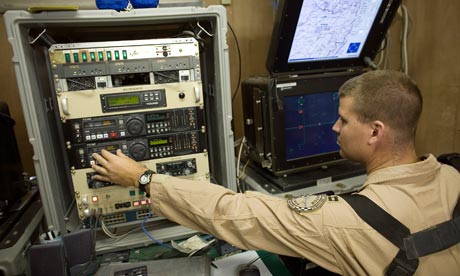
The CIA has killed more than 200 children in drone strikes outside of legitimate war zones since 2004, it is alleged. In Pakistan, Yemen and Somalia an estimated total of between 451 and 1,035 civilians were killed in at least 373 strikes according to the Bureau of Investigative Journalism, the most accurate source of "kill statistics".

Who in their right mind would give a powerful unmanned air force to a covert organisation with such a track record for unaccountable and illegal killing? The number of strikes in Pakistan has dramatically increased from 52 under George W Bush during his five years of conflict to 282 during Obama's three and a half-year watch. Obama is establishing a dangerous precedent that is, at best, legally questionable in a world where more than 50 countries are acquiring the technology.

This is big business with billions of dollars at stake. Israeli companies are pursuing new drone markets in Asia and Latin America. The US has restricted drone sales to its allies but now, with defence budgets shrinking, companies such as Northrop Grumman and General Atomics are lobbying their government to loosen export restrictions and open foreign markets in South America and the Middle East. Other countries such as India and Pakistan are also hungry for the technology. Russia has unveiled its MiG Skat combat drone with on-board cruise missiles for strikes on air defences as well as ground and naval targets, while Iran demonstrated an armed rocket launched drone, the Karrar, in 2010.

But it is China that is showing the greatest commercial potential for selling armed drones. The US-China Economic and Security Review Commission noted with concern that China "has deployed several types of unmanned aerial vehicles for both reconnaissance and combat". More worryingly, the Washington Post quotes Zhang Qiaoliang from the Chengdu Aircraft Design and Research Institute as saying, "the United States doesn't export many attack drones, so we're taking advantage of that hole in the market". Given the 10-year spate of CIA drone strikes, what can be said when other countries use drone strikes against perceived threats in other states? More


Monday, July 23, 2012

Destroying the Commons: How the Magna Carta Became a Minor Carta -Noam Chomsky

Down the road only a few generations, the millennium of Magna Carta, one of the great events in the establishment of civil and human rights, will arrive. Whether it will be celebrated, mourned, or ignored is not at all clear.

That should be a matter of serious immediate concern. What we do right now, or fail to do, will determine what kind of world will greet that event. It is not an attractive prospect if present tendencies persist — not least, because the Great Charter is being shredded before our eyes.

The first scholarly edition of Magna Carta was published by the eminent jurist William Blackstone. It was not an easy task. There was no good text available. As he wrote, “the body of the charter has been unfortunately gnawn by rats” — a comment that carries grim symbolism today, as we take up the task the rats left unfinished.

Blackstone’s edition actually includes two charters. It was entitled The Great Charter and the Charter of the Forest. The first, the Charter of Liberties, is widely recognized to be the foundation of the fundamental rights of the English-speaking peoples — or as Winston Churchill put it more expansively, “the charter of every self-respecting man at any time in any land.” Churchill was referring specifically to the reaffirmation of the Charter by Parliament in the Petition of Right, imploring King Charles to recognize that the law is sovereign, not the King. Charles agreed briefly, but soon violated his pledge, setting the stage for the murderous Civil War.

After a bitter conflict between King and Parliament, the power of royalty in the person of Charles II was restored. In defeat, Magna Carta was not forgotten. One of the leaders of Parliament, Henry Vane, was beheaded. On the scaffold, he tried to read a speech denouncing the sentence as a violation of Magna Carta, but was drowned out by trumpets to ensure that such scandalous words would not be heard by the cheering crowds. His major crime had been to draft a petition calling the people “the original of all just power” in civil society — not the King, not even God. That was the position that had been strongly advocated by Roger Williams, the founder of the first free society in what is now the state of Rhode Island. His heretical views influenced Milton and Locke, though Williams went much farther, founding the modern doctrine of separation of church and state, still much contested even in the liberal democracies.

As often is the case, apparent defeat nevertheless carried the struggle for freedom and rights forward. Shortly after Vane’s execution, King Charles granted a Royal Charter to the Rhode Island plantations, declaring that “the form of government is Democratical,” and furthermore that the government could affirm freedom of conscience for Papists, atheists, Jews, Turks — even Quakers, one of the most feared and brutalized of the many sects that were appearing in those turbulent days. All of this was astonishing in the climate of the times.

A few years later, the Charter of Liberties was enriched by the Habeas Corpus Act of 1679, formally entitled “an Act for the better securing the liberty of the subject, and for prevention of imprisonment beyond the seas.” The U.S. Constitution, borrowing from English common law, affirms that “the writ of habeas corpus shall not be suspended” except in case of rebellion or invasion. In a unanimous decision, the U.S. Supreme Court held that the rights guaranteed by this Act were “[c]onsidered by the Founders [of the American Republic] as the highest safeguard of liberty.” All of these words should resonate today. More


Monday, June 25, 2012

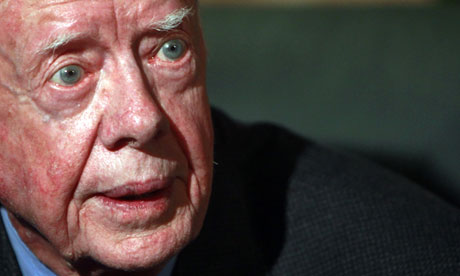
Jimmy Carter savages US foreign policy over drone strikes

Former president calls on Washington to regain moral leadership in wake of drone strikes and targeted assassinations?

Drone strikes and targeted assassinations abroad have seen the US violating human rights in a way that "abets our enemies and alienates our friends", according to the former president Jimmy Carter.

He said America was "abandoning its role as a champion of human rights", and called on Washington to "reverse course and regain moral leadership".

Jimmy Carter: 'America’s violation of international human rights abets our enemies and alienates our friends.' Photograph: Amr Abdallah Dalsh/Reuters

Revelations that US officials were targeting people including their own citizens abroad were "only the most recent disturbing proof" of how far such violations had extended, he wrote in the New York Times.

At a time when popular revolutions were sweeping the globe, the US should be strengthening, not weakening, "basic rules of law and principles of justice", Carter said.

Attacks on human rights after 9/11 had been "sanctioned and escalated by bipartisan executive and legislative actions, without dissent from the general public", he said. "As a result, our country can no longer speak with moral authority on these critical issues."

Carter added: "While the country has made mistakes in the past, the widespread abuse of human rights over the last decade has been a dramatic change from the past."

The Universal Declaration of Human Rights, adopted in 1948 with US leadership, "has been invoked by human rights activists and the international community to replace most of the world's dictatorships with democracies and to promote the rule of law in domestic and global affairs," he said. More


Wednesday, May 2, 2012

Real Politics Must be in the Streets: The Constitutional Crimes of Barack Obama - By Dave Lindorff

May 01, 2012 "Information Clearing House" -- As we slog towards another vapid, largely meaningless exercise in pretend democracy with the selection of a new president and Congress this November, it is time to make it clear that the current president, elected four years ago by so many people with such inflated expectations four years ago (myself included, as I had hoped, vainly it turned out, that those who elected him would then press him to act in progressive ways), is not only a betrayer of those hopes, but is a serial violator of his oath of office. He is, in truth, a war criminal easily the equal of his predecessor, George W. Bush, and perhaps even of Bush’s regent, former Vice President Dick Cheney.


Let me count the ways,

* For starters, in vowing to “preserve, protect and defend the US Constitution of the United States,” President Obama, upon taking office, had a sacred obligation to prosecute the people who had gravely wounded that document prior to his assuming office. It was clear, as I wrote in my book The Case for Impeachment: The Legal Argument for Removing President George W. Bush from Office (St. Martin’s Press, 2006), that Bush and Cheney had ordered and condoned and covered up torture of captives in their so-called “War” on Terror, as well as in the very real wars against Iraq and Afghanistan, committing grievous war crimes that are not only violations of international law, but of the US Criminal Code, given that the US is a leading author and signatory of the Geneva Accords). They also were war criminals of the first degree for orchestrating, through lies to both the UN Security Council and the US Congress and the American people, about the alleged threat and imminence of any threat by Iraq to the US or its allies. President Obama, under the UN Charter and under US law, as the president, commander in chief and top law officer in the nation, was bound to investigate and prosecute those crimes. Instead, he ordered that there would be no prosecutions.

* A federal court also ruled that President Bush had committed a felony in using the National Security Agency and several complicit telecommunications companies to spy on massive numbers of Americans with no warrants. Again, instead of prosecuting the president once he replaced him, President Obama said there would be no prosecution, and he went on to expand that spying program exponentially, effectively shredding beyond recognition the Fourth Amendment against unreasonable searches and seizures, which had been a leading rallying issue for the revolutionists of 1776.

* President Obama, on his own initiative, has moved beyond the illegal wars in Iraq and Afghanistan, launching illegal wars against Libya, Yemen and Pakistan, largely through the use of American military aircraft, cruise missiles and especially pilotless drones.

In addition to being illegal acts of war against nations that pose no imminent threat to the US, these clear acts of war have caused vastly disproportionate civilian deaths -- reportedly as many as 40 civilians, including many children, are being killed by drone strikes inside Pakistan for each of the supposed targeted “terrorists.” Jist the disproportionality of such "collateral damage" is a heinous war crime, even leaving aside the illegality of such strikes being conducted by the US within the border of a sovereign nation not at war with the US. More

________________________________________________________________

The ideas expressed here are those of the author of the article and do not necessarily reflect those of the the Cayman Institute, the South Asian Strategic Stability Institute or their Editors.