Saturday, February 18, 2012

Khader Adnan: No food without freedom

Friday is the 62nd day of the Palestinian prisoner's protest against his detention by Israel.
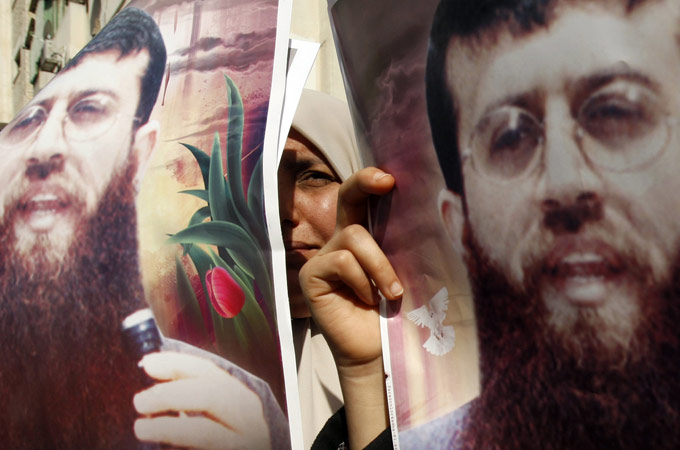
Sixty-one days. That is how long it’s been since Khader Adnan has eaten.

The 33-year-old Palestinian was taken from his home in Arrabeh village near Jenin in the occupied West Bank at 3:30am on December 17. One day later he began his hunger strike to protest against the "humiliation and policy of administrative detention". Adnan, like hundreds of other Palestinians, was arrested under a military order that Israel has named "administrative detention", which allows prisoners to be held without charge or trial for periods of up to six months, spells that can be renewed indefinitely.

Sahar Francis is a lawyer with Addameer, a prisoner rights groups based in the West Bank city of Ramallah, and a member of Khader Adnan’s legal team. She visited the hunger striker in Ziv hospital in Safad, Israel, on Friday.

She described her client, who remains shackled to his hospital bed, as "mentally perfect, but physically very weak".

Francis told Al Jazeera that Adnan was being given only glucose and other sugars through an intravenous drip, but refusing anything else that would be considered a breach of his protest. Doctors told Francis that he could suffer from a heart attack or from the failure of other internal organs and die at any moment.

Adnan's family and legal team were hoping that he would be released this week when his case went before a military appeals court. However, the appeal was denied and the court ordered that Adnan must finish the four month administrative detention, set to end on May 8.

In response to Al Jazeera’s request for an interview, the Israeli military sent a statement that read:

"Khader Adnan was arrested with an administrative arrest warrant for activities that threaten regional security. This warrant was authorised by a judicial review."

Francis and Adnan's legal team argue that, after losing some 40kg from more than 60 days without food, Adnan is wheelchair-bound and too weak to pose a risk to anyone.

Amnesty International and Human Rights Watch have both called on the Israeli authorities either to release Adnan or immediately charge him with criminal offences and have him tried. More


The Carter Center Calls on Israel to Release Hunger Striker Khader Adnan

Atlanta…The Carter Center calls on the Israeli government to immediately charge or release Palestinian prisoner Khader Adnan, who was arrested on Dec. 17, 2011, based on "secret evidence" and has been held in administrative detention without charge.

<P><SPAN class=colCHeading>Press Releases</SPAN></P>

Mr. Adnan has undertaken a hunger strike since his arrest 62 days ago and his life is in imminent danger. His grave medical condition has been verified by Physicians for Human Rights-Israel.

Mr. Adnan's case highlights the inconsistencies of Israel's administrative detention policies with internationally recognized rights to due process.

As of Jan. 15, 2012, Israel is holding 307 Palestinians in administrative detention. Read the Carter Center's recent statement on the administrative detention of elected Palestinian legislators. More


Thursday, February 16, 2012

The West Bank's Bobby Sands

 Khader Adnan's two-month hunger strike has made him a hero among Palestinians outraged by Israel's policy of arbitrary detention.
 
It was only after talking with lucidity and animation for an hour about her husband's 61-day hunger strike that Randa Jihad Adnan's eyes, visible though the opening of her nekab, filled with tears. Until then, this articulate 31-year-old graduate in sharia law from Al Najar University in Nablus, the pregnant mother of two young daughters aged four and one and half, had described with almost disconcerting poise the two months following the arrest of her husband, Khader Adnan, on 17 December.
He was seized at 3.30am by some of the scores of Israeli military and security personnel who surrounded the family home in a West Bank village south of Jenin, and is now being held in the Israeli Rebecca Ziv hospital in Safed. Yesterday she was allowed to visit him with the children and her father-in-law.
There they found him, weak and extremely thin, his beard unkempt and his fingernails long. He was shackled by two legs and one arm to his bed, and was connected to a heart monitor. Though mentally alert, he could speak only with difficulty. "I was shocked," she said yesterday. "I couldn't speak for about three minutes, and it was the same for my daughters."
Mrs Adnan is convinced that the Israeli authorities only allowed the visit because they wanted the family to put pressure on her husband to end his hunger strike. He had started this on 18 December in protest at his arrest, his treatment and the subsequent detention order served on him.
"My father-in-law said to him: 'We want you to stay alive. You cannot defeat this state on your own.' He told him he wanted him to end the strike. I told him I wished he would drink a cup of milk. But he said: 'I did not expect this from you. I know you are with me all the time. Please stop it." Mrs Adnan said yesterday: "I know my husband. He will not change his mind. I expect him to die." More
 

Tuesday, February 14, 2012

Power blackout in Gaza as Egypt stops fuel smuggling

 The Gaza Strip’s sole electricity station has become inoperative because Egypt has begun to crack down on fuel smuggling activities through their shared border, a Palestinian energy official in Gaza said Tuesday.
Gaza Energy Authority official Ahmed Abul Amreen said in a press conference that the authority cannot meet electricity demands for hospitals, educational facilities, and water and sewage stations. He said the amount of electricity Gaza receives from an Israeli company fulfills only 35 percent of the population’s needs.
Palestinian news agency Maan quoted Abul Amreen as saying that the power plant’s inactivity has brought the strip’s primary electricity source to a halt, noting that Gaza already suffers a great shortage in wattage supplies.
The official held Israel responsible for the crisis. He also called upon the Egyptian Parliament to back Palestinians and continue to support them with the necessary fuel supplies.
Abul Amreen said an energy authority delegation that recently met with Egyptian officials received pledges that fuel supplies would resume.
Abul Amreen also stressed that a drastic solution for Gaza’s energy crisis would be to include the strip in an electricity linkage plan approved by the Arab League more than two years ago. He urged that the project begin immediately given the availability of the blueprints and funds required.
For nearly two weeks, Gaza has been undergoing a worsening fuel crisis caused by a halt in supplies smuggled through underground tunnels traversing its border with Egypt. The conundrum has rendered 90 percent of local oil stations idle.
Israel supplies Gaza with about 120 megawatts of electricity a day, while the strip’s only power plant produces 60 megawatts. But since Gaza needs at least 270 megawatts, the strip suffers daily blackouts that can last for eight hours.
The Israeli and Egyptian closure of Gaza’s borders in 2007 severely restricted its fuel supply. Fuel was first smuggled through tunnels from Egypt and eventually used in electricity generation after a local engineer developed a refining process. The engineer was later abducted by Israeli intelligence agents during a trip to Ukraine, Maan said. More
 

Monday, February 13, 2012

Thousands of Palestinians in the Jordan Valley risk forced displacement, says UN body

Sixty thousand Palestinians live under harsh conditions in the Jordan Valley and the Dead Sea area - one of the most isolated and restricted areas in occupied Palestine. 
The UN Office for the Coordination of Humanitarian Affairs (OCHA) has summarized their humanitarian situation in its February 2012 fact sheet.
The Jordan Valley and Dead Sea area covers about one third of the West Bank. Eighty-seven percent of the land is designated as Area C, where Israeli exercises full control over security, planning and construction. The area is earmarked for the use of the Israeli military or falls under the jurisdiction of the illegal Israeli settlements. An additional 7% is designated as a nature reserve. In total, Palestinians are prohibited from using 94% of their own land.
Meanwhile, 9,500 Israeli settlers have established 37 settlements in the occupied Jordan Valley in contravention of international law. The Fourth Geneva Convention prohibits Israel from transferring parts of its own civilian population into occupied territory. Supported by Israel, the settlers have developed highly profitable agricultural, tourist, mineral and other businesses, including Ahava cosmetics.
Severe restrictions on Palestinians
One quarter of the Palestinian population of the Jordan Valley and Dead Sea area - around 15,000 – live in Area C, including some 7,900 Bedouins and herders. The Israeli authorities obstruct construction activity by the Palestinian communities by withholding building permits for homes, schools, clinics, roads and water networks.
Palestinians in the area have restricted access to water resources. Water consumption in most herding communities is about 20 liters per person per day. This stands in sharp contrast to the World Health Organization’s recommendation of 100 liters per person a day. The settlers in the area consume a shocking 300 liters per person per day.
In addition, Palestinian access to and from the Jordan Valley is highly constrained. Four of the six access routes to the Jordan Valley are controlled by Israeli checkpoints. Non-residents are only allowed to cross these checkpoints as pedestrians or by traveling via registered public transportation. Palestinians who own commercial vehicles have to coordinate the crossing in advance, according to OCHA. Numerous checkpoints, roadblocks and trenches in the area are an obstacle impeding Palestinian access to grazing and agricultural land, services, and markets for agricultural produce. Moreover, the restricted freedom of movement undermines family and social ties. The map printed in OCHA’s fact sheet provides a clear overview of the situation.
Israel’s full military control of Area C has resulted in food scarcity and water scarcity. A joint survey by UNRWA, Unicef and the World Food Program revealed that 79% of the Bedouin and Palestinian herders in Area C in the West Bank – the Jordan Valley and the Dead Sea area included - are food insecure. The food insecurity in the herding communities in Area C is much higher than among the Palestinian population in the West Bank and the Gaza Strip where respectively 25% and 61% of the households are food insecure.
Forced displacement and evictions
In 2011, the Israeli authorities demolished over 200 Palestinian-owned structures in the area, displacing around 430 people and affecting the livelihoods of another 1,200 Palestinians. According to OCHA, thousands of Palestinians in the area are at risk of forced displacement due to home demolitions, forced evictions from closed military zones and a range of restrictions imposed by Israel.
However, the Palestinians are determined to continue living on their land. For example, Abed Yasin Rashaida, who has lived for 15 years in Fasayil in the occupied Jordan Valley, says on video: ”We are Bedouin. Once we were nomads – we used to move from one place to another. Eventually we settled here to let our children study at school.” On 20 December 2012, the Israeli army demolished some houses and animal shelters in Fasayil. “They started demolishing at eight in the morning. The bulldozers destroyed everything and covered the mattresses with soil. Flour, sugar, lentils, oil – they destroyed everything,” according to Rashaida. More
 

Sunday, February 12, 2012

"Containment" of a nuclearised Iran or Containment of a nuclear Israel?

Will AIPAC and Bibi get their war? 
 
Does Netanyahu really want a war on Iran, or does he want to prove that no one could stop him if he did?

Washington, DC - These are strange times for those of us who follow the debate about a possible war with Iran. It is clear that the Israeli government and its neoconservative camp followers here in the United States are increasing pressure on President Obama to either attack Iran or let Israel do it (in which case we would be forced to join in). But the idea of another war in the Middle East is so outlandish that it seems inconceivable it could actually occur.
Still, the conventional wisdom holds that it can, because this is an election year and the assumption is that no-one will say no to Israeli Prime Minister Binyamin Netanyahu.
War enthusiasm will rise to a fever pitch by March, when AIPAC holds its annual policy conference. Netanyahu will, if the past is any indication, bring the crowd of 10,000 to its feet by depicting Iran as the new Nazi Germany and by coming very close to stating that only war can stop these new Nazis. Other speakers will say the same. The few who mention the idea of diplomacy will be met with stony silence.
From the convention centre, 10,000 delegates will be dispatched to Capitol Hill with two or three "asks" for members of Congress. One will, no doubt, be that "containment" of a nuclearised Iran be ruled off the table (leaving war as the only remaining option should Iran get the bomb). Another will likely be that the US stop all dealings with the Palestinian Authority should Hamas and Fatah permanently reconcile. A third could apply either to Iran or Palestine and will inevitably demand fealty to whatever Netanyahu's policy of the moment happens to be. I've sat in on those meetings where the AIPAC "asks" are developed, and it was always clear that the substance didn't matter all that much.
The goal of the "asks" is ensuring that Congress follow the script. Invariably at least one of these AIPAC goals will be put into legislative language and quickly pass both chambers of Congress. In fact, usually the "ask" is already in legislative form, so that the AIPAC citizen lobbyists can simply demand that their legislators sign on as co-sponsors (if they haven't already done so). Once the AIPAC bill has the requisite number of co-sponsors, the House and Senate leadership brings it to the floor where it passes with few dissenters.
All hell breaks loose if a member of Congress should object. More
 Perhaps it is not Iran that should  "Contained", rather a nuclear armed Israel who is not a signatory to the Nuclear Non-Proliferation Treaty that should be "Contained". Editor

Thursday, February 2, 2012

Why is the BBC so afraid of the word "Palestine

 This week, the BBC issued its final ruling on a controversy which has been raging for nearly a year after the words “Free Palestine” were censored from a freestyle rap played on Radio 1Xtra.

Appearing on the popular Charlie Sloth Hip Hop M1X last February, the artist Mic Righteous performed a rap which included the lyrics: “I can scream Free Palestine for my pride/still pray for peace.”
BBC producers replaced the word ‘Palestine’ with the sound of breaking glass and this is the version that was aired and which can be seen on a video on the BBC website (the censorship occurs at 2:59). The edited performance was repeated in April on the same show.
BBC upholds censorship decision
Palestine Solidarity Campaign (PSC) has spent the last eight months trying to find out why the decision to censor an artist who raised the issue of Palestine was made. During the course of a long correspondence, the BBC’s head of editorial standards for audio and music, Paul Smith, wrote that the show’s producer “did not edit out the word ‘Palestine’ because it was offensive — referencing Palestine is fine, but implying that it is not free is the contentious issue.” More