Showing posts with label fracking. Show all posts

Saturday, October 5, 2013

New Report First to Quantify Damage Done by Gas Drilling

“The numbers don't lie — fracking has taken a dirty and destructive toll on our environment. If this dirty drilling continues unchecked, these numbers will only get worse,” said John Rumpler, senior attorney for Environment America.

“At health clinics, we’re seeing nearby residents experiencing nausea, headaches and other symptoms linked to fracking pollution,” said David Brown, a toxicologist who has reviewed health data from Pennsylvania. “With billions of gallons of toxic waste coming each year, we’re just seeing the ‘tip of the iceberg’ in terms of health risks.”

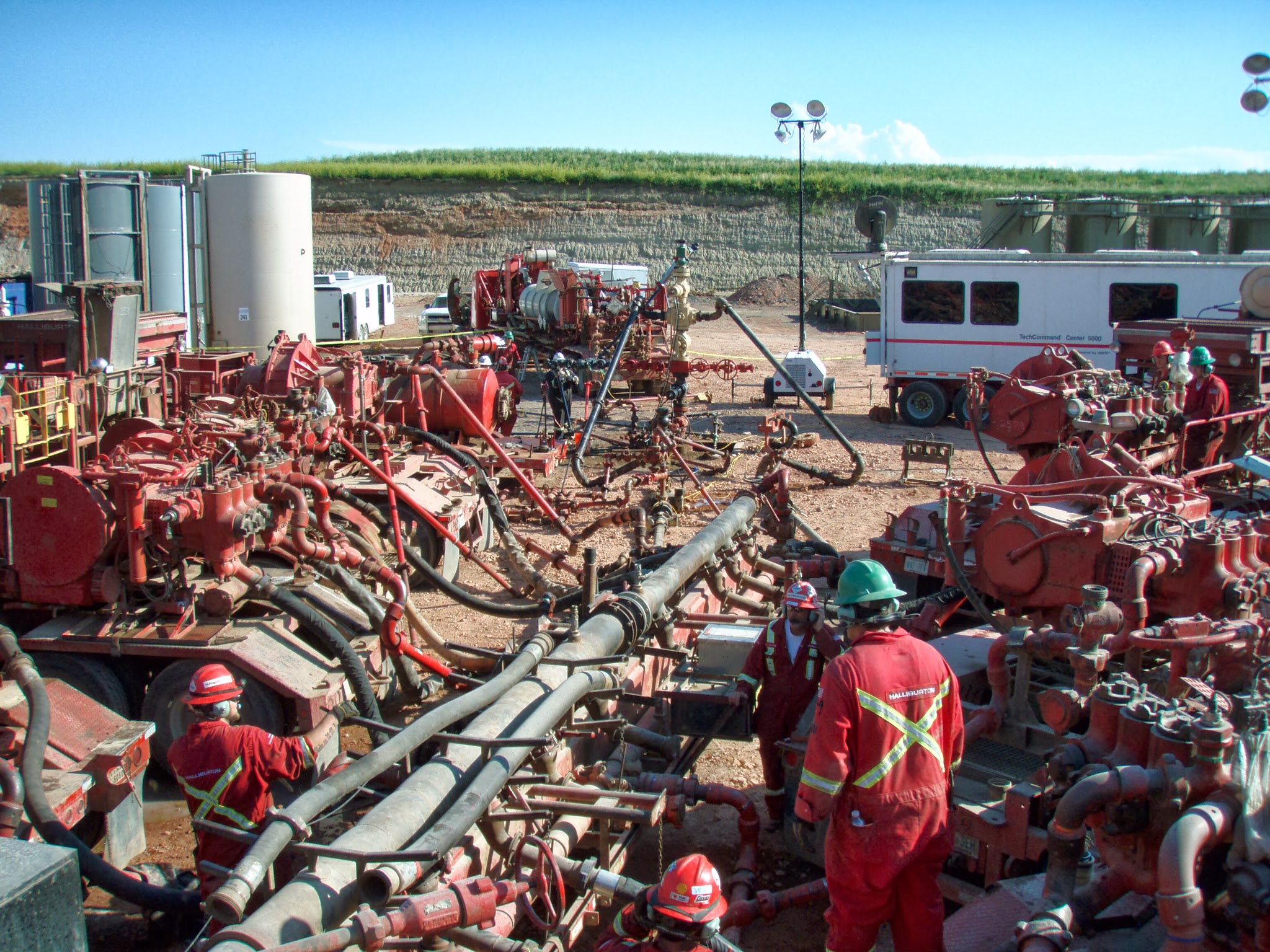
The “Fracking by the Numbers” report measured key indicators of fracking threats across the country, including:

• 280 billion gallons of toxic wastewater generated in 2012,
• 450,000 tons of air pollution produced in one year,
• 250 billion gallons of fresh water used since 2005,
• 360,000 acres of land degraded since 2005,
• 100 million metric tons of global warming pollution since 2005.

Fracking also inflicts other damage not quantified in the report — ranging from contamination of residential wells to ruined roads to earthquakes at disposal sites.
Reviewing the totality of this fracking damage, the report’s authors conclude:

Given the scale and severity of fracking’s myriad impacts, constructing a regulatory regime sufficient to protect the environment and public health from dirty drilling — much less enforcing such safeguards at more than 80,000 wells, plus processing and waste disposal sites across the country — seems implausible. In states where fracking is already underway, an immediate moratorium is in order. In all other states, banning fracking is the prudent and necessary course to protect the environment and public health.

At the federal level, the report’s data on land destroyed by fracking operations comes as the Obama administration considers a rule for fracking on public lands, and as the oil and gas industry is seeking to expand fracking to several places which help provide drinking water for millions of Americans — including the White River National Forest in Colorado and the Delaware River basin, which provides drinking water for more than 15 million Americans.

Along with the new numbers in today’s report, Environment America’s John Rumpler added one more: the more than 1 million public comments submitted this summer to the Obama administration rejecting its proposed rule for fracking on public lands as far too weak. Environment America is urging President Obama to follow the recommendation of his administration’s advisory panel on fracking to keep sensitive areas as off-limits to fracking.

“We need decisive action from Washington to protect our communities,” said John Fenton, a rancher from Pavillion, Wyoming who last week appealed to federal officials to re-open an investigation into contamination of drinking water there.

“The bottom line is this: The numbers on fracking add up to an environmental nightmare,” said Rumpler. “For our environment and for public health, we need to put a stop to fracking.”
Of particular concern are the billions of gallons of toxic waste created from fracking, which threaten the environment, public health and drinking water. Environment America is calling on federal officials to close the loophole that exempts this waste from our nation’s hazardous waste law. Rep. Matt Cartwright (PA-17) has introduced the CLEANER Act, H.R. 2825, to close that loophole.

“The data from today’s report shows that fracking is taking a dirty and destructive toll on our environment and health,” said Rumpler. “It’s time for our federal officials to step up; they can start by keeping fracking out of our forests and away from our parks, and closing the loophole exempting toxic fracking waste from our nation’s hazardous waste law.” More

Download Report


Tuesday, August 20, 2013

British police detain protesters at anti-fracking demo

BALCOMBE, England (Reuters) - British police dispersed hundreds of protesters who blocked access to an oil exploration site in rural England on Monday in an intensification of an almost month-long standoff over the nascent shale gas extraction industry in Britain.

A total of 36 people were detained, both in the village of Balcome and in London, in the first of two days of "direct action" against the drilling process known as fracking, which protesters fear may trigger small earthquakes and pollute water supplies.

Hundreds of protesters converged on the West Sussex village and repeatedly scuffled with around 400 police who were bussed in from 10 different forces around Britain.

While many played drums and sang, others chained themselves to each other at the entrance of the Cuadrilla Resources-owned site, behind tall metal fences down a country lane bordered by dense woodland.

"This protest is part of a huge wave that's building up," 32-year-old Mark Weaver from London told Reuters. "There's a lot of people who are going to be watching what's happening here."

Desperate to stimulate a U.S.-style production boom and offset dwindling North Sea oil and gas reserves, the Conservative-led government has backed fracking as an "energy revolution" that can create jobs and lower energy prices.

Activists argue the government should invest in renewable energy rather than fracking, the retrieval of gas and oil from rock by injection of high-pressure water, sand and chemicals.

Caroline Lucas, Britain's only elected Green Party member of parliament, was among those detained. "Along with everyone else who took action today, I'm trying to stop a process which could cause enormous damage for decades to come," she said.

ANGER

Thirty people were detained after protesters refused to move from the entrance of the Cuadrilla site in Balcombe, about 35 miles south of London. The protests have already forced Cuadrilla to halt drilling at the site.

Six other people were detained in London after gluing themselves to glass doors at the public relations firm employed by the privately-owned energy company, chaired by former BP chief Lord Browne, and blocking the entrance.

Cuadrilla, which is drilling a conventional oil well in Balcombe, is the only company to have fracked a shale gas well in Britain, making its activities a target for protesters.

The debate has turned angry in recent weeks with death threats sent to the head of Cuadrilla and around 75 people arrested at the Balcombe site since protesters set up camp there in July, including those held on Monday.

With natural gas imports from outside the North Sea set to surpass domestic production by 2015, Britain has been looking for new gas sources to meet rising import needs, with a eye on the U.S., where a massive expansion of shale gas extraction has driven down energy prices and cut dependence on imports.

Imports for Britain have so far mostly come from Norway and, increasingly Qatar. Last year it imported around 50 billion cubic meters of gas via pipelines and liquefied natural gas (LNG) ships.

The country has potentially vast shale gas resources in underground rock formations; the government said last month there may be 1,300 trillion cubic feet of gas present in the north of England alone.

"Why would you want fracking on your doorstep?" said protester Melanie Strickland, 30, who works for a health charity. "It pollutes water, it causes earthquakes. It's profoundly undemocratic because it tends to happen without any consultation so I think there'll be resistance everywhere." More


Tuesday, July 9, 2013

The Biggest Criminal Enterprise in History

Terracide and the Terrarists Destroying the Planet for Record Profits

We have a word for the conscious slaughter of a racial or ethnic group: genocide. And one for the conscious destruction of aspects of the environment: ecocide. But we don’t have a word for the conscious act of destroying the planet we live on, the world as humanity had known it until, historically speaking, late last night. A possibility might be “terracide” from the Latin word for earth. It has the right ring, given its similarity to the commonplace danger word of our era: terrorist.

The truth is, whatever we call them, it’s time to talk bluntly about the terrarists of our world. Yes, I know, 9/11 was horrific. Almost 3,000 dead, massive towers down, apocalyptic scenes. And yes, when it comes to terror attacks, the Boston Marathon bombings weren’t pretty either. But in both cases, those who committed the acts paid for or will pay for their crimes.

In the case of the terrarists -- and here I’m referring in particular to the men who run what may be the most profitable corporations on the planet, giant energy companies like ExxonMobil, Chevron,ConocoPhillips, BP, and Shell -- you’re the one who’s going to pay, especially your children and grandchildren. You can take one thing for granted: not a single terrarist will ever go to jail, and yet they certainly knew what they were doing.

It wasn’t that complicated. In recent years, the companies they run have been extracting fossil fuels from the Earth in ever more frenetic and ingenious ways. The burning of those fossil fuels, in turn, has putrecord amounts of carbon dioxide (CO2) into the atmosphere. Only this month, the CO2 level reached400 parts per million for the first time in human history. A consensus of scientists has long concluded that the process was warming the world and that, if the average planetary temperature rose more than two degrees Celsius, all sorts of dangers could ensue, including seas rising high enough to inundate coastal cities, increasingly intense heat waves, droughts, floods, ever more extreme storm systems, and so on.

How to Make Staggering Amounts of Money and Do In the Planet

None of this was exactly a mystery. It’s in the scientific literature. NASA scientist James Hansen first publicized the reality of global warming to Congress in 1988. It took a while -- thanks in part to the terrarists -- but the news of what was happening increasingly made it into the mainstream. Anybody could learn about it.

Those who run the giant energy corporations knew perfectly well what was going on and could, of course, have read about it in the papers like the rest of us. And what did they do? They put their money into funding think tanks, politicians, foundations, and activists intent on emphasizing “doubts” about the science (since it couldn’t actually be refuted); they and their allies energetically promoted what came to be known as climate denialism. Then they sent their agents and lobbyists and money into the political system to ensure that their plundering ways would not be interfered with. And in the meantime, they redoubled their efforts to get ever tougher and sometimes “dirtier” energy out of the ground in ever tougher and dirtier ways.

The peak oil people hadn’t been wrong when they suggested years ago that we would soon hit a limit in oil production from which decline would follow. The problem was that they were focused on traditional or “conventional” liquid oil reserves obtained from large reservoirs in easy-to-reach locations on land or near to shore. Since then, the big energy companies have invested a remarkable amount of time, money, and (if I can use that word) energy in the development of techniques that would allow them to recover previously unrecoverable reserves (sometimes by processes that themselves burn striking amounts of fossil fuels): fracking, deep-water drilling, and tar-sands production, among others.

They also began to go after huge deposits of what energy expert Michael Klare calls “extreme” or “tough” energy -- oil and natural gas that can only be acquired through the application of extreme force or that requires extensive chemical treatment to be usable as a fuel. In many cases, moreover, the supplies being acquired like heavy oil and tar sands are more carbon-rich than other fuels and emit more greenhouse gases when consumed. These companies have even begun using climate change itself -- in the form of a melting Arctic -- to exploit enormous and previously unreachable energy supplies. With the imprimatur of the Obama administration, Royal Dutch Shell, for example, has been preparing to test out possible drilling techniques in the treacherous waters off Alaska.

Call it irony, if you will, or call it a nightmare, but Big Oil evidently has no qualms about making its next set of profits directly off melting the planet. Its top executives continue to plan their futures (and so ours), knowing that their extremely profitable acts are destroying the very habitat, the very temperature range that for so long made life comfortable for humanity.

Their prior knowledge of the damage they are doing is what should make this a criminal activity. And there are corporate precedents for this, even if on a smaller scale. The lead industry, the asbestos industry, and the tobacco companies all knew the dangers of their products, made efforts to suppress the information or instill doubt about it even as they promoted the glories of what they made, and went right on producing and selling while others suffered and died.

And here’s another similarity: with all three industries, the negative results conveniently arrived years, sometimes decades, after exposure and so were hard to connect to it. Each of these industries knew that the relationship existed. Each used that time-disconnect as protection. One difference: if you were a tobacco, lead, or asbestos exec, you might be able to ensure that your children and grandchildren weren’t exposed to your product. In the long run, that’s not a choice when it comes to fossil fuels and CO2, as we all live on the same planet (though it's also true that the well-off in the temperate zones are unlikely to be the first to suffer).

If Osama bin Laden’s 9/11 plane hijackings or the Tsarnaev brothers’ homemade bombs constitute terror attacks, why shouldn’t what the energy companies are doing fall into a similar category (even if on a scale that leaves those events in the dust)? And if so, then where is the national security state when we really need it? Shouldn’t its job be to safeguard us from terrarists and terracide as well as terrorists and their destructive plots?

The Alternatives That Weren’t

It didn’t have to be this way.

On July 15, 1979, at a time when gas lines, sometimes blocks long, were a disturbing fixture of American life, President Jimmy Carter spoke directly to the American people on television for 32 minutes, calling for a concerted effort to end the country’s oil dependence on the Middle East. “To give us energy security,” he announced,

“I am asking for the most massive peacetime commitment of funds and resources in our nation's history to develop America's own alternative sources of fuel -- from coal, from oil shale, from plant products for gasohol, from unconventional gas, from the sun... Just as a similar synthetic rubber corporation helped us win World War II, so will we mobilize American determination and ability to win the energy war. Moreover, I will soon submit legislation to Congress calling for the creation of this nation's first solar bank, which will help us achieve the crucial goal of 20% of our energy coming from solar power by the year 2000.”

It’s true that, at a time when the science of climate change was in its infancy, Carter wouldn’t have known about the possibility of an overheating world, and his vision of “alternative energy” wasn’t exactly a fossil-fuel-free one. Even then, shades of today or possibly tomorrow, he was talking about having “more oil in our shale alone than several Saudi Arabias.” Still, it was a remarkably forward-looking speech.

Had we invested massively in alternative energy R&D back then, who knows where we might be today? Instead, the media dubbed it the “malaise speech,” though the president never actually used that word, speaking instead of an American “crisis of confidence.” While the initial public reaction seemed positive, it didn’t last long. In the end, the president's energy proposals were essentially laughed out of the room and ignored for decades.

As a symbolic gesture, Carter had 32 solar panels installed on the White House. (“A generation from now, this solar heater can either be a curiosity, a museum piece, an example of a road not taken, or it can be a small part of one of the greatest and most exciting adventures ever undertaken by the American people: harnessing the power of the sun to enrich our lives as we move away from our crippling dependence on foreign oil.”) As it turned out, “a road not taken” was the accurate description. On entering the Oval Office in 1981, Ronald Reagan caught the mood of the era perfectly. One of his first acts was to order the removal of those panels and none were reinstalled for three decades, until Barack Obama was president.

Carter would, in fact, make his mark on U.S. energy policy, just not quite in the way he had imagined. Six months later, on January 23, 1980, in his last State of the Union Address, he would proclaim what came to be known as the Carter Doctrine: “Let our position be absolutely clear,” he said. “An attempt by any outside force to gain control of the Persian Gulf region will be regarded as an assault on the vital interests of the United States of America, and such an assault will be repelled by any means necessary, including military force.”

No one would laugh him out of the room for that. Instead, the Pentagon would fatefully begin organizing itself to protect U.S. (and oil) interests in the Persian Gulf on a new scale and America’s oil wars would follow soon enough. Not long after that address, it would start building up a Rapid Deployment Force in the Gulf that would in the end become U.S. Central Command. More than three decades later, ironies abound: thanks in part to those oil wars, whole swaths of the energy-rich Middle East are in crisis, if not chaos, while the big energy companies have put time and money into a staggeringly fossil-fuel version of Carter’s “alternative” North America. They’ve focused on shale oil, and on shale gas as well, and with new production methods, they are reputedly on the brink of turning the United States into a “new Saudi Arabia.” More


Saturday, February 23, 2013

Disgusting Flood of Fracking Water Devastates Egyptian Village

Port Said and Cairo have been dominating Egyptian headlines of late, while Fares, a small agricultural community 75 km north of Aswan, has gone completely unnoticed despite enduring a humanitarian tragedy of epic proportions.

Since 2009, after DanaGas began to drill pilot hydraulic fracturing wells in order to evacuate fossil fuels, a process commonly called fracking, poisonous water has been spewing from the holes, inundating farm lands and homes.

Egypt Independent’s Steven Viney wrote a brave expose of the story, which stars a shady cast of corporate and government characters who have bypassed all environmental and social due process standards in order to test their controversial technology. Scores of local residents have evacuated the area in search of higher, cleaner ground, but the paper reports that government officials are prohibiting them from settling on “private land.”

Fracking involves drilling deep vertical tunnels down to rock that is saturated with natural gas or oil. Vertical tunnels are then built through the rock and water and highly corrosive chemicals are pumped through those at high pressure in order to force expel the embedded fossil fuels.

Elsewhere in the world fracking has either been banned altogether or activists are working on making them so and for good reason. Not only has fracking been associated with groundwater contamination, but there is some evidence that fracking can cause earthquake disturbances in areas that are normally fairly stable.

But in Egypt, DanaGas proceeded to test its technology without suffering any repercussions for its apparent failure. Yet the firm flat out denies that the floodwaters which have destroyed crops and homes in Fares have anything to do with their fracking holes.

What’s more, the government agency responsible for monitoring environmental issues in the country, the Egyptian Environmental Affairs Agency (EEAA), has passed the buck to Ganope – the umbrella organization responsible for DanaGas’ projects that has a Production Sharing Agreement (PSA) with the Ministry of Petroleum.

“Mahmoud Shawki, the EEAA official responsible for overlooking oil and gas drilling environmental impact reports, stated that Fares was the sole responsibility of Ganope,” EI reported.

Ganope, however, claims that the EEAA should be accountable.

Meanwhile, poisonous streams of water up to five foot high are flooding Fares and residents are pleading for help.

“Please help us,” Sheikh Ahmed Abdel Hameed, both a resident of Fares and one of its leading activists, begged Egypt Independent correspondents.

“We have tried all in our power and knocked on every door possible. Nothing is working and no one cares because we are a small village and far away, but we are Egyptians too, and we have nowhere to safely live and no land to farm to survive.” More

Please head over to Egypt Independent for the full report.