Showing posts with label tibet. Show all posts

Saturday, April 12, 2014

China tortured Tibetan prisoner with pain-inducing injections

The Dharamshala, India based Tibetan rights group says the Chinese police and prison authorities brutally tortured a Tibetan political prisoner in detention, using pain-inducing injections.

Goshul Lobsang

"Goshul Lobsang, who recently died of torture injuries, might have received injections designed to cause and exacerbate his pain while he was being tortured in detention. The use of torture methods to increase pain is consistent with other Chinese torture tactics. For example, the Chinese adopted Soviet torture techniques to inflict pain faster," said Tsering Tsomo, director of the Tibetan Centre for Human Rights and Democracy (TCHRD).

"Goshul Lobsang was arrested on 29 June 2010[ii] by Machu County Public Security Bureau (PSB) officers. For about 5 months he was subjected to severe torture including pain-inducing injections, and deprived of sleep and food by the interrogation officers in Machu County," the report said, citing with a source who hails from the same village as Goshul Lobsang.

"Chinese officers used sharp-pointed objects such as toothpicks to repeatedly pierce and penetrate into the tops of his finger nails and cuticles of Goshul Lobsang. This stabbing, applied with force and consistency, resulted in severe bleeding, swelling and pain making Goshul Lobsang unable to temporarily use his hands," another source told group.

Normally, the use of techniques to make torture more painful does not result in any further violations of international law. This is because the fundamental question under international law is whether a person was tortured, not how much the victim was tortured. However, in 1974 the UN General Assembly passed a resolution on Principles of Medical Ethics. While not legally binding on its own, the resolution recognized and emphasized a pre-existing rule of international law—that nobody is allowed to participate in torture. The resolution emphasized that medical professionals should not use their unique knowledge or position to facilitate torture.

The use of pain-inducing injections on Golshul Lobsang to facilitate and expedite his torture was not only a violation of international law but also an extreme violation of medical ethics. The widespread and systematic torture in Chinese prisons cannot exist without the active and implied consent of medical professionals. The medical professionals working in Chinese prisons should use Golshul Lobsang's death and the participation of medical professionals in his death as an opportunity to support medical ethics and oppose torture.

The group said they has also obtained a copy of a note written by Goshul Lobsang while he was imprisoned at Ding Xi (??) city in Gansu Province. Goshul Lobsang shared the note which he had written on 28 September 2012 with a select group of friends on 1 March 2014, just weeks before his death. In the note titled "Prisoner of Clear Conscience", Goshul Lobsang clearly challenges the official Chinese propaganda that Tibetan activists are criminals deserving to be imprisoned. Instead he asserts that his conscience is clear and that he has no regrets for defying authoritarian, oppressive policies. Below is a translation of the note:

Prisoner of Clear Conscience

"I have a family. I have siblings. I have a wife and children. For them, I have sincere love and affection, and for the sake of this love and affection, I am determined to sacrifice my life. But for the sake of our own people, even if I lose this love and affection, I will have no regrets. I am an ordinary nomad who loves his people, so I am willing to do anything for my people. I might lose this bony and haggard body that has suffered brutal pain and torture inflicted out of sheer hatred, I still will not have any regrets. I have the desire to follow in the footsteps of martyrs who expressed everything through flaming fire, but I lack courage [to do such a thing].

However, I don't have the desire to bow my head in surrender to an environment, which denies freedom to speak out against lies and to struggle for equality. [Therefore], I fell into such a situation [of torture and suffering], for which I, an ordinary nomad, have no regrets. What I desire is a free world wherein people can enjoy a life of harmony – I don't want an atmosphere of darkness, a society wherein life is subjected to oppression.

I have no regrets, although all of a sudden, I may be compelled to separate from the path of life that [I have been treading along] with my beloved mother, siblings, wife and children. I may have to depart with [feelings] of cold, heavy sadness, but I have no sense of guilt in my heart.

My clear conscience is my only asset in this world. I don't possess anything other than this, and I don't need anything other than this.

[But] my only regret that weighs heavily on my heart is the lack of profound sense of solidarity among our people, because of which we are unable to achieve a strong unified stand.

Fellow countrymen, we must have a far-sighted [political] vision and strong unity. We must have a strong sense of faith in our culture and tradition, and a sense of gratitude to those who have contributed so much to our nation.

Fellow countrymen of the Land of Snows, we must all uphold unity. May this unity be sustained for tens of thousands of years!"

Goshul Lobsang,28 September 2012,Dingxi, Gansu

According to sources in the region, Goshul Lobsang led a difficult life, harassed by the local authorities since his return from India in mid-1990s. He went to India in 1992 to study in a Tibetan school. He was first detained in late 1990s when many leaflets apparently calling for freedom appeared in Machu area. He never accepted the accusations and the Machu County PSB officers had to release him for lack of evidence. However, he continued to be under police surveillance making it difficult for him to lead a normal life. Thereafter, for some time, he left for Lhasa and other areas but later returned to teach English to fellow nomads and neighbourhood children.

During the 2008 uprising, Goshul Lobsang took part in the protests that rocked Machu area for three consecutive days beginning 17 March. He even hoisted a Tibetan flag outside his nomad tent in defiance of the Chinese authorities.

In January 2009, when leaflets calling on Tibetans not to celebrate ostentatious Losar (Tibetan New Year) and the local authorities to stop colluding with human traffickers appeared in Machu, Goshul Lobsang and others shared these incidents on the popular Chinese instant messaging site known as QQ. The authorities had one more reason for target Goshul Lobsang after this incident.

On 10 April 2009, fed up with the authorities' constant harassment of local Tibetans since the 2008 protests in Machu, Goshul Lobsang and some other Tibetans confronted the local officials in an attempt to clarify the matter. Instead of engaging in civil talks, the police officers started beating Goshul Lobsang and another Tibetan, Dakpa. The severe beatings prompted around 400 local Tibetans to directly confront the police, with some locals raising protest slogans and throwing stones. As the matter escalated, the police had no choice but to temporarily let go of Goshul Lobsang and Dakpa.

But the local authorities were firm in their resolve to arrest Goshul Lobsang as soon as possible but they did not want to antagonise the whole community. Therefore, on 12 April 2009, local authorities called a meeting of major village leaders in Bhelpan Township and served them an ultimatum to surrender the five ringleaders of the 2008 protests including Goshul Lobsang. It was around this time that Goshul Lobsang took to the mountains to escape arrest. He spent about a year in wilderness without any access to basic necessities including food and medication.

On 29 June 2010, Goshul Lobsang was arrested by the Machu County PSB who held him for about five months in Machu County. On 26 November 2010, he was sentenced to 10 years in prison by the Kanlho (Ch: Gannan) Intermediate People's Court and imprisoned at Ding Xi, about 100 km from Lanzhou.

He remained in prison for about three years in extreme health condition. By November 2013, the state of his health alarmed the prison officials who decided that Goshul Lobsang should not die in prison. Shortly after, Goshul Lobsang's family members were called to fetch him but on the condition that they signed a letter stating that Goshul Lobsang's medical condition was caused by natural causes. The family had no choice but to sign the letter because they knew Goshul Lobsang wouldn't survive long and they wanted him to spend his last moments at his home. He was released on 29 November 2013.

On 19 March 2014, at around 1 am, Goshul Lobsang died surrounded by his family members. He was cremeted on 26 March 2014. He is survived by his mother Tardon, 73, wife Tarpey, 39, son Sherab, 18, daughter Dolma, 14, and unidentified siblings. More


Wednesday, October 9, 2013

China: End “outrageous” police violence against Tibetan protesters

Chinese authorities must end excessive use of force against peaceful Tibetan protesters, Amnesty International said after police fired on and injured dozens of demonstrators.

Reports emerged today that Chinese police had opened fire on Tibetan protesters in the town of Diriu in the Tibet Autonomous Region on 6 October, injuring at least 60 people, some seriously. It is unclear if the police used live ammunition or tear gas.

“It is outrageous for the police to start firing on a peaceful gathering. This latest incident shows that the Chinese authorities have done nothing to rein in excessive use of force by their security forces or to increase respect for Tibetans’ right to freedom of peaceful assembly,” said Corinna-Barbara Francis, Amnesty International’s China Researcher.

There have even been reports that some of those seriously injured were denied medical care for several days, at least one of whom is still in very critical condition.

The protesters had gathered to demand the release of a local Tibetan who had been detained on 29 September after speaking out against authorities’ efforts to force local families and monasteries to fly the Chinese flag.

According to the International Campaign for Tibet 40 others were detained on the same day, some of whom remain in detention and the whereabouts of the others remains unknown.

The 6 October incident is the second time in recent months that security forces have fired on a peaceful gathering of Tibetans. On 6 July, in Tawu, Sichuan province, at least ten Tibetans who had gathered to celebrate the Dalai Lama’s birthday were injured.

Since the Tibetan mass protests of 2008 against Chinese rule, the Chinese authorities have stepped up repression in Tibetan areas and imposed intrusive, pervasive, military and security controls on the local population.

The authorities also continue to subject Tibetans to humiliating "patriotic education", which forces them to denounce the Dalai Lama and express support for the Chinese Communist Party.

“Across the Tibetan region the situation remains tense, and the Chinese authorities are doing nothing to improve it by continuing to deny Tibetans their most basic human rights. The daily harassment and humiliating treatment have to end,” said Corinna-Barbara Francis. More


Sunday, July 14, 2013

China confiscates Tibetan farmland for hydroproject in Muge

DHARAMSHALA, July 13: In another major incidence of official land grabbing, large areas of farming land and grassland used by Tibetans in the Muge region of Sungchu in eastern Tibet have been confiscated by local Chinese authorities.


The Dharamshala based Tibetan Centre for Human Rights and Democracy in a report Friday cited sources as saying that local Chinese authorities have appropriated all farmlands in Achu nomadic camp in lower Muge area in the name of hydropower projects to generate electricity.

Traditional grasslands in Achu camp used by local herds for grazing in autumn, in addition to farmlands in neighbouring A-ngag and Agon camps have also been confiscated for ‘development’ projects, the group said.

“The Chinese authorities gave no explanation for the large scale land-grab,” TCHRD noted. “They were not consulted before, during or after the execution of the so-called development projects. Their participation and agency in shaping policies conducive to local conditions were denied.”

The security apparatus in the region has also seen a new boost with the ongoing construction of additional police stations in the region.

“At the time of reporting, a new police station is being built near Muge Monastery. The initial plan was to build the police station within the monastery. But the plan was changed when the authorities met with stiff resistance from the senior monastic staff,” TCHRD said while adding that the upcoming police station has “heightened concerns and tension” among local Tibetans in Muge.

The group said that currently no reports are available on whether any displacement occurred during the confiscation of farmlands, particularly in Achu camp, which lost all farmland. No information is also available on official compensation given to the aggrieved families.

“Local accounts report that local Tibetans are facing enormous challenges in freely expressing their grievances given the violent official reprisals,” TCHRD said. “Addressing these legitimate grievances peacefully should be the priority of to ensure true harmony and stability in Tibet.”

Earlier this year, a Tibetan man Gachoe, around 35, was arrested on January 19 for taking part in a public-led protest against Chinese government land seizures from local Tibetans in Nangchen region.

Protests against land seizures by Chinese authorities in Tibet have led to mass demonstrations and at least two self-immolations by Tibetans.

On September 13, 2012, Passang Lhamo, 62, set herself on fire in China's capital city of Beijing in protesting the illegal land grabbing in her native Keygudo region of eastern Tibet.

She was reportedly taken to hospital where she was treated for "severe burn injuries."

Passang Lhamo was forced to head to Beijing after local authorities in Keygudo refused to allow her to retain her ancestral home following the major rebuilding process in the region in the aftermath of the devastating 2010 earthquake. Repeated appeals to the central authorities in Beijing had also failed to yield any concrete results. More


China confiscates Tibetan farmland for hydroproject in Muge

DHARAMSHALA, July 13: In another major incidence of official land grabbing, large areas of farming land and grassland used by Tibetans in the Muge region of Sungchu in eastern Tibet have been confiscated by local Chinese authorities.


The Dharamshala based Tibetan Centre for Human Rights and Democracy in a report Friday cited sources as saying that local Chinese authorities have appropriated all farmlands in Achu nomadic camp in lower Muge area in the name of hydropower projects to generate electricity.

Traditional grasslands in Achu camp used by local herds for grazing in autumn, in addition to farmlands in neighbouring A-ngag and Agon camps have also been confiscated for ‘development’ projects, the group said.

“The Chinese authorities gave no explanation for the large scale land-grab,” TCHRD noted. “They were not consulted before, during or after the execution of the so-called development projects. Their participation and agency in shaping policies conducive to local conditions were denied.”

The security apparatus in the region has also seen a new boost with the ongoing construction of additional police stations in the region.

“At the time of reporting, a new police station is being built near Muge Monastery. The initial plan was to build the police station within the monastery. But the plan was changed when the authorities met with stiff resistance from the senior monastic staff,” TCHRD said while adding that the upcoming police station has “heightened concerns and tension” among local Tibetans in Muge.

The group said that currently no reports are available on whether any displacement occurred during the confiscation of farmlands, particularly in Achu camp, which lost all farmland. No information is also available on official compensation given to the aggrieved families.

“Local accounts report that local Tibetans are facing enormous challenges in freely expressing their grievances given the violent official reprisals,” TCHRD said. “Addressing these legitimate grievances peacefully should be the priority of to ensure true harmony and stability in Tibet.”

Earlier this year, a Tibetan man Gachoe, around 35, was arrested on January 19 for taking part in a public-led protest against Chinese government land seizures from local Tibetans in Nangchen region.

Protests against land seizures by Chinese authorities in Tibet have led to mass demonstrations and at least two self-immolations by Tibetans.

On September 13, 2012, Passang Lhamo, 62, set herself on fire in China's capital city of Beijing in protesting the illegal land grabbing in her native Keygudo region of eastern Tibet.

She was reportedly taken to hospital where she was treated for "severe burn injuries."

Passang Lhamo was forced to head to Beijing after local authorities in Keygudo refused to allow her to retain her ancestral home following the major rebuilding process in the region in the aftermath of the devastating 2010 earthquake. Repeated appeals to the central authorities in Beijing had also failed to yield any concrete results. More


Saturday, May 11, 2013

China destroys ancient Buddhist buildings in Lhasa Capitol of Tibet

Dharamshala: - - Ignoring both religious freedom and the outcry of the Tibetan people, the Chinese authorities have begun demolishing the ancient capital of Lhasa, including one of the most important Buddhist sites of the city, Tibet's holiest Jokhang Temple.

Destruction in Lhasa

Chinese authorities are planning to destroy the ancient Buddhist capital of Lhasa, and replace it with a tourist city similar to Lijiang. "Shangri-La" in Yunnan Province. Several large-scale construction projects are underway for a number of shopping malls around the Buddhist holy temple as well as underground parking at Barkhor Street.

"Traditional Tibetan buildings in this ancient city are once again facing the destruction crisis under Chinese modernization", well-known Tibetan writer Woeser told the RFA Mandarin section. She is also appealing to the global institutions, including UNESCO and Tibetans around the world to 'save Lhasa.'

Woeser, who is currently living in Beijing, has published an article on her blog-page (Sunday, May 5) with pictures of the ongoing construction in the ancient city of Lhasa. She has called for a global intervention in the serious situation in the city, where thousand year-old traditional buildings are being destroying by the Chinese in the name of modernization and social stability.

'The construction project in the areas of Barkor streets of the Jokhang temple covers an area of 150,000 square meters to use as new shopping malls and 1,117 square meters for the underground parking spaces", said the sources.

Woeser said many recent visitors already raised strong concerns over the constructions as well as the fate of Lhasa. She expressed her concern over the Chinese authorities' activities and condemned them for demolishing the ancient symbols of Tibetan civilization.

She alludes to photos of the ongoing constructions that she has received, "The photos reflect the situation in the old town of Lhasa, it is a serious matter of concern."

Woeser claims that this is an unlawful act, aiming directly at multiple targets. There is an old Tibetan saying: 'One stone for two birds', which springs to mind.

She said its not only just for economic development, there are other targets. If we look carefully at the photos of the shopping mall project, there are several requirements for alterations of the Tibetan old city, including one called 'evacuation'. This means clearing vendors from the Barkhor streets, perhaps better named 'destruction.'

The Tibetan writer said China was criticized after converting the two ancient Chinese cities; Lijiang in Yunnan and Hunan city into modern tourist cities, with both projects now widely seen as poor decisions.

In fact, such reconstruction has already occurred in Tibet. China now wants the Tibetan Autonomous Region to become like the Zhongdian City (Tibetan: Gyalthang county of eastern Tibet). After the reconstruction, Lijiang was changed to "Shangri-La", mainly to attract tourists. She said this kind of destruction has caused great damage and should be considered 'tourist colonialism'.

Previous experiences from the so-called economic development of Gyalthang County, which caused the disappearance of many Tibetan cultural symbols, including the disappearance of the customs and cultural heritage of the Tibetan people is the "most worrying matter of concern."

The Chinese government is also set to expand various so-called 'interests', including governmental and economic measures, regardless of the consequences. The regime is seeking to further "maintenance in social stability", meaning the authorities have significantly increased surveillance and monitoring in the region, particularly in Lhasa city, prompting an escalation of security measures.

The Potala Palace was added to the UNESCO World Heritage List in 1994. In 2000 and 2001, Jokhang Temple and Norbulingka were added to the list as extensions to the sites. Rapid modernization has been a concern for UNESCO, however, which expressed concern over the building of modern structures immediately around the palace, which threaten the palace's unique atmosphere. More


Friday, September 28, 2012

Global support for Tibetan rights urged

Tibetan exiles from around the world have decided to boost efforts to gain global support for their struggle against China's rule over their homeland, and also urged their ethnic brethren in Tibet to stop giving up their lives in self-immolation protests.

The prime minister of Tibet's government-in-exile, addressing a meeting in the northern Indian hill town of Dharamsala, called on the international community to resist growing pressure from China and stand up for human rights in his homeland.

Lobsang Sangay, who last year took over political duties from the Buddhist spiritual leader the Dalai Lama, said that a spate of self-immolation protests were proof of severe Chinese repression in Tibet.

"Now I have more responsibilities, the Chinese government is raising pressure on the West," Sangay told 400 delegates from around the world who gathered for the meeting.

"We have to re-establish our strong contacts with these countries."

Dharmsala has been the headquarters of their spiritual leader, the Dalai Lama, since he fled Tibet in 1950s.

Fatal protests

Sangay said Tibetan exiles were determined to highlight that authoritarian Chinese rule was triggering the scores of fatal protests.

"We send a strong message to China that we will not tolerate these repressive policies," he said.

"We seek and need support from the international community to push China to stop oppression in Tibet."

Sangay also said the efforts to win international support would focus on getting more support in India because of its strategic location and its stake in the region's geopolitics.

Penpa Tsering, speaker of the Tibetan exile parliament, said Tibetans should not give up their lives, and instead work toward solving the Tibetan issue with China.

"We Tibetans have a small population and each life is precious," he said at the end of the meeting.

The self-proclaimed Tibetan government-in-exile says 41 Tibetans have died from 51 attempts at self-immolation have been made since March 2009.

It considers them a sign of the suffering Tibetans feel under China's repressive policies. More


Sunday, April 1, 2012

Delhi Disgraces Itself (Again)

The past week brought fresh evidence of just how deeply India abounds in contradiction. On the one hand, New Delhi won international plaudits for standing up for democratic norms in Asia by voting at the United Nations Human Rights Council to investigate alleged war crimes in neighboring Sri Lanka.

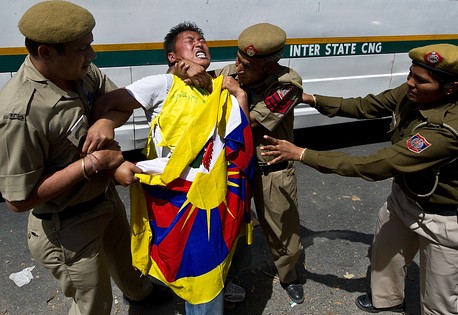
Inside its own borders, however, it further tarnished its credentials as a liberal democracy. Eager to avoid discomforting Chinese President Hu Jintao, in town for the annual BRICS (Brazil, Russia, India, China, South Africa) summit, New Delhi invoked a colonial-era law to impose a heavy-handed police lockdown of the Tibetan exile community. Police units sealed off Tibetan neighborhoods in the capital, denying residents the right of assembly and peaceful protest, or even free movement. People elsewhere in New Delhi who even looked Tibetan were harassed by police, an action that the Delhi High Court reprimanded as “racial profiling.”

Adopting the Chinese practice of rounding up dissidents in advance of politically-sensitive dates, Indian police placed over 300 Tibetans in preventive custody, including two Tibetan exiles who were detained while speaking at the Press Club of India. Tenzin Tsundue, an influential Tibetan poet, was forcibly dragged away while addressing a women’s forum. Tsewang Rigzin, an American citizen who serves as president of the Tibetan Youth Congress, was deported the moment he arrived at New Delhi’s international airport.

These measures – instituted after a Tibetan exile, Jamphel Yeshi, set himself ablaze at a large anti-Hu rally held near the Indian parliament – are the latest instance of the country’s timorous commitment to the ideals of free expression. The past year has witnessed other notable examples, including the imbroglio over Salman Rushdie’s abortive appearance at the Jaipur Literary Festival as well as the invective directed at Joseph Lelyveld’s biography of Mahatma Gandhi. The Hindu newspaper called the Rushdie affair “a national shame” and charged that “India has again betrayed its heritage of providing sanctuary to persecuted individuals and ideas, not to speak of its Constitution.” More


Wednesday, March 28, 2012

Tibet, India, China, and the Yearning for Freedom

Jamphel Yeshi was one of the hundreds of Tibetans who gathered in New Delhi earlier this week to demonstrate against Chinese president Hu Jintao’s visit to India as part of the annual BRICS summit. As the Indian police attempted to thwart their peaceful protest, Yeshi doused himself with kerosene and set fire to his body. Engulfed in flames, he charged through the street, screaming pro-freedom slogans – and joined the dozens who have immolated their bodies to draw attention to the brutal crackdown in Tibet by Chinese forces.

India spent the last decade trumpeting its democracy as it steered closer to the United States. And yet its response to Yeshi’s sacrifice would make a dictator proud. Eager to not offend the visiting Chinese head of state, India invoked a colonial-era law against the Tibetans in New Delhi. As of today, every Tibetan in the city is effectively under house arrest.

Students are holed up inside their hostels. Families are barred from leaving their homes. Children have been forced to miss school. Patients cannot visit the hospital. Any gathering of Tibetans – however small and whatever its purpose – is cause for arrest.

In America’s imagination, India often appears as the democratic counterweight to authoritarian China’s rise. “If America’s future competitor in the world is likely to be China,” Robert Kagan recently wrote in a celebrated essay, “then a richer and more powerful India will be an asset, not a liability, to the United States.”

In reality, it was a considerably poorer and weaker India that ever truly challenged China in the name of liberal democratic values. India granted asylum to the Dalai Lama in 1959 despite Zhou Enlai’s threats, and Beijing’s persistent demand that Tibetans be banned from protesting against China elicited a brief answer from India’s foreign office: “There is by law and Constitution complete freedom of expression of opinion in Parliament and the press and elsewhere in India”. More